🌿 Plant Growth Regulators
Plant Growth Regulators.
Plant growth regulators coordinate growth, development, and stress responses at very low concentrations. Understanding hormone classes and their physiological effects is central to both theory and field-level crop management.
Plant growth regulators or phytohormones are organic substances produced naturally
in higher plants, controlling growth or other physiological functions at a site remote from its
place of production and active in minute amounts. Thimmann (1948) proposed the term
Phyto hormone as these hormones are synthesized in plants . Plant growth regulators include
auxins, gibberellins, cytokinins, ethylene, growth retardants and growth inhibitors. Auxins
are the hormones first discovered in plants and later gibberellins and cytokinins were also
discovered.
Hormone
An endogenous compound, which is synthesized at one site and transported to
another site where it exerts a physiological effect in very low concentration. But ethylene
(gaseous nature), exert a physiological effect only at a near a site where it is synthesized.
Classified definition of a hormone does not apply to ethylene.
- Defined as organic compounds other than nutrients, that affects the physiological
processes of growth and development in plants when applied in low
concentrations.
- Defined as either natural or synthetic compounds that are applied directly to a
target plant to alter its life processes or its structure to improve quality, increase
yields, or facilitate harvesting.
Plant Hormone
When correctly used, is restricted to naturally occurring plant substances, there fall
into five classes. Auxin, Gibberellins, Cytokinin, ABA and ethylene. Plant growth regulator
includes synthetic compounds as well as naturally occurring hormones.
Plant Growth Hormone
The primary site of action of plant growth hormones at the molecular level remains
unresolved.
Reasons
-
Each hormone produces a great variety of physiological responses.
-
Several of these responses to different hormones frequently are similar.
-
The response of a plant or a plant part to plant growth regulators may vary with the
variety of the plant.
- Even a single variety may respond differently depending on its age, environmental
conditions and physiological state of development (especially its natural hormone
content) and state of nutrition. There are always exceptions for a general rule suggesting
the action of a specific growth regulator on plants.
- There are several proposed modes of action in each class of plant hormone, with
substantial arguments for and against each mode.
Hormone groups
Auxin - Substances generally resembles IAA and has the ability
to stimulate the elongation of coleoptiles.
Gibberellins - are diterpenoids, which have the ability to elongate the
stem of green seedlings especially certain dwarf and rosette
types.
Cytokinin - Usually substituted Adenines, which resembles zeatin
(Naturally occurring cytokinin in Zea mays ) and have the
ability to stimulate cytokinensis in cultures of tobacco cells.
Ethylene - Gaseous regulator that stimulate is diametric growth
in the apices of dicot seedlings.
Inhibitors - are regulators of growth, which originally depress the
Auxins
Auxins are a group of phytohormones produced in the shoot and root apices and they
migrate from the apex to the zone of elongation. Auxins promote the growth along the
longitudinal axis of the plant and hence the name (auxeing : to grow). The term, auxin was
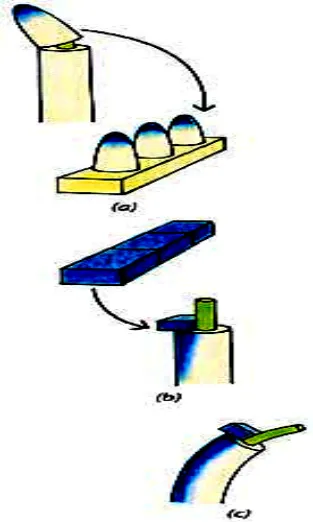
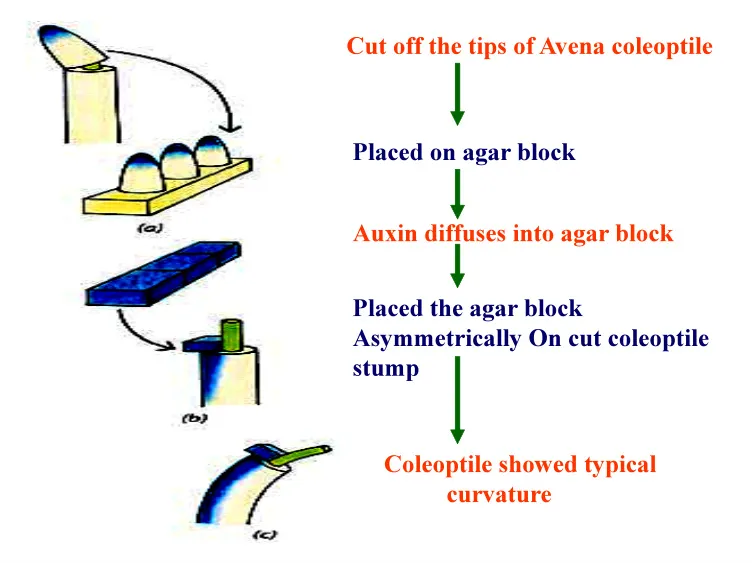
introduced by Kogl and Haagen- Smit (1931). Went (1928) isolated auxin from the Avena
coleoptile tips by a method called Avena coleoptile or curvature test and concluded that no
growth can occur without auxin. Auxins are widely distributed through out the plant
however, abundant in the growing tips such as coleoptile tip, buds, root tips and leaves.
Indole Acetic Acid (IAA) is the only naturally occurring auxin in plants. The synthetic
auxins include,
Avena Curvature Test
IBA : Indole Butyric Acid
NAA : Naphthalene Acetic acid
MENA: Methyl ester of Naphthalene acetic acid
MCPA: 2 Methyl 4 chloro phenoxy acetic acid
TIBA : 2, 3, 5 Tri iodo benzoic acid
 2, 4-D : 2, 4 dichloro phenoxy acetic acid
2, 4, 5-T: 2, 4, 5 – Trichloro phenoxy acetic acid
Natural auxins may occur in the form of either free auxins - which freely move or
diffuse out of the plant tissues readily or bound auxins - which are released from plant tissues
only after hydrolysis, autolysis or enzymolysis.
Physiological effects of auxin
Cell division and elongation
The primary physiological effects of auxin are cell division and cell elongation in the
shoots. It is important in the secondary growth of stem and differentiation of xylem and
phloem tissues.
Apical dominance
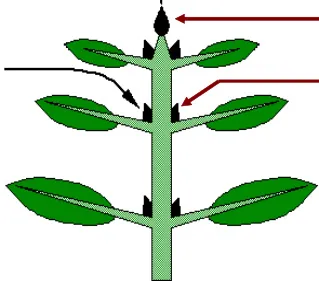
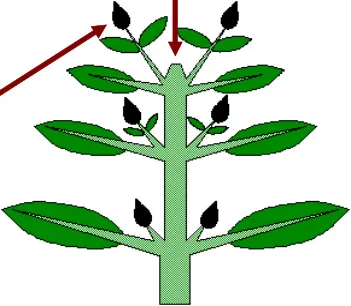
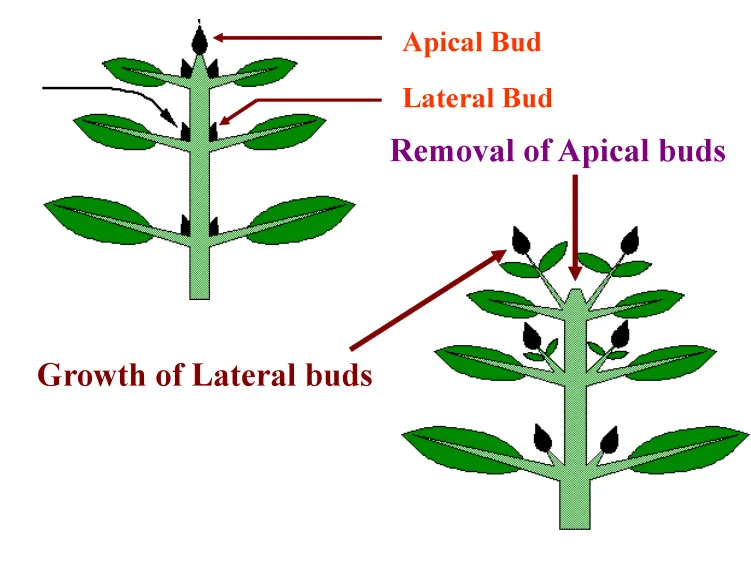
In many plants, if the terminal bud is intact and growing, the growth of lateral buds
just below it remains suppressed. Removal of the apical bud results in the rapid growth of
lateral buds. This phenomenon in which the apical bud dominates over the lateral buds and
does not allow the lateral buds to grow is known as apical dominance .
Skoog and Thimmann (1948) pointed out that the apical dominance might be under
the control of auxin produced at the terminal bud and which is transported downward through
the stem to the lateral buds and hinders the growth. They removed the apical bud and
replaced it with agar block. This resulted in rapid growth of lateral buds. But when they
replaced the apical bud with agar block containing auxin, the lateral buds remained
suppressed and did not grow.
Root initiation
In contrast to stem, the higher concentration of auxin inhibits the elongation of roots
but the number of lateral roots is considerably increased i.e., higher concentration of auxin
induces more lateral branch roots. Application of IAA in lanolin paste (lanolin is a soft fat
prepared from wool and is good solvent for auxin) to the cut end of a young stem results in
an early and extensive rooting. This fact is of great practical importance and has been widely
utilized to promote root formation in economically useful plants which are propagated by
cuttings.
Prevention of abscission
Natural auxins prevent the formation of abscission layer which may otherwise result
in the fall of leaves, flowers and fruits.
Parthenocarpy
Auxin can induce the formation of parthenocarpic fruits (fruit formation without
pollination and fertilization). In parthenocarpic fruits, the concentration of auxin in the
ovaries is higher than in the ovaries of plants which produce fruits only after fertilization. In
the later cases, the concentration of the auxin in ovaries increases after pollination and
fertilization.
Respiration
Auxin stimulates respiration and there is a correlation between auxin induced growth
and respiration. Auxin may increase the rate of respiration indirectly through increased
supply of ADP by rapidly utilizing ATP in the expanding cells.
Callus formation
Besides cell elongation, auxin may also be active in cell division. In many tissue
cultures, where the callus growth is quite normal, the continued growth of such callus takes
place only after the addition of auxin.
Eradication of weeds
Some synthetic auxins especially 2, 4- D and 2, 4, 5-T are useful in eradication of
weeds at higher concentrations.
Flowering and sex expression
Auxins generally inhibit flowering but in pine apple and lettuce it promotes uniform
flowering.
Distribution of auxin in plants
In plants, auxin (IAA) is synthesized in growing tips or meristematic regions from
where; it is transported to other plant parts. Hence, the highest concentration of IAA is found
in growing shoot tips, young leaves and developing auxiliary shoots. In monocot seedling,
the highest concentration of auxin is found in coleoptile tip which decreases progressively
towards its base.
In dicot seedlings, the highest concentration is found in growing regions of shoot,
young leaves and developing auxiliary shoots. Within the plants, auxin may present in two
forms. i.e., free auxins and bound auxins . Free auxins are those which are easily extracted by
various organic solvents such as diethyl ether. Bound auxins on the other hand, need more
drastic methods such as hydrolysis, autolysis, enzymolysis etc. for extraction of auxin. Bound
auxins occur in plants as complexes with carbohydrates such as glucose, arabionse or sugar
alcohols or proteins or amino acids such as aspartate, glutamate or with inositol.
Biosynthesis of auxin (IAA) in plants
Thimann (1935) found that an amino acid, tryptophan is converted into Indole 3
acetic acid. Tryptophan is the primary precursor of IAA in plants. IAA can be formed from
tryptophan by two different pathways.
- By deamination of tryptophan to form indole-3-pyruvic acid followed by
decarboxylation to from indole-3-acetaldehyde. The enzymes involved are
tryptophan deamintion and indole pyruvate decarboxylase respectively.
- By decarboxylation of tryptophan to form tryptamine followed by deamination to
form indole-3-acetaldehyde and the enzymes involved are tryptophan decarboxylase
and tryptamine oxidase respectively. Indole 3-acetaldehyde can readily be oxidized to
indole 3-acetic acid (IAA) in the presence of indole 3-acetaldehyde dehydrogenase.
Transport of auxin in plant
The transport of auxin is predominantly polar. In stems, polar transport of auxin is
basipetal i.e., it takes place from apex towards base. Polar transport of auxin is inhibited by 2,
3, 5 Triiodobenzoic acid (TIBA) and Naphthyl thalamic acid (NPA). The substances are
called as antiauxins.
Destruction / Inactivation of auxin in plants
Auxin is destructed by the enzyme IAA oxidase in the presence of O2 by oxidation.
IAA Oxidase
Rapid inactivation may also occur by irradiation with x-rays and gamma rays. UV
light also reduces auxin levels in plants. Inactivation or decomposition of IAA by light has
been called as photo oxidation.
Mechanism of Action
IAA increases the plasticity of cell walls so that the cells stretch easily in response to
turgor pressure. It has been suggested that IAA acts upon DNA to influence the production of
mRNA. The mRNA codes for specific enzymes responsible for expansion of cell walls.
Recent evidences indicate that IAA increases oxidative phosphorylation in respiration and
enhanced oxygen uptake. The growth stimulation might be due to increased energy supply
and it is also demonstrated that auxin induces production of ethylene in plants.
Gibberellins
Discovery
A Japanese scientist Kurosawa found that the rice seedlings infected by the fungus
Gibberella fujikuroi grow taller and turned very thin and pale. An active substance was
isolated from the infected seedlings and named as Gibberellin.
Biosynthesis of gibberellins in plants
The primary precursor for the formation of gibberellins is acetate.
Acetate + COA → Acetyl COA → Mevalonic acid → MA pyrophosphate →
Isopentanyl pyrophosphate → Geranyl pyrophosphate → GGPP → Kaurene → Gibberellins.
Physiological effects of gibberellins
Seed germination
Certain light sensitive seeds eg. Lettuce and tobacco show poor germination in dark.
Germination starts vigorously if these seeds are exposed to light or red light. This
requirement of light is overcome if the seeds are treated with gibberellic acid in dark.
Dormancy of buds
In temperature regions the buds formed in autumn remain dormant until next spring
due to severe cold. This dormancy of buds can be broken by gibberellin treatments. In
potato also, there is a dormant period after harvest, but the application of gibberellin sprouts
the refer vigorously.
Root growth
Gibberellins have little or no effect on root growth. At higher concentration, some
inhibition of root growth may occur. The initiation of roots is markedly inhibited by
gibberellins in isolated cuttings.
Elongation of internodes
The most pronounced effect of gibberellins on the plant growth is the elongation of
the internodes. Therefore in many plants such as dwarf pea, dwarf maize etc gibberellins
overcome the genetic dwarfism.
Bolting and flowering
In many herbaceous plants, the early period of growth shows rosette habit with short
stem and small leaves. Under short days, the rosette habit is retained while under long days
bolting occurs i.e. the stem elongates rapidly and is converted into polar axis bearing flower
primordia. This bolting can also be induced in such plants by the application of gibberellins
even under non-inductive short days.
In Hyoscyamus niger (a long day plant) gibberellin treatment causes bolting and
flowering under non-inductive short days. While in long day plants the gibberellin treatment
usually results in early flowering. In short day plants, its effects are quite variable. It may
either have no effect or inhibit or may activate flowering.
Parthenocarpy
Germination of the pollen grains is stimulated by gibberellins; likewise, the growth of
the fruit and the formation of parthenocarpic fruits can be induced by gibberellin treatment.
In many cases, eg. pome and stone fruits where auxins have failed to induce parthenocarpy,
the gibberellins have proven to be successful. Seedless and fleshly tomatoes and large sized
seedless grapes are produced by gibberellin treatments on commercial scale.
Synthesis of the enzyme α - amylase
One important function of gibberellins is to cause the synthesis of the enzyme α
amylase in the aleurone layer of the endosperm of cereal grains during germination. This
enzyme brings about hydrolysis of starch to form simple sugars which are then translocated
to growing embryo to provide energy source.
Distribution of gibberellins in plant
Gibberellins are found in all parts of higher plants including shoots, roots, leaves,
flower, petals, anthers and seeds. In general, reproductive parts contain much higher
concentrations of gibberellins than the negative parts. Immature seeds are especially rich in
gibberellins (10-100 mg per g fresh weight).
In plants, gibberellins occur in two forms free gibberellins and bound gibberellins.
Bound gibberellins usually occur as gibberellin – glycosides.
CYTOKININS (Kinetin)
Kinetin was discovered by Skoog and Miller (1950) from the tobacco pith callus and
the chemical substance was identified as 6-furfuryl aminopurine. Because of its specific
effect on cytokinesis (cell division), it was called as cytokinins or kinetin. The term,
cytokinin was proposed by Letham (1963). Fairley and Kingour (1966) used the term,
phytokinins for cytokinins because of their plant origin. Chemically cytokinins are kinins and
they are purine derivatives.
Cytokinins, besides their main effect on cell division, also regulate growth and hence
they are considered as natural plant growth hormones. Some of the very important and
commonly known naturally occurring cytokinins are Coconut milk factor and Zeatin. It was
also identified that cytokinin as a constituent of t-RNA.
Naturally occurring cytokinins
Cytokinins can be extracted from coconut milk (liquid endosperm of coconut), tomato
juice, flowers and fruits of Pyrus malus ; fruits of Pyrus communis (Pear), Prunus cerasiferae
(plum) and Lycopersicum esculentum (bhendi); Cambial tissues of Pinus radiata, Eucalyptus
regnans and Nicotiana tabacum ; immature fruits of Zea mays, Juglans sp. and Musa sp;
female gametophytes of Ginkgo biloba ; fruitlets, embryo and endosperms of Prunus persica ;
seedling of Pisum sativum ; root exudates of Helianthus annuus and tumour tissues of
tobacco. According to Skoog and Armstrong (1970), at least seven well established types of
cytokinins have been reported from the plants.
Biosynthesis
It is assumed that cytokinins are synthesised as in the case of purines in plants
(nucleic acid synthesis). Root tip is an important site of its synthesis. However, developing
seeds and cambial tissues are also the site of cytokinin biosynthesis. Kende (1965) reported
that cytokinins move upwards perhaps in the xylem stream. However, basipetal movement in
petiole and isolated stems are also observed. Seth et al (1966) found that auxin enhances
kinetin movement (translocation) in bean stems.
Physiological effects of cytokinins
- Cell division
The most important biological effect of kinetin on plants is to induce cell division
especially in tobacco pith callus, carrot root tissue, soybean cotyledon, pea callus etc.
- Cell enlargement
Like auxins and gibberellins, the kinetin may also induce cell enlargement.
Significant cell enlargement has been observed in the leaves of Phaseolus vulgaris, pumpkin
cotyledons, tobacco pith culture, cortical cells of tobacco roots etc.
- Concentration of apical dominance
External application of cytokinin promotes the growth of lateral buds and hence
counteracts the effect of apical dominance
- Dormancy of seeds
Like gibberellins, the dormancy of certain light sensitive seeds such as lettuce and
tobacco can also be broken by kinetin treatment.
- Delay of senescence ( Richmand - Lang effect)
The senescence of leaves usually accompanies with loss of chlorophyll and rapid
breakdown of proteins. Senescence can be postponed to several days by kinetin treatment by
improving RNA synthesis followed by protein synthesis.
Richmand and Lang (1957) while working on detached leaves of Xanthium found that
kinetin was able to postpone the senescence for a number of days.
- Flower induction
Cytokinins can be employed successfully to induce flowering in short day plants.
- Morphogenesis
It has been shown that high auxin and low kinetin produced only roots whereas high
kinetin and low auxin could promote formation of shoot buds.
- Accumulation and translocation of solutes
Plants accumulate solutes very actively with the help of Cytokinin and also help in
solute translocation in phloem.
- Protein synthesis
Osborne (1962) demonstrated the increased rate of protein synthesis due to
translocation bys kinetin treatment.
- Other effects
Cytokinins provide resistance to high temperature, cold and diseases in some plants.
They also help in flowering by substituting the photoperiodic requirements. In some cases,
they stimulate synthesis of several enzymes involved in photosynthesis.
- Commercial applications
Cytokinins have been used for increasing shelf life of fruits, quickening of root
induction and producing efficient root system, increasing yield and oil contents of oil seeds
like ground nut.
Ethylene
Ethylene is the only natural plant growth hormone exists in gaseous form.
Important physiological elects
- The main role of ethylene is it hastens the ripening of fleshy fruits eg. Banana, apples,
pears, tomatoes, citrus etc.
-
It stimulates senescence and abscission of leaves
-
It is effective in inducing flowering in pine apple
-
It causes inhibition of root growth
-
It stimulates the formation of adventitious roots
-
It stimulates fading of flowers
-
It stimulates epinasty of leaves.
Abscisic acid
Addicott (1963) isolated a substance strongly antagonistic to growth from young
cotton fruits and named Abscissin II. Later on this name was changed to Abscisic acid. This
substance also induces dormancy of buds therefore it also named as Dormin.
Abscisic acid is a naturally occurring growth inhibitor.
Physiological effects
The two main physiological effects are
-
Geotropism in roots
-
Stomatal closing
-
Besides other effects
-
Geotropism in roots
Geotropic curvature of root is mainly due to translocation of ABA in basipetal
direction towards the root tip.
- Stomatal closing
ABA is synthesized and stored in mesophyll chloroplast. In respond to water stress,
the permeability of chloroplast membrane is lost which resulted is diffusion of ABA out of
chloroplast into the cytoplasm of the mesophyll cells. From mesophyll cells it diffuses into
guard cells where it causes closing of stomata.
- Other effects
i. Including bud dormancy and seed dormancy
ii. Includes tuberisation
iii. Induces senescence of leaves fruit ripening, abscission of leaves, flowers and fruits
iv. Increasing the resistance of temperate zone plants to frost injury.
Growth retardants
There is no. of synthesis compounds which prevent the gibberellins from exhibiting
their usual responses in plants such as cell enlargement or stem elongation. So they are
called as anti gibberellins or growth retardants. They are
-
Cycocel (2- chloroethyl trimethyl ammonium chloride (CCC)
-
Phosphon D – (2, 4 – dichlorobenzyl – tributyl phosphonium chloride)
-
AMO – 1618
-
Morphactins
-
Maleic hydrazide
Summary Cheat Sheet
Hormone Snapshot
- Major classes: Auxin, Gibberellin, Cytokinin, Ethylene, ABA.
- Auxin is central for apical dominance, rooting, and cell elongation.
- Gibberellins promote stem elongation, bolting, and seed germination.
- ABA is linked with stress responses and stomatal closure.
Exam Traps
- Ethylene is gaseous and often acts near its synthesis site.
- Growth regulators include natural hormones and synthetic analogs.
- Growth retardants generally counter gibberellin-type elongation effects.
References
1 source • [1]
References
Plant Physiology course notes - Plant Growth Regulators
BookLesson Doubts
Ask questions, get expert answers