🧪 Practical Applications of Plant Growth Regulators
Understand how plant growth regulators are used in rooting, dormancy management, flowering, fruiting, ripening, and canopy control.
Plant growth regulators (PGRs) are valuable in agriculture because they let farmers and horticulturists influence plant processes that would otherwise depend only on internal hormonal balance. Their practical value lies in propagation, flowering control, fruit development, ripening, and stress-related management.
Rooting and Propagation
Auxin-type regulators such as IBA and NAA are widely used to induce rooting in cuttings and improve vegetative propagation.
Important point:
- IBA is especially known for promoting a strong fibrous root system
This is why auxin treatments are common in nursery and plantation crop propagation.
Germination and Dormancy
Different PGRs can either promote or suppress germination.
- gibberellins promote germination and help break dormancy
- ABA acts as a germination inhibitor and supports dormancy
This makes PGRs useful in seed technology, nursery management, and crop scheduling.
Fruit Set, Development, and Ripening
The source notes highlight several commercially important applications:
- fruit set support through specific auxin-like compounds
- berry size improvement in grapes by gibberellic acid
- better fruit shape through suitable regulator combinations
- parthenocarpy through gibberellins and auxin-type regulators
- ripening control through ethylene-releasing compounds such as Ethrel
Example:
- gibberellic acid is widely associated with bunch and berry improvement in grapes.
Sex Expression, Abscission, and Organ Size
PGRs are also used to modify developmental patterns.
Sex expression
- gibberellins may favor male flower production in some cucurbits
- auxin-related regulation can influence female flower expression in some crops
Abscission
- NAA and IAA may help control unwanted abscission
- Ethrel can induce abscission where required
Plant size and tillering
- GA may increase plant height
- growth retardant-type compounds may reduce excessive elongation
- cytokinins may support tillering
This is where physiology becomes directly useful in agronomy and horticulture.
Other Important Commercial Uses
The source lesson also lists applications such as:
- antitranspirant use
- stimulation of papaya latex flow
- support of rubber latex flow
- sugarcane ripening regulation
- morphogenesis through auxin-cytokinin balance
- weed control through synthetic auxin herbicides such as 2,4-D
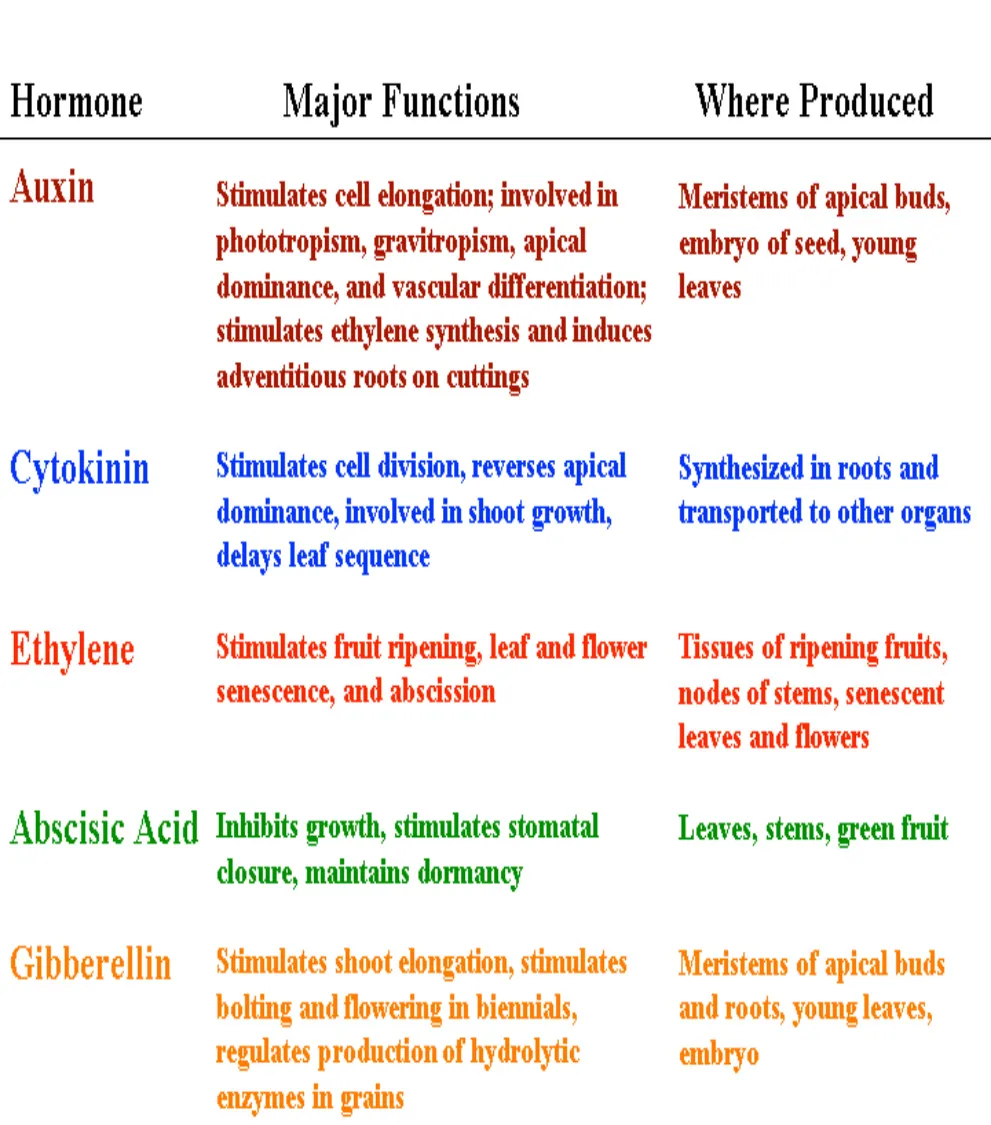
Summary Cheat Sheet
| Application area | Main regulator logic |
|---|---|
| Rooting | Auxins such as IBA and NAA |
| Germination | Gibberellins promote; ABA inhibits |
| Fruit set and size | Auxins and gibberellins |
| Ripening | Ethylene-releasing compounds |
| Abscission control | NAA, IAA, Ethrel depending on objective |
| Plant form | GA, cytokinins, and growth retardants depending on need |
References
1 source • [1]
References
Plant Physiology course notes - Practical Applications of PGRs
BookLesson Doubts
Ask questions, get expert answers