🌿 Environmental stresses
Environmental stresses.
Environmental stresses limit crop growth by altering water relations, metabolism, and cellular stability. This lesson covers drought, flooding, salinity, temperature, and radiation stresses with key adaptation and mitigation points.
The occurrence of unfavorable environmental factors such as moisture deficit / excess,
high radiation, low and high temperature, salinity of water and soil, nutrient deficiency or
toxicity and pollution of atmosphere, soil and water are likely to affect the crop growth in
terms of morphology (plant size, architecture, malformation of plant organs, growth (height,
volume, weight), physiological and metabolic processes and yield of crop plants.
Stress and strain
Any environmental factor potentially unfavorable to plant is termed as stress . The
effect of stress on plant condition is called strain . According to Newton's law of
motion, a force is always accompanied by a counterforce, for an action there is always
equal and opposite reaction. Stress is the action and whereas strain is the reaction.
I. DROUGHT (Water stress)
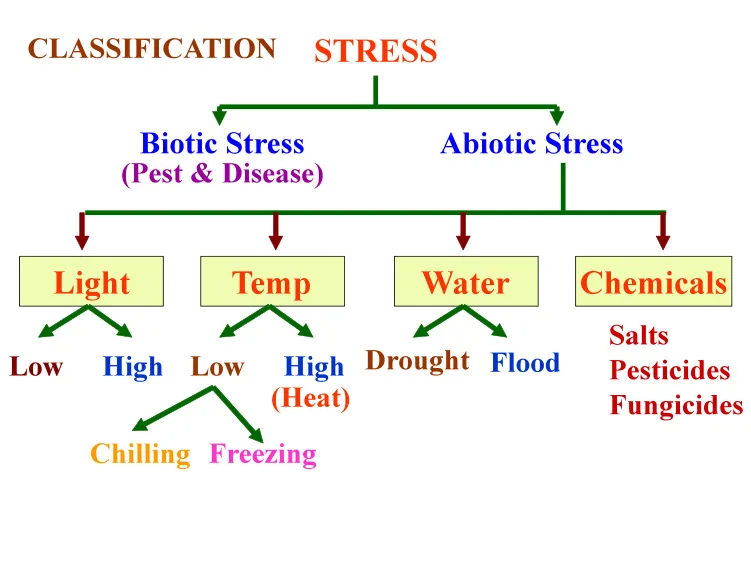 Drought is defined as the deficiency of water severe enough to check the plant
growth . Drought has been classified into two broad categories viz., soil drought and
atmospheric drought. Soil drought leads to atmospheric drought. Atmospheric drought
occurs due to low atmospheric humidity, high wind velocity and high temperature which
cause a plant to lose most of its water.
Physiological changes occur due to drought
- Functioning of stomata
In general, stomata lose their function and may die, because wilting after certain limit
denatures the starch in the guard cells and also in the mesophyll cells.
- Carbohydrates metabolism in green leaves
The very first effect of drought on carbohydrates metabolism is that starch disappears
from the wilted leaves and sugar accumulates simultaneously.
- Photosynthetic activity
CO2 diffusion into the leaf is prevented due to decrease in stomatal opening and there
by reduces photosynthetic activity in green cells.
- Osmotic pressure
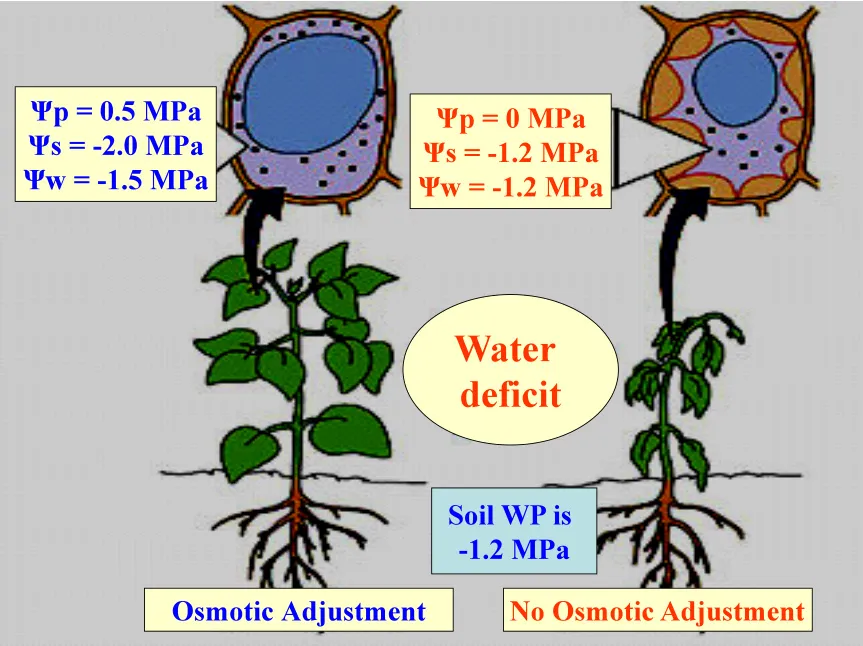
The reduced amount of water during drought causes an increase in the osmotic
pressure of plant cell. This increase in osmotic pressure permits the plant to utilize better soil
moisture.
- Permeability
The permeability to water and urea increases during drought.
- Biochemical effects
Water shortage alters the chemical composition. For example, starch is converted to
sugar, besides this, there is a considerable increase in nitrate nitrogen and protein synthesis is
adversely affected.
Adaptation to drought
Drought resistance
Drought resistance is defined as the capacity of plants to survive during the period of
drought with little or no injury. There are three important categories of plants growing in the
areas facing drought. They are ephemerals, succulents and non-succulent perennials
Ephemerals
These are short lived plants and they complete their life cycle within a short
favourable period during rainy season. They pass dry periods in the form of seeds. They are
called as drought escaping plants .
Succulent plants
These plants accumulate large quantities of water and use it slowly during dry period.
Thus, they pass dry periods or drought without facing it. Such plants develop several
morphological adaptations for reducing transpiration such as thick cuticle, reduced leaf area,
sunken stomata etc.
Non succulent plants
These plants are in fact the real drought enduring (tolerant) plants. They tolerate
drought without adapting any mechanism to ensure continuous supply of water. They
develop many morphological adaptations which are collectively called xeromorphy. They
develop, in general, greyish colour, reflecting surfaces, smaller leaves, extensive root system,
leaf fall during dry season, sunken stomata and thick cuticle etc. They develop an elaborated
conducting system. The stomata remain closed mostly in dry periods.
The plants develop several protoplasmic peculiarities such as cell size, cell structure,
increased permeability, increased imbibition power, elasticity, small vacuoles, higher
osmotic pressure etc.
Osmotic adjustment
Methods to overcome drought
-
Selection of drought tolerant species
-
Adjusting the tome of sowing in such a way that the crop completes its lifecycle
before the onset of drought
-
Seed hardening with KCl, KH2PO4, CaCl2 or Thiourea
-
Thinning of poorly established plants
-
Mulching to minimize the evaporative loss
-
Foliar spray of antitranspirants such as Kaolin, PMA, Waxes and Silicone oils
-
Foliar spray of KCl
-
Foliar spray of growth retardants such as CCC and MC
HIGH MOISTURE STRESS - FLOODING / WATER LOGGING
Water logging refers to a condition when water is present in excess amount than its
optimum requirement. It creates an anaerobic situation in the rhizosphere due to which the
plant experiences the stress (O2 deficient stress).
Nature of Water logging Stress
In the water logged soils, water gets filled in the pores of the soil which are
previously occupied by O2. Such soils suffer O2 deficiency.
This O2 deficiency depresses growth and survival of plants growing in it.
Flood sensitive plants (eg. Tomato, soybean and sunflower) are killed in the water
logged conditions, while the tolerant species (eg. Rice) withstand water logging for a
considerable time. However, continuous submergence of rice for more than 10 days is also
deleterious resulting in death and decay of the plants.
Plant Water Relations in Flooding Stress
The flooding often induces stomatal closure mostly in C3 plants. This causes lower
water flow in these plants. This also results in leaf dehydration because of reduced root
permeability. Ultimately, wilting of leaves occurs due top the restricted water flow from the
roots to the shoots.
Occurrence of these changes in leaves, shoots or roots is due to the transfer of toxic
substances (acetaldehyde / alcohol) produced under anaerobic conditions in the roots as well
as the levels of PGRs transported from the roots to shoots via transpiration stream.
Levels of Endogenous PGRs under Flooding Stress
Endogenous levels of PGRs such as GA and cytokinins (CK) are reduced in the roots.
This has enhanced levels of ABA and ethylene in the shoots causing stomatal closure and
early onset of senescence respectively.
It is also reported that levels of auxins are reduced and that of Aminocyclopropane -1
Carboxylic Acid (ACC), precursor for the ethylene biosynthesis are increased under flooding
stress.
Important roles played by these endogenous PGRs during high moisture (flooding)
stress are summarized in the following table.
Effect of flooding stress on the endogenous levels of PGRs and their effect on plants
| Sl. No. |
Level of PGR in plants |
Effects on plants under water logging |
|---|---|---|
| 01. | Reduced Auxins | Causes “Hypertrophy” (Swelling of stem base by collapse or enlargement of cells in cortex) |
| 02. | Decreased GA | Causes reduction in cell enlargement and stem elongation |
| 03. | Decreased CK | Results in early on-set of senescence and reduced rate of assimilate partitioning to the sinks |
| 04. | Increased ABA | Cause stomatal closure with consequential decrease in the rate of gas exchanges during photosynthesis, respiration and transpiration; results in efflux of K+ from the guard cells; decreases ion transport due to lower rate of transpiration; decrease the starch formation in the guard cells resulting in stomatal closure |
| 05. | Increased Ethylene |
Causes “Epinasty” of leaves (uneven growth of leaves due to more cell elongation on upper side than the lower side of the leaf); induces senescence and Hypertrophy in plants. |
Thus, the O2 stress in the roots under flooding produces signals, via transpiration stream,
to the leaves affecting stomatal behaviour ultimately.
Mitigation of High Moisture (Water logging) Stress
- Providing adequate drainage for draining excessive stagnating water around the root
system.
- Spray of growth retardant of 500 ppm cycocel for arresting apical dominance and
thereby promoting growth of laterals
-
Foliar spray of 2% DAP + 1% KCl (MOP)
-
Nipping terminal buds for arresting apical dominance and thus promoting growth
sympodial branches (as in cotton) for increasing productivity
- Spray of 40 ppm NAA for controlling excessive pre-mature fall of
flowering/buds/young developing fruits and pods
-
Spray of 0.5 ppm brassinolide for increasing photosynthetic activity
-
Foliar spray of 100 ppm salicylic acid for increasing stem reserve utilization under
high moisture stress
- Foliar spray of 0.3 % Boric acid + 0.5 % ZnSO4 + 0.5 % FeSO4 + 1.0 % urea during
critical stages of the stress.
SALT STRESS
Salt stress occurs due to excess salt accumulation in the soil. As a result, water
potential of soil solution decreases and therefore exosmosis occurs. This leads to
physiological drought causing wilting of plants.
Classification of saline soil: 1. Saline soil 2. Alkaline soil
- Saline soil
In saline soils, the electrical conductivity is greater than 4 dS/m, exchangeable
sodium percentage is less than 15% and pH is less than 8.5. These soils are dominated by Cl [-]
and SO [2-]
4 [ ions. ]
- Alkaline soil
Alkaline soils are also termed as sodic soils wherein, the electrical conductivity is less
than 4 dS/m, exchangeable sodium percentage is greater than 15% and pH of the soil is
greater than 8.5. These soils are dominated by CO [-]
Classification of plants
3 [ and HCO][-]
3 [ ions. ]
Plants are classified into two types based on the tolerance to salt stress. They are
halophytes and glycophytes.
Halophytes
Halophytes are the plants that grow under high salt concentrations. They are again
divided into two types based on extreme of tolerance.
Euhalophytes : can tolerate extreme salt stress
Oligohalophyte s: can tolerate moderate salt stress
Glycophytes
Glycophytes are the plants that cannot grow under high salt concentration.
Effect of salt stress on plant growth and yield
- Seed germination
Salt stress delays seed germination due to the reduced activity of the enzyme, α
amylase
- Seedling growth
The early seedling growth is more sensitive. There is a significant reduction in root
emergence, root growth and root length.
- Vegetative growth
When plants attain vegetative stage, salt injury is more severe only at high
temperature and low humidity. Because under these conditions, the transpiration rate will be
very high as a result uptake of salt is also high.
- Reproductive stage
Salinity affects panicle initiation, spikelet formation, fertilization and pollen grain
germination.
- Photosynthesis
Salinity drastically declines photosynthetic process. Thylakoid are damaged by high
concentration of salt and chlorophyll b content is drastically reduced.
Mechanism of salt tolerance
- Some plants are able to maintain high water potential by reducing the transpiration
rate.
- Salts are accumulated in stem and older leaves in which metabolic processes take
place in a slower rate.
-
Na [+] (sodium ion) toxicity is avoided by accumulating high amount of K [+] ions.
-
Accumulation of toxic ions in the vacuole but not in the cytoplasm.
-
Accumulation of proline and abscissic acid which are associated with tolerance of the
plants to salt.
Relative salt tolerant crops
Tolerant crops: Cotton, sugar cane, barley
Semi tolerant crops: Rice, maize, wheat, oats, sunflower, soybean
Sensitive crops: Cow pea, beans, groundnut and grams
Mitigation of Salt Stress
-
Seed hardening with NaCl (10 mM concentration)
-
Application of gypsum @ 50% Gypsum Requirement (GR)
-
Incorporation of daincha (6.25 t/ha) in soil before planting
-
Foliar spray of 0.5 ppm brassinolode for increasing photosynthetic activity
-
Foliar spray of 2% DAP + 1% KCl (MOP) during critical stages
-
Spray of 100 ppm salicylic acid
-
Spray of 40 ppm of NAA for arresting pre-mature fall of flowers / buds / fruits
-
Extra dose of nitrogen (25%) in excess of the recommended
-
Split application of N and K fertilizers
-
Seed treatment + soil application + foliar spray of Pink Pigmented Facultative
Methnaotrops (PPFM) @ 10 [6] as a source of cytokinins.
TEMPERATURE STRESS
Temperature stress includes both high temperature stress and low temperature stress.
Low temperature stress causes chilling injury and freezing injury.
Low temperature stress
Chilling injury
The tropical origin plants are injured when the temperature drops to some point close
to 0°C. The injury which occurs due to low temperature but above zero degree centigrade is
called chilling injury.
Freezing injury
Freezing injury occurs when the temperature is 0°C or below.
Effect of freezing and chilling injury plants
- The lipid molecules in cell membrane get solidified i.e. changed from liquid state to
solid state. Hence, the semi-permeable nature of the membrane is changed and the
membrane becomes leaky.
-
Inactivation of mitochondria
-
Streaming of protoplasm is stopped
-
Accumulation of respiratory metabolites which become highly toxic
-
Ice formation inside the cell occurs.
Prevention of cold injury
-
Some plants change the pattern of growth.
-
The growth is completely arrested during this period.
-
In cell membrane, unsaturated fatty acid content is increased.
-
Intracellular ice formation is reduced.
-
The quantity of free enzymes, sugars and proteins increases.
High temperature stress
The effect of high temperature is heat Injury. Heat Injury occurs when plant
temperature is higher than that of environment (exceeds 35°C).
General effects of high temperature
High temperature affects
-
Seedling growth and vigour
-
Water and nutrient uptake
-
Solute transport
-
Photosynthesis and respiration
-
General metabolic processes
-
Fertilization and maturation
Cellular Changes during heat stress
When plants are exposed to temperatures higher than 45 [0] C it experiences heat stress.
The cellular changes due to heat stress are
-
Disruption of cytoskeleton and microtubules.
-
Fragmentation of golgi complex
-
Increase in number of lysosomes
-
Swelling of mitochondria thereby resulting in decreased respiration and oxidative
phosphorylation
-
Disruption of normal protein synthesis
-
Disappearance of polysomes
-
Disruption of splicing of mRNA precursors
-
Cessation of pre-RNA processing
-
Decline in transcription by RNA polymerase I
-
Inhibition of chromatin assembly
-
Decline in DNA synthesis
Acclimation to high temperature
Morphological Adaptations
 - Reflective leaf hair

 - Leaf waxes

 - Leaf orientation

 - Maximize conductive or convective loss of heat
Xanthophyll deepoxidase
Zeaxanthin decreases membrane fluidity and stabilises the membrane
Heat Shock Proteins (HSPs)
Plants have the capacity to interact with the environment in many different ways and
to survive under extreme abiotic and perhaps also biotic stress conditions. The response to
heat stress (hs) is highly conserved in organisms but owing to the sessile life style it is of
utmost importance to plants. The hs-response is characterised by (i) a transient alteration of
gene expression (synthesis of heat shock proteins: HSP) and (ii) by the acquisition of a
higher level of stress tolerance (acclimation). The induction of HSP-expression is not
restricted to high temperature stress, HSPs are also linked to a number of other abiotic
stresses including cold, freezing, drought, dehydration, heavy metal, and oxidative stresses.
HSP are molecular chaperones, which either prevent complete denaturation (small HSP:
sHSP) or are supporting proper folding (other HSP) of enzymes under or after protein
denaturing conditions. Manipulation of the hs-response has the potential to improve common
stress tolerance that may lead to a more efficient exploitation of the inherent genetic potential
of agriculturally important plants.
HSPs are classified into different families and designated by molecular weight in kDa.
 - HSP 100 k Da

 - HSP 90

 - HSP 70

 - HSP 60

 - 15 – 30 kDa low molecular mass HSPs or Small HSPs.
Functions
- HSPs 60, 70 and 90 : act as molecular chaperons, involving ATP dependent
stabilization and folding of proteins and assembly of oligomeric proteins.
- Some HSPs : assist in polypeptide transport across membranes into cellular
compartments.
- Some HSPS : temporarily bind and stabilize an enzyme at a particular stage in cell
development, later releasing the enzyme to become active.
- Binding of HSP with particular polypeptide within subcellular compartment avoid
denaturation of many proteins at high temperatures.
Mitigation of Low Temperature Stress
- Seed hardening with 0.01% Ammonium molybdate and foliar spray of
0.1 % ammonium molybdate at critical stages of stress
-
Foliar spray of 2% calcium nitrate spray for membrane integrity
-
Foliar spray of 2% DAP + 1% KCl (MOP)
-
Foliar spray of 500 ppm cycocel for increasing root penetration in search of
moisture for alleviation
-
Spray of 100 ppm salicylic acid
-
Brassinolide (0.5 ppm) for enhancing photosynthetic activity of plants
-
Seed treatment + soil application + foliar spray of Pink Pigmented Facultative
Methnaotrops (PPFM) @ 10 [6] as a source of cytokinins.
Mitigation of High Temperature Stress
- Seed hardening with 0.5% CaCl2 solution for arresting membrane damage due to
high temperature stress
-
Split application of N and K fertilizers
-
Foliar spray of 2% DAP + 1% KCl (MOP) (during the spray, sufficient moisture
should be present in the soil for avoiding leaf scorching)
-
Folar spray of 3% Kaoline
-
Foliar spray of 0.5% zinc sulphate + 0.3 % boric acid + 0.5 % Ferrous sulphate +
1% urea
- Spray of 40 ppm NAA for controlling pre-mature flower / fruit drops due to high
temperature stress
- Foliar spray of 1% Urea + 2 % MgSO4 + 0.5 % ZnSO4 (for arresting chlorophyll
degradation due to high temperature stress)
-
Foliar spray of 2% calcium nitrate spray for membrane integrity
-
Foliar spray of 0.5 ppm Brassinolide for increasing photosynthetic activity during
stress
- Spray of 100 ppm salicylic acid for increase stem reserve utilization and increasing
Harvest Index of crops under stress
- Seed treatment + soil application + foliar spray of Pink Pigmented Facultative
Methnaotrops (PPFM) @ 10 [6] as a source of cytokinins.
Low light and UV radiation stresses
Low Light Stress
In some places (e.g. Thanjavur), the light intensity might be even up to 60000 lux in
the first season but it would be low up to 30000 lux in the second season causing very poor
productivity. Light quality is also very poor by showing about 400-440nm instead of the
normal 600-640nm. The abnormal light intensity and quality causes reduced yield in any
crops.
UV-RADIATION STRESS
UV radiation is divided into three categories
-
UV A – wavelength ranges from 320 to 400 nm and this is less lethal to the plants.
-
UV B – wavelength ranges from 280 to 320 nm and this is lethal to the plants.
-
UV C – wavelength is less than 280 nm and it is highly lethal to all biological
systems.
The UV radiations cause environmental stress as the cell constituents like proteins
and nucleic acids absorb UV radiation in the range of 250-400 nm (UV A and UV B) and
cause death of the tissues. In general, on the outer atmosphere of the earth, CO2, ozone and
water vapour form a layer and this layer prevent the entry of UV radiation. However, ozone
depletion causes easy entry of UV radiation. In general, 1% reduction in ozone (O3) causes
2% increase in UV radiation.
UV radiation and plant response
-
UV radiation slows down the growth of plants
-
Damage the process of photosynthesis
-
Prevent maturation and ripening process
-
Accelerate genetic mutation.
Mitigation of Low Light Stress:
-
Foliar spray of 2% DAP + 1% KCl (MOP)
-
Spray of 2% coconut water
-
Spray of 40 ppm of NAA
-
0.5 ppm Brassinolide spray
-
Spray of 100 ppm Salicylic acid
-
Spray of 500 ppm CC for arresting excessive vegetative growth
-
Split application of N and K fertilizers
-
Foliar spray of 0.3 % Boric acid + 0.5 % Zinc sulphate
-
Seed treatment + soil application + foliar spray of Pink Pigmented Facultative
Methanotrophs (PPFM) @ 10 [6] as a source of cytokinins.
Summary Cheat Sheet
Stress Types
- Major stresses: drought, flooding, salinity, low temperature, high temperature, UV.
- Stress affects physiology, growth rate, and final yield components.
- Tolerance involves morphological, biochemical, and hormonal adjustments.
- Mitigation combines crop, nutrient, and foliar management strategies.
Exam Traps
- Stress resistance and stress avoidance are not identical concepts.
- Halophytes and glycophytes differ fundamentally in salt response.
- Low and high temperature injuries have distinct cellular mechanisms.
References
1 source • [1]
References
Plant Physiology course notes - Environmental Stresses
BookLesson Doubts
Ask questions, get expert answers