🧫 FERTILIZERS - USE
FERTILIZERS.
Fertilizer use efficiency depends on balanced nutrient supply, product choice, and legal quality controls. This lesson introduces fertilizer use patterns, classification, and regulatory context.
LECTURE 20
FERTILIZERS - USE AND LEGISLATION
Definition, Classification, Indian Scene, products,
consumption, Legislation
Fertilizers
Fertilizers are the materials either natural or manufactured, containing
nutrients essential for normal growth and development of plants. It may also
be defined that any material or substance intended for use as a nutrient
carrier in soil or crops for boosting crop yields.
In India, the use of artificial fertilizers was first initiated in 1896 when
imported Chilean nitrate was used as a fertilizer. By about 1905 calcium
nitrate, calcium cyanamide, ammonium sulphate, super phosphate and
potassium sulphate were also imported and used.
After the World War I, the Imperial Chemical Industries carried out
valuable field experiments on different crops particularly on rice with
ammonium sulphate during the period 1920-30, which established the
26 (2/2)
general superiority over other nitrogenous fertilizers. The manufacture of
ammonium sulphate in India was first started at Belegolla in Mysore in
1938 on a small scale.
| Share of total fertilizer consumption (%) in 12 (2/2) India |
Col2 |
|---|---|
| Rice | 40.5 |
| Wheat | 24.2 |
| Sugarcane | 8.7 |
Later in 1947, its manufacture was started at Alwaye . In 1951, the
Government of India set up fertilizer factory at Sindri for the production of
ammonium sulphate in the public sector. Gradually several factories were
established and use of fertilizers become increasingly popular.
Presently India is the Third producer of N and P fertilizers in the
world.
Classification of fertilizers
The fertilizer materials may be classified in several ways
Based on fertilizer mixture behavior
- Straight or simple nitrogenous, phosphatic or Potassic
fertilizers;
- Complex fertilizers having more than one nutrient in single material
and fertilizers having more than one nutrient in single material
- Fertilizer mixtures home mixed or factory mixed materials.
Based on their chemical reaction and nature
- Acidic, neutral, and basic fertilizers
Based on nutrients present
- Simple fertilizers which contain only one nutrient
(Single carrier)
- Compound fertilizers which contain more than one nutrient
(Multinutrient carrier)
Physical properties of fertilizers:
Physical properties of fertilizers have bearing on bagging storage,
transportation, handling, and application. They are properties include –
hygroscopic nature, free moisture content, particle size, melting point,
solubility, specific gravity, segregation,
granule hardness, angle of response, drillability etc.,
Chemical properties of fertilizers:
Chemical properties include the nature and amount of nutrients
present, associated elements, their chemical reaction, and salt index .
These make a basis for their selection by the cultivators so that they may
achieve highest productivity with least damage to soil fertility and least unit
cost of fertilizers.
INDIAN FERTILIZER SCENE
India is the Third largest producer and consumer of fertilizers in the world.
At present, there are 59 large size fertilizer plants in the country manufacturing
range of fertilizers. The current installed capacity is 12.1 m tonnes per annum
(tpa).
This fertilizer sector is highly subsidized. It relies heavily on imports to
meet domestic demand. Indian Government incurs a total subsidy bill about 14%
of fiscal deficit every year.
The major grades of fertilizers are Nitrogenous (N), Phosphatic (P)
and Potassic (K). N accounts for 71%, P for 22%, and K for 7% of the total
fertilizer consumption. Potassic grade of fertilizer is totally imported and is
not manufactured in India.
Urea (85% of N fertilizer consumption) constitutes 58% of the total
consumption of fertilizers in India. Di-ammonium phosphate (DAP) accounts
for approximately 66% of consumption of phosphatic fertilizers.
The N based fertilizer uses indigenously available feedstock (raw
material) to produce ammonia, which is processed further to make urea.
Rock phosphate and potash, the key raw materials for Phosphatic
and Potassic fertilizers respectively are imported into India, due to lack of
domestic availability.
Before April 1, 1997, the State Governments fixed fertilizer prices at non
remunerative levels. In addition, there were procedural delays in fixing prices
for each crop season, and delays in reimbursing subsidy to the producers.
The reimbursement price fixation is now done by the Central Government,
which may lead to more realistic price levels, and faster disbursements of
subsidies.
27 (3/8)
Consumption of Fertilizer by Nutrients (‘000 tonnes)
| Year | N | P O 2 5 |
K O 2 |
Total |
|---|---|---|---|---|
| 1951-52 | 58.7 | 6.9 | - | 65.6 |
| 1961-62 | 249.8 | 60.5 | 28.0 | 338.3 |
| 1971-72 | 1798.0 | 558.2 | 300.6 | 2656.8 |
| 1981-82 | 4068.7 | 1322.3 | 676.2 | 6067.2 |
| 1991-92 | 8046.3 | 3321.2 | 1360.6 | 12728.0 |
| 1992-93 | 8426.8 | 2843.8 | 883.9 | 12154.5 |
| 1993-94 | 8788.3 | 2669.3 | 908.7 | 12366.3 |
| 1994-95 | 9507.1 | 2931.7 | 1124.8 | 13563.6 |
| 1995-96 | 9822.8 | 2897.5 | 1155.8 | 13876.2 |
| 1996-97 | 10301.8 | 2976.8 | 1029.6 | 14308.1 |
| 1997-98 | 10901.8 | 3913.6 | 1372.5 | 16187.8 |
| 1998-99 | 11353.8 | 4112.2 | 1331.5 | 16797.5 |
| 1999-00 | 11592.7 | 4798.3 | 1678.7 | 18069.7 |
| 2000-01 | 10861.9 | 4212.4 | 1557.1 | 16631.4 |
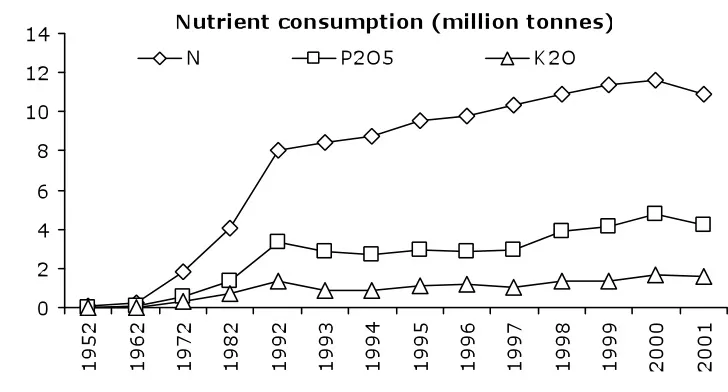
Important Fertilizer Products in India
| Col1 | Grade (%) | Consumption (1999-2000) ‘000 tonnes |
|---|---|---|
| Produced in India | Produced in India | Produced in India |
Straight Nitrogenous |
Straight Nitrogenous |
Straight Nitrogenous |
| Urea | 46 N | 20277.66 |
| Ammonium sulphate | 20.6 N | 638.10 |
| Ammonium chloride | 25 N | 75.19 |
| Calcium ammonium nitrate | 25 N | 347.25 |
Straight Phosphatic |
Straight Phosphatic |
Straight Phosphatic |
| Single super phosphate | 16 P2O5 | 3600.99 |
| Diammonium phosphate | 18-46-0 | 6937.68 |
NP/NPK Complex FertilizersN: P2O5: K2O |
NP/NPK Complex FertilizersN: P2O5: K2O |
NP/NPK Complex FertilizersN: P2O5: K2O |
| Ammonium Phosphate Sulphate | 16-20-0 | 220.89 |
| Nitro Phosphate with Potash | 15-15-15 | 341.82 |
| Urea Ammonium Phosphate 27 (4/ |
28-28-0 8) |
173.66 |
| Urea Ammonium Phosphate 27 (4/ |
14-35-14 | 184.32 |
| Nitro Phosphate | 20-20-0 | 1531.56 |
| Nitro Phosphate | 23-23-0 | 222.19 |
| Others | 10-26-26 | 529.79 |
| Others | 12-32-16 | 499.45 |
| Others | 17-17-17 | 681.00 |
| Others | 19-19-19 | 126.63 |
| Col1 | 14-28-14 | 11.47 |
|---|---|---|
Imported Fertilizers |
Imported Fertilizers |
Imported Fertilizers |
Straight Potassic |
Straight Potassic |
Straight Potassic |
| Muriate of potash | 60 K2O | 2049.24 |
| Sulphate of potash | 50 K2O | 17.50 |
Straight Phosphatic |
||
| Rock phosphate | 12-18 P2O5 | 102.96 |
27 (5/8)
Summary Cheat Sheet
Key Recall Points
- FERTILIZERS - USE is exam-relevant for SSAC122 and objective questions in soil science.
- Use soil-test based interpretation with focus on pH, CEC, and nutrient availability.
- Apply the 4R principle: right source, right rate, right time, and right method.
Exam Traps
- Do not mix up soil fertility concepts with fertilizer quantity alone.
- Numerical and term-based questions often test definitions, units, and threshold values.
- In problem-solving, interpretation must follow soil reaction, crop stage, and management context.
References
3 sources • [1] [2] [3]
References
ICAR e-Course: Soil Chemistry, Soil Fertility and Nutrient Management
OfficialBrady and Weil, The Nature and Properties of Soils
BookLesson Doubts
Ask questions, get expert answers