Soil Science 🪨
Core Soil Science courses for BSc Agriculture covering soil formation, properties, fertility, nutrient management, fertilizers and problematic soils.
Course Structure
What's Inside

Fundamentals of Soil Science
Lecture notes covering Fundamentals of Soil Science as per ICAR 5th Dean Committee syllabus. Course Code: SSAC 121 | Credits: 3(2+1).
Soil Chemistry, Soil Fertility and Nutrient Management
Lecture notes covering Soil Chemistry, Soil Fertility and Nutrient Management as per ICAR 5th Dean Committee syllabus. Course Code: SSAC 122 | Credits: 2(1+1).
Manures, Fertilizers and Soil Fertility Management
Lecture notes covering Manures, Fertilizers and Soil Fertility Management as per ICAR 5th Dean Committee syllabus. Course Code: SSAC 222 | Credits: 3(2+1).
Problematic Soils and their Management
Lecture notes covering Problematic Soils and their Management as per ICAR 5th Dean Committee syllabus. Course Code: SSAC 223 | Credits: 2(1+1).
Soil Science
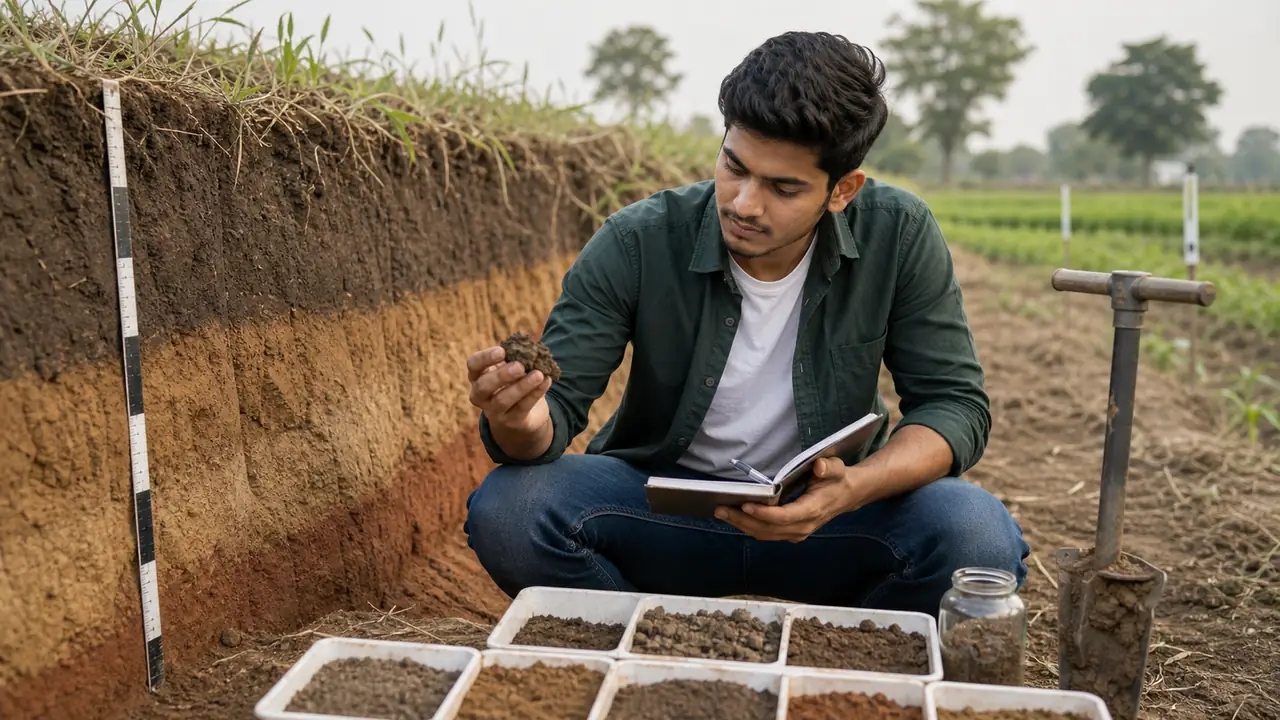
Soil Science explains how soil forms, how it behaves, and how it supports crop growth. In agriculture, this subject connects the field, the plant, water, nutrients, and management decisions, so it becomes a base for agronomy, irrigation, plant nutrition, and land-use planning.
Courses included in this section
- Introduction to Soil Science
- Soil Chemistry, Soil Fertility and Nutrient Management
- Manures, Fertilizers and Agrochemicals
- Problematic Soils and their Management
Why Soil Science matters
Good agriculture starts with good soil understanding. If students can read soil texture, structure, pH, organic matter status, and nutrient availability correctly, they can make better decisions on crop choice, fertilizer use, irrigation, reclamation, and long-term productivity.
Main learning themes
- soil as a natural body and medium for plant growth
- soil formation, weathering, profile development, and soils of India
- physical properties such as texture, structure, bulk density, porosity, water, air, and temperature
- chemical properties such as pH, colloids, cation exchange, and buffering
- soil organic matter, soil organisms, and soil health
- essential plant nutrients, soil fertility, and nutrient management
- manures, fertilizers, soil testing, and fertilizer recommendation approaches
- saline, sodic, acidic, compacted, eroded, and polluted soils with their management
How to study this section well
Start with soil basics before moving to fertility and problem soils. Focus on cause-and-effect links: how a soil property changes water movement, root growth, nutrient uptake, and final crop performance. Revise definitions with examples from Indian agriculture, and do not skip practical topics such as sampling, pH, EC, organic carbon, and nutrient estimation because they make the theory easier to retain.
Who benefits most from this section
This section is especially useful for BSc Agriculture students building first-principles understanding, ICAR-aligned exam preparation, and learners who want a clear base for agronomy, soil fertility, irrigation, land management, and agricultural-extension topics.
Core takeaway
Soil Science teaches students to diagnose the field before prescribing a solution. When they understand the soil properly, crop management becomes more accurate, more efficient, and more sustainable.
Frequently Asked Questions
Why is soil science important in agriculture?
Soil science is important because soil controls water availability, root growth, nutrient supply, and overall crop performance, making it central to productive and sustainable farming.
What is soil science in simple words?
Soil science is the study of how soil forms, what properties it has, how it behaves, and how it can be managed to support plant growth and land use.
What topics are covered in soil science for BSc Agriculture?
This subject usually covers soil formation, physical and chemical properties, organic matter, fertility, nutrient management, fertilizers, soil testing, and problematic soils with their management.
Why do agriculture students study soil pH, EC, and CEC?
They study these because pH, electrical conductivity, and cation exchange capacity strongly affect nutrient availability, salt problems, buffering, and overall soil management decisions.
How does soil science help in crop management?
It helps crop management by improving decisions related to fertilizer use, irrigation, amendment needs, reclamation, crop suitability, and long-term soil health.
How should students study soil science effectively?
Students should study it through cause-and-effect links between soil properties and crop response, and reinforce theory with practical topics like sampling, pH, EC, texture, and nutrient estimation.