Fundamentals of Soil Science
Lecture notes covering Fundamentals of Soil Science as per ICAR 5th Dean Committee syllabus. Course Code: SSAC 121 | Credits: 3(2+1).
Frequently Asked Questions
What is SSAC 121 in BSc Agriculture?
SSAC 121 is a foundational soil science course that introduces soil formation, soil profile, physical properties, soil water, air, temperature, colloids, organic matter, and basic soil chemistry.
What is the difference between pedological and edaphological concepts of soil?
Pedology studies soil as a natural body and its origin and classification, while edaphology studies soil in relation to plant growth and agricultural use.
Why is soil texture important?
Soil texture is important because the proportions of sand, silt, and clay influence water holding, aeration, nutrient retention, workability, and root growth.
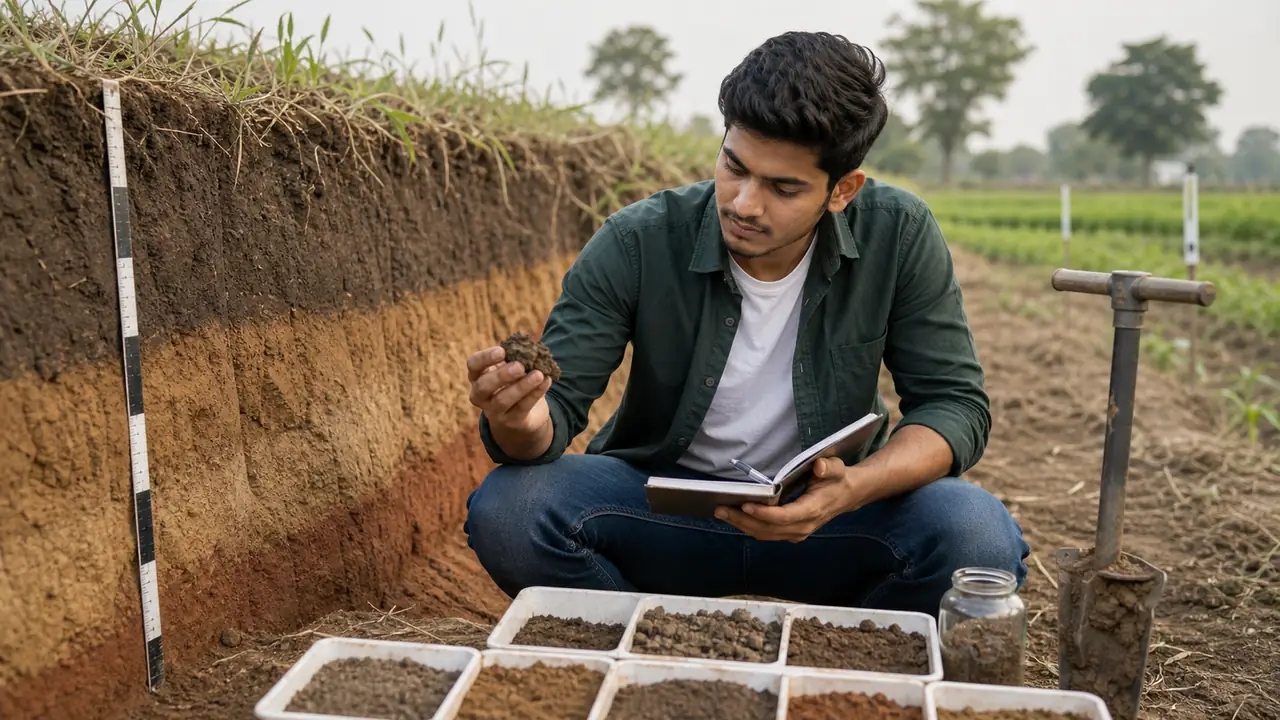
What is a soil profile in simple words?
A soil profile is the vertical section of soil that shows its different layers or horizons from the surface downward.
Why are soil pH and soil colloids important?
They are important because they influence nutrient availability, ion exchange, buffering, and the chemical environment that roots experience.
What is cation exchange capacity in simple words?
Cation exchange capacity, or CEC, is the soil's ability to hold and exchange positively charged nutrient ions, which affects fertility and nutrient management.
Why do students study soil organic matter and soil organisms?
They study them because organic matter and soil organisms support nutrient cycling, aggregation, biological activity, and long-term soil health.
Why is soil pollution included in an introductory soil science course?
Soil pollution is included because pesticides and inorganic contaminants affect soil health, crop safety, and environmental sustainability, making prevention and mitigation important.