🧫 Tolerance limit in Plant
Tolerance limit in Plant.
LECTURE 22
Tolerance limit in Plant Nutrient for various fertilizers
Category Limit
Straight fertilizers
containing <20% plant
nutrients
Straight fertilizers
containing >20% plant
nutrients
: 0.1 Unit of nutrient
: 0.2 Unit of nutrient
Calcium ammonium nitrate : 0.3 Unit of nutrient
Complex/ Mixed fertilizers : 0.5 unit for each and maximum
of 2.5 % for all nutrients
Fertilizer Movement Control Order
The Fertilizer Movement Order (F.M.O.) was promulgated by
Government of India in April 1973 to ensure an equitable distribution of
fertilizers in various States. According to the fertilizer movement order, no
person or agency can export chemical fertilizers from any State. However,
Food Corporation of India, Warehousing Corporation of India and Indian
Potash Limited; materials like Rock phosphate, bone meal (both raw and
steamed) and zinc sulphate are exempted from the movement restriction.
Agency responsible for Enforcement of F.C.O
The Controller of Fertilizers for India, usually a Joint Secretary to the
Government of India (Ministry of Agriculture) is responsible for the
enforcement of F.C.O. throughout the country.
Electrical Conductivity of the soil saturation extract
Measurement of EC of the soil saturation extract is essential for the
assessment of saline soil for the plant growth.
EC (dS m [-1] )
<2 - Salinity effects mostly negligible
2-4 - Yields of very sensitive crops may be restricted
4-8 - Yields of many crops restricted
8-16 - Only tolerant crops yield satisfactorily
>16 - Only a few tolerant crops yield satisfactorily
Concentration of water soluble boron
The determination of water-soluble boron concentration is also
another criteria for characterization of saline soils. The critical limits of boron
concentration for the plant growth are given below.
Boron
concentration
<0.7 - Crops can grow (safe)
10 (19/26)
0.7-1.5 - Marginal
(ppm) >1.5 - Unsafe
Reclamation of Saline Soils
In saline soils, reclamation consists mainly in removing the excess salts.
This can be done either
-
By scraping the salts from the surface (or)
-
Washing them down into lower layers beyond the root zone preferably
completely out of the solum (or)
- By growing salt tolerant crops (or) by a combination of two (or) more of
these methods
Scraping helps to remove salts that have formed an encrustation on
the surface, but it is never very helpful in complete reclamation. Substantial
quantities of soluble salts are still present in the soil body and hinder plant
growth.
Salt tolerant crops
High salt tolerant crops - Rice, sugarcane, Sesbania, oats
Medium salt tolerant crops - Castor, cotton, sorghum, cumbu
Low salt tolerant crops - Pulses, pea, sunnhemp, sesamum
The growing of salt tolerant plants with a view to remove salts is also
not a practical proposition. Although these plants remove substantial
quantities of salts from the soil, comparatively larger quantities are still left
behind. Salt formation is a continuous process; hence, the reclamation is
never complete
LEACHING REQUIREMENT (LR) It may be defined as
The fraction of the irrigation water that must be leached through the
LR=
Where
LR - Leaching requirement in percentage
Ddw - Depth of drainage water in inches
Diw - Depth of irrigation water in inches
ECiw - EC of irrigation water (dSm [-1] )
ECdw - EC of drainage water (dSm [-1] )
If the soil is not free draining, artificial drains are opened (or) tile
drains laid underground to help to wash out the salts.
ALKALI SOIL (sodic/ Solonetz )
Alkali (or) sodic soil is defined as a soil having a conductivity of the
saturation extract less than 4 dS m [-1] and an ESP of > 15. The pH is usually
between 8.5 and 10.0. Formerly these soils were called “ black alkali soils ”
Genesis/ origin
It is evident that soil colloids adsorb and retain cations on their
charged surfaces. Cation adsorption occurs due to electrical charges at the
surface of the soil colloids. While, adsorbed cations are combined
chemically with the soil colloids, they may be replaced by other cations that
occur in soil solution. The reaction of cation in solution that replaces an
adsorbed cation is called as cation exchange and is expressed as cmol (p [+] )
kg [-1] .
Calcium and magnesium are the principal cations found in the soil
solution and on the exchange complex of normal soils in arid regions. When 10 (20/26)
excess soluble salts accumulate in these soils, sodium frequently becomes
the dominant cation in the soil solution. In arid regions as the solution
becomes concentrated through evaporation or water absorption by plants,
the Ca [2+] and Mg [2+] are precipitated as CaSO4, CaCO3 and MgCO3 with a
corresponding increase in sodium concentration. When the Na [+]
concentration is more than 15% of the total cations a part of the original
exchangeable Ca [2+] and Mg [2+ ] replaced by sodium resulting in alkali soils.
Na [+]
Clay Ca [2+] + 2 Na [+ ] ↔ Clay + Ca [2+]
Na [+]
Though the reaction is reversible, Ca [2+ ] are removed in drainage water
as soon as they formed. Hence, the reaction proceeds in one direction from
left to right only. The process whereby a normal soil is converted into an
alkali soil is known as “ alkalization ”.
Characteristics various methods are available to characterize
- A direct determination of exchangeable sodium
Exchangeable sodium = Total sodium - Soluble sodium
- The soil pH also gives an indication of soil alkalinity indirectly. An
increase in pH reading of 1.0 or more, with change in moisture content
from a low to high value has itself been found useful in some area for
detecting alakali conditions.
The higher the ESP, the higher is the soil pH.
- Sodium Adsorption Ratio (SAR)
The US Salinity Laboratory
developed the concept of
SAR =
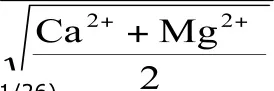
SAR to define the equilibrium between
soluble and exchangeable cations
(Na [+], Ca [2+], Mg [2+] are concentrations in saturation extract in me L [-1] )
The value of SAR can be used for the determination of exchangeable
ESP =
The following regression equation is also used to work out ESP
Y = 0.0673 + 0.035 X
Where Y - indicates ESP and X - indicates SAR
Soils having SAR value greater than 13 are considered as sodic soils.
Impact of soil sodicity
-
Dispersion of soil colloids leads to development of compact soil
-
Due to compactness of soil, aeration, hydraulic conductivity, drainage
and microbial activity are reduced
-
High sodicity caused by Na2CO3 increases soil pH
-
High hydroxyl (OH [-] ) ion concentration has direct detrimental effect on
plants.
-
Excess of Na [+] induces the deficiencies of Ca [2+] and Mg [2+]
-
High pH in alkali soil decreases the availability of many plant nutrients
like P, Ca, N, Mg, Fe, Cu, and Zn.
10 (22/26)
Summary Cheat Sheet
Key Recall Points
- Tolerance limit in Plant is exam-relevant for SSAC122 and objective questions in soil science.
- Use soil-test based interpretation with focus on pH, CEC, and nutrient availability.
- Apply the 4R principle: right source, right rate, right time, and right method.
Exam Traps
- Do not mix up soil fertility concepts with fertilizer quantity alone.
- Numerical and term-based questions often test definitions, units, and threshold values.
- In problem-solving, interpretation must follow soil reaction, crop stage, and management context.
References
3 sources • [1] [2] [3]
References
ICAR e-Course: Soil Chemistry, Soil Fertility and Nutrient Management
OfficialBrady and Weil, The Nature and Properties of Soils
BookLesson Doubts
Ask questions, get expert answers