🌼 Botanical Insecticides
Botanical pesticides such as neem, nicotine, and pyrethrum used in crop protection.
This lesson explains key concepts in a structured way and connects them to practical agricultural applications and exam-oriented understanding.
PRODUCTS, NICOTINE AND PYRETHRUM
Botanical insecticides
Toxicants derived from plants are used in insect control and among them neem
products, nicotine and pyrethrum are well known.
Insecticidal butylamides
Several members of the Compositae and Rutaceae groups of
plants contain insecticidal unsaturated butylamides. Example: Pellitorine
and Fagaramide. These compounds like several of the pyrethrins, have a
rapid knock down effect of flying insects; their practical application as
insecticides is unfortunately, limited by chemical instability. However a
number of synthetic analogues have been examined and several show
promise as insecticides.
Azadirachtin
Neem – derived from Persian word Asad-dilakt-I-hind, which means free
tree of India - Azadirachta indica A. Juss.
In India 14 million trees (1959 survey) of which 50 % in UP. Though not a
forest tree it grows wild I the forests of AP, Tamil Nadu and Karnataka.
Full-grown neem tree yields 50 kg fruit annually and 350 kg of leaves.
India probably produces 0.7 million tones of fruits and 5 million tones of
leaves every year.
Almost every part of the tree is bitter and finds its application in
indigenous medicine. Oil and cosmetic industries are the users of neem.
The refined and purified neem seed oil has many therapeutic properties.
Considerable quantities of oil are used in cosmetic preparations. The
neem cake after oil recovery is used for slow release of nitrogenous
fertilizers.
Neem oil contains limonoids, a class of compounds that act as
antifeedants or growth regulators in insects. They do not kill instantly but
wipe out a whole generation of insects by preventing the young ones from
maturing and the adults from reproducing.
The most effective of the limonoids is a compound called azadirachtin.
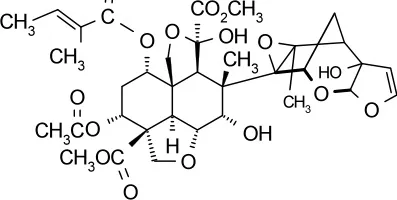
It is similar to the insect hormone ecdysone, which is needed for moulting
during insect development. It works at a concentration of 1-10 ppm by
blocking ecdysone’s action, thereby preventing the larvae from shedding
their external skeletons and maturing. It also prevents feeding in about
200 insects at a concentration of 10-100 ppm.
The knowledge about neem in India is at least a few centuries ago. Indian
scientists had been studying neem for about 70 years and isolated some
active compounds by 1960’s.
A number of neem formulations are being produced by small-scale
formulators and marketed as insecticides. (Neemguard, Margocode,
Nimbicidine, Neemplus, Sukrina, Achook etc.).
Neem oil has some of the less known antifeedants like., salanin, nimbin
and epoxyazadiradione.(4 International conferences were held discussing
regarding production, structure elucidation, isolation of ai, residue
analysis).
Nicotine (C10 H14 N2 ).
Its chemical name is I-methyl-2,3 (pyridyl) pyrrolidine. It is the principal alkaloid in
tobacco (An alkaloid may be defined in general as a naturally occuring heterocyclic,
optically active nitrogenous base of relatively high molecular weight and having marked
physiological activity). Nicotine is found in the leaves of Nicotinana tabacam and N.
rustic a in the range of 2 to 14 per cent. Among the twelve alkaloids present in tobacco
nicotine is the most important one contributing about 97 per cent and the other two of
insecticidal value are (i) Nornicotine (C9 H12 N2) 2-(3-pyridyl pyrrolidine) (ii) Anabusine
(Neonicotine, 3-(2-piperdyl) pyridine.
Pyrethrum
The insecticidal principle in pyrethrum is found in the flower heads of certain plants
of chrysanthemum genus, family compositeae. Only a few species like c.roseum,
c.cineravieflium, c.marshalli and C.tamrutene have been found t<' be valuable sources
of this insecticide. It is used as dusts and sprays.
The flowers are dried at 54.4°C. These flowers are ground to a fine powder and
extracted with the solvents. The solvent is repeatedly percolated through the ground
flowers and the weak extracts. are evaporated in a vacuum still to recover the solvent.
The extracted powder (pyrethrum) containing traces of pyrethrins is sometimes used as
carriers in dust preparations. Dust concentrates are made from concentrated pyrethrum
extracts with a non-volatile solvent and a suitable absorbent carrier and then diluted
before use with an inert diluent. Antioxidants such as tannic acid or hydroquinone are
used to stabilise the pyrethrins in dust preparations. Concentrated extracts of pyrethrum
in aectone, alcohol or a hydrocarbon solvent together with an emulsifier is sold ill the
market.
Miscellaneous compounds
Picrotoxinin (PTX) has been isolated from the seeds of Anamirta
cocculus and is moderately toxic to Insects. E.g. Cockroaches, but is more
toxic to mice. PTX, like avermectins act on GABA regulated chloride ion
channels and functions as a GABA receptor antagonist.
Other compounds with a similar mode of action include the
trioxabicyclooctanes. Eg. The phosphorus ester and
bicycloorthocarboxylates: all are nerve poisons, which are not
cholinesterase inhibitors. The compounds were generally more toxic to
mammals than insects; the bicycloorthocarboxylates, however, can
sometimes show selective activity to house flies and cockroaches and
consequently, have potential for development as novel insecticides.
Insect neurapeptides (INPs) generally containing 5 – 10 amino acid
residues play vital role as circulating neurohormones and
neurotransmitters. They control many aspects of insect’s growth,
development and reproduction together with important physiological and
metabolic processes. Twenty five such processes are thought to be
mediated via these neuropeptides. By 1988, some 27 INPs have been
identified and their structures elucidated. For instance, in the locust, the
adipokinetic hormones AKH I and II, stimulate lipid metabolism during
periods of sustained activity. Eg. Migratory flight. Increased knowledge of
the structures and physiology of INPs should provide new potential target
sites for the design of novel insecticides. Peptide synthesis is one possible
area of exploitation – if certain physiologically active peptides were
introduced to the insect at the wrong time. Severe disruptive effects would
result.
If the gene coding for INPs could be introduced into crop plants,
then insects attacking the crop could be killed. Another promising line of
research would be the design of novel peptides and other molecules to
block the INP receptors.
Summary Cheat Sheet
| Topic | Key exam point |
|---|---|
| Main class | Botanical insecticides |
| Common examples | Neem, pyrethrum, rotenone, and nicotine |
| Neem note | Major active principle is azadirachtin |
| Pyrethrum note | Botanical insecticide derived from chrysanthemum flowers |
| Nicotine note | Classical plant-derived insecticidal alkaloid |
| Role in IPM | Useful in integrated pest management because of botanical origin and selective application contexts |
| Product diversity | Includes extracts, oils, and naturally derived active fractions |
| Mode theme | Often act as antifeedant, repellent, contact poison, or growth disruptor depending on source |
| Exam distinction | Botanical source and active principle are often asked together |
| Trap | Do not assume all botanicals are harmless; botanical origin does not remove toxicity concerns |
References
3 sources • [1] [2] [3]
References
Principles of Soil Science and Agricultural Chemistry — Standard BSc Agriculture Textbook
BookLesson Doubts
Ask questions, get expert answers