💻 Solving Simulteneous
Solving Simulteneous.
This lesson covers core applied mathematics concepts and their agricultural applications for BSc Agriculture learners.
MATHS :: Lecture 21 :: Solving simulteneous equation and cramers rule
__
INVERSE OF A MATRIX
Definition
Let A be any square matrix. If there exists another square matrix B Such that AB = BA = I (I is a unit matrix) then B is called the inverse of the matrix A and is denoted by A-1. The cofactor method is used to find the inverse of a matrix. Using matrices, the solutions of simultaneous equations are found.
Introduction to Vectors
Vector Transformations
Vector Dot Product and Vector Length
Unit Vectors
Matrix Vector Products
Matrices to solve a vector combination problem
Converting a line from Cartesian to vector form
Working Rule to find the inverse of the matrix
Step 1: Find the determinant of the matrix.
Step 2: If the value of the determinant is non zero proceed to find the inverse of the matrix.
Step 3: Find the cofactor of each element and form the cofactor matrix.
Step 4: The transpose of the cofactor matrix is the adjoint matrix.
Step 5: The inverse of the matrix A-1 =  Example
Find the inverse of the matrix
Example
Find the inverse of the matrix 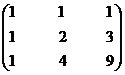 Solution
Let A =
Solution
Let A =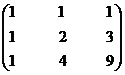 Step 1
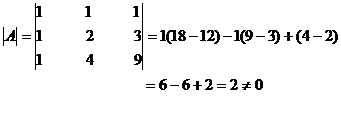 Step 2
The value of the determinant is non zero
\A-1 exists.
Step 3
Let Aij denote the cofactor of aij in
Step 2
The value of the determinant is non zero
\A-1 exists.
Step 3
Let Aij denote the cofactor of aij in 








 Step 4
The matrix formed by cofactors of element of determinant
Step 4
The matrix formed by cofactors of element of determinant  is
is 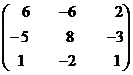 \adj A =
 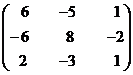 Step 5
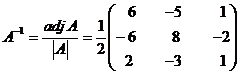 =
= 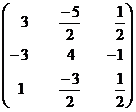 __
__
---|---
Summary Cheat Sheet
- Focus on core formulas, definitions, and solved patterns from this lesson.
- Practice stepwise derivations and numerical substitutions carefully.
- Connect each concept to practical agricultural problem-solving contexts.
References
1 source
References
Primary classroom notes and standard BSc Agriculture applied mathematics references.
Lesson Doubts
Ask questions, get expert answers