💱 Exchange Rates
Understanding foreign exchange rates - direct, indirect, buying, selling, spot and forward rates
What is Exchange Rate?
Exchange Rate is the rate at which one currency is exchanged for another.
- Example: 1 USD = ₹89.52
This means to buy 1 US Dollar, you need to pay ₹89.52 in Indian Rupees.
Variants of Exchange Rates
There are several types of exchange rates based on different factors:
| Variant Type | Description |
|---|---|
| Direct or Indirect Rate | How the rate is quoted (home vs foreign currency) |
| Buying or Selling Rate | Whether bank is buying or selling FC |
| Spot or Forward Rate | When the transaction will be settled |
Value Date
- The actual date of delivery of currencies/funds under a sale or purchase contract
- Also called settlement date
- This is when the actual exchange of currencies takes place
Direct Rate vs Indirect Rate
Direct Rate
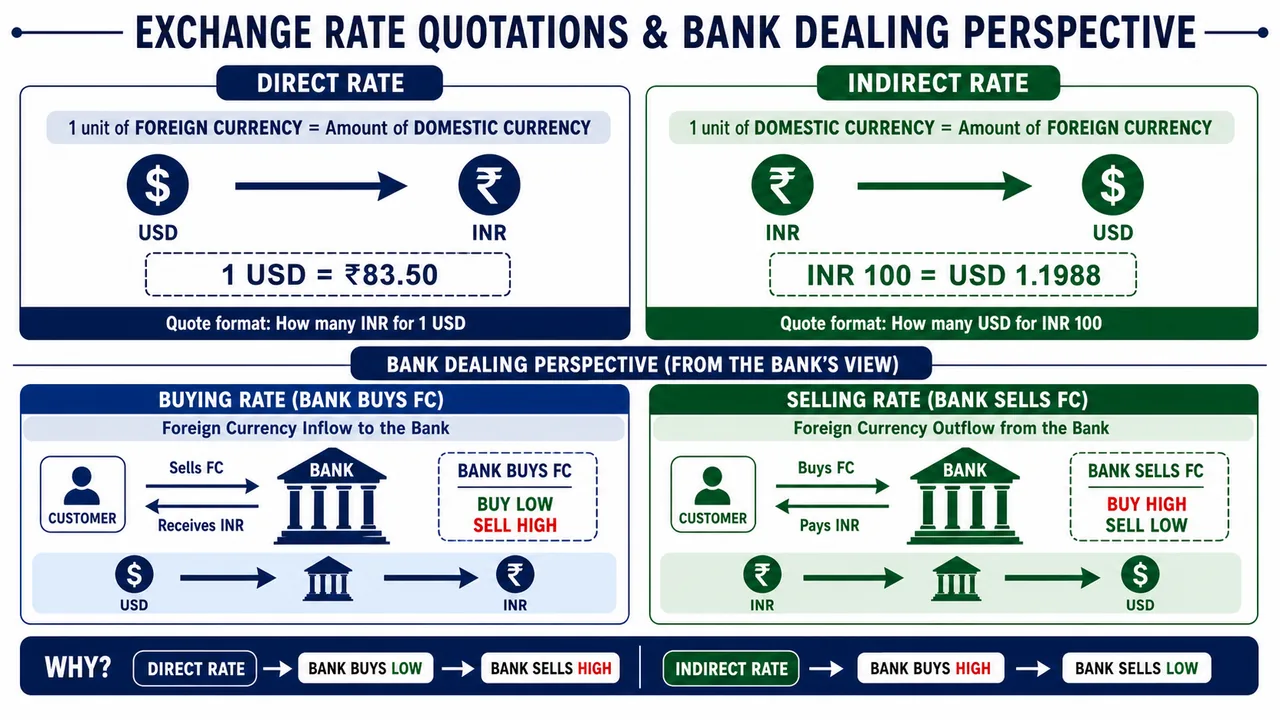
- Quoted as fixed unit of Foreign Currency (FC) and variable units of Home Currency
- OR: Domestic currency per unit of foreign currency
- Example: 1 USD = ₹89.52 (or ₹89.70)
- In India, direct rate is used for most of currencies
- Maxim: Buy Low, Sell High
Indirect Rate
- Quoted as fixed unit of Home Currency and variable units of Foreign Currency
- OR: Foreign currency per unit of home currency
- Example: ₹100 = USD 1.12 (or 1.11)
- Maxim: Buy High, Sell Low
- Used for JPY, Lira, Indonesian Rupiah etc.
| Feature | Direct Rate | Indirect Rate |
|---|---|---|
| Fixed Unit | Foreign Currency | Home Currency |
| Variable Unit | Home Currency | Foreign Currency |
| Example | 1 USD = ₹89.52 | ₹100 = USD 1.12 |
| Maxim | Buy Low, Sell High | Buy High, Sell Low |
| Used for | Most currencies | JPY, Lira, Rupiah |
Buying Rate vs Selling Rate
These are from the perspective of the bank.
Pro Content Locked
Upgrade to Pro to access this lesson and all other premium content.
₹99 charged monthly · Cancel anytime
- All Agriculture & Banking Courses
- AI Lesson Questions (100/day)
- AI Doubt Solver (50/day)
- Glows & Grows Feedback (30/day)
- AI Section Quiz (20/day)
- 22-Language Translation (100/day)
- Recall Questions (20/day)
- AI Quiz (15/day)
- AI Quiz Paper Analysis (100/day)
- AI Step-by-Step Explanations (100/day)
- Spaced Repetition Recall (FSRS)
- AI Tutor
- Immersive Text Questions
- Audio Lessons — Hindi & English
- Mock Tests & Previous Year Papers
- Summary & Mind Maps
- XP, Levels, Leaderboard & Badges
- Generate New Classrooms
- Voice AI Teacher (AgriDots Live)
- AI Revision Assistant
- Knowledge Gap Analysis
- Interactive Revision (LangGraph)
🔒 Secure via Razorpay · Cancel anytime · No hidden fees
What is Exchange Rate?
Exchange Rate is the rate at which one currency is exchanged for another.
- Example: 1 USD = ₹89.52
This means to buy 1 US Dollar, you need to pay ₹89.52 in Indian Rupees.
Variants of Exchange Rates
There are several types of exchange rates based on different factors:
| Variant Type | Description |
|---|---|
| Direct or Indirect Rate | How the rate is quoted (home vs foreign currency) |
| Buying or Selling Rate | Whether bank is buying or selling FC |
| Spot or Forward Rate | When the transaction will be settled |
Value Date
- The actual date of delivery of currencies/funds under a sale or purchase contract
- Also called settlement date
- This is when the actual exchange of currencies takes place
Direct Rate vs Indirect Rate
Direct Rate
- Quoted as fixed unit of Foreign Currency (FC) and variable units of Home Currency
- OR: Domestic currency per unit of foreign currency
- Example: 1 USD = ₹89.52 (or ₹89.70)
- In India, direct rate is used for most of currencies
- Maxim: Buy Low, Sell High
Indirect Rate
- Quoted as fixed unit of Home Currency and variable units of Foreign Currency
- OR: Foreign currency per unit of home currency
- Example: ₹100 = USD 1.12 (or 1.11)
- Maxim: Buy High, Sell Low
- Used for JPY, Lira, Indonesian Rupiah etc.
| Feature | Direct Rate | Indirect Rate |
|---|---|---|
| Fixed Unit | Foreign Currency | Home Currency |
| Variable Unit | Home Currency | Foreign Currency |
| Example | 1 USD = ₹89.52 | ₹100 = USD 1.12 |
| Maxim | Buy Low, Sell High | Buy High, Sell Low |
| Used for | Most currencies | JPY, Lira, Rupiah |
Buying Rate vs Selling Rate
These are from the perspective of the bank.
Buying Rate
- Used for inflow of FC (bank receives FC - delivers INR)
- Bank is the buyer of foreign currency
- Example: Purchase of FC export bill or cancellation of FC DD issued by bank
- Customer sells FC → Bank buys FC → Bank pays customer in INR
Selling Rate
- Used for outflow of FC (bank delivers FC - receives INR)
- Bank is the seller of foreign currency
- Example: Issue of FC DD to customer or payment of FC import bill on behalf of an importer
- Customer buys FC → Bank sells FC → Customer pays bank in INR
Spread or Margin
- The difference between buying rate and selling rate
- Also known as trading margin
- This is the bank's profit on forex transactions
- Formula: Spread = Selling Rate - Buying Rate
Fixed Rate vs Floating Rate
Fixed Rate
- Fixed by Monetary Authority (Central Bank)
- Pegged to one or more currencies
- Exchange rate remains constant unless government changes it
Floating Rate
- India adopted in 1993
- Value decided by demand and supply in the market
- Also called market-determined exchange rate
- RBI may intervene to manage volatility (managed float)
Spot Rate vs Forward Rate
Spot Rate
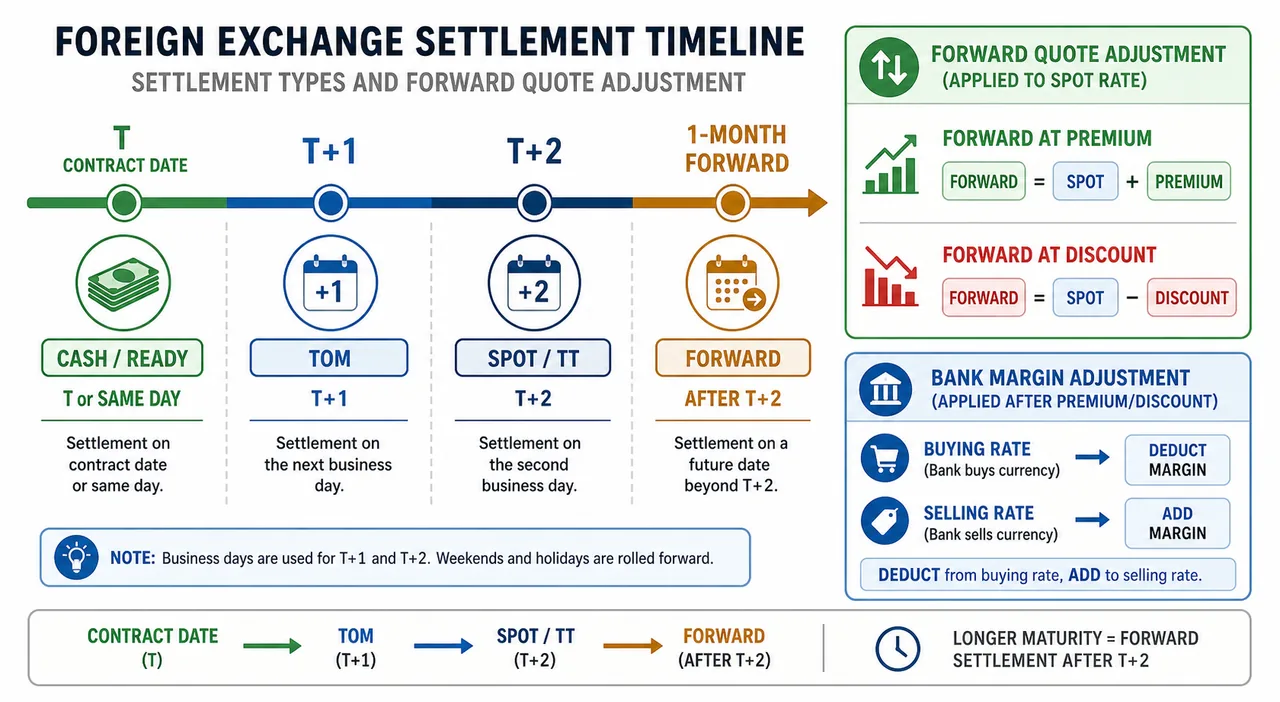
- Used for spot transactions (settled in T + 2 working days i.e. next two working days)
- Also called TT Rate (Telegraphic Transfer Rate)
| Settlement Type | Description | Example |
|---|---|---|
| Same day (T-0) | Cash or Ready rate | Contract: Jan 12 (Fri) → Delivery: Jan 12 |
| T+1 day | Tom rate (Tomorrow) | Contract: Jan 12 (Fri) → Delivery: Jan 15 (Mon) |
| T+2 days | Spot or TT rate | Contract: Jan 12 (Fri) → Delivery: Jan 16 (Tue) |
Forward Rate
- Used for forward transactions (after T+2 working days)
- Agreed today for delivery on a future date
Forward Rate Scenarios:
| Scenario | Condition | Action |
|---|---|---|
| Forward @ Premium | Future rate > Spot rate | Premium added to spot rate |
| Forward @ Discount | Spot rate > Future rate | Discount deducted from spot rate |
Bank Margin Adjustment:
- Deduct from buying rate AND add to selling rate
- Applied after adjusting premium or discount
📝 Example: Bank Margin Calculation
Given:
- Spot rate: 1 USD = ₹84.00 / 84.20 (Bid/Offer)
- Forward premium (1 month): 20 paise
- Bank margin: 5 paise
Step 1: Adjust for Premium/Discount
| Rate Type | Spot Rate | + Premium | After Premium |
|---|---|---|---|
| Buying (Bid) | ₹84.00 | + 0.20 | ₹84.20 |
| Selling (Offer) | ₹84.20 | + 0.20 | ₹84.40 |
Step 2: Apply Bank Margin (AFTER premium)
| Rate Type | After Premium | Margin Adjustment | Final Rate |
|---|---|---|---|
| Buying | ₹84.20 | - 0.05 (deduct) | ₹84.15 |
| Selling | ₹84.40 | + 0.05 (add) | ₹84.45 |
Final Forward Rates:
- Bank's Buying Rate: ₹84.15 per USD
- Bank's Selling Rate: ₹84.45 per USD
- Bank's Spread: ₹0.30 (84.45 - 84.15)
Key Memory Point: Margin always works in bank's favor - they buy cheaper (deduct) and sell higher (add)
Bid/Offer Rates
Inter-bank market rates are quoted as:
1 USD = ₹89.10 / 89.20
- 1st part (₹89.10) = Bid Rate (bank's rate to buy)
- 2nd part (₹89.20) = Offer Rate (bank's rate to sell)
Cross Rates
When rate between 2 currencies is not directly given/available, it is calculated through a 3rd common currency.
Also called Chain Rule method.
Examples:
Example 1: Euro to Rupee
- Euro/USD rate: 1 Euro = 1.18 USD
- USD/Rupee rate: 1 USD = ₹89.20
- Euro-Rupee rate = 1.18 × 89.20 = ₹105.56
Example 2: INR to Yen
- USD/JPY rate = 156.43 (JPY quoted per 100 units)
- USD/INR = 89.20
- INR/JPY = (89.20 / 156.43) × 100 = ₹57.02 per 100 Yen
FC Rates for Specific Transactions
Understanding which rate to apply depends on two factors:
- Is the bank buying or selling FC? (Bank's perspective)
- Is there a bill/document involved? (TT vs Bills rate)
Key Rule: Bank always profits - uses lower rate when buying FC, higher rate when selling FC
| Sr. | Transaction | Rate to Apply |
|---|---|---|
| 1 | Issue of FC DD | TT Selling rate |
| 2 | Cancellation of FC DD issued by bank | TT Buying rate |
| 3 | Encashment of FC DD | TT Buying rate |
| 4 | Purchase of FC export bill from exporter | Bills Buying rate |
| 5 | Reversal of dishonoured FC export bill | TT Selling rate |
| 6 | Crystallization of overdue FC export bill | TT Selling rate |
| 7 | Payment of FC import bill | Bills Selling rate |
| 8 | Crystallization of overdue FC import bill under LC | Bills Selling rate |
| 9 | Transfer of funds from FCNR to NRE | TT Buying rate |
| 10 | Transfer of funds from NRE to FCNR | TT Selling rate |
| 11 | Payment in INR after credit of FC in NOSTRO a/c | TT Buying rate |
| 12 | Receipt of FC in NOSTRO a/c after payment in Rupee | Bills Buying rate |
Explanation of Each Transaction
📝 Click to see detailed explanations
1. Issue of FC DD → TT Selling rate
- Customer wants FC (in form of DD), bank is selling FC
- No bill involved, so TT rate applies
2. Cancellation of FC DD issued by bank → TT Buying rate
- Bank takes back the FC DD, effectively buying back FC from customer
- Customer gets INR refund
3. Encashment of FC DD → TT Buying rate
- Customer brings FC DD, wants INR
- Bank is receiving FC = buying FC from customer
4. Purchase of FC export bill from exporter → Bills Buying rate
- Exporter has FC bill (document), sells to bank
- Bank is buying FC + bill handling = Bills Buying rate
5. Reversal of dishonoured FC export bill → TT Selling rate
- Original transaction was bills buying (bank bought FC)
- Dishonour means bank reverses = selling FC back to exporter
- No bill now (it's been dishonoured), so TT rate
6. Crystallization of overdue FC export bill → TT Selling rate
- Export bill was sent abroad but became overdue/unpaid
- Bill is no longer valid (failed abroad) - no documents in hand
- Bank debits exporter's account = selling FC to exporter
- TT rate because no active bill transaction exists now
7. Payment of FC import bill → Bills Selling rate
- Importer needs to pay in FC
- Bank is selling FC to importer + bill handling
8. Crystallization of overdue FC import bill under LC → Bills Selling rate
- Import bill under LC became overdue
- Bank still holds the shipping documents (LC means bank is holding docs)
- Bank crystallizes = selling FC to importer against those documents
- Bills rate because documents are still with the bank (bill transaction continues)
9. Transfer from FCNR to NRE → TT Buying rate
- Converting FC (FCNR) to INR (NRE)
- Bank is receiving FC from customer = buying FC
- No bill, so TT rate
10. Transfer from NRE to FCNR → TT Selling rate
- Converting INR (NRE) to FC (FCNR)
- Bank is giving FC to customer = selling FC
11. Payment in INR after credit of FC in NOSTRO a/c → TT Buying rate
- Bank already received FC in its NOSTRO account
- Now paying INR to customer = bank bought FC
- TT rate (telegraphic transfer)
12. Receipt of FC in NOSTRO a/c after payment in Rupee → Bills Buying rate
- Bank paid INR first, FC credited later
- Bank is buying FC with documentation delay
- Bills rate for the handling
Foreign Currency Positions
FC Position
- FC position = Amount payable or receivable in FC
- Position can be closed or open
Closed Position
- Matched position (sale = purchase)
- No risk position
Open Position
- Mismatched position (sale ≠ purchase) → Risk position
- Position limit fixed by Board of Directors and reported to RBI
- Sale > Purchase = Short position
- Purchase > Sale = Long position
Effect of Rate Change
| Position | Rate Increases | Rate Decreases |
|---|---|---|
| Long (purchase > sale) | Gain ✅ | Loss ❌ |
| Short (sale > purchase) | Loss ❌ | Gain ✅ |
Day Light vs Overnight Position
- Day light position = Balance during day time (higher balance allowed)
- Overnight position = Balance at close of day (lower balance limit)
Swap
- Exchange of FC flows relating to different value dates between two parties
- Swap involves 2 transactions simultaneously:
- Combination of spot and forward
- Combination of 2 forwards
- These are in opposite direction
Example:
- Sale of FC spot @ 1 USD = ₹89.15
- AND simultaneous purchase of FC 2 month forward @ 1 USD = ₹89.75
- (or vice-versa)
Objective: To cover the forex fluctuation risk
Arbitrage
- Practice of taking advantage of price difference in FC rates between 2 or more markets
- Example: Purchase of FC in one market (where rate is lower) and simultaneous sale of same currency in another market (where rate is higher)
- Objective: To make profit due to rate difference in two markets
Summary Cheat Sheet
| Parameter | Detail |
|---|---|
| Exchange Rate | Rate at which one currency is exchanged for another |
| Value Date | Actual date of delivery (settlement date) |
| Direct Rate | Fixed FC, variable home currency (Buy Low, Sell High) |
| Indirect Rate | Fixed home currency, variable FC (Buy High, Sell Low) |
| India Uses | Direct rate for most currencies |
| Indirect Rate For | JPY, Lira, Indonesian Rupiah |
| Buying Rate | FC inflow (bank receives FC, pays INR) |
| Selling Rate | FC outflow (bank delivers FC, receives INR) |
| Spread/Margin | Difference between buying and selling rate |
| Fixed Rate | Set by Monetary Authority, pegged to currency |
| Floating Rate | India adopted 1993, demand/supply driven |
| Spot Rate (T+2) | Settled in 2 working days (TT rate) |
| Cash Rate (T-0) | Same day settlement (Ready rate) |
| Tom Rate (T+1) | Next day settlement |
| Forward Rate | Settlement after T+2 days |
| Forward @ Premium | Future rate > Spot rate (add premium) |
| Forward @ Discount | Spot rate > Future rate (deduct discount) |
| Margin Adjustment | Deduct from buying, add to selling (after premium/discount) |
| Bid Rate | Bank's rate to buy FC (1st part of quote) |
| Offer Rate | Bank's rate to sell FC (2nd part of quote) |
| Cross Rate | Calculated through 3rd common currency (Chain Rule) |
FC Transaction Rate Quick Reference
| Transaction | Rate Used |
|---|---|
| Issue DD to customer | TT Selling rate |
| Purchase FC export bill | Bills Buying rate |
| Payment of FC import bill | Bills Selling rate |
| Dishonoured export bill | TT Selling rate |
| FCNR to NRE transfer | TT Buying rate |
| Crystallisation of export bill | TT Selling rate |
FC Positions Quick Reference
| Term | Definition |
|---|---|
| FC Position | Amount payable or receivable in FC |
| Closed Position | Sale = Purchase (no risk) |
| Open Position | Sale ≠ Purchase (risk position) |
| Long Position | Purchase > Sale (gain if rate ↑) |
| Short Position | Sale > Purchase (gain if rate ↓) |
| Day Light Position | Balance during day time (higher limit) |
| Overnight Position | Balance at close of day (lower limit) |
| Position Limit | Fixed by BOD, reported to RBI |
Swap & Arbitrage
| Concept | Definition |
|---|---|
| Swap | 2 opposite FC transactions at different value dates |
| Swap Types | Spot + Forward OR Forward + Forward |
| Swap Objective | Cover forex fluctuation risk |
| Arbitrage | Profit from rate difference between markets |
| Arbitrage Method | Buy low in one market, sell high in another |
Lesson Doubts
Ask questions, get expert answers