Finance
Agricultural finance and banking notes for NABARD Grade A, IBPS AFO and RRB SO — general banking concepts, financial schemes, RBI circulars, cooperative credit, priority sector lending, and agricultural marketing and economics.

Course Structure
What's Inside
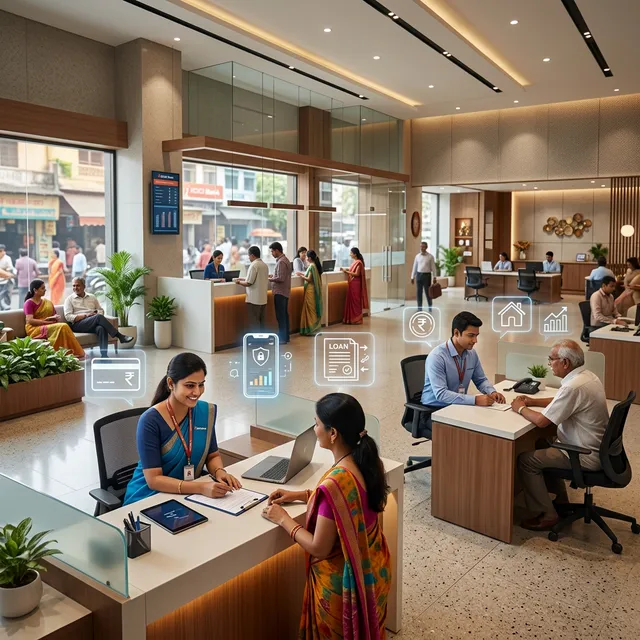

General Banking
General banking awareness for NABARD Grade A and IBPS AFO — banking system, types of banks, RBI functions and monetary policy, NPA, SARFAESI, negotiable instruments, banking regulation and financial inclusion schemes.

RBI Circular
RBI circulars and monetary policy updates for NABARD Grade A and IBPS AFO — repo rate changes, credit policy, priority sector lending norms, MCLR, regulatory guidelines, bank compliance updates and current RBI notifications relevant to banking exams.

Marketing
Agricultural and bank marketing notes for NABARD Grade A and IBPS AFO — market types, product pricing, distribution channels, consumer behaviour, bank marketing strategies, CRM, digital banking marketing and financial product promotion.

Current Banking and Financial Affairs 2026
Current Banking and Financial Affairs notes for the first half of 2026, organised by banking, appointments, economy, national finance, international finance, and reports.

Financial Schemes
Master government and institutional financial schemes, subsidies, and support programs for banking exams.
Finance and Banking is the highest-weightage subject in India's agriculture and rural banking competitive exams. Whether you are targeting NABARD Grade A, IBPS AFO, or RRB SO, a firm grip on banking concepts, government schemes, and RBI policy is non-negotiable. This is not just theoretical knowledge — examiners test whether you can apply RBI guidelines, calculate PSL shortfalls, and identify the correct scheme for a given scenario.
This course covers every dimension of agricultural finance: from the foundational structure of India's banking system and monetary policy instruments, to the hundreds of government financial schemes that flow through that system to farmers, SHGs, and MSMEs. RBI circulars are updated as they are released, keeping you current with the latest regulatory changes that appear in exams.
The material is designed for efficiency — each concept is linked to exam-relevant facts, numerical thresholds, and the specific question types that have appeared in previous IBPS AFO and NABARD exams. By the end of this course, you will be able to answer any banking awareness question with speed and precision.
Course Structure
| Section | Topics | Lessons |
|---|---|---|
| 01 General Banking | Monetary policy, repo rate, reverse repo, CRR, SLR, MSF, bank rate, priority sector lending (PSL), NPA classification, SARFAESI, CIBIL, Basel norms, money market instruments, NBFC regulation, cooperative credit structure, RRBs | 96 |
| 02 Financial Schemes | PMJDY, PMMY (MUDRA — Shishu/Kishore/Tarun), KCC, PM-KISAN, PM-FASAL Bima Yojana, Agri Infra Fund, AIF, SHG-BLP, NRLM, PMAY, NPS, gold monetisation, gold bonds, Startup India, Stand-Up India, MSME credit schemes | 42 |
| 03 Current Banking & Financial Affairs | January-May 2026 banking and financial awareness notes — banking affairs, appointments, economy, national finance, international finance, reports and rankings | 6 |
| 04 RBI Circulars | Analysis of recent RBI circulars — interest rate decisions, PSL amendments, NBFC regulations, digital lending guidelines, forex policy updates | 30 |
| 05 Banking & Financial Marketing | Marketing concepts in banking — product, price, place, promotion, customer segmentation, CRM, bancassurance, cross-selling | 7 |
Key Facts to Know
The most frequently tested figures in Finance & Banking:
| Concept | Key Figure |
|---|---|
| PSL target — domestic commercial banks | 40% of ANBC |
| PSL target — agriculture (domestic banks) | 18% of ANBC |
| PSL target — weaker sections | 10% of ANBC |
| PSL target — RRBs | 75% of ANBC |
| CRR (Cash Reserve Ratio) | 4% (check latest RBI circular) |
| SLR (Statutory Liquidity Ratio) | 18% (check latest RBI circular) |
| KCC interest rate (after subvention) | 4% p.a. for prompt repayment |
| KCC interest subvention | 2% + 3% prompt repayment incentive |
| KCC maximum loan without collateral | ₹1.6 lakh |
| MUDRA — Shishu | Up to ₹50,000 |
| MUDRA — Kishore | ₹50,001 – ₹5 lakh |
| MUDRA — Tarun | ₹5 lakh – ₹10 lakh |
| PMJDY zero-balance account overdraft | Up to ₹10,000 |
| NABARD establishment date | 12 July 1982 |
| NABARD established on recommendations of | Shivaraman Committee |
| SHG-BLP — SHG size | 10–20 members (typically rural women) |
| NPA classification — substandard | Overdue > 90 days |
| RIDF — administered by | NABARD |
| PM-KISAN annual income support | ₹6,000 (3 instalments of ₹2,000) |
Who Should Study This Course?
- IBPS AFO — Agricultural Field Officer (General Banking Awareness section — ~40 questions directly from this syllabus)
- NABARD Grade A/B — Development Assistant and Manager cadres (Economic & Social Issues + Agriculture paper)
- IBPS RRB SO — Regional Rural Bank Specialist Officer (Agriculture Officer cadre)
- RBI Assistant — General Awareness and Banking Awareness sections
- SBI PO — General/Financial Awareness section
Frequently Asked Questions
What is the difference between CRR and SLR?
CRR (Cash Reserve Ratio) is the percentage of a bank's net demand and time liabilities (NDTL) that it must maintain as cash with the RBI — it earns no interest. SLR (Statutory Liquidity Ratio) is the percentage of NDTL that banks must maintain in liquid assets such as gold, cash, or approved government securities — banks can hold this themselves and it earns interest through G-sec yields. Both are monetary policy tools controlled by the RBI's Monetary Policy Committee (MPC). A higher CRR/SLR reduces money supply; a lower CRR/SLR injects liquidity into the system.
What is a Non-Performing Asset (NPA)?
An NPA is a loan or advance where the principal or interest payment has been overdue for more than 90 days (for term loans). Banks classify NPAs into three sub-categories: Substandard (overdue for up to 12 months after becoming NPA), Doubtful (substandard for more than 12 months), and Loss (uncollectible, identified by the bank or auditors). NPA recognition is critical for exam questions involving balance sheet provisioning, SARFAESI Act application, and CIBIL score impacts.
What is the PMJDY scheme and why is it tested in exams?
PMJDY (Pradhan Mantri Jan Dhan Yojana) was launched on 28 August 2014 and is the world's largest financial inclusion programme. Under PMJDY, any Indian citizen can open a zero-balance savings account at any bank or post office. Account holders receive a RuPay debit card, ₹1 lakh accident insurance cover, and ₹30,000 life insurance. Accounts active for 6 months become eligible for overdraft up to ₹10,000. PMJDY is tested because it demonstrates understanding of India's financial inclusion architecture and the Direct Benefit Transfer (DBT) system.
How is RBI circular content tested in IBPS AFO?
RBI circulars appear in IBPS AFO's current affairs portion and General Banking Awareness. Examiners test: changes to repo rate / reverse repo rate, revisions to PSL sub-targets, new guidelines on digital lending or NBFCs, and scheme-specific amendments. The best approach is to track circulars published in the 6 months before the exam. Our RBI Circular section adds each new circular as a lesson within days of publication, with exam-angle highlights so you know exactly what to memorise.
Frequently Asked Questions
What is Priority Sector Lending (PSL) and what are the targets?
Priority Sector Lending (PSL) refers to mandated lending by banks to sectors like agriculture, MSME, education, housing, and export credit that need institutional credit but lack access. The RBI mandates that domestic commercial banks lend 40% of Adjusted Net Bank Credit (ANBC) to priority sectors, with 18% specifically to agriculture and 10% to weaker sections. Regional Rural Banks (RRBs) have a higher target of 75% of ANBC. Foreign banks with fewer than 20 branches must achieve 40% PSL with a 32% sub-target for exports.
What are MUDRA loan categories and their limits?
MUDRA (Micro Units Development and Refinance Agency) loans are classified into three tiers based on loan size. Shishu covers loans up to ₹50,000 for very early-stage micro enterprises. Kishore covers loans from ₹50,001 to ₹5 lakh for growing enterprises. Tarun covers loans from ₹5 lakh to ₹10 lakh for established micro units seeking expansion. All three categories are covered under PMMY (Pradhan Mantri MUDRA Yojana) and carry no processing fee. These limits are a very frequent exam question.
What is KCC interest subvention and how does it work?
Under the Kisan Credit Card (KCC) scheme, the central government provides an interest subvention of 2% per annum on short-term crop loans up to ₹3 lakh. An additional 3% prompt repayment incentive is given to farmers who repay on time, making the effective interest rate just 4% per annum for punctual borrowers (7% - 2% subvention - 3% incentive). The full subvention is available only for loans disbursed through scheduled commercial banks, RRBs, and cooperative banks.
What is the role of NABARD in agriculture finance?
NABARD (National Bank for Agriculture and Rural Development) is the apex development finance institution for agriculture and rural India. It provides refinance to commercial banks, RRBs, and cooperative banks for agricultural and rural credit. NABARD supervises RRBs and State Cooperative Banks, implements rural development schemes, and manages funds like the Rural Infrastructure Development Fund (RIDF). It was established on 12 July 1982 on the recommendations of the Shivaraman Committee. NABARD does not lend directly to farmers — it works through other financial institutions.
How many questions on Finance & Banking appear in IBPS AFO?
In IBPS AFO (Agricultural Field Officer), the General Banking Awareness section typically carries 40 questions in the online written exam. Questions cover banking concepts (policy rates, PSL, NPA norms), government financial schemes (PMJDY, PMMY, KCC), RBI guidelines, and agricultural marketing and economics. Finance & Banking is one of the highest-weightage sections in IBPS AFO — strong preparation here can be the deciding factor between selection and rejection.
What is the SHG-Bank Linkage Programme?
The Self Help Group–Bank Linkage Programme (SHG-BLP) is India's largest microfinance initiative, promoted by NABARD since 1992. Under this programme, banks extend direct credit to Self Help Groups (groups of 10–20 rural women) without collateral. The SHG saves internally, builds credit history, and then receives a bank loan typically 4× its corpus. The scheme follows grading norms — Grade I SHGs are eligible for credit linkage. India has the world's largest SHG movement under this programme, with Andhra Pradesh and Telangana having the highest concentration.