RBI Circular Digest — February 2026
Exam-focused analysis of key RBI circulars from February 2026 with quick memory tables and implications for banking exams.
RBI Circulars February 2026
This lesson organizes the most exam-relevant RBI circular changes from February 2026 into compact decision tables. Focus on the regulatory change, effective date, who is affected, and what changed operationally.
Quick Exam Snapshot
| Circular Theme | What Changed | Why It Matters in Exams |
|---|---|---|
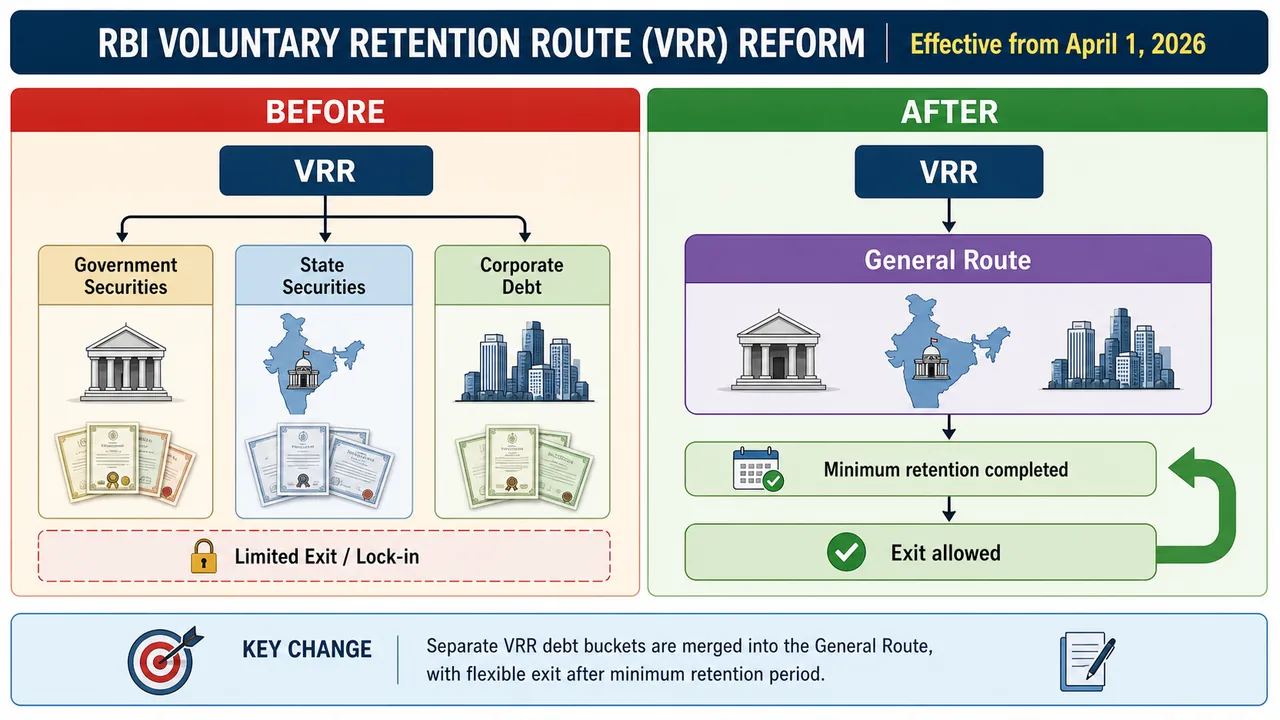
| VRR reform | VRR debt buckets merged into General Route; flexible exit after minimum retention | Tested as a policy-structure and market-access change |
| Agency banks opening | Agency banks must remain open on 31 March 2026 for government business | Frequently asked as date + applicability fact |
| CME amendment | Refined definition and ceilings for capital market exposure | High-value for prudential norms and limit-based MCQs |
RBI/2025-2026/205 A.P. (DIR Series) Circular No. 21 - Voluntary Retention Route – Imparting predictability and increasing ease of doing business
Background
The Voluntary Retention Route (VRR) was introduced by the RBI to encourage Foreign Portfolio Investors (FPIs) to invest in Indian debt markets by providing certain operational flexibilities, subject to a minimum retention period. This framework aimed to attract stable and long-term FPI investments. The current circular refers to the Foreign Exchange Management (Debt Instruments) Regulations, 2019, and the Master Direction - Reserve Bank of India (Non-resident Investment in Debt Instruments) Directions, 2025, which govern FPI investments.
Key Decision
On a review, the RBI has decided to make two significant changes to the VRR framework:
-
Integration of Investment Limits: The investment limits under the VRR for Central Government securities (including Treasury Bills), State Government Securities, and corporate debt securities will now be subsumed under the investment limit for FPI investments under the General Route. This means VRR limits will no longer be separate but will count towards the overall FPI debt investment limits under the General Route.
-
Increased Exit Flexibility for FPIs: FPIs that had committed to retention periods longer than the stipulated minimum will now have the option to liquidate their portfolio (fully or partly) and exit the VRR after the completion of the minimum retention period, even if their initial commitment was for a longer duration.
These directions will come into force with effect from April 01, 2026. All existing VRR investments on this date will also be transferred to the respective investment limits under the General Route.
Exam Relevance
- Voluntary Retention Route (VRR) Integration: The significant change is that VRR investment limits are now subsumed under the General Route for FPI debt investments. Exam Insight: Questions can focus on how FPI investment limits in debt are now calculated and the abolishment of separate VRR limits.
- Effective Date: The changes come into effect from April 01, 2026. Exam Insight: Specific dates of implementation for regulatory changes are frequently tested.
- FPI Exit Flexibility: FPIs can now exit VRR after the minimum retention period, even if a longer period was initially chosen. Exam Insight: This highlights a change that impacts FPI operational flexibility; understand the 'after minimum retention period' condition.
- Regulatory Framework: The circular refers to the Foreign Exchange Management (Debt Instruments) Regulations, 2019, and the Master Direction - Reserve Bank of India (Non-resident Investment in Debt Instruments) Directions, 2025. The directions are issued under sections 10(4) and 11(1) of the Foreign Exchange Management Act, 1999 (FEMA). Exam Insight: Knowing the base regulations and the sections of FEMA under which RBI issues directions is important.
Summary Table: VRR Changes
| Feature | Before (Prior to April 01, 2026) | After (From April 01, 2026) |
|---|---|---|
| Investment Limits (FPIs) | Separate investment limits for VRR in debt securities. | VRR limits are subsumed under General Route FPI debt limits. |
| FPI Exit Flexibility | FPIs committed to longer retention periods had to adhere to them. | FPIs can exit after minimum retention period, even if committed longer. |
| Effective Date | N/A | April 01, 2026 |
All Agency Banks to remain open for public on March 31, 2026 (Tuesday)
Background
The Reserve Bank of India (RBI) issued this circular based on a request from the Government of India. The primary objective is to ensure that all government financial transactions, both receipts and payments, pertaining to the Financial Year 2025-26 are fully accounted for within that fiscal year. Since March 31, 2026 is a Tuesday and typically a public holiday for banks, special instructions were needed to facilitate this year-end financial closure.
Key Decision
All Agency Banks (banks that conduct government business) are advised to keep all their branches dealing with government receipts and payments open for public transactions on March 31, 2026 (Tuesday). This is a mandatory instruction to enable the timely completion of government accounts for the fiscal year 2025-26. Banks are also required to give due publicity to inform the public about the availability of these banking services on this specific day.
Exam Relevance
- Circular Date: The circular was issued on February 03, 2026. Exam Insight: Specific dates of important circulars, especially those impacting financial year-ends or public holidays, can be a direct question point.
- Applicability Date: The directive specifically applies to March 31, 2026. Exam Insight: The exact date for which a special arrangement is made is a critical detail that can be tested.
- Affected Entities: The instruction is applicable to All Agency Banks dealing with government business, not all commercial banks. Exam Insight: Distinguish between the scope of application – whether it's universal or specific (e.g., 'Agency Banks' vs. 'All Scheduled Commercial Banks').
- Reason for Directive: The core reason is to complete and account for all Government transactions (receipts and payments) for Financial Year 2025-26. Exam Insight: Understanding the 'why' behind a regulatory change helps in answering conceptual questions related to banking operations and government finance.
Summary Table
| Feature | Details |
|---|---|
| Circular Number | RBI/2025-26/204 DoR.CO.SOG(Leg) No.401/09.08.024/2025-26 |
| Date of Issue | February 03, 2026 |
| Subject | Agency Banks to remain open on March 31, 2026 |
| Applicable To | All Agency Banks (dealing with Govt. business) |
| Date of Action | March 31, 2026 (Tuesday) |
| Reason | To account for all Government transactions in FY 2025-26 |
| Key Action | Keep branches dealing with Govt. business open |
| Additional Note | Banks must give due publicity |
RBI/2025-2026/212DOR.CRE.REC.403/07-03-001/2025-26: Reserve Bank of India (Commercial Banks - Concentration Risk Management) Amendment Directions, 2026
Background
The Reserve Bank of India (RBI) periodically reviews and updates its regulatory framework to ensure the stability and health of the banking system. This circular, issued on February 13, 2026, amends the existing Reserve Bank of India (Commercial Banks - Concentration Risk Management) Directions, 2025. The amendments are primarily driven by the need to align with recent changes introduced in the Reserve Bank of India (Commercial Banks – Credit Facilities) Amendment Directions, 2026, and to refine the guidelines related to Capital Market Exposures (CME) for commercial banks. These changes are crucial for managing concentration risk in the public interest, leveraging powers conferred by Sections 21 and 35A of the Banking Regulation Act, 1949.
Key Decision
The RBI has undertaken a comprehensive review of the Concentration Risk Management Directions. The key decisions involve:
- New Definitions: Introduction of clear definitions for terms like "Acquisition Finance", "Bridge Finance", "Capital Market Intermediaries (CMIs)", "Collateral Security", "Non-debt Mutual Funds", and "Primary Security", aligning them with the Credit Facilities Directions, 2025.
- Refined CME Scope: Deletion of previous paragraphs (4(8), 95, 97, 98, 101) and insertion of new comprehensive Paragraph 95A, which explicitly defines what constitutes a bank's Capital Market Exposure (CME), covering both direct and indirect, fund-based and non-fund-based exposures, including various investment and credit facilities.
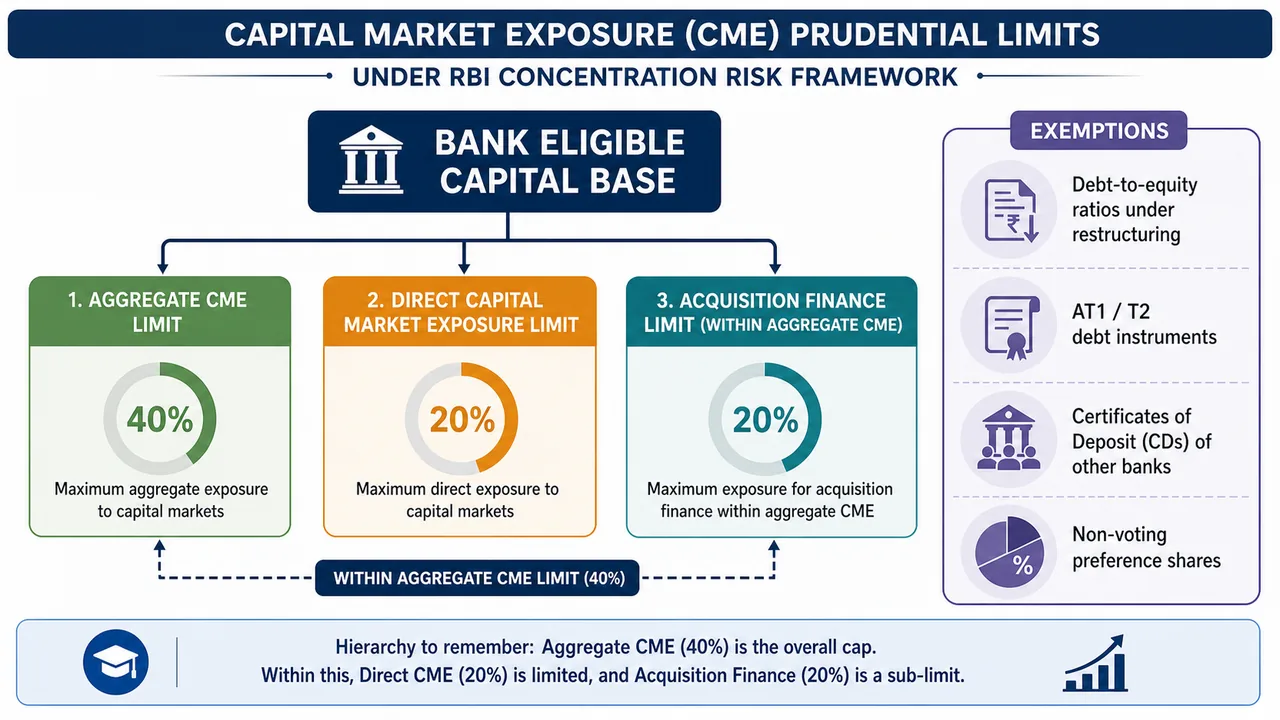
- Revised Prudential Ceilings for CME: Establishment of new, consolidated prudential ceilings for aggregate CME, direct capital market exposures, and acquisition finance exposures under new Paragraph 98A.
- Updated Exemptions and Exclusions: Clarification of exposures that are exempt from or excluded from the CME computation, such as certain acquisitions during restructuring and specific types of investments (e.g., in critical financial infrastructure, AT1/T2 instruments, CDs, non-voting preference shares, and parts of underwriting commitments).
- Board's Role: Modifications to the board's responsibility regarding policy for fixing intra-day exposure limits to capital markets.
Exam Relevance
Here’s what students should focus on for exam preparation:
- Regulatory Authority: The circular is issued under Sections 21 and 35A of the Banking Regulation Act, 1949. Exam Insight: Questions often test the legal framework underpinning RBI regulations.
- New Definitions: Be aware of the newly inserted definitions, especially "Non-debt Mutual Funds", "Acquisition Finance", and "Capital Market Intermediaries (CMIs)". Exam Insight: Direct questions on definitions or their application are common.
- Components of CME (Paragraph 95A): Understand the broad categories of what comprises Capital Market Exposure – both Investment Exposures (equity, preference shares, non-debt MFs, REITs/InvITs, AIFs) and Credit Exposures (advances for share investment, credit to CMIs, acquisition finance, bridge finance, underwriting). Exam Insight: A question might list several items and ask which one is or is not included in CME.
- CME Prudential Ceilings (Paragraph 98A):
- Aggregate CME: Shall not exceed 40% of a bank's eligible capital base (solo and consolidated). Exam Insight: This specific percentage is a prime candidate for multiple-choice questions.
- Direct Capital Market Exposure: Shall not exceed 20% of eligible capital base (solo and consolidated). Exam Insight: Differentiating between aggregate and direct limits is key.
- Acquisition Finance Exposure: Shall not exceed 20% of its eligible capital base, within the 40% aggregate CME ceiling. Exam Insight: Note that this is a sub-limit within the overall aggregate.
- Exemptions from Ceilings (Paragraph 100): Acquisition of shares due to debt-to-equity conversion during a restructuring process or under IBC, 2016, is exempt from CME ceilings. Exam Insight: This is an important exception that can appear in scenario-based questions.
- Exclusions from CME Computation (Paragraph 101A):
- Investments in own subsidiaries, JVs, and sponsored RRBs are excluded (but additional exposures after listing are included).
- Investments in critical financial infrastructure.
- Portion of acquisition finance used for refinancing target company's debt.
- Investments in Additional Tier I and Tier II debt instruments of other banks/AIFIs.
- Investment in CDs of other banks.
- Investment in/loan against non-voting preference shares.
- Underwriting commitments up to 70% of the credit equivalent amount for primary issues of shares/convertible instruments/non-debt equity MFs. Exam Insight: The 70% threshold for underwriting exclusion is a crucial number.
Summary Table
| Aspect | Old Provision (Prior to Feb 13, 2026) | New Provision (Effective Feb 13, 2026) |
|---|---|---|
| Circular Reference | Reserve Bank of India (Commercial Banks - Concentration Risk Management) Directions, 2025 | Reserve Bank of India (Commercial Banks - Concentration Risk Management) Amendment Directions, 2026 |
| Definitions (Para 4) | Existing definitions (including paragraph 4(8)). | New definitions inserted: "Acquisition Finance", "Bridge Finance", "Capital Market Intermediaries (CMIs)", "Collateral Security", "Non-debt Mutual Funds", "Primary Security" (referring to Credit Facilities Directions, 2025). Paragraph 4(8) deleted. |
| Board's Role (Para 6(1)(v)) | Policy for fixing intra-day exposure limits to the capital markets within prescribed prudential limits. | Substituted with specific wording: "Policy for fixing intra-day exposure limits to the capital markets within the prudential limits prescribed in these Directions for a bank's aggregate capital market exposures (CME)." |
| CME Definition (Para 95) | Defined in Paragraph 95 (now deleted). | Paragraph 95 deleted. New Paragraph 95A inserted, comprehensively detailing CME to include investment exposures (equity, non-debt MFs, REITs/InvITs, AIFs) and credit exposures (advances for share investment, credit to CMIs, acquisition finance, bridge finance, underwriting, IPCs, clearing member trade exposures). |
| CME Ceilings (Para 97, 98, 98A) | Defined in Paragraphs 97 and 98 (now deleted). | Paragraphs 97 and 98 deleted. New Paragraph 98A inserted: • Aggregate CME: Not to exceed 40% of eligible capital base. • Direct Capital Market Exposure: Not to exceed 20% of eligible capital base. • Acquisition Finance: Not to exceed 20% of eligible capital base (within the 40% aggregate CME). • Separate sub-limits for intra-day exposures. |
| Ceilings Reference (Para 99) | Refers to paragraphs 97 and 98. | Partially modified to refer to paragraph 98A. |
| CME Exemptions (Para 100) | Acquisition of shares due to debt-to-equity conversion during restructuring/IBC exempted, subject to Section 19(2) of BR Act, 1949. | Same exemption retained. |
| CME Exclusions (Para 101, 101A) | Defined in Paragraph 101 (now deleted). | Paragraph 101 deleted. New Paragraph 101A inserted, detailing exclusions such as: • Investment in own subsidiaries/JVs/RRBs (with caveat after listing). • Investments in critical financial infrastructure. • Refinancing portion of acquisition finance. • Investment in AT1/T2 debt instruments of other banks/AIFIs. • Investment in CDs of other banks. • Investment in/loan against non-voting preference shares. • Underwriting commitments up to 70% of credit equivalent amount. • Promoters shares in SPV of infra projects. |
Lesson Doubts
Ask questions, get expert answers