🎯 Government Policies for Beekeeping Promotion
Sweet Revolution, NBHM, World Bee Day, beekeeping as 5th agricultural input, and recent achievements in Indian apiculture
In the previous lesson, we covered the key institutions -- NBB, CBRTI, KVIC -- that form the backbone of Indian apiculture. Now we examine the government policies and schemes that fund, promote, and regulate beekeeping at the national level.
In 2016, a tribal beekeeper in Jharkhand managing 30 colonies of Apis mellifera earned over Rs. 1.5 lakh from honey sales -- more than his income from paddy cultivation. His success was enabled by government training under the Sweet Revolution initiative. India's policy framework for beekeeping has expanded rapidly, recognising honey bees as a formal agricultural input and allocating Rs. 500 crores for the National Beekeeping and Honey Mission. Understanding these schemes is essential for banking, NABARD, and agriculture exams.
This lesson covers:
- Sweet Revolution (Meethi Kranti) -- vision and lead agency
- World Bee Day -- date, origin, and significance
- Beekeeping as the 5th agricultural input
- NBHM -- budget, mini missions, and implementing agency
- Madhukranti Portal and recent achievements
Sweet Revolution (Meethi Kranti)

| Feature | Detail |
|---|---|
| Launched | 2016 by the Prime Minister |
| Also called | Meethi Kranti or Honey Mission |
| Vision | Double farmers' income through beekeeping and pollination services |
| Lead agency | KVIC (Khadi & Village Industries Commission, Ministry of MSME) |
| Best state for implementation | Jharkhand -- ~30% forest cover, suitable climate, rich biodiversity |
World Bee Day -- 20th May
| Feature | Detail |
|---|---|
| Observed since | 2018 |
| Proposed by | Government of Slovenia with support of Apimondia (International Federation of Beekeepers' Associations) |
| Declared by | UN General Assembly |
| Named after | Anton Jansa (born 20 May 1734) -- pioneer of modern apiculture from Slovenia |
| Purpose | Raise awareness about the essential role of bees and pollinators in food security |
- Pollinators are responsible for the reproduction of approximately 75% of the world's flowering plants and about 35% of global food crops.
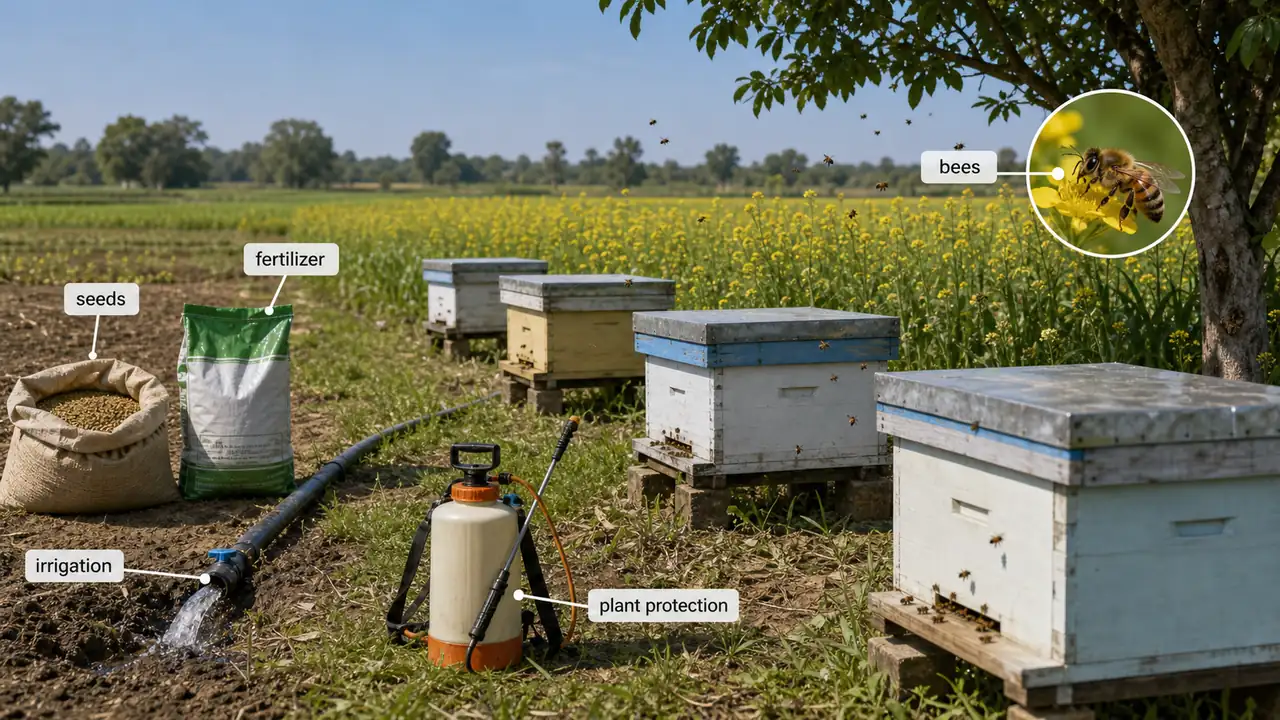
Beekeeping as the 5th Agricultural Input
| Traditional Input | New Addition |
|---|---|
| 1. Seeds | |
| 2. Fertilizers | |
| 3. Irrigation | |
| 4. Plant protection | |
| 5. Beekeeping / Honeybees |
- Beekeeping is the 5th and most important input for overall sustainable development of Agriculture/Horticulture.
- ICAR, CAUs/SAUs, and state agriculture departments are directed to include beekeeping in the Package of Practices (PoP) for each crop and region.
- Pollination by bees can increase crop yields by 20-30% on average, making colonies one of the most cost-effective inputs.
TIP
Pro Content Locked
Upgrade to Pro to access this lesson and all other premium content.
₹99 charged monthly · Cancel anytime
- All Agriculture & Banking Courses
- AI Lesson Questions (100/day)
- AI Doubt Solver (50/day)
- Glows & Grows Feedback (30/day)
- AI Section Quiz (20/day)
- 22-Language Translation (100/day)
- Recall Questions (20/day)
- AI Quiz (15/day)
- AI Quiz Paper Analysis (100/day)
- AI Step-by-Step Explanations (100/day)
- Spaced Repetition Recall (FSRS)
- AI Tutor
- Immersive Text Questions
- Audio Lessons — Hindi & English
- Mock Tests & Previous Year Papers
- Summary & Mind Maps
- XP, Levels, Leaderboard & Badges
- Generate New Classrooms
- Voice AI Teacher (AgriDots Live)
- AI Revision Assistant
- Knowledge Gap Analysis
- Interactive Revision (LangGraph)
🔒 Secure via Razorpay · Cancel anytime · No hidden fees
In the previous lesson, we covered the key institutions -- NBB, CBRTI, KVIC -- that form the backbone of Indian apiculture. Now we examine the government policies and schemes that fund, promote, and regulate beekeeping at the national level.
In 2016, a tribal beekeeper in Jharkhand managing 30 colonies of Apis mellifera earned over Rs. 1.5 lakh from honey sales -- more than his income from paddy cultivation. His success was enabled by government training under the Sweet Revolution initiative. India's policy framework for beekeeping has expanded rapidly, recognising honey bees as a formal agricultural input and allocating Rs. 500 crores for the National Beekeeping and Honey Mission. Understanding these schemes is essential for banking, NABARD, and agriculture exams.
This lesson covers:
- Sweet Revolution (Meethi Kranti) -- vision and lead agency
- World Bee Day -- date, origin, and significance
- Beekeeping as the 5th agricultural input
- NBHM -- budget, mini missions, and implementing agency
- Madhukranti Portal and recent achievements
Sweet Revolution (Meethi Kranti)
| Feature | Detail |
|---|---|
| Launched | 2016 by the Prime Minister |
| Also called | Meethi Kranti or Honey Mission |
| Vision | Double farmers' income through beekeeping and pollination services |
| Lead agency | KVIC (Khadi & Village Industries Commission, Ministry of MSME) |
| Best state for implementation | Jharkhand -- ~30% forest cover, suitable climate, rich biodiversity |
World Bee Day -- 20th May
| Feature | Detail |
|---|---|
| Observed since | 2018 |
| Proposed by | Government of Slovenia with support of Apimondia (International Federation of Beekeepers' Associations) |
| Declared by | UN General Assembly |
| Named after | Anton Jansa (born 20 May 1734) -- pioneer of modern apiculture from Slovenia |
| Purpose | Raise awareness about the essential role of bees and pollinators in food security |
- Pollinators are responsible for the reproduction of approximately 75% of the world's flowering plants and about 35% of global food crops.
Beekeeping as the 5th Agricultural Input
| Traditional Input | New Addition |
|---|---|
| 1. Seeds | |
| 2. Fertilizers | |
| 3. Irrigation | |
| 4. Plant protection | |
| 5. Beekeeping / Honeybees |
- Beekeeping is the 5th and most important input for overall sustainable development of Agriculture/Horticulture.
- ICAR, CAUs/SAUs, and state agriculture departments are directed to include beekeeping in the Package of Practices (PoP) for each crop and region.
- Pollination by bees can increase crop yields by 20-30% on average, making colonies one of the most cost-effective inputs.
TIP
Exam Mnemonic -- "SFIPB": Seeds, Fertilizers, Irrigation, Plant protection, Beekeeping -- the five agricultural inputs. Beekeeping is the 5th and newest.
National Beekeeping and Honey Mission (NBHM)
IMPORTANT
NBHM: Rs. 500 crores for 3 years (2020-2023), implemented by National Bee Board (NBB), 100% Central Sector Scheme, has 3 Mini Missions.
| Feature | Detail |
|---|---|
| Scheme type | Central Sector Scheme (100% funded by Central Government) |
| Budget | Rs. 500 crores for 2020-2023 |
| Implementing agency | National Bee Board (NBB) under Ministry of Agriculture & Farmers Welfare |
| Part of | Atma Nirbhar Bharat package (2020) |
| Collaboration | KVIC Honey Mission, MIDH, rural development, MSME, AYUSH, commerce, tribal affairs |
Three Mini Missions
| Mini Mission | Focus Area | Objective |
|---|---|---|
| Mini Mission-I | Production | Improve crop productivity through pollination via scientific beekeeping |
| Mini Mission-II | Post-harvest | Collection, processing, storage, marketing, value addition, infrastructure |
| Mini Mission-III | Research | Technology generation for different regions, agro-climatic zones |
Madhukranti Portal
- "Madhukranti Portal" is an initiative of NBB, Ministry of Agriculture & Farmers Welfare under NBHM (not NHM -- this is a common exam trap).
- Technical and banking partner: Indian Bank (MoU signed with NBB).
- Purpose: Online registration to achieve traceability of honey from hive to shelf.
- Covers all stakeholders: beekeepers, aggregators, processors, exporters, retailers.
- Helps in checking adulteration -- honey adulteration (mixing cheap sugar syrups) is a major concern.
- As of December 2022: 10,000 beekeepers/societies/firms with 20 lakh honeybee colonies registered.
TIP
Exam Trap: Madhukranti Portal is under NBHM, not NHM. This distinction is frequently tested.
Recent Achievements
| Achievement | Detail |
|---|---|
| NAFED Honey Corners | 14-15 dedicated retail spaces in NAFED Bazaars; planned expansion to 200+ stores |
| Honey Testing Lab | World-class lab at NDDB, Anand, Gujarat; NABL-accredited |
| FSSAI standards | Standards for honey, beeswax, royal jelly notified; SMR and Foreign Oligosaccharides tests added |
| Testing labs | 100 Mini + 4-5 Regional labs planned under NBHM |
| FPOs | 70 FPOs formed (65 by NABARD, 5 by NAFED in Bihar, UP, MP, Rajasthan, WB) |
| NHAI collaboration | Planting bee-friendly flora along national highways as foraging corridors |
| Bee Breeders | 29 developed; each produces at least 2,000 queen bee colonies/year |
| IBDCs | 16 Integrated Beekeeping Development Centres in 16 states as training hubs |
| GBPs | Good Beekeeping Practices advisories published and circulated to all states |
| GI Tags | NBB supporting GI tags for region-specific honeys (e.g., Sundarbans, Nilgiri) |
| TRIFED | Promoting beekeeping and wild honey procurement in tribal areas; exports to various countries |
| AICRP centres | 25 centres conducting research; first Pollinator Garden at GB Pant University, Pantnagar |
Key Organisations Referenced
| Abbreviation | Full Name | Role |
|---|---|---|
| NBB | National Bee Board | Apex body for scientific beekeeping |
| KVIC | Khadi & Village Industries Commission | Village industry promotion, Sweet Revolution |
| NBHM | National Beekeeping & Honey Mission | Central scheme for beekeeping development |
| NAFED | National Agricultural Cooperative Marketing Federation | Marketing support, Honey Corners |
| NDDB | National Dairy Development Board | Honey testing lab at Anand |
| FSSAI | Food Safety & Standards Authority of India | Quality standards for bee products |
| NABARD | National Bank for Agriculture & Rural Development | FPO formation |
| TRIFED | Tribal Cooperative Marketing Development Federation | Tribal beekeeping promotion |
| Apimondia | International Federation of Beekeepers' Associations | World Bee Day advocacy |
Summary Table
| Key Fact | Answer |
|---|---|
| Sweet Revolution launched | 2016 |
| Lead agency for Sweet Revolution | KVIC |
| World Bee Day | 20th May (since 2018) |
| Named after | Anton Jansa (Slovenia) |
| Beekeeping is which agricultural input? | 5th |
| NBHM budget | Rs. 500 crores (2020-2023) |
| NBHM scheme type | Central Sector (100% Central funded) |
| NBHM implementing body | NBB |
| Mini Missions | 3 (Production, Post-harvest, Research) |
| Madhukranti Portal under | NBHM (not NHM) |
| Portal banking partner | Indian Bank |
| Honey testing lab | NDDB, Anand, Gujarat (NABL-accredited) |
| FPOs formed | 70 (65 by NABARD) |
| IBDCs | 16 states |
| Bee Breeders | 29 (2,000 colonies/year each) |
| First Pollinator Garden | GB Pant University, Pantnagar |
TIP
Quick Exam Recall: Sweet Revolution = 2016 (KVIC). World Bee Day = 20 May (Anton Jansa, Slovenia, 2018). NBHM = Rs. 500 Cr, NBB, 3 Mini Missions, Central Sector. Beekeeping = 5th input. Madhukranti = NBHM (not NHM). Honey Lab = NDDB Anand.
References
1 source
References
Summary Cheat Sheet
| Concept / Topic | Key Details |
|---|---|
| Sweet Revolution (Meethi Kranti) | Launched 2016 by PM; lead agency = KVIC |
| Best state for Sweet Revolution | Jharkhand (~30% forest cover) |
| World Bee Day | 20th May (since 2018); proposed by Slovenia + Apimondia |
| World Bee Day named after | Anton Jansa (born 20 May 1734, Slovenia) |
| Pollinators role | ~75% of flowering plants; ~35% of global food crops |
| Beekeeping – agricultural input | 5th input after Seeds, Fertilizers, Irrigation, Plant protection |
| NBHM budget | Rs. 500 crores for 3 years (2020-2023) |
| NBHM scheme type | Central Sector Scheme (100% Central funded) |
| NBHM implementing agency | National Bee Board (NBB) under MoA&FW |
| NBHM – part of | Atma Nirbhar Bharat package (2020) |
| Mini Mission-I | Production — crop productivity via scientific beekeeping |
| Mini Mission-II | Post-harvest — processing, storage, marketing, value addition |
| Mini Mission-III | Research — technology for different agro-climatic zones |
| Madhukranti Portal | Under NBHM (NOT NHM); banking partner = Indian Bank |
| Madhukranti Portal purpose | Traceability of honey; checking adulteration |
| Honey Testing Lab | World-class at NDDB, Anand, Gujarat (NABL-accredited) |
| FPOs formed | 70 (65 by NABARD, 5 by NAFED) |
| IBDCs | 16 Integrated Beekeeping Development Centres in 16 states |
| Bee Breeders developed | 29; each produces ≥ 2,000 queen bee colonies/year |
| First Pollinator Garden | GB Pant University, Pantnagar |
| TRIFED | Promotes beekeeping and wild honey in tribal areas |
TIP
Next: The apiculture sub-section is now complete. The next sub-section covers Sericulture -- the science of silk production from silkworms.