🧪 Quality Control Institutions: AGMARK, ISO, ISI, ECOMARK, HACCP, CODEX & FSSAI
Understand the key quality control and food safety standards in agricultural marketing -- AGMARK, ISO, ISI/BIS, ECOMARK, HACCP, Codex Alimentarius, and FSSAI -- with establishment years, headquarters, and exam-focused facts.
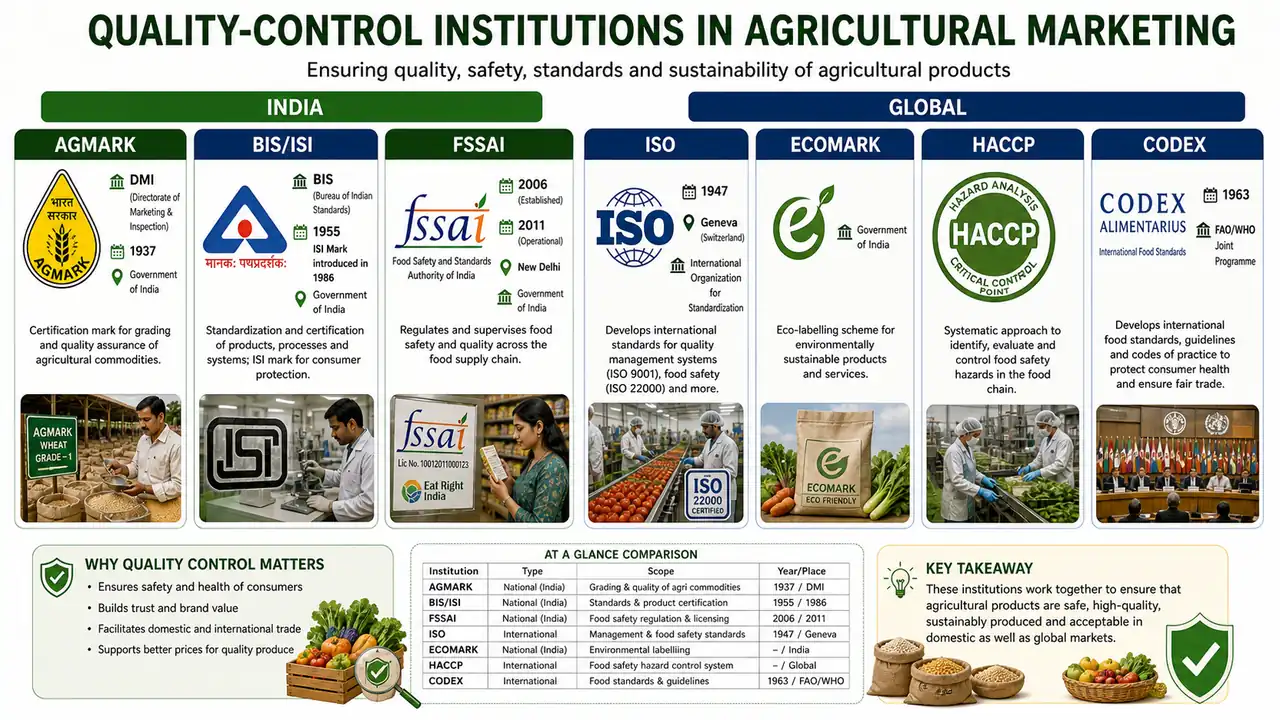
When you buy a packet of ghee with the Agmark seal, a bag of wheat flour with the ISI mark, or a bottle of honey with an FSSAI licence number, you are relying on quality control institutions that protect consumers and help farmers get better prices for graded produce. This lesson covers all the major quality and food safety standards relevant to agricultural marketing.
Quick Overview
| Standard / Institution | Established | Scope | Key Fact |
|---|---|---|---|
| AGMARK | 1937 (Act) | Agricultural produce grading (India) | First domestic grading: ghee (1938) |
| ISO | 1947 | International standards for goods and services | HQ: Geneva; India is founding member |
| ISI / BIS | 1955 (ISI); renamed 1986 (BIS) | Indian industrial standards | ISI mark on industrial items |
| ECOMARK | -- | Environment-friendly products (India) | Issued by BIS; Ministry of Environment scheme |
| HACCP | -- | Food safety system (international) | Preventive approach; focuses on critical control points |
| CODEX | 1963 | Global food standards (FAO + WHO) | Recognizes HACCP; reference for WTO disputes |
| FSSAI | 2006 (Act); 2011 (formed) | Food safety regulation (India) | Consolidated 8 older food laws; HQ: New Delhi |
Domestic Grading and Standard-Setting Systems
1. AGMARK -- Agricultural Produce (Grading and Marking) Act
Agmark stands for "Agricultural Marking" -- a certification mark that assures buyers of the quality and purity of agricultural products.
Pro Content Locked
Upgrade to Pro to access this lesson and all other premium content.
Charged once for one year · ₹1188 total
Save ₹100/month vs ₹2388/year launch price
- All Agriculture & Banking Courses
- AI Lesson Questions (100/day)
- AI Doubt Solver (50/day)
- Glows & Grows Feedback (30/day)
- AI Section Quiz (20/day)
- 22-Language Translation (100/day)
- Recall Questions (20/day)
- AI Quiz (15/day)
- AI Quiz Paper Analysis (100/day)
- AI Step-by-Step Explanations (100/day)
- Spaced Repetition Recall (FSRS)
- AI Tutor
- Immersive Text Questions
- Audio Lessons — Hindi & English
- Mock Tests & Previous Year Papers
- Summary & Mind Maps
- XP, Levels, Leaderboard & Badges
- Generate New Classrooms
- Voice AI Teacher (AgriDots Live)
- AI Revision Assistant
- Knowledge Gap Analysis
- Interactive Revision (LangGraph)
🔒 Secure one-time yearly payment via Razorpay · No hidden fees
When you buy a packet of ghee with the Agmark seal, a bag of wheat flour with the ISI mark, or a bottle of honey with an FSSAI licence number, you are relying on quality control institutions that protect consumers and help farmers get better prices for graded produce. This lesson covers all the major quality and food safety standards relevant to agricultural marketing.
Quick Overview
| Standard / Institution | Established | Scope | Key Fact |
|---|---|---|---|
| AGMARK | 1937 (Act) | Agricultural produce grading (India) | First domestic grading: ghee (1938) |
| ISO | 1947 | International standards for goods and services | HQ: Geneva; India is founding member |
| ISI / BIS | 1955 (ISI); renamed 1986 (BIS) | Indian industrial standards | ISI mark on industrial items |
| ECOMARK | -- | Environment-friendly products (India) | Issued by BIS; Ministry of Environment scheme |
| HACCP | -- | Food safety system (international) | Preventive approach; focuses on critical control points |
| CODEX | 1963 | Global food standards (FAO + WHO) | Recognizes HACCP; reference for WTO disputes |
| FSSAI | 2006 (Act); 2011 (formed) | Food safety regulation (India) | Consolidated 8 older food laws; HQ: New Delhi |
Domestic Grading and Standard-Setting Systems
1. AGMARK -- Agricultural Produce (Grading and Marking) Act
Agmark stands for "Agricultural Marking" -- a certification mark that assures buyers of the quality and purity of agricultural products.
| Feature | Detail |
|---|---|
| Act | Agriculture Produce (Grading and Marking) Act, 1937 |
| Nature | Permissive (not mandatory) -- voluntary for domestic trade |
| Rules | General Grading and Marking Rules, 1937 (revised 1988) |
| Implementing authority | DMI (Directorate of Marketing & Inspection), HQ: Faridabad |
| Central Agmark Laboratory | Nagpur |
| Ownership | Exclusive property of Government of India (not a private trademark) |
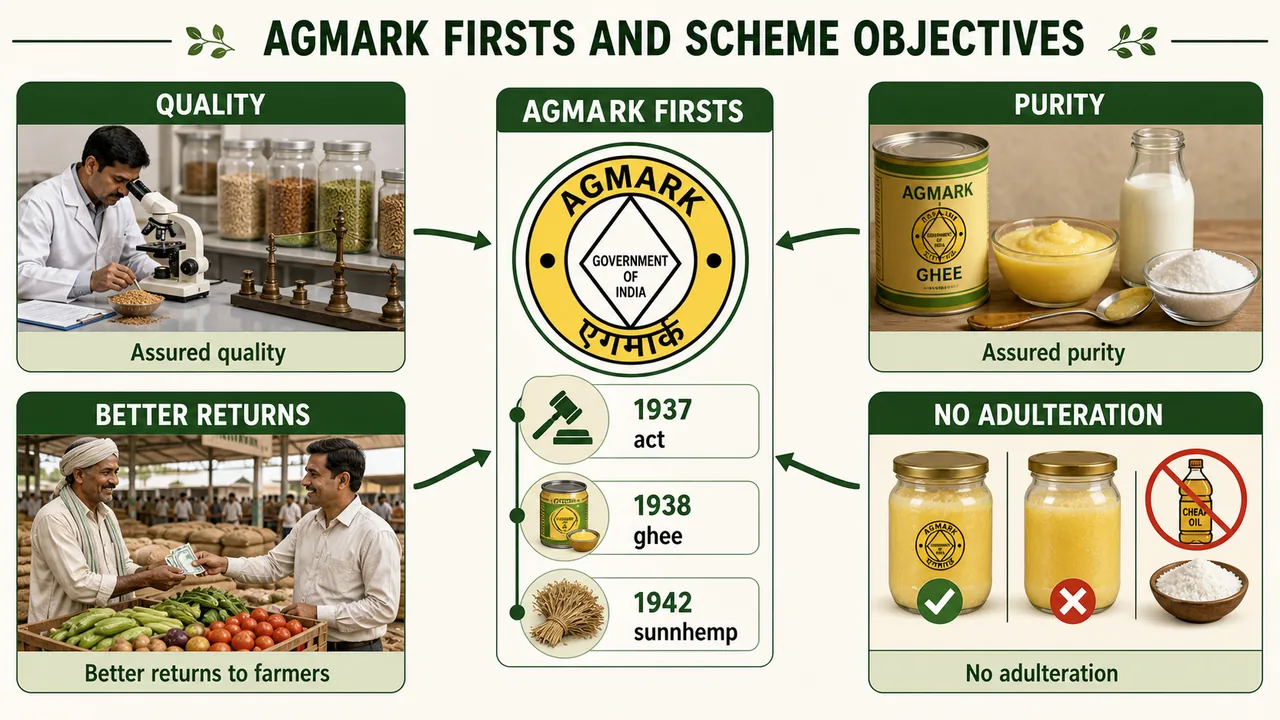
Key Firsts in Agmark Grading
| Milestone | Product | Year |
|---|---|---|
| First domestic grading | Ghee | 1938 |
| First export grading (compulsory) | Sunnhemp | 1942 |
NOTE
Agmark firsts: Domestic grading started with ghee (1938) | Export grading (compulsory) started with sunnhemp (1942). Agmark for domestic market is voluntary; for export it is compulsory.
Objectives of Agmark Scheme
| Objective | How It Helps |
|---|---|
| Assure consumers of pre-tested quality and purity | Builds consumer trust and confidence |
| Enable producers of good quality to get better returns | Quality-graded products fetch premium prices |
| Ensure sale with uniform composition and well-defined quality | Removes uncertainty for buyers |
| Eliminate adulteration malpractices | Safeguards against fraudulent practices in the supply chain |
2. International Organization for Standardization (ISO)
| Feature | Detail |
|---|---|
| Established | 1947 UPPSC 2021 |
| Headquarters | Geneva, Switzerland |
| Members | 164 countries |
| India's status | Founding member |
Purpose of ISO
- Promote development of international standards to facilitate global exchange of goods and services
- Develop cooperation in intellectual, scientific, technological, and economic activities
- ISO standards ensure products and services are safe, reliable, and of good quality worldwide
Agricultural relevance: ISO standards for food safety management (e.g., ISO 22000) help Indian agri-exporters meet international quality requirements.
3. Indian Standard Institution (ISI) / Bureau of Indian Standards (BIS)
| Feature | Detail |
|---|---|
| Original name | Indian Standard Institution (ISI) |
| Came into force | 1955 |
| Renamed to | Bureau of Indian Standards (BIS) in 1986 |
| Governing law | ISI Certification Mark Act (now BIS Act) |
Key Points
- Industrial items are stamped with the ISI mark to indicate conformity with Indian Standards
- Standards framed in consultation with industries, scientists, and technical organizations
- BIS now sets standards for thousands of products, including many agricultural and food products
Agricultural example: ISI mark on agricultural implements like hand pumps, sprayers, and storage containers assures farmers of quality and durability.
Global Standards and Sustainability Frameworks
4. ECOMARK
| Feature | Detail |
|---|---|
| Issued by | Bureau of Indian Standards (BIS) |
| Scheme by | Ministry of Environment, Government of India |
| Purpose | Certify products with least impact on the ecosystem |
| Basis | Bio-degradability and environmental friendliness |
An Ecomark on a product tells the consumer it is environmentally friendly. The scheme encourages manufacturers to adopt green production practices and helps consumers make eco-conscious choices.
Agricultural relevance: Organic manures, bio-pesticides, and biodegradable packaging for farm produce can qualify for Ecomark certification.
Food Safety Control and Trade Benchmarks
5. HACCP (Hazard Analysis and Critical Control Point)
| Feature | Detail |
|---|---|
| Full form | Hazard Analysis and Critical Control Point |
| Nature | Internationally recognized food safety system |
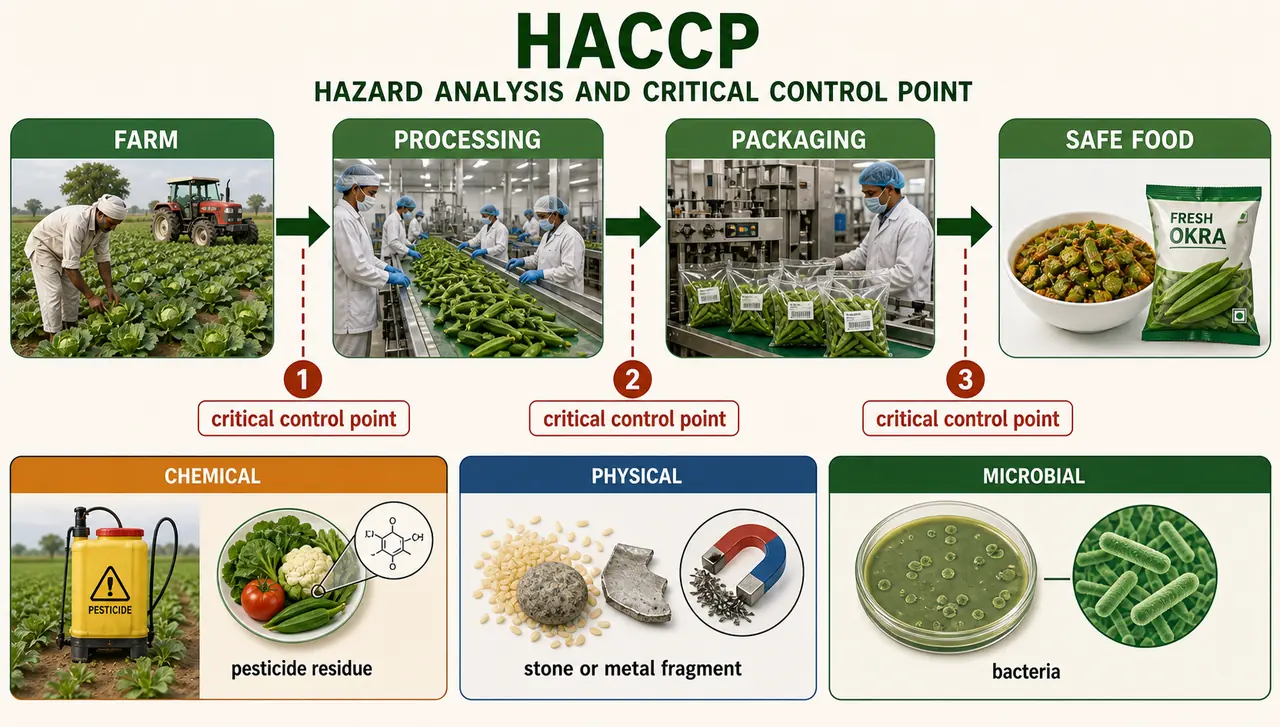
| Approach | Preventive -- identifies and controls hazards at every production step, rather than testing the final product |
Three Types of Hazards HACCP Addresses
| Hazard Type | Example in Agriculture |
|---|---|
| Chemical | Pesticide residues on fruits, aflatoxins in groundnuts |
| Physical | Stones in rice, metal fragments in processed food |
| Microbial | Salmonella in poultry, E. coli in fresh produce |
By identifying critical control points in the food production chain, HACCP ensures potential dangers are addressed before they reach the consumer. Adopting HACCP is increasingly important for Indian agri-exporters seeking access to international markets with stringent food safety standards.
6. Codex Alimentarius Commission (CODEX)
| Feature | Detail |
|---|---|
| Established | 1963 UPPSC 2021 |
| Established by | FAO (Food and Agriculture Organisation, UN) + WHO (World Health Organisation) |
| Purpose | Setting global food standards |
| Relationship with HACCP | Recognizes HACCP-based systems (sometimes referred as CODEX-HACCP) |
What is Codex Alimentarius?
The Codex Alimentarius is a series of food standards, codes, and regulations that:
- Countries use as models for domestic food legislation
- Apply to international trade in food products
- Serve as a reference point in trade disputes under the WTO
Agricultural relevance: When India exports basmati rice or spices, Codex standards serve as the benchmark for quality and safety that importing countries expect.
7. Food Safety and Standards Authority of India (FSSAI)
| Feature | Detail |
|---|---|
| Established under | Food Safety and Standards Act, 2006 |
| Formed | 2011 |
| Type | Autonomous body |
| Parent Ministry | Ministry of Health & Family Welfare, GoI |
| Headquarters | New Delhi |
| Status | Apex food regulatory body in India |
Role of FSSAI
FSSAI is the single reference point for all matters relating to food safety and standards, regulations, and enforcement in India. It sets rules for food manufacturing, storage, distribution, sale, and import to ensure food is safe for consumption.
Acts/Orders Consolidated by FSSAI
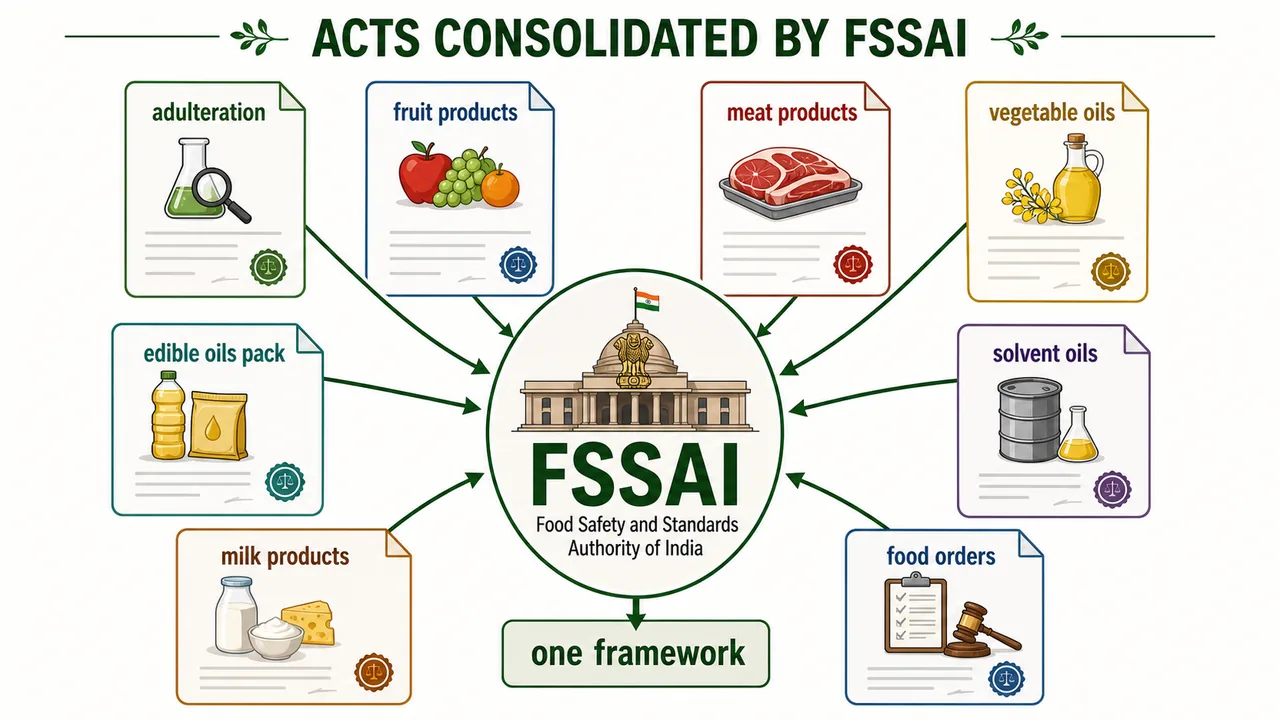
FSSAI consolidated 8 different food-related laws into a single unified framework under the FSS Act, 2006:
NOTE
FSSAI consolidated 8 food laws into one framework. This is frequently asked in exams.
| # | Act / Order Repealed | What It Governed |
|---|---|---|
| 1 | Prevention of Food Adulteration Act, 1954 | Food adulteration control |
| 2 | Fruit Products Order, 1955 (FPO) | Manufacture and marketing of fruit and vegetable products |
| 3 | Meat Food Products Order, 1973 | Meat processing and safety |
| 4 | Vegetable Oil Products (Control) Order, 1947 | Quality of vegetable oils |
| 5 | Edible Oils Packaging (Regulation) Order, 1998 | Packaging standards for edible oils |
| 6 | Solvent Extracted Oil, De-oiled Meal, and Edible Flour (Control) Order, 1967 | Solvent-extracted oil products |
| 7 | Milk and Milk Products Order, 1992 | Dairy industry regulation |
| 8 | Any other order under Essential Commodities Act, 1955 relating to food | Miscellaneous food-related orders |
Comparison Table: All Quality Control Standards
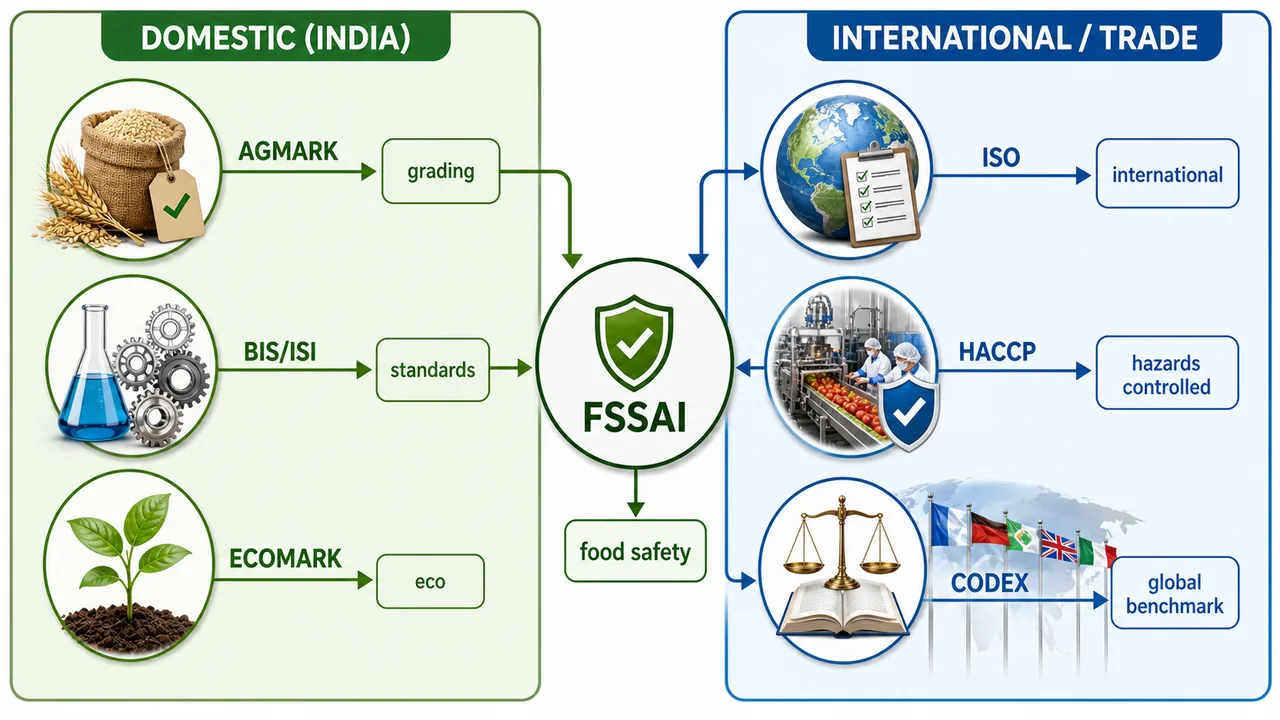
| Standard | Year | Scope | Mandatory? | Focus Area |
|---|---|---|---|---|
| AGMARK | 1937 | India (agricultural produce) | Voluntary for domestic; compulsory for export | Quality and purity grading |
| ISO | 1947 | International (164 countries) | Voluntary | Global product/service standards |
| ISI/BIS | 1955/1986 | India (industrial items) | Mandatory for some products | Industrial quality standards |
| ECOMARK | -- | India (eco-friendly products) | Voluntary | Environmental impact |
| HACCP | -- | International | Increasingly required for exports | Food safety (preventive approach) |
| CODEX | 1963 | International (FAO + WHO) | Reference standard | Global food standards and trade |
| FSSAI | 2006/2011 | India (all food products) | Mandatory (licence required) | Food safety and standards |
IMPORTANT
Exam Mnemonic -- "AI-EH-CF" for remembering all 7 standards in order: Agmark (1937), ISO (1947), ISI/BIS (1955/1986), Ecomark, HACCP, Codex (1963), FSSAI (2006/2011)
Summary Cheat Sheet
| Concept / Topic | Key Details / Explanation |
|---|---|
| AGMARK | Agricultural Marking; Act of 1937; certification for quality & purity; implemented by DMI |
| Agmark nature | Permissive (voluntary) for domestic trade; compulsory for export |
| Agmark firsts | First domestic grading: Ghee (1938); first export grading: Sunnhemp (1942) |
| Central Agmark Lab | Located at Nagpur; owned by Government of India |
| ISO | International Organization for Standardization; est. 1947; HQ: Geneva, Switzerland; 164 members; India is founding member |
| ISO purpose | Promote international standards for safe, reliable, good quality goods and services |
| ISI / BIS | Indian Standard Institution (est. 1955); renamed Bureau of Indian Standards in 1986 |
| ISI mark | Stamped on industrial items to indicate conformity with Indian Standards |
| ECOMARK | Issued by BIS; scheme by Ministry of Environment; certifies environment-friendly (bio-degradable) products |
| HACCP | Hazard Analysis and Critical Control Point; internationally recognized; preventive food safety system |
| HACCP 3 hazard types | Chemical (pesticide residues), Physical (stones, metal), Microbial (salmonella, E. coli) |
| Critical Control Points | Points in food production chain where hazards are identified and controlled before reaching consumer |
| CODEX | Codex Alimentarius Commission; est. 1963 by FAO + WHO; global food standards |
| CODEX role | Reference point for WTO trade disputes; recognizes HACCP-based systems |
| FSSAI | Food Safety and Standards Authority of India; FSS Act 2006, formed 2011; autonomous body |
| FSSAI ministry | Ministry of Health & Family Welfare; HQ: New Delhi; apex food regulatory body |
| FSSAI consolidated | 8 food laws into one framework (PFA Act 1954, FPO 1955, Meat 1973, Veg Oil 1947, Edible Oils 1998, Solvent Oil 1967, Milk 1992, EC Act food orders) |
| Standards chronology | AI-EH-CF — Agmark (1937), ISO (1947), ISI/BIS (1955/86), Ecomark, HACCP, Codex (1963), FSSAI (2006/11) |
| Mandatory standards | ISI/BIS (for some products), FSSAI (licence required); others are voluntary |