🏬 Storage & Marketing Institutions: CWC, FCI, CCI, JCI, MPEDA & APEDA
Learn about India's key storage and marketing institutions -- CWC, SWCs, FCI, CCI, JCI, Commodity Boards, MPEDA, and APEDA -- their establishment, headquarters, functions, and exam-important facts.
After a bumper wheat harvest in Punjab, the grain must be stored safely until it is distributed across the country. Without proper warehousing, millions of tonnes would rot in the open. India has established several institutions to ensure scientific storage, fair procurement, price support, and export promotion of agricultural produce. This lesson covers all the major storage and commodity-related institutions.
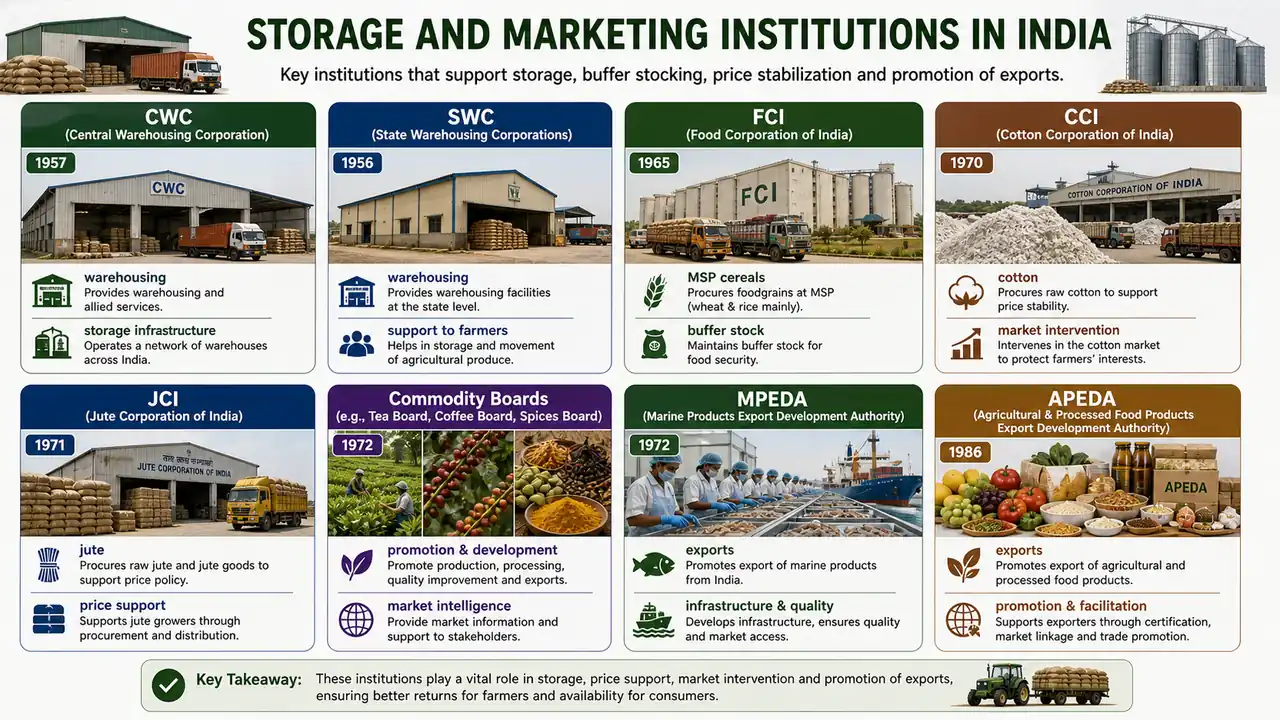
Quick Overview
| Institution | Established | Headquarters | Primary Role |
|---|---|---|---|
| SWC (first) | 1956 | Bihar (first state) | State-level warehousing |
| CWC | 1957 | New Delhi | Central warehousing |
| FCI | 1965 | New Delhi | Cereal procurement at MSP |
| CCI | 1970 | Mumbai | Cotton price support |
| JCI | 1971 | Kolkata | Jute price support |
| MPEDA | 1972 | -- | Marine product exports |
| APEDA | 1986 | New Delhi | Agri and processed food exports |
TIP
Mnemonic for chronological order: "SaCuFi-CCJ-MA" -- SWC (56), CWC (57), FCI (65), CCI (70), JCI (71), MPEDA (72), APEDA (86). Or simply remember: storage institutions came first (1950s), then commodity corporations (1960s-70s), then export agencies (1970s-80s).
Pro Content Locked
Upgrade to Pro to access this lesson and all other premium content.
Charged once for one year · ₹1188 total
Save ₹100/month vs ₹2388/year launch price
- All Agriculture & Banking Courses
- AI Lesson Questions (100/day)
- AI Doubt Solver (50/day)
- Glows & Grows Feedback (30/day)
- AI Section Quiz (20/day)
- 22-Language Translation (100/day)
- Recall Questions (20/day)
- AI Quiz (15/day)
- AI Quiz Paper Analysis (100/day)
- AI Step-by-Step Explanations (100/day)
- Spaced Repetition Recall (FSRS)
- AI Tutor
- Immersive Text Questions
- Audio Lessons — Hindi & English
- Mock Tests & Previous Year Papers
- Summary & Mind Maps
- XP, Levels, Leaderboard & Badges
- Generate New Classrooms
- Voice AI Teacher (AgriDots Live)
- AI Revision Assistant
- Knowledge Gap Analysis
- Interactive Revision (LangGraph)
🔒 Secure one-time yearly payment via Razorpay · No hidden fees
After a bumper wheat harvest in Punjab, the grain must be stored safely until it is distributed across the country. Without proper warehousing, millions of tonnes would rot in the open. India has established several institutions to ensure scientific storage, fair procurement, price support, and export promotion of agricultural produce. This lesson covers all the major storage and commodity-related institutions.
Quick Overview
| Institution | Established | Headquarters | Primary Role |
|---|---|---|---|
| SWC (first) | 1956 | Bihar (first state) | State-level warehousing |
| CWC | 1957 | New Delhi | Central warehousing |
| FCI | 1965 | New Delhi | Cereal procurement at MSP |
| CCI | 1970 | Mumbai | Cotton price support |
| JCI | 1971 | Kolkata | Jute price support |
| MPEDA | 1972 | -- | Marine product exports |
| APEDA | 1986 | New Delhi | Agri and processed food exports |
TIP
Mnemonic for chronological order: "SaCuFi-CCJ-MA" -- SWC (56), CWC (57), FCI (65), CCI (70), JCI (71), MPEDA (72), APEDA (86). Or simply remember: storage institutions came first (1950s), then commodity corporations (1960s-70s), then export agencies (1970s-80s).
Storage Institutions
1. Central Warehousing Corporation (CWC)
| Feature | Detail |
|---|---|
| Established | 1957 |
| Type | Statutory body |
| Headquarters | New Delhi |
| Warehouses | 422 across the country |
| Capacity | 10.1 million tonnes |
Functions of CWC
| Function | Description |
|---|---|
| Build and acquire godowns | Strategically located near production centres, markets, and transport hubs |
| Provide scientific storage | For agricultural produce, seeds, manures, fertilizers, and other notified commodities |
| Subscribe to SWC capital | CWC contributes 50% of each State Warehousing Corporation's share capital |
| Buffer stocking | Supports price stabilization and food security |
Agricultural example: A wheat farmer in Haryana stores his produce at a CWC warehouse, receiving a warehouse receipt that he can use as collateral for a bank loan.
2. State Warehousing Corporations (SWCs)
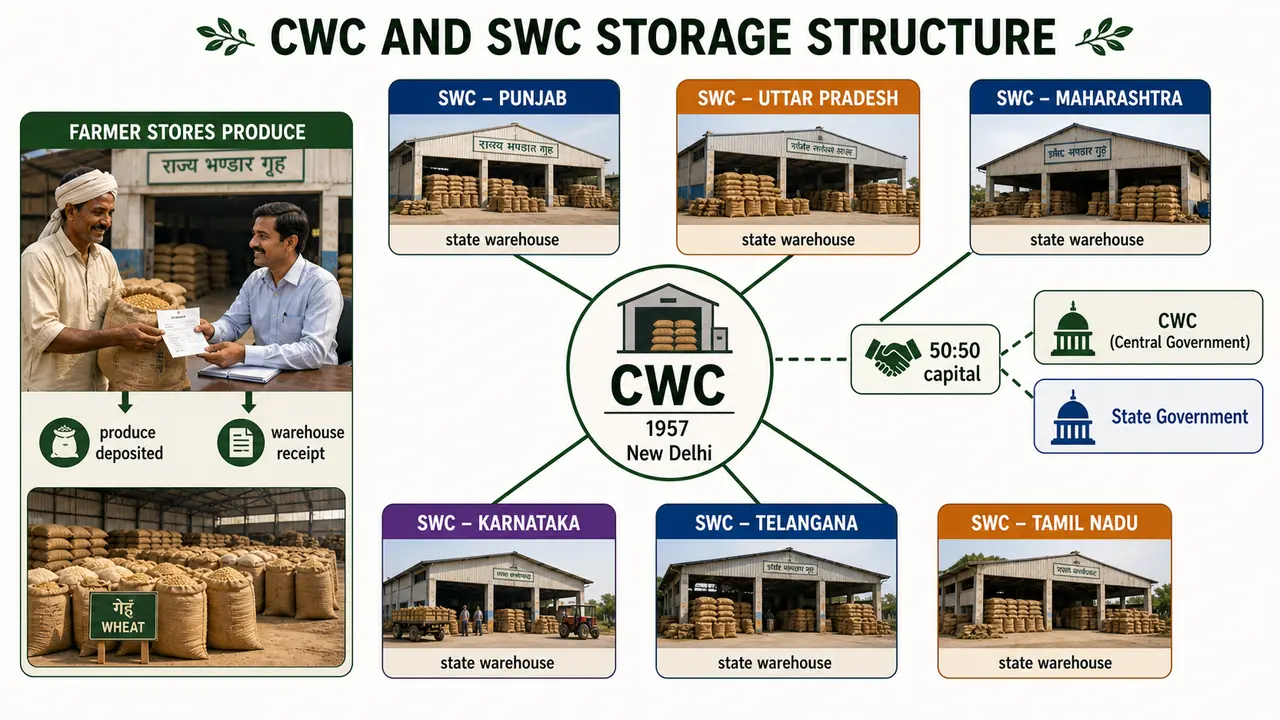
| Feature | Detail |
|---|---|
| First SWC | Bihar (1956) -- even before CWC was established |
| Capital structure | 50:50 between concerned State Government and CWC |
The equal partnership ensures both central and state governments share responsibility and investment in building storage infrastructure at the state level.
Agricultural example: An oilseed farmer in Madhya Pradesh uses an SWC godown to store his soybean crop until prices improve in the off-season.
Commodity Procurement and Price Support Institutions
3. Food Corporation of India (FCI)
| Feature | Detail |
|---|---|
| Established | 1965 |
| Headquarters | New Delhi |
| Status | Nodal agency for procurement of cereals (wheat, rice, coarse millets) |
Four Key Functions of FCI
| Function | How It Helps Farmers and Consumers |
|---|---|
| Procurement at MSP | Purchases a sizeable portion of marketable surplus at Minimum Support Price from farmers, ensuring a guaranteed price floor |
| Public distribution | Timely release of stocks through fair price shops (PDS) to prevent consumer prices from rising unduly |
| Price stabilization | Minimizes seasonal price fluctuations and inter-regional price variations by maintaining a purchasing and distribution network |
| Buffer stocking | Builds a sizable buffer stock of cereals to meet shortfalls from internal procurement or imports; essential for food security and emergency preparedness |
Agricultural example: During rabi season, FCI procures wheat at MSP from Punjab and Haryana farmers, stores it in its godowns, and releases it throughout the year via ration shops across India.
IMPORTANT
FCI is the nodal agency for cereal procurement (wheat, rice, coarse millets), NOT for all crops. CCI handles cotton; JCI handles jute.
4. Cotton Corporation of India (CCI)
| Feature | Detail |
|---|---|
| Established | 1970 |
| Set up by | Ministry of Commerce, GoI |
| Headquarters | Mumbai |
| Major role | Price support operations for cotton |
Functions of CCI
| Function | Description |
|---|---|
| Price support | Purchases cotton at MSP when market prices fall below support level, protecting cotton farmers from distress sales |
| Import handling | Manages import of cotton when domestic supply is short |
| Stable supply to mills | Maintains supplies to government and private textile mills |
| Price stabilization | Imparts stability to cotton prices in the long run |
CCI plays a dual role: protecting farmers (through procurement) and industry (through stable supply).
5. Jute Corporation of India (JCI)
| Feature | Detail |
|---|---|
| Established | 1971 |
| Set up by | Ministry of Commerce, GoI |
| Headquarters | Kolkata |
| Major role | Price support for jute growers |
JCI ensures jute growers receive a reasonable price and protects them from exploitation by middlemen. It conducts price support operations in the major jute-growing states: West Bengal, Bihar, Odisha, and Assam.
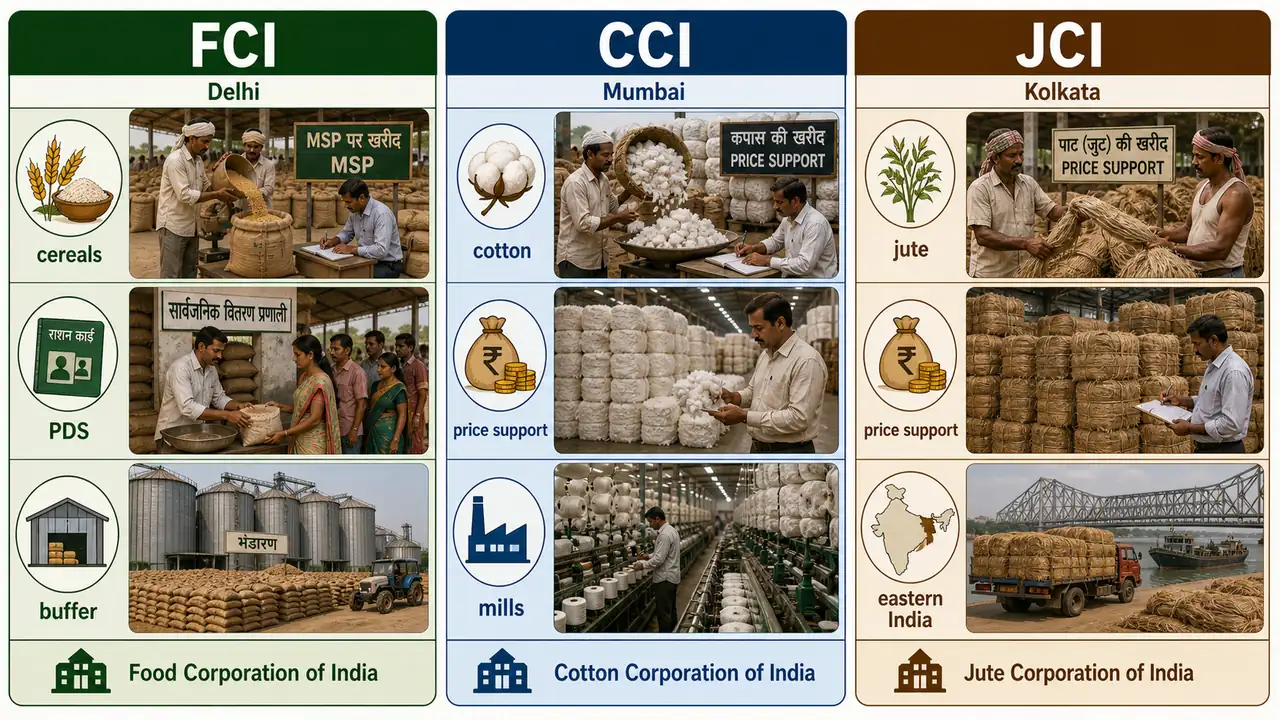
Comparison: FCI vs CCI vs JCI
| Feature | FCI | CCI | JCI |
|---|---|---|---|
| Commodity | Cereals (wheat, rice, coarse millets) | Cotton | Jute |
| Established | 1965 | 1970 | 1971 |
| HQ | New Delhi | Mumbai | Kolkata |
| Ministry | Consumer Affairs / Agriculture | Commerce | Commerce |
| Key function | MSP procurement + PDS distribution + buffer stocking | Cotton price support + supply to textile mills | Jute price support in eastern India |
Specialized Commodity Boards
Under the Ministry of Commerce, several specialized boards promote the production, processing, and marketing of specific commodities. Each board focuses on a particular crop and works to improve quality, expand markets, and support producer livelihoods. Major boards include those for tea, coffee, rubber, spices, tobacco, and coir.
Export Promotion Institutions
6. Marine Product Export Development Authority (MPEDA)
| Feature | Detail |
|---|---|
| Established | 1972 |
| Role | Nodal agency for promoting export of marine products from India |
MPEDA helps the marine products industry with quality improvement, market development, and trade facilitation, making India one of the leading exporters of shrimp, fish, and other seafood.
7. Agricultural and Processed Food Products Export Development Authority (APEDA)
| Feature | Detail |
|---|---|
| Established | 13th February, 1986 |
| Governing Act | Agricultural and Processed Food Products Export Development Authority Act, 1985 |
| Set up by | Ministry of Commerce, GoI |
| Headquarters | New Delhi |
| Additional responsibility | Monitor import of sugar |
14 Product Categories Under APEDA
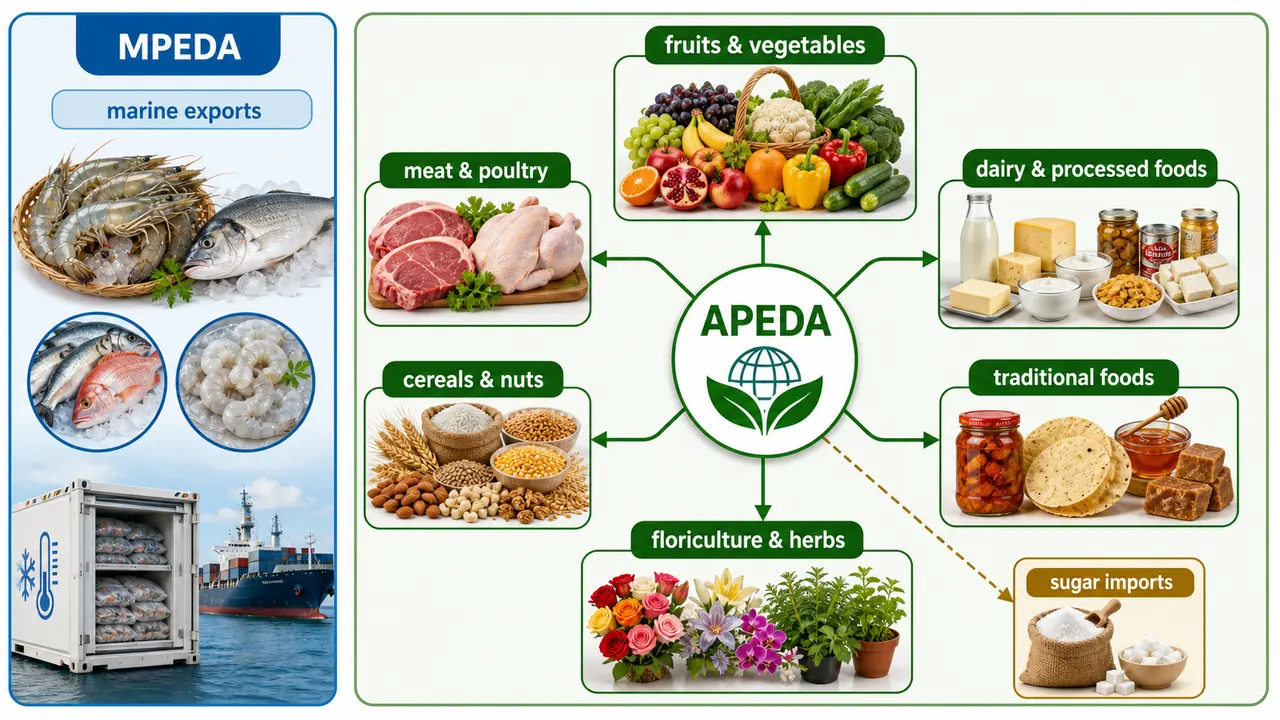
| # | Product Category | Notable Export Items |
|---|---|---|
| 1 | Fruits, Vegetables and their Products | Mangoes, onions, bananas |
| 2 | Meat and Meat Products | Buffalo meat (top agri-export) |
| 3 | Poultry and Poultry Products | Eggs, processed chicken |
| 4 | Dairy Products | Skimmed milk powder, ghee |
| 5 | Confectionery, Biscuits and Bakery Products | Biscuits, cakes |
| 6 | Honey, Jaggery and Sugar Products | Natural honey, organic jaggery |
| 7 | Cocoa and its products, Chocolates | Cocoa beans, chocolate |
| 8 | Alcoholic and Non-Alcoholic Beverages | Fruit juices, spirits |
| 9 | Cereal and Cereal Products | Basmati rice (major export) |
| 10 | Groundnuts, Peanuts and Walnuts | Groundnut kernels |
| 11 | Pickles, Papads and Chutneys | Traditional Indian condiments |
| 12 | Guar Gum | India is world's largest producer and exporter |
| 13 | Floriculture and Floriculture Products | Rose, marigold, orchids |
| 14 | Herbal and Medicinal Plants | Ashwagandha, tulsi, neem |
TIP
APEDA's dual mandate: Export promotion of 14 scheduled product categories + monitoring import of sugar. This dual role is a common exam question.
e-NWR — Electronic Negotiable Warehouse Receipt
Electronic Negotiable Warehouse Receipt (e-NWR) is a document of title issued in electronic form against commodities stored in registered warehouses. It transforms warehousing from a simple storage function into a financial instrument for farmers.
How e-NWR Works
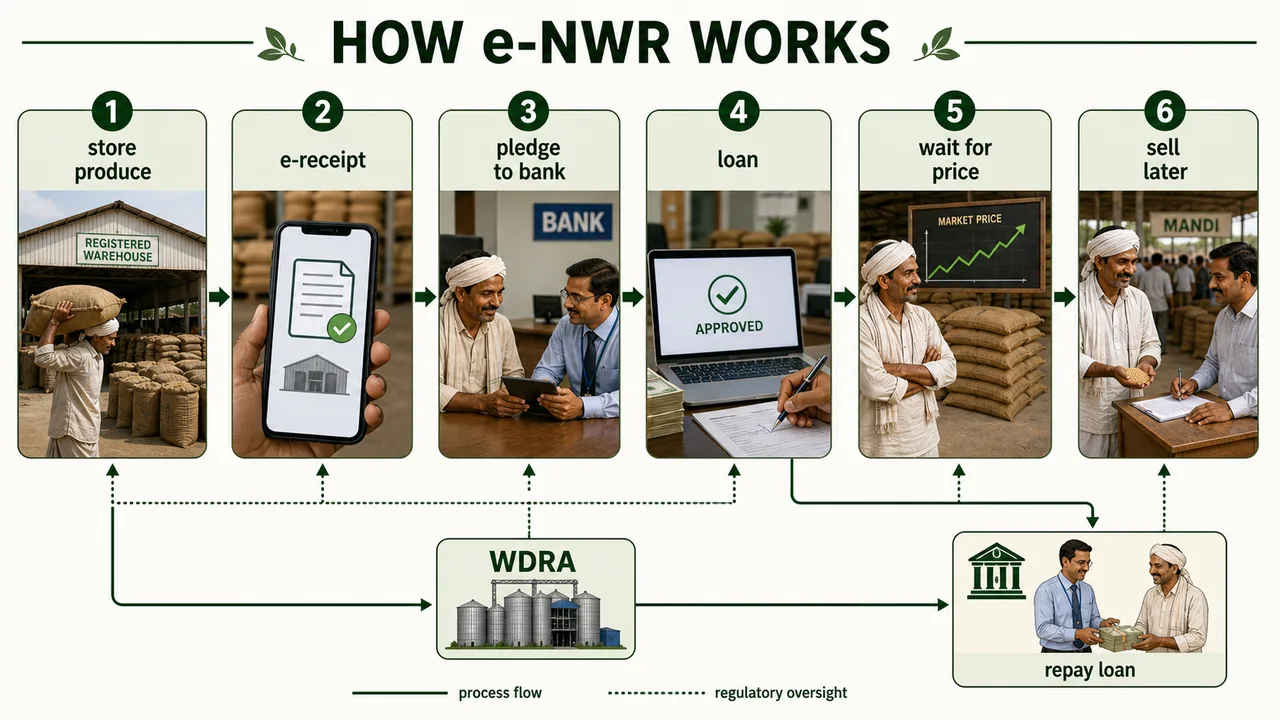
A farmer deposits his wheat harvest in a WDRA-registered warehouse. The warehouse issues an e-NWR — an electronic receipt proving ownership of the stored commodity. The farmer can then:
- Pledge the e-NWR to a bank and get a loan (up to 70% of commodity value)
- Wait for better prices instead of distress selling at harvest time
- Transfer or sell the e-NWR to a buyer without physically moving the goods
| Feature | Detail |
|---|---|
| Regulator | WDRA (Warehousing Development and Regulatory Authority) |
| Governing Act | Warehousing (Development and Regulation) Act, 2007 |
| Format | Electronic (not paper) — eliminates fraud and duplication |
| Negotiability | Can be transferred, traded, pledged, or split |
| Loan against e-NWR | Up to 70% of commodity value |
Benefits of e-NWR
| Benefit | How It Helps Farmers |
|---|---|
| Access to credit | Farmers get loans against stored produce without selling |
| Prevents distress selling | Farmers can hold produce and sell when prices are better |
| Reduced wastage | Scientific storage in registered warehouses |
| Price discovery | Real-time market information through electronic platforms |
| Transparency | Electronic system eliminates fraud, duplication, and disputes |
| Negotiability | Receipts can be transferred to buyers without moving goods |
TIP
Exam key: e-NWR is regulated by WDRA under the 2007 Act. Primary purpose: prevent distress selling by enabling warehouse-based credit. Remember: WDRA regulates, banks lend, farmers benefit.
Summary Cheat Sheet
| Concept / Topic | Key Details / Explanation |
|---|---|
| CWC | Central Warehousing Corporation; est. 1957; HQ: New Delhi; statutory body; 422 warehouses, 10.1 MT capacity |
| CWC functions | Build godowns, provide scientific storage, subscribe 50% of SWC capital, buffer stocking |
| SWC | State Warehousing Corporations; first SWC: Bihar (1956) — even before CWC |
| SWC capital | 50:50 between State Government and CWC |
| FCI | Food Corporation of India; est. 1965; HQ: New Delhi; nodal agency for cereal procurement (wheat, rice, coarse millets) |
| FCI 4 functions | Procurement at MSP, public distribution (PDS), price stabilization, buffer stocking |
| FCI — NOT all crops | FCI handles cereals only; CCI handles cotton; JCI handles jute |
| CCI | Cotton Corporation of India; est. 1970; HQ: Mumbai; Ministry of Commerce |
| CCI functions | Cotton price support, import handling, stable supply to textile mills, price stabilization |
| JCI | Jute Corporation of India; est. 1971; HQ: Kolkata; Ministry of Commerce |
| JCI states | Price support in West Bengal, Bihar, Odisha, Assam |
| FCI vs CCI vs JCI | FCI (cereals, New Delhi) vs CCI (cotton, Mumbai) vs JCI (jute, Kolkata) |
| Commodity Boards | Under Ministry of Commerce; Tea, Coffee, Rubber, Spices, Tobacco, Coir boards for specific crops |
| MPEDA | Marine Products Export Development Authority; est. 1972; promotes seafood exports |
| APEDA | Agricultural & Processed Food Products Export Development Authority; est. 13 Feb 1986; HQ: New Delhi |
| APEDA Act | Agricultural & Processed Food Products Export Development Authority Act, 1985 |
| APEDA covers | 14 product categories — fruits/veg, meat, poultry, dairy, honey, cocoa, beverages, cereals, groundnuts, pickles, guar gum, floriculture, herbal plants |
| APEDA dual mandate | Export promotion of 14 categories + monitoring import of sugar |
| MPEDA vs APEDA | MPEDA = marine products; APEDA = agricultural + processed foods |
| Chronological order | SWC (56) → CWC (57) → FCI (65) → CCI (70) → JCI (71) → MPEDA (72) → APEDA (86) |
| Mnemonic — SaCuFi-CCJ-MA | Storage first (1950s), commodity corps (1960s-70s), export agencies (1970s-80s) |
| e-NWR | Electronic Negotiable Warehouse Receipt — electronic document of title against stored commodities |
| e-NWR regulator | WDRA (Warehousing Development and Regulatory Authority) |
| WDRA Act | Warehousing (Development and Regulation) Act, 2007 |
| e-NWR loan | Up to 70% of commodity value |
| e-NWR purpose | Prevent distress selling; enable warehouse-based credit and price discovery |
| e-NWR benefits | Credit access, price discovery, reduced wastage, transparency, negotiability |