🍡 Market Integration: Horizontal, Vertical & Conglomeration
Understand how firms expand by consolidating marketing functions -- horizontal integration, vertical integration (forward and backward), and conglomeration -- with agricultural examples.
Consider a dairy farmer in Gujarat who starts by simply selling raw milk. Over time, he sets up a small processing unit to make paneer and ghee. Later, he opens a retail outlet in the nearby town. This farmer has integrated multiple marketing functions -- production, processing, and retailing -- under one management. This is market integration in action.
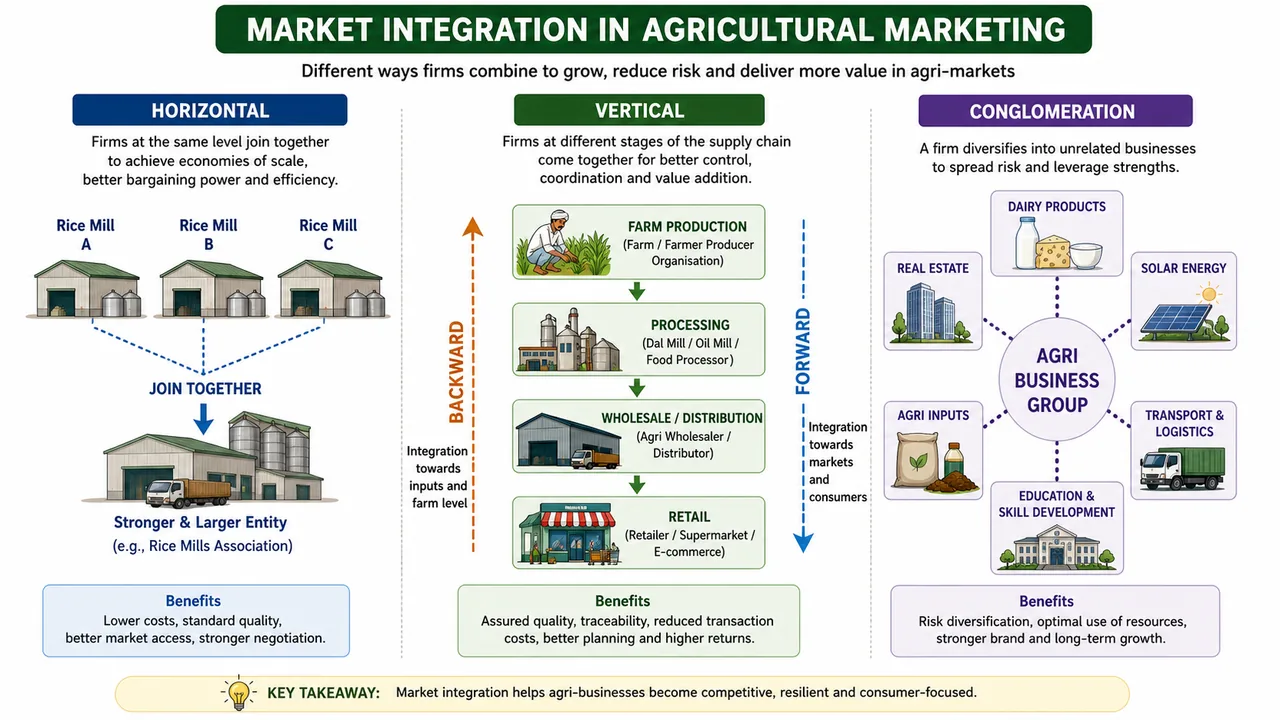
What is Market Integration?
Kohls and Uhl define market integration as: "A process which refers to the expansion of firms by consolidating additional marketing functions and activities under a single management."
In simple terms, market integration happens when a firm takes over more stages of the marketing process so that multiple functions are performed under one roof.
Key points:
- Integration shows the relationship of firms in a market
- It influences market conduct and marketing efficiency
- Greater integration can reduce costs but may also reduce competition
- Markets differ in the extent of integration
Agricultural examples:
Pro Content Locked
Upgrade to Pro to access this lesson and all other premium content.
Charged once for one year · ₹1188 total
Save ₹100/month vs ₹2388/year launch price
- All Agriculture & Banking Courses
- AI Lesson Questions (100/day)
- AI Doubt Solver (50/day)
- Glows & Grows Feedback (30/day)
- AI Section Quiz (20/day)
- 22-Language Translation (100/day)
- Recall Questions (20/day)
- AI Quiz (15/day)
- AI Quiz Paper Analysis (100/day)
- AI Step-by-Step Explanations (100/day)
- Spaced Repetition Recall (FSRS)
- AI Tutor
- Immersive Text Questions
- Audio Lessons — Hindi & English
- Mock Tests & Previous Year Papers
- Summary & Mind Maps
- XP, Levels, Leaderboard & Badges
- Generate New Classrooms
- Voice AI Teacher (AgriDots Live)
- AI Revision Assistant
- Knowledge Gap Analysis
- Interactive Revision (LangGraph)
🔒 Secure one-time yearly payment via Razorpay · No hidden fees
Consider a dairy farmer in Gujarat who starts by simply selling raw milk. Over time, he sets up a small processing unit to make paneer and ghee. Later, he opens a retail outlet in the nearby town. This farmer has integrated multiple marketing functions -- production, processing, and retailing -- under one management. This is market integration in action.
What is Market Integration?
Kohls and Uhl define market integration as: "A process which refers to the expansion of firms by consolidating additional marketing functions and activities under a single management."
In simple terms, market integration happens when a firm takes over more stages of the marketing process so that multiple functions are performed under one roof.
Key points:
- Integration shows the relationship of firms in a market
- It influences market conduct and marketing efficiency
- Greater integration can reduce costs but may also reduce competition
- Markets differ in the extent of integration
Agricultural examples:
- A dairy farmer setting up a milk processing plant (takes on processing function)
- A retailer establishing wholesale facilities (integrates backward into the supply chain)
Types of Market Integration
| Type | Direction | Definition | Agricultural Example |
|---|---|---|---|
| Horizontal | Same level | Firms performing similar functions merge or combine | Farmers forming a milk cooperative |
| Vertical (Forward) | Towards consumer | Firm expands into functions closer to the consumer | Wholesaler opens retail shops |
| Vertical (Backward) | Towards producer | Firm expands into functions closer to the raw material source | Flour mill starts purchasing wheat directly from villages |
| Conglomeration | Unrelated businesses | Combination of unrelated activities under united management | ITC (cigarettes + agri-business + hotels + FMCG) |
1. Horizontal Integration
Horizontal integration occurs when a firm gains control over other firms performing similar marketing functions at the same level of the marketing chain.
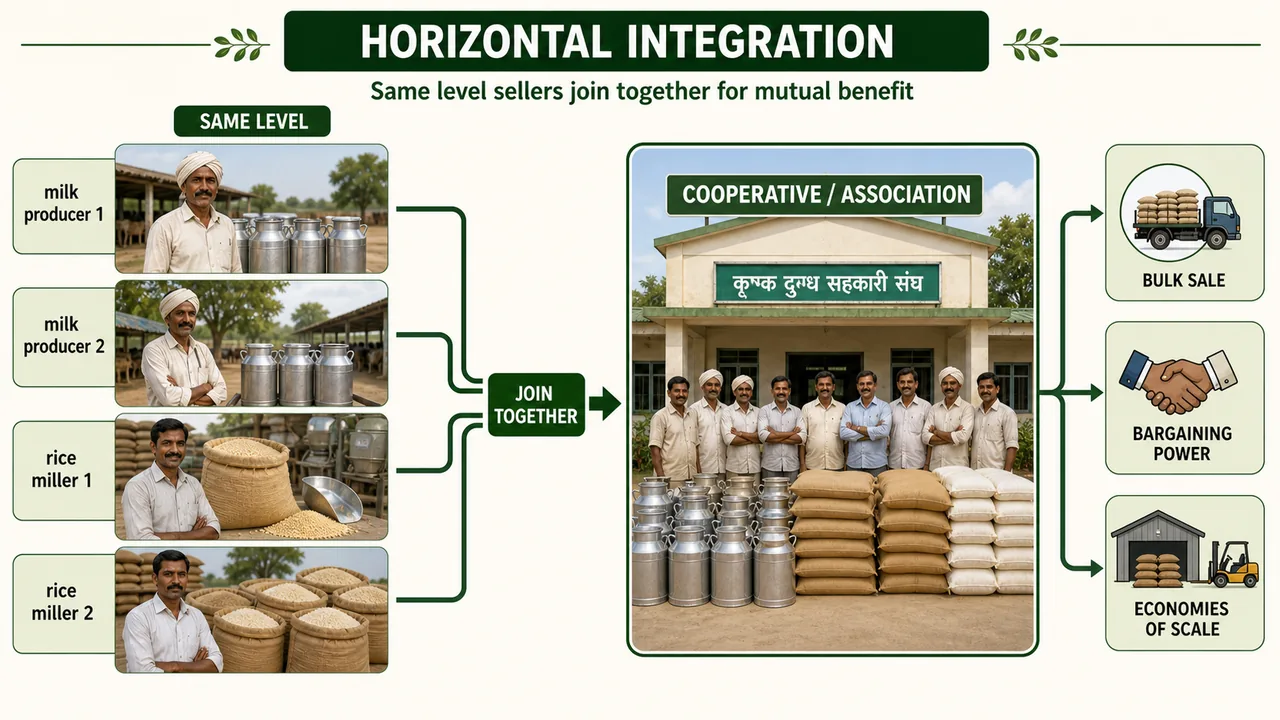
How it works:
- Several marketing agencies (e.g., sellers) combine to form a union
- This reduces their effective number and the extent of competition
- Members gain greater bargaining power and economies of scale
Agricultural examples:
- Farmers joining hands to form cooperatives (e.g., Amul dairy cooperative) -- they sell milk in bulk and reduce per-unit marketing costs
- Several rice millers in a district forming an association to negotiate better paddy prices
Who benefits and who does not?
| Stakeholder | Impact |
|---|---|
| Members of the group | Beneficial -- economies of scale, shared resources, stronger market position |
| Consumers / Buyers | Not beneficial -- combined sellers may restrict supply or raise prices, reducing competition |
TIP
Think of horizontal integration as firms standing side by side (same level) and joining hands.
2. Vertical Integration
Vertical integration occurs when a firm performs more than one activity in the sequence of the marketing process. Instead of focusing on just one stage, the firm expands into upstream or downstream activities.
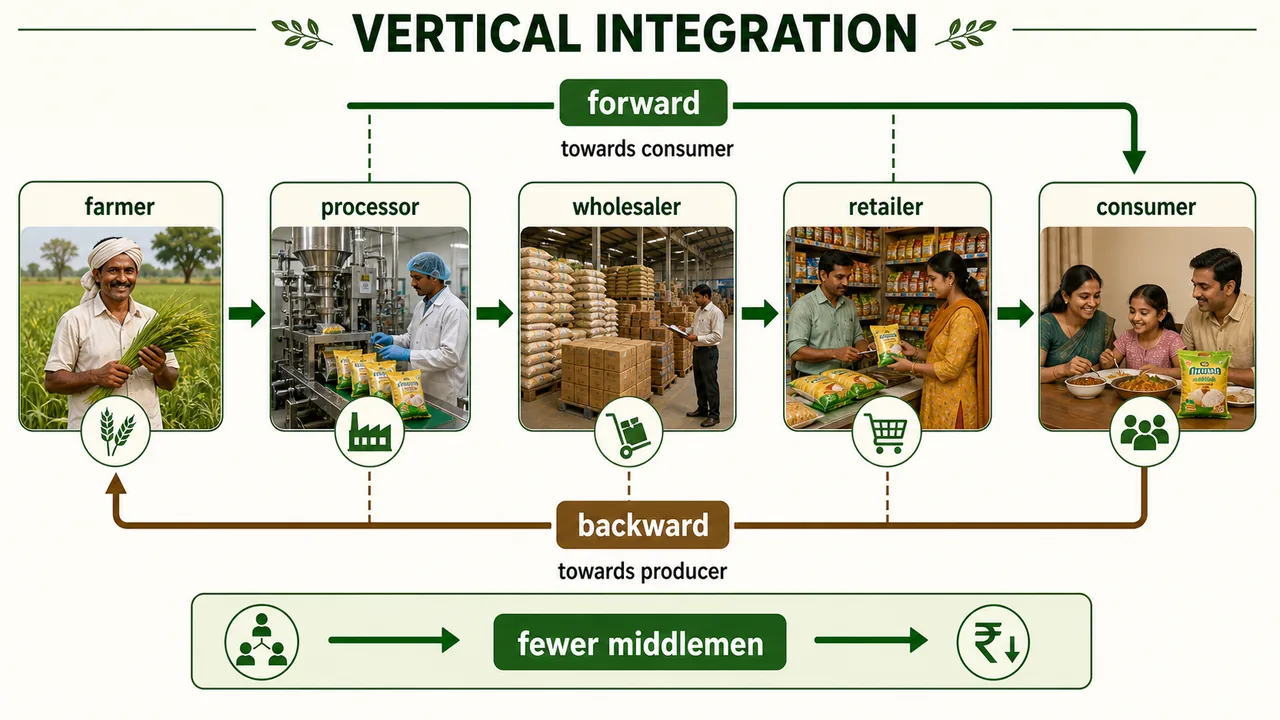
How it works:
- Two or more functions are linked within a single firm or ownership
- Eliminates margins of intermediate agencies
- The firm enjoys greater market power and lower costs
Agricultural examples:
- A commission agent who also does retailing
- A flour mill that purchases wheat from farms, processes it, and sells flour through its own retail outlets
Two Types of Vertical Integration
| Type | Direction | Definition | Example |
|---|---|---|---|
| Forward integration | Towards the consumer (downstream) | Firm takes on functions closer to the final buyer | A sugarcane farmer starts a jaggery-making unit and sells directly at a local market |
| Backward integration | Towards the producer (upstream) | Firm takes on functions closer to the raw material source | A food processing company starts purchasing produce directly from villages instead of through commission agents |
Real-world firms often integrate both vertically and horizontally:
- Horizontal expansion: A retail chain increases the number of stores or the range of commodities sold (growing wider at the same level)
- Vertical expansion: The same chain operates its own wholesale purchasing and processing units (growing deeper into multiple levels)
Example: Reliance Fresh operates multiple retail stores (horizontal) and also runs its own farm procurement and cold chain (vertical).
3. Conglomeration
Conglomeration is a combination of agencies or activities not directly related to each other, operating under united management. Unlike horizontal or vertical integration, it involves diversification into unrelated businesses.
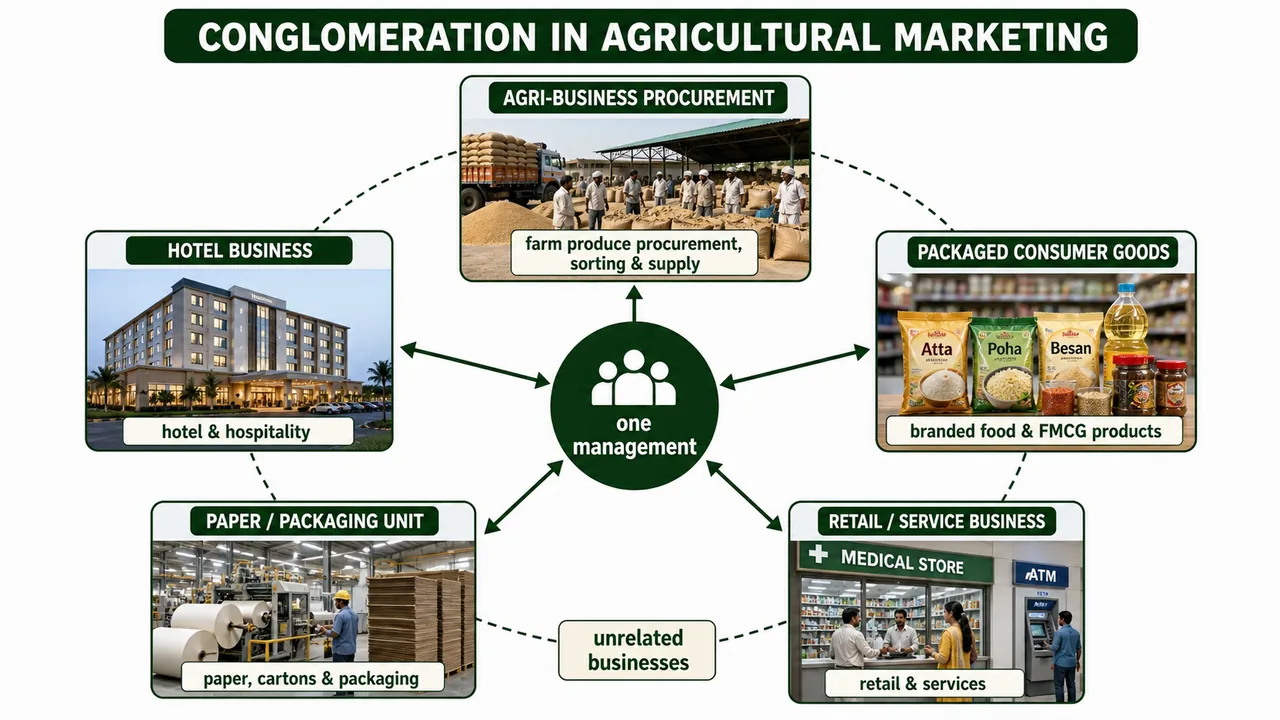
Examples:
- ITC Limited -- cigarettes, agri-business (e-Choupal), hotels, FMCG, paperboards
- Hindustan Unilever -- soaps, food products, tea, ice cream
- Delhi Cloth and General Mill -- cloth and vanaspati
Conglomeration helps firms spread risk across different markets and industries.
Comparison of Integration Types
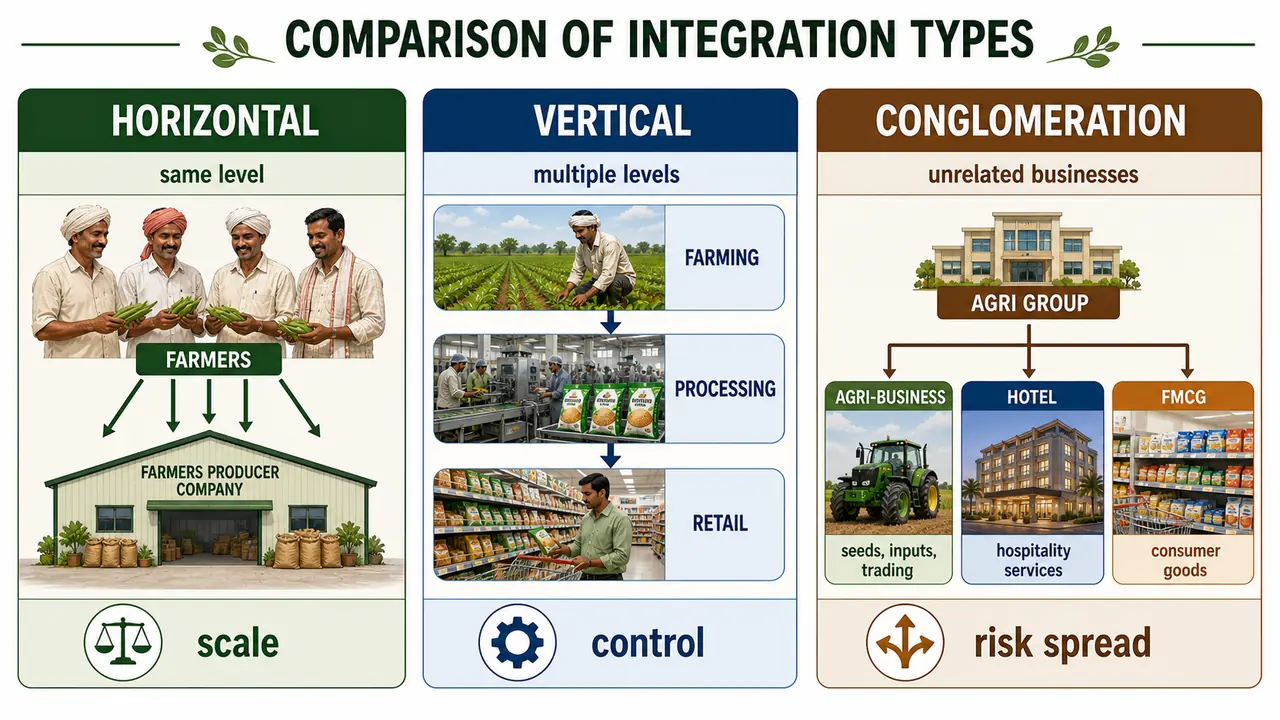
| Feature | Horizontal | Vertical | Conglomeration |
|---|---|---|---|
| Direction | Same level of the chain | Across different levels of the chain | Unrelated businesses |
| Purpose | Reduce competition, gain bargaining power | Control more stages, reduce middlemen costs | Diversify risk |
| Effect on competition | May reduce competition at that level | May reduce number of middlemen | No direct effect on a specific market |
| Agricultural example | Farmer cooperatives (Amul, IFFCO) | Dairy farmer → processing → retailing | ITC (agri-business + hotels + FMCG) |
| Benefit | Economies of scale | Cost reduction, quality control | Risk diversification |
IMPORTANT
Exam Tip -- Remember the 3 types with "HVC":
- Horizontal = Same level firms merging (e.g., farmer cooperatives)
- Vertical = Different levels merging (Forward: towards consumer; Backward: towards producer)
- Conglomeration = Unrelated businesses under one management
Summary Cheat Sheet
| Concept | Key Point |
|---|---|
| Market integration (definition) | Expansion of firms by consolidating additional marketing functions under single management (Kohls and Uhl) |
| Horizontal integration | Same-level firms combine; benefits members through economies of scale; may harm consumers by reducing competition |
| Vertical integration | Firm performs functions at multiple levels; forward (towards consumer) and backward (towards producer) |
| Conglomeration | Unrelated businesses under one management; spreads risk across industries |
| Impact on efficiency | Greater integration can reduce costs but may also reduce competition |