💹India's Agricultural Trade
Agricultural exports and imports, trade surplus, top export commodities, Agricultural Export Policy, Agri-Export Zones, and Geographical Indications (GI Tags) with exam-oriented tables
From Farm to Foreign Markets
India is the world’s largest producer of spices, second-largest producer of rice and wheat, and a major exporter of marine products. Yet, when a shrimp farmer in Andhra Pradesh sends his harvest to the USA or a basmati rice grower in Haryana exports to Iran, they are part of a trade system that contributes only about 2-3% of global agricultural trade. Understanding India’s agricultural trade — what we export, where, and the policies driving growth — is essential for competitive exams.
India’s Position in Global Agricultural Trade
| Parameter | Value (2017-18) |
|---|---|
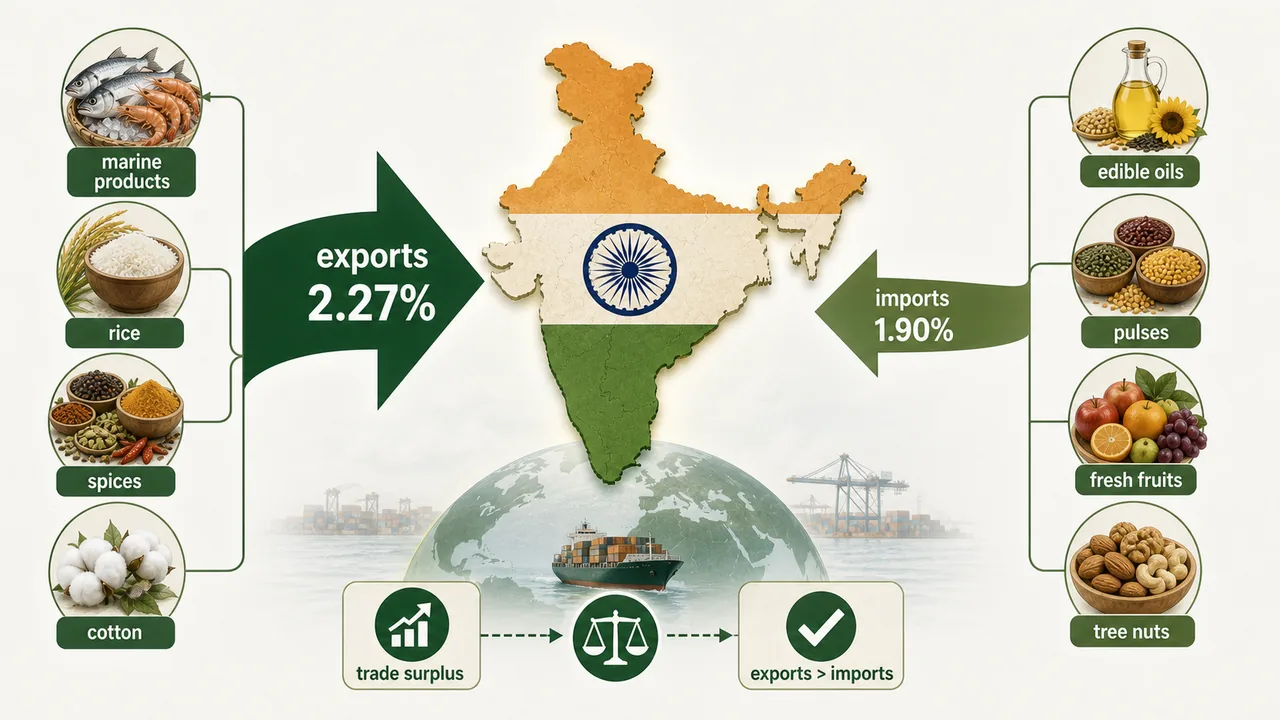
| Share in world agricultural exports | 2.27% |
| Share in world agricultural imports | 1.90% |
| Agricultural exports as % of agricultural GDP | 9% |
| Agricultural imports as % of agricultural GDP | 5.47% |
| Agricultural exports as % of total exports | 12.80% |
| Total agricultural export value | US$ 38.74 billion |
| Total agricultural import value | US$ 20.35 billion |
| Trade balance | Surplus (exports > imports) |
TIP
India consistently maintains a trade surplus in agriculture (exports exceed imports). This strengthens foreign exchange reserves. The surplus was about US$ 18 billion in 2017-18.
Top Export Destinations and Commodities
Highest Export Destinations (in order)
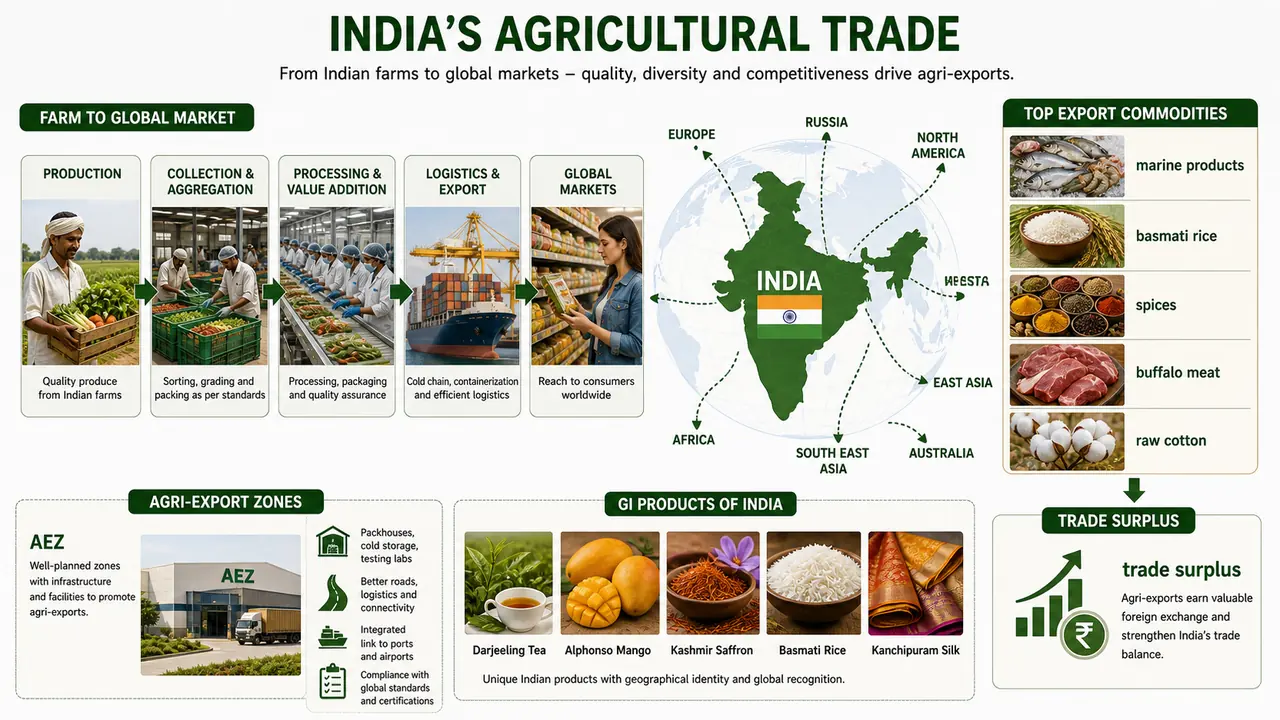
USA > Vietnam > Iran > China > UAE
Top Agricultural Exports by Value (2018-19)
| Rank | Commodity |
|---|---|
| 1 | Marine Products (shrimp, fish) |
| 2 | Rice — Basmati |
| 3 | Buffalo Meat |
| 4 | Spices |
| 5 | Rice — Non-Basmati |
| 6 | Raw Cotton |
Agricultural Insight: India’s export strength lies in marine products, rice, meat, and spices — commodities where India has both a production advantage and strong global demand. Basmati rice and spices benefit from India’s unique agro-climatic conditions.
Top 10 Agricultural Commodities — Exports
| No. | Commodity | 2015-16 | 2016-17 | 2017-18 |
|---|---|---|---|---|
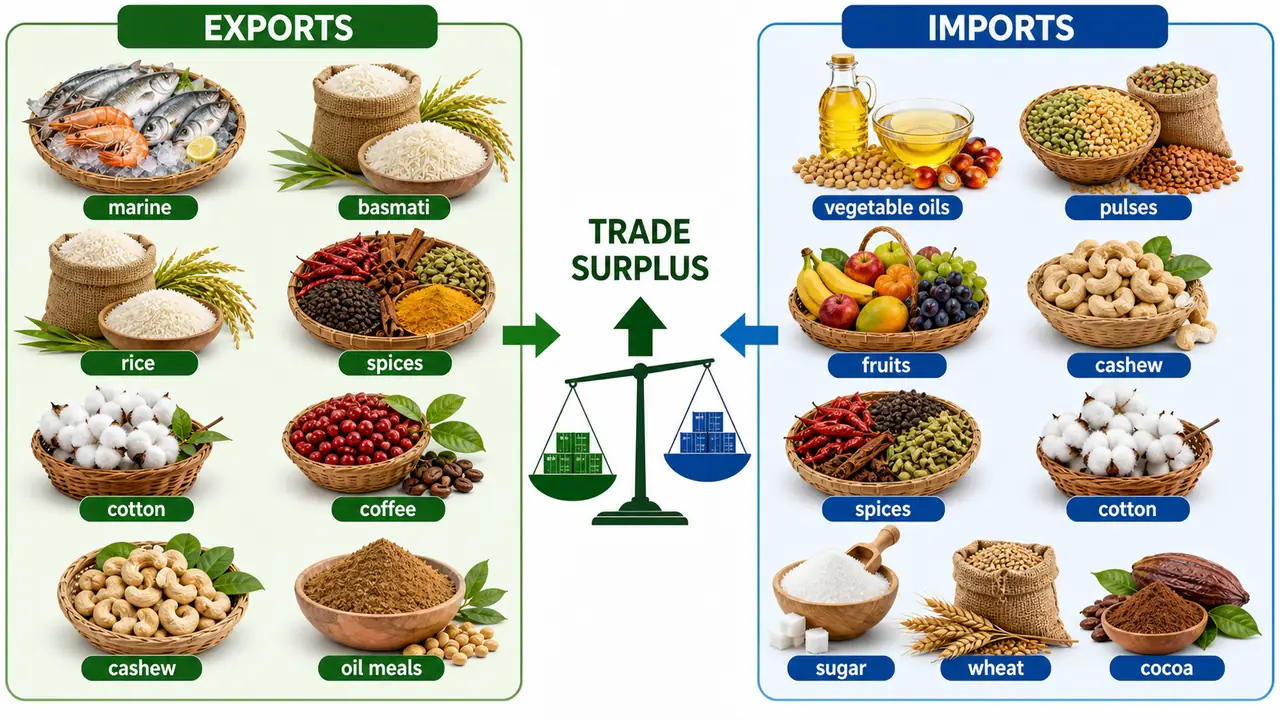
| 1 | Rice-basmati | 22719 | 21604 | 26841 |
| 2 | Rice (other than basmati) | 15583 | 17145 | 22927 |
| 3 | Spices | 16630 | 19442 | 20014 |
| 4 | Cotton raw | 12821 | 10982 | 12156 |
| 5 | Oil meals | 3599 | 5371 | 6969 |
| 6 | Coffee | 5125 | 5668 | 6245 |
| 7 | Cashew nut | 5028 | 5303 | 5945 |
| 8 | Sugar | 9825 | 8678 | 5229 |
| 9 | Fresh vegetables | 5237 | 5772 | 4997 |
| 10 | Groundnut | 4075 | 5454 | 3384 |
| Total Agriculture commodities export | 215396 | 227554 | 550173 |
Top 10 Agricultural Commodities — Imports
| No. | Commodity | 2015-16 | 2016-17 | 2017-18 |
|---|---|---|---|---|
| 1 | Vegetable Oils | 68677 | 73047 | 74996 |
| 2 | Pulses | 25619 | 28523 | 18748 |
| 3 | Fresh Fruits | 11072 | 11241 | 12525 |
| 4 | Cashew nut | 3701 | 9027 | 9134 |
| 5 | Spices | 5400 | 5758 | 6377 |
| 6 | Cotton raw | 2566 | 6337 | 6306 |
| 7 | Sugar | 4038 | 6868 | 6036 |
| 8 | Wheat | 873 | 8509 | 2358 |
| 9 | Misc. processed items | 1811 | 2116 | 2238 |
| 10 | Cocoa products | 1399 | 1540 | 1472 |
| Total Agriculture commodities export | 140311 | 164680 | 152061 |
Agricultural Export Policy
- Government set an overall target of increasing agri and allied exports to US$ 60 billion by 2022
- A new Agricultural Export Policy was unveiled for the first time in India’s history during 2017-18
IMPORTANT
The Agricultural Export Policy of 2017-18 was India’s first-ever dedicated policy for agricultural exports. This is a landmark fact for exams.
Key Objectives of the Export Policy
| Objective | Agricultural Example |
|---|---|
| Diversify the export basket | Move beyond rice and spices to processed foods and organic products |
| Promote value-added exports | Exporting mango pulp instead of raw mangoes |
| Improve institutional framework | Streamline certifications (FSSAI, APEDA, phytosanitary) |
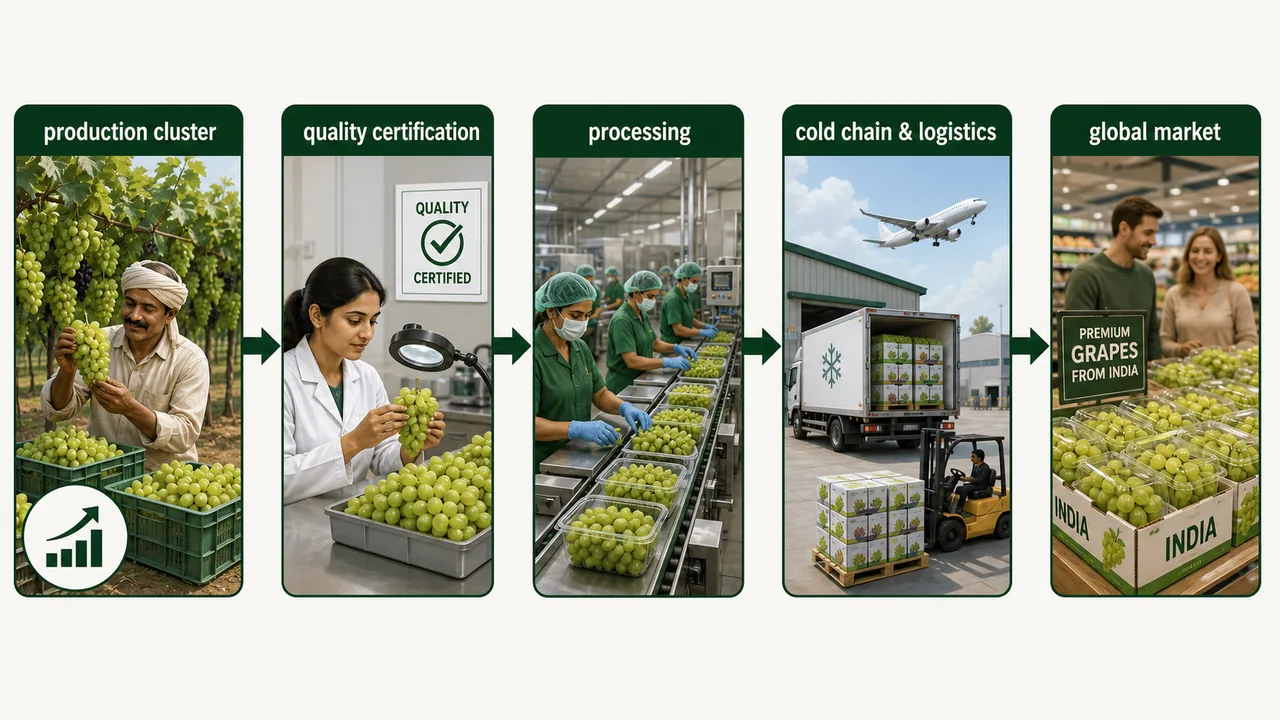
| Create export-ready supply chains | Cold chain from farm to port for grapes and pomegranates |
| Boost farmer income through global market access | Linking GI-tagged products to premium international buyers |
Agri-Export Zones (AEZs)
AEZs are designated geographical areas where all stakeholders — farmers, processors, exporters, and government agencies — work together to develop and export specific agricultural products.
| Feature | Detail |
|---|---|
| Concept | Promote agricultural exports by concentrating resources in specific zones |
| Identified By | State Governments |
| Services | Comprehensive package from state agencies, agricultural universities, and central institutions |
| Goal | Create export-ready supply chains that give farmers better prices and market linkages |
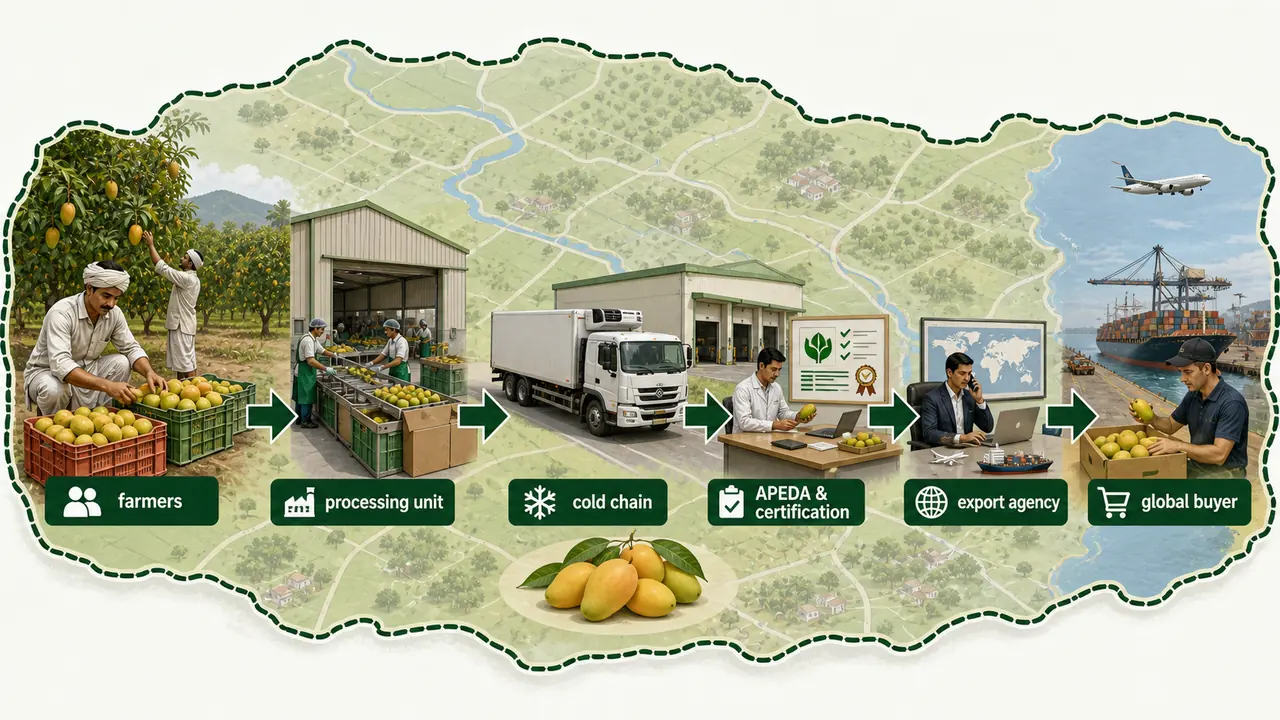
Agricultural Example: An AEZ for Alphonso mangoes in Ratnagiri (Maharashtra) brings together mango growers, processing units, cold chain operators, APEDA certification, and export agencies — creating a seamless pipeline from orchard to international supermarket shelf.
| Crop | State |
|---|---|
| Medicinal Plant | Kerala |
| Medicinal & Aromatic Plants | Uttarakhand |
| Pineapple | West Bengal & Tripura |
| Darjeeling Tea | West Bengal |
| Rose Onion and Vanilla | Karnataka |
| Grape & Grapevine and Pomegranate | Maharashtra |
| Chilli, Mango Pulp | Andhra Pradesh |
| Walnut | Jammu & Kashmir |
| Seed Spices, Wheat, Lentil and Grams | Madhya Pradesh |
| Cut Flowers, Cashewnut | Tamil Nadu |
| Honey | Bihar |
| Value Added Onion, Sesame Seeds | Gujarat |
| Turmeric and Ginger | Odisha |
| Ginger | Sikkim, Assam |
| Fresh and Processed Ginger | Assam |
| Coriander and Cumin | Rajasthan |
Geographical Indication (GI) Tags
A GI Tag is a sign used on products that have a specific geographical origin and possess qualities or reputation attributable to that place. For agricultural products, GI tags are powerful tools for premium pricing and brand protection.

| Feature | Detail |
|---|---|
| Governing Law | Geographical Indications of Goods (Registration and Protection) Act, 1999 |
| Purpose | Protect uniqueness of regional products; prevent misuse of product name |
| Benefit to Farmers | Premium pricing and better market recognition |
| Benefit to Consumers | Assurance of authenticity and quality |
Famous GI-Tagged Agricultural Products
| Product | Region | Why It Is Special |
|---|---|---|
| Darjeeling Tea | West Bengal | Unique muscatel flavour from high-altitude terroir |
| Alphonso Mango | Ratnagiri, Maharashtra | Distinct aroma, sweetness, and texture |
| Basmati Rice | Indo-Gangetic plains | Long grain, aroma, and non-sticky texture |
| Malabar Pepper | Kerala | Pungency and oil content from Western Ghats climate |
| Nagpur Orange | Maharashtra | Sweet-sour balance from Vidarbha’s soil and climate |
| Banaras Langda Mango | Uttar Pradesh | Unique flavour and fibreless pulp |
| Kashmir Saffron | Jammu & Kashmir | Deep colour, strong aroma, highest quality |
NOTE
GI tags link a product’s quality to its terroir — the local environment, soil, and climate. The first GI tag registered in India was Darjeeling Tea (2004-05). GI tags are valid for 10 years and can be renewed.
| Product | State |
|---|---|
| Kashmiri Pashmina | J & K |
| Kangra Tea | Himachal Pradesh |
| Uttarakhand Tejpata | Uttarakhand |
| Basmati Rice | Delhi, Punjab & Haryana |
| Bikaneri Bhujia | Bikaner, Rajasthan |
| Large Cardamom | Sikkim |
| Munga Silk | Assam |
| Assam Tea | Assam |
| Naga Mircha | Nagaland |
| Naga Tree Tomato | Nagaland |
| Mizo Chilli | Mizoram |
| Tripura Queen Pineapple | Tripura |
| Memong narang | Meghalaya |
| Khasi Mandarin | Meghalaya |
| Gobindbhog rice | West Bengal |
| Darjeeling Tea | West Bengal |
| Bhagalpur Silk | Bihar |
| Gir Kesar Mango | Gujarat |
| Nagpur Orange | Maharashtra |
| Nagpur Valley Wine | Maharashtra |
| Feni | Goa |
| Benganpalli mango | Andhra Pradesh |
| Byadgi Chilli | Karnataka |
| Mysore Silk | Karnataka |
| Mysore Sandal Oil | Karnataka |
| Kandhamal Haldi | Odisha |
| Malabar Pepper | Kerala |
| Kanchipuram Silk | Tamil Nadu |
Exam Tips and Mnemonics
| Topic | Tip |
|---|---|
| Trade Balance | India has a surplus in agricultural trade — exports > imports |
| Top Export | Marine products rank #1 by value — not rice, not spices |
| Export Destinations | ”USA Leads” — USA > Vietnam > Iran > China > UAE |
| Export Policy | 2017-18 = India’s first-ever agricultural export policy |
| GI Tag Act | 1999 Act — “GI came in the last year of the 20th century” |
| First GI Tag | Darjeeling Tea — “India’s first GI is its most famous tea” |
| AEZs | Identified by state governments, not central government |
| Export Target | US$ 60 billion by 2022 (aspirational target) |
Summary Table
| Topic | Key Fact |
|---|---|
| India’s Global Share | Exports 2.27%, Imports 1.90% of world agricultural trade (2017) |
| Trade Balance | Surplus — exports US 20.35 bn |
| Top Export Commodity | Marine Products (by value, 2018-19) |
| Top Export Destination | USA |
| Agricultural Export Policy | First-ever, unveiled 2017-18; target US$ 60 bn by 2022 |
| Agri-Export Zones | State-identified zones for specific export commodities |
| GI Tags | Registered under GI Act 1999; protect regional agricultural products |
| First Indian GI | Darjeeling Tea |
| Agri Exports % of Total Exports | 12.80% (2017-18) |
Summary Cheat Sheet
| Concept / Topic | Key Details / Explanation |
|---|---|
| India’s share in world agri exports | 2.27% (2017-18) |
| India’s share in world agri imports | 1.90% (2017-18) |
| Agri exports value | US$ 38.74 billion (2017-18) |
| Agri imports value | US$ 20.35 billion (2017-18) |
| Trade balance | Surplus — exports exceed imports by ~US$ 18 billion |
| Agri exports as % of total exports | 12.80% |
| Agri exports as % of agri GDP | 9% |
| Top export destinations (order) | USA > Vietnam > Iran > China > UAE |
| Top export commodity (#1 by value) | Marine Products (shrimp, fish) — NOT rice or spices |
| Top exports (order) | Marine Products → Basmati Rice → Buffalo Meat → Spices → Non-Basmati Rice → Raw Cotton |
| Agricultural Export Policy | India’s first-ever dedicated agri export policy; unveiled 2017-18 |
| Export target | US$ 60 billion by 2022 (aspirational) |
| Export Policy objectives | Diversify basket, promote value-added exports, improve institutional framework, create export-ready supply chains |
| Agri-Export Zones (AEZs) | Designated geographic areas for specific export commodities; identified by State Governments |
| AEZ concept | Concentrates farmers, processors, exporters, agencies for seamless export pipeline |
| GI Tag (Geographical Indication) | Sign on products with specific geographical origin and qualities attributable to that place |
| GI Act | Geographical Indications of Goods Act, 1999 — “Last year of the 20th century” |
| First Indian GI | Darjeeling Tea (registered 2004-05) |
| GI validity | 10 years, renewable |
| Famous GI products | Darjeeling Tea, Alphonso Mango, Basmati Rice, Malabar Pepper, Nagpur Orange, Kashmir Saffron |
| GI benefit | Premium pricing for farmers; authenticity assurance for consumers; brand protection |
Pro Content Locked
Upgrade to Pro to access this lesson and all other premium content.
₹2388 billed yearly
- All Agriculture & Banking Courses
- AI Lesson Questions (100/day)
- AI Doubt Solver (50/day)
- Glows & Grows Feedback (30/day)
- AI Section Quiz (20/day)
- 22-Language Translation (30/day)
- Recall Questions (20/day)
- AI Quiz (15/day)
- AI Quiz Paper Analysis
- AI Step-by-Step Explanations
- Spaced Repetition Recall (FSRS)
- AI Tutor
- Immersive Text Questions
- Audio Lessons — Hindi & English
- Mock Tests & Previous Year Papers
- Summary & Mind Maps
- XP, Levels, Leaderboard & Badges
- Generate New Classrooms
- Voice AI Teacher (AgriDots Live)
- AI Revision Assistant
- Knowledge Gap Analysis
- Interactive Revision (LangGraph)
🔒 Secure via Razorpay · Cancel anytime · No hidden fees
From Farm to Foreign Markets
India is the world’s largest producer of spices, second-largest producer of rice and wheat, and a major exporter of marine products. Yet, when a shrimp farmer in Andhra Pradesh sends his harvest to the USA or a basmati rice grower in Haryana exports to Iran, they are part of a trade system that contributes only about 2-3% of global agricultural trade. Understanding India’s agricultural trade — what we export, where, and the policies driving growth — is essential for competitive exams.
India’s Position in Global Agricultural Trade
| Parameter | Value (2017-18) |
|---|---|
| Share in world agricultural exports | 2.27% |
| Share in world agricultural imports | 1.90% |
| Agricultural exports as % of agricultural GDP | 9% |
| Agricultural imports as % of agricultural GDP | 5.47% |
| Agricultural exports as % of total exports | 12.80% |
| Total agricultural export value | US$ 38.74 billion |
| Total agricultural import value | US$ 20.35 billion |
| Trade balance | Surplus (exports > imports) |
TIP
India consistently maintains a trade surplus in agriculture (exports exceed imports). This strengthens foreign exchange reserves. The surplus was about US$ 18 billion in 2017-18.
Top Export Destinations and Commodities
Highest Export Destinations (in order)
USA > Vietnam > Iran > China > UAE
Top Agricultural Exports by Value (2018-19)
| Rank | Commodity |
|---|---|
| 1 | Marine Products (shrimp, fish) |
| 2 | Rice — Basmati |
| 3 | Buffalo Meat |
| 4 | Spices |
| 5 | Rice — Non-Basmati |
| 6 | Raw Cotton |
Agricultural Insight: India’s export strength lies in marine products, rice, meat, and spices — commodities where India has both a production advantage and strong global demand. Basmati rice and spices benefit from India’s unique agro-climatic conditions.
Top 10 Agricultural Commodities — Exports
| No. | Commodity | 2015-16 | 2016-17 | 2017-18 |
|---|---|---|---|---|
| 1 | Rice-basmati | 22719 | 21604 | 26841 |
| 2 | Rice (other than basmati) | 15583 | 17145 | 22927 |
| 3 | Spices | 16630 | 19442 | 20014 |
| 4 | Cotton raw | 12821 | 10982 | 12156 |
| 5 | Oil meals | 3599 | 5371 | 6969 |
| 6 | Coffee | 5125 | 5668 | 6245 |
| 7 | Cashew nut | 5028 | 5303 | 5945 |
| 8 | Sugar | 9825 | 8678 | 5229 |
| 9 | Fresh vegetables | 5237 | 5772 | 4997 |
| 10 | Groundnut | 4075 | 5454 | 3384 |
| Total Agriculture commodities export | 215396 | 227554 | 550173 |
Top 10 Agricultural Commodities — Imports
| No. | Commodity | 2015-16 | 2016-17 | 2017-18 |
|---|---|---|---|---|
| 1 | Vegetable Oils | 68677 | 73047 | 74996 |
| 2 | Pulses | 25619 | 28523 | 18748 |
| 3 | Fresh Fruits | 11072 | 11241 | 12525 |
| 4 | Cashew nut | 3701 | 9027 | 9134 |
| 5 | Spices | 5400 | 5758 | 6377 |
| 6 | Cotton raw | 2566 | 6337 | 6306 |
| 7 | Sugar | 4038 | 6868 | 6036 |
| 8 | Wheat | 873 | 8509 | 2358 |
| 9 | Misc. processed items | 1811 | 2116 | 2238 |
| 10 | Cocoa products | 1399 | 1540 | 1472 |
| Total Agriculture commodities export | 140311 | 164680 | 152061 |
Agricultural Export Policy
- Government set an overall target of increasing agri and allied exports to US$ 60 billion by 2022
- A new Agricultural Export Policy was unveiled for the first time in India’s history during 2017-18
IMPORTANT
The Agricultural Export Policy of 2017-18 was India’s first-ever dedicated policy for agricultural exports. This is a landmark fact for exams.
Key Objectives of the Export Policy
| Objective | Agricultural Example |
|---|---|
| Diversify the export basket | Move beyond rice and spices to processed foods and organic products |
| Promote value-added exports | Exporting mango pulp instead of raw mangoes |
| Improve institutional framework | Streamline certifications (FSSAI, APEDA, phytosanitary) |
| Create export-ready supply chains | Cold chain from farm to port for grapes and pomegranates |
| Boost farmer income through global market access | Linking GI-tagged products to premium international buyers |
Agri-Export Zones (AEZs)
AEZs are designated geographical areas where all stakeholders — farmers, processors, exporters, and government agencies — work together to develop and export specific agricultural products.

| Feature | Detail |
|---|---|
| Concept | Promote agricultural exports by concentrating resources in specific zones |
| Identified By | State Governments |
| Services | Comprehensive package from state agencies, agricultural universities, and central institutions |
| Goal | Create export-ready supply chains that give farmers better prices and market linkages |
Agricultural Example: An AEZ for Alphonso mangoes in Ratnagiri (Maharashtra) brings together mango growers, processing units, cold chain operators, APEDA certification, and export agencies — creating a seamless pipeline from orchard to international supermarket shelf.
| Crop | State |
|---|---|
| Medicinal Plant | Kerala |
| Medicinal & Aromatic Plants | Uttarakhand |
| Pineapple | West Bengal & Tripura |
| Darjeeling Tea | West Bengal |
| Rose Onion and Vanilla | Karnataka |
| Grape & Grapevine and Pomegranate | Maharashtra |
| Chilli, Mango Pulp | Andhra Pradesh |
| Walnut | Jammu & Kashmir |
| Seed Spices, Wheat, Lentil and Grams | Madhya Pradesh |
| Cut Flowers, Cashewnut | Tamil Nadu |
| Honey | Bihar |
| Value Added Onion, Sesame Seeds | Gujarat |
| Turmeric and Ginger | Odisha |
| Ginger | Sikkim, Assam |
| Fresh and Processed Ginger | Assam |
| Coriander and Cumin | Rajasthan |
Geographical Indication (GI) Tags
A GI Tag is a sign used on products that have a specific geographical origin and possess qualities or reputation attributable to that place. For agricultural products, GI tags are powerful tools for premium pricing and brand protection.

| Feature | Detail |
|---|---|
| Governing Law | Geographical Indications of Goods (Registration and Protection) Act, 1999 |
| Purpose | Protect uniqueness of regional products; prevent misuse of product name |
| Benefit to Farmers | Premium pricing and better market recognition |
| Benefit to Consumers | Assurance of authenticity and quality |
Famous GI-Tagged Agricultural Products
| Product | Region | Why It Is Special |
|---|---|---|
| Darjeeling Tea | West Bengal | Unique muscatel flavour from high-altitude terroir |
| Alphonso Mango | Ratnagiri, Maharashtra | Distinct aroma, sweetness, and texture |
| Basmati Rice | Indo-Gangetic plains | Long grain, aroma, and non-sticky texture |
| Malabar Pepper | Kerala | Pungency and oil content from Western Ghats climate |
| Nagpur Orange | Maharashtra | Sweet-sour balance from Vidarbha’s soil and climate |
| Banaras Langda Mango | Uttar Pradesh | Unique flavour and fibreless pulp |
| Kashmir Saffron | Jammu & Kashmir | Deep colour, strong aroma, highest quality |
NOTE
GI tags link a product’s quality to its terroir — the local environment, soil, and climate. The first GI tag registered in India was Darjeeling Tea (2004-05). GI tags are valid for 10 years and can be renewed.
| Product | State |
|---|---|
| Kashmiri Pashmina | J & K |
| Kangra Tea | Himachal Pradesh |
| Uttarakhand Tejpata | Uttarakhand |
| Basmati Rice | Delhi, Punjab & Haryana |
| Bikaneri Bhujia | Bikaner, Rajasthan |
| Large Cardamom | Sikkim |
| Munga Silk | Assam |
| Assam Tea | Assam |
| Naga Mircha | Nagaland |
| Naga Tree Tomato | Nagaland |
| Mizo Chilli | Mizoram |
| Tripura Queen Pineapple | Tripura |
| Memong narang | Meghalaya |
| Khasi Mandarin | Meghalaya |
| Gobindbhog rice | West Bengal |
| Darjeeling Tea | West Bengal |
| Bhagalpur Silk | Bihar |
| Gir Kesar Mango | Gujarat |
| Nagpur Orange | Maharashtra |
| Nagpur Valley Wine | Maharashtra |
| Feni | Goa |
| Benganpalli mango | Andhra Pradesh |
| Byadgi Chilli | Karnataka |
| Mysore Silk | Karnataka |
| Mysore Sandal Oil | Karnataka |
| Kandhamal Haldi | Odisha |
| Malabar Pepper | Kerala |
| Kanchipuram Silk | Tamil Nadu |
Exam Tips and Mnemonics
| Topic | Tip |
|---|---|
| Trade Balance | India has a surplus in agricultural trade — exports > imports |
| Top Export | Marine products rank #1 by value — not rice, not spices |
| Export Destinations | ”USA Leads” — USA > Vietnam > Iran > China > UAE |
| Export Policy | 2017-18 = India’s first-ever agricultural export policy |
| GI Tag Act | 1999 Act — “GI came in the last year of the 20th century” |
| First GI Tag | Darjeeling Tea — “India’s first GI is its most famous tea” |
| AEZs | Identified by state governments, not central government |
| Export Target | US$ 60 billion by 2022 (aspirational target) |
Summary Table
| Topic | Key Fact |
|---|---|
| India’s Global Share | Exports 2.27%, Imports 1.90% of world agricultural trade (2017) |
| Trade Balance | Surplus — exports US 20.35 bn |
| Top Export Commodity | Marine Products (by value, 2018-19) |
| Top Export Destination | USA |
| Agricultural Export Policy | First-ever, unveiled 2017-18; target US$ 60 bn by 2022 |
| Agri-Export Zones | State-identified zones for specific export commodities |
| GI Tags | Registered under GI Act 1999; protect regional agricultural products |
| First Indian GI | Darjeeling Tea |
| Agri Exports % of Total Exports | 12.80% (2017-18) |
Summary Cheat Sheet
| Concept / Topic | Key Details / Explanation |
|---|---|
| India’s share in world agri exports | 2.27% (2017-18) |
| India’s share in world agri imports | 1.90% (2017-18) |
| Agri exports value | US$ 38.74 billion (2017-18) |
| Agri imports value | US$ 20.35 billion (2017-18) |
| Trade balance | Surplus — exports exceed imports by ~US$ 18 billion |
| Agri exports as % of total exports | 12.80% |
| Agri exports as % of agri GDP | 9% |
| Top export destinations (order) | USA > Vietnam > Iran > China > UAE |
| Top export commodity (#1 by value) | Marine Products (shrimp, fish) — NOT rice or spices |
| Top exports (order) | Marine Products → Basmati Rice → Buffalo Meat → Spices → Non-Basmati Rice → Raw Cotton |
| Agricultural Export Policy | India’s first-ever dedicated agri export policy; unveiled 2017-18 |
| Export target | US$ 60 billion by 2022 (aspirational) |
| Export Policy objectives | Diversify basket, promote value-added exports, improve institutional framework, create export-ready supply chains |
| Agri-Export Zones (AEZs) | Designated geographic areas for specific export commodities; identified by State Governments |
| AEZ concept | Concentrates farmers, processors, exporters, agencies for seamless export pipeline |
| GI Tag (Geographical Indication) | Sign on products with specific geographical origin and qualities attributable to that place |
| GI Act | Geographical Indications of Goods Act, 1999 — “Last year of the 20th century” |
| First Indian GI | Darjeeling Tea (registered 2004-05) |
| GI validity | 10 years, renewable |
| Famous GI products | Darjeeling Tea, Alphonso Mango, Basmati Rice, Malabar Pepper, Nagpur Orange, Kashmir Saffron |
| GI benefit | Premium pricing for farmers; authenticity assurance for consumers; brand protection |
Knowledge Check
Take a dynamically generated quiz based on the material you just read to test your understanding and get personalized feedback.
Lesson Doubts
Ask questions, get expert answers