🌍 WTO and Agriculture — From GATT to Global Trade Rules
Genesis of GATT and WTO, Agreement on Agriculture (AoA), subsidy boxes (green, blue, amber), SPS measures, TRIPs and forms of intellectual property rights with agricultural examples
How Global Trade Rules Affect Indian Farmers
When India exports basmati rice to Iran or imports palm oil from Indonesia, the rules governing these trades are set by the World Trade Organization (WTO). Whether it is the MSP a wheat farmer in Punjab receives, the pesticide residue limit on tea exported from Darjeeling, or the patent on a new Bt cotton seed variety — WTO agreements influence all of it. Understanding the journey from GATT to WTO is essential for competitive exams.
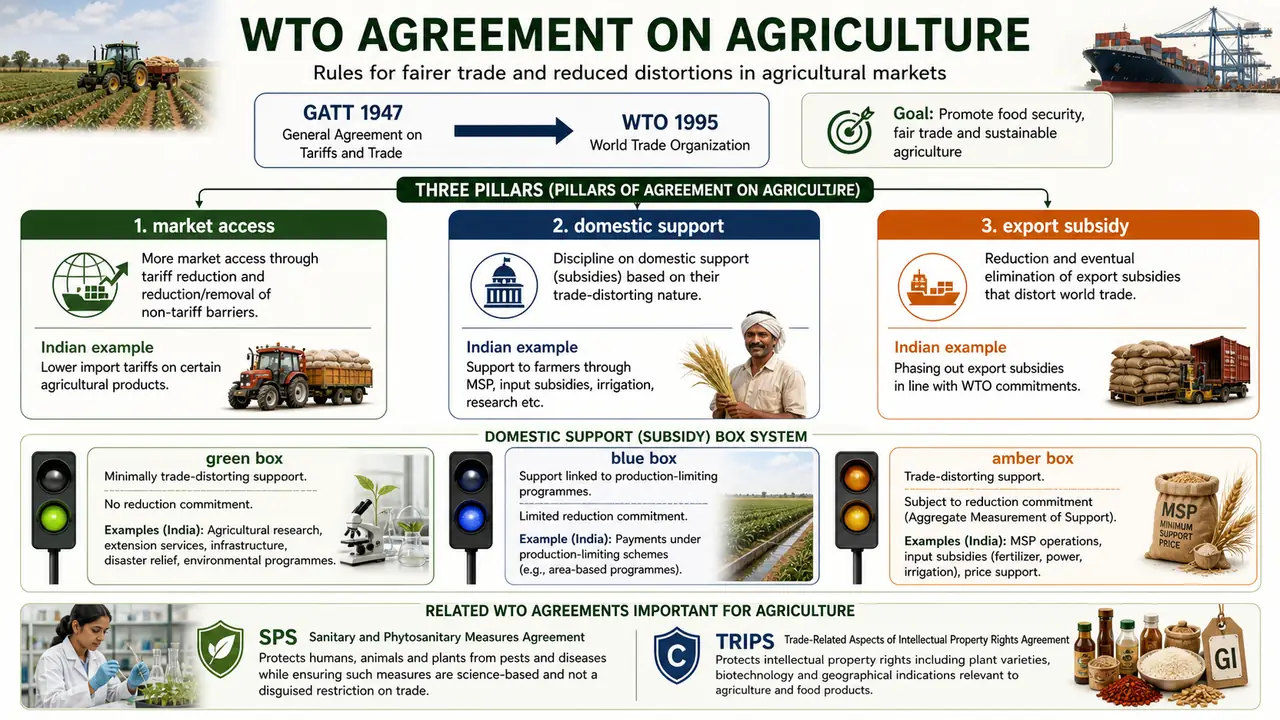
From Bretton Woods to GATT
| Event | Year | Key Detail |
|---|---|---|
| Bretton Woods Conference | 1944 | Held in New Hampshire, USA; 44 allied nations recognized the need for trade liberalization; also established IMF and World Bank |
| GATT Established | 1947 | At Geneva, Switzerland; a set of rules and forum for multilateral trade negotiations |
| India's Status | 1947 | Founding member of GATT — among the original 23 contracting parties |
| Negotiation Rounds | 1947-1994 | Progressively expanded from tariff reduction to non-tariff barriers, agriculture, services, and intellectual property |
Main Features of GATT
| Feature | Detail | Agricultural Impact |
|---|---|---|
| Agricultural tariff reduction | 30% reduction for all agricultural commodities from 1994 | Lower import duties = easier entry for foreign farm products |
| Input subsidy reduction | Agricultural input subsidies reduced by 30% | Countries had to cut fertilizer, seed, and irrigation subsidies |
| Export subsidy reduction | Export subsidies reduced by 36%; volume of subsidized exports by 21% | Aimed at removing unfair advantages in global agricultural markets |
| Trade liberalization gains | Expected 2-10% rise in agri commodity prices; potential gain of US$ 200 billion globally | More efficient resource allocation benefits all participating countries |
| India's PDS protection | India can offer export subsidies without altering PDS and food security policies | Critical provision allowing India to maintain food security programmes |
| TRIPS | Seeds and plant varieties must be protected by patents or an effective sui generis system | Brought intellectual property into the agricultural domain |
| Removal of QRs | All quantitative restrictions, export duties, and minimum export prices to be removed | Opened markets but exposed domestic producers to global competition |
| TRIMS | No restrictions on quantum of foreign investment | Foreign companies could invest freely in agriculture and agribusiness |
Key Criticism: GATT reforms were more beneficial to developed countries because they export high-value manufactured goods, while developing countries often export raw agricultural commodities — creating an uneven distribution of gains.
Pro Content Locked
Upgrade to Pro to access this lesson and all other premium content.
Charged once for one year · ₹1188 total
Save ₹100/month vs ₹2388/year launch price
- All Agriculture & Banking Courses
- AI Lesson Questions (100/day)
- AI Doubt Solver (50/day)
- Glows & Grows Feedback (30/day)
- AI Section Quiz (20/day)
- 22-Language Translation (100/day)
- Recall Questions (20/day)
- AI Quiz (15/day)
- AI Quiz Paper Analysis (100/day)
- AI Step-by-Step Explanations (100/day)
- Spaced Repetition Recall (FSRS)
- AI Tutor
- Immersive Text Questions
- Audio Lessons — Hindi & English
- Mock Tests & Previous Year Papers
- Summary & Mind Maps
- XP, Levels, Leaderboard & Badges
- Generate New Classrooms
- Voice AI Teacher (AgriDots Live)
- AI Revision Assistant
- Knowledge Gap Analysis
- Interactive Revision (LangGraph)
🔒 Secure one-time yearly payment via Razorpay · No hidden fees
How Global Trade Rules Affect Indian Farmers
When India exports basmati rice to Iran or imports palm oil from Indonesia, the rules governing these trades are set by the World Trade Organization (WTO). Whether it is the MSP a wheat farmer in Punjab receives, the pesticide residue limit on tea exported from Darjeeling, or the patent on a new Bt cotton seed variety — WTO agreements influence all of it. Understanding the journey from GATT to WTO is essential for competitive exams.
From Bretton Woods to GATT
| Event | Year | Key Detail |
|---|---|---|
| Bretton Woods Conference | 1944 | Held in New Hampshire, USA; 44 allied nations recognized the need for trade liberalization; also established IMF and World Bank |
| GATT Established | 1947 | At Geneva, Switzerland; a set of rules and forum for multilateral trade negotiations |
| India's Status | 1947 | Founding member of GATT — among the original 23 contracting parties |
| Negotiation Rounds | 1947-1994 | Progressively expanded from tariff reduction to non-tariff barriers, agriculture, services, and intellectual property |
Main Features of GATT
| Feature | Detail | Agricultural Impact |
|---|---|---|
| Agricultural tariff reduction | 30% reduction for all agricultural commodities from 1994 | Lower import duties = easier entry for foreign farm products |
| Input subsidy reduction | Agricultural input subsidies reduced by 30% | Countries had to cut fertilizer, seed, and irrigation subsidies |
| Export subsidy reduction | Export subsidies reduced by 36%; volume of subsidized exports by 21% | Aimed at removing unfair advantages in global agricultural markets |
| Trade liberalization gains | Expected 2-10% rise in agri commodity prices; potential gain of US$ 200 billion globally | More efficient resource allocation benefits all participating countries |
| India's PDS protection | India can offer export subsidies without altering PDS and food security policies | Critical provision allowing India to maintain food security programmes |
| TRIPS | Seeds and plant varieties must be protected by patents or an effective sui generis system | Brought intellectual property into the agricultural domain |
| Removal of QRs | All quantitative restrictions, export duties, and minimum export prices to be removed | Opened markets but exposed domestic producers to global competition |
| TRIMS | No restrictions on quantum of foreign investment | Foreign companies could invest freely in agriculture and agribusiness |
Key Criticism: GATT reforms were more beneficial to developed countries because they export high-value manufactured goods, while developing countries often export raw agricultural commodities — creating an uneven distribution of gains.
Why GATT Became Inadequate
Over time, global trade moved beyond simple tariff cuts. Agriculture, services, investment rules, and intellectual property all became major trade issues. GATT was not designed as a permanent institution to manage this broader agenda, which is why the system eventually evolved into the WTO.
| Round | Year | Country | Remark |
|---|---|---|---|
| 1st | 1944 | Geneva, Switzerland | |
| 2nd | 1948 | France | Concentrated on Tariff, rules and trade policies till 1964 |
| 3rd | 1956 | England | --do-- |
| 4th | 1956 | Geneva | --do-- |
| 5th | 1960 | Dillon | --do-- |
| 6th | 1967 | Kenny | Antidumping |
| 7th | 1973-79 | Tokyo | Framework of GATT arrangements |
| 8th | 1986-93 | Uruguay | Boundaries were expanded to TRIPS, TRIMS, GATTS, Agricultural trade etc. |
| 9th | 1994 | Marakesh, Morocco | WTO establishment on 01-01-1995 |
From GATT to WTO
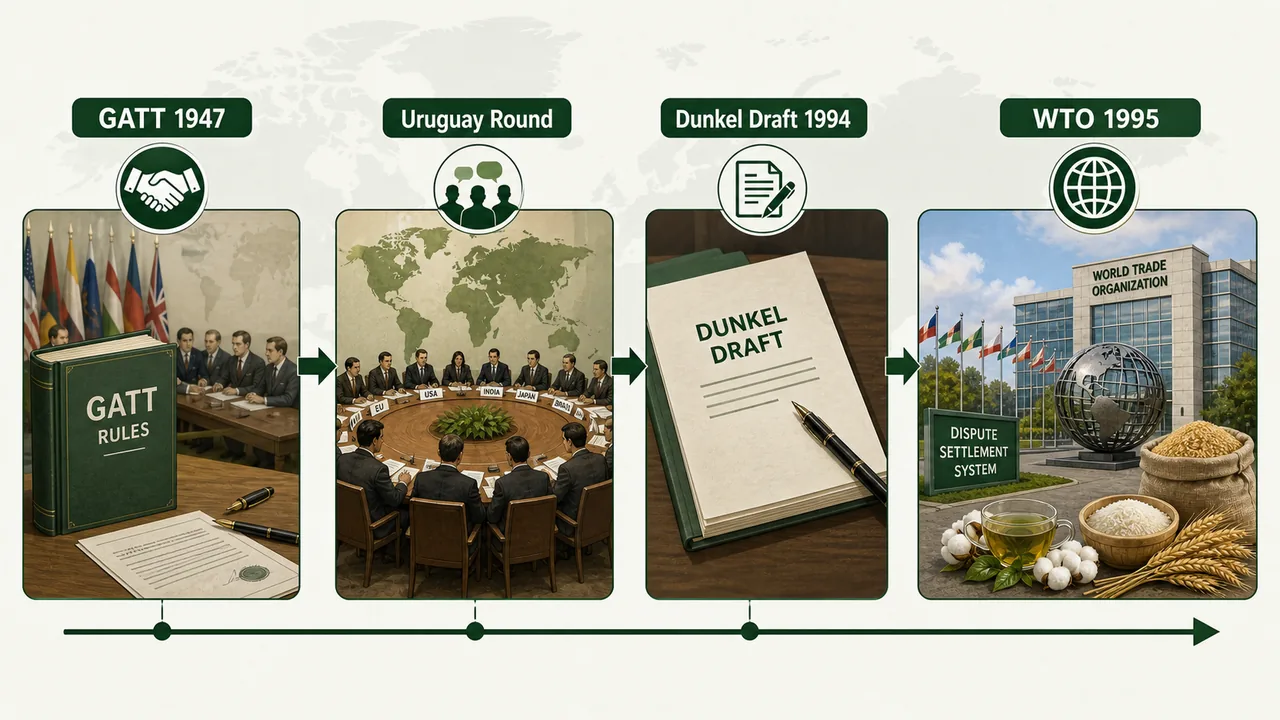
| Year | Event |
|---|---|
| Till 1964 | Negotiations focused on tariffs, rules, and trade policies |
| 1982 | USA proposed including TRIPS, agriculture, and services — initially opposed, eventually accepted |
| 1989-94 | Dunkel Draft discussed (named after Arthur Dunkel, GATT Director-General); signed at Marrakesh, Morocco in 1994 |
| 1 January 1995 | WTO established at Geneva, replacing GATT |
| Current | 164 member countries (as of 2021); Afghanistan is the newest member |
Structure of WTO
| Division | Function | Meeting Frequency |
|---|---|---|
| Ministerial Conference | Highest decision-making body; principal policy decisions | Once in 2 years |
| General Council | Handles day-to-day work; also acts as Trade Policy Review Body and Dispute Settlement Body | Regular |
| Specialized Bodies | (a) Dispute Settlement Body (DSB) — legally binding dispute resolution (b) Trade Policy Review Body (TPRB) — reviews member trade policies | As needed |
TIP
Why WTO is stronger than GATT: GATT was just a set of rules; WTO is a permanent institution with a binding dispute settlement mechanism. Under GATT, any country could block a dispute ruling. Under WTO, rulings stand unless all members agree to reject them (negative consensus).
Main Functions of WTO
- Covers trade in goods, services, TRIPS, and TRIMS — much broader than GATT
- Faster and more automatic dispute settlement system
- Recognized as a major international economic institution alongside IMF and World Bank
Agreement on Agriculture (AoA)
The AoA was one of the most significant outcomes of the Uruguay Round — it brought agriculture under multilateral trade rules for the first time.
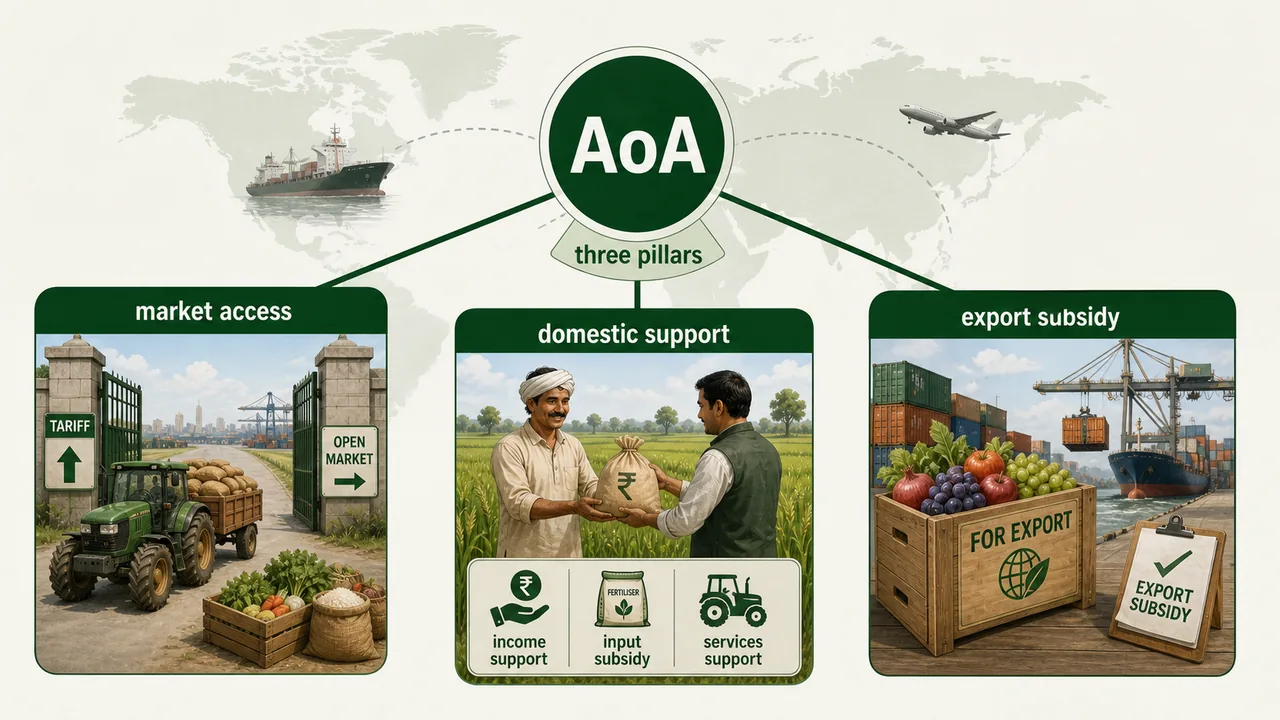
| Feature | Detail |
|---|---|
| Signed | Part of Uruguay Round Agreement, April 1994 |
| Effective | 1 January 1995 |
| Three Pillars | Market Access, Domestic Support, Export Subsidy |
Why the AoA Matters for Agriculture
The AoA matters because it brought agriculture under formal multilateral trade discipline for the first time. Earlier, many countries protected farm sectors through heavy tariffs, subsidies, and export support. The AoA tried to classify and gradually discipline those protections.
Three Pillars of AoA
| Pillar | What It Means | Agricultural Example |
|---|---|---|
| Market Access | Reducing barriers to agricultural imports (tariffs, quotas, restrictions) | India reducing import duty on edible oils |
| Domestic Support | Reducing trade-distorting domestic subsidies | Cuts to fertilizer subsidies that give unfair advantage |
| Export Subsidy | Reducing government subsidies that artificially cheapen agricultural exports | Reducing sugar export subsidies |
Reduction Commitments Under AoA
| Parameter | Developed Countries | Developing Countries | LDCs |
|---|---|---|---|
| Tariff reduction | 36% over 6 years (1995-2000) | 24% over 10 years (1995-2004) | Exempt |
| Domestic support (AMS) reduction | 20% over 6 years | 13.3% over 10 years | Exempt |
| Export subsidy reduction | 36% (value), 21% (volume) | 24% (value), 14% (volume) | Exempt |
NOTE
The differential treatment reflects Special and Differential Treatment (S&DT) — developing countries get more time and flexibility to adjust. LDCs (Least Developed Countries) are fully exempt.
India's Position Under AoA
- India is under no obligation to reduce domestic support because its AMS is below the de minimis threshold of 10% for developing countries
- India provides no export subsidies to agriculture — hence no reduction commitment on this front
| S.N. | Pillars of AOA | Developed countries (1995-2000) | Developing countries (1995-2004) |
|---|---|---|---|
| 1. | Market access: Tariff cuts for agricultural products (Average) (Base period: 1986-88) minimum cut per product line | 36% / 15% | 24% / 10% |
| 2. | Domestic support (Base: 1986-88) AMS | 20% | 13% |
| 3. | Export subsidies: (Base: 1986-90) Subsidy volume: / Subsidised quantities (Volume) | 36% / 21% | 24% / 13% |
Aggregate Measure of Support (AMS) and Subsidy Boxes
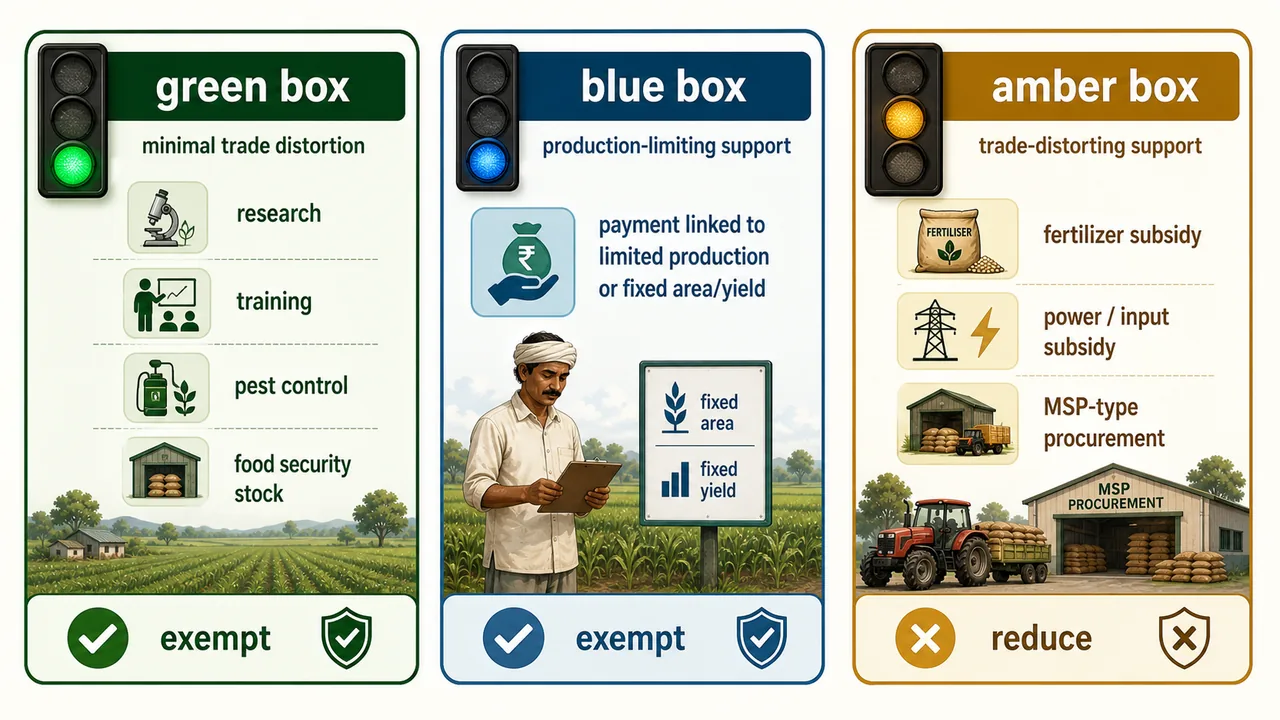
The AMS measures total trade-distorting domestic support. Not all subsidies are treated equally — WTO classifies them into "boxes" by colour.
De Minimis Thresholds
| Country Type | De Minimis Limit | Meaning |
|---|---|---|
| Developed | 5% of production value | Below this, no reduction needed |
| Developing & LDCs | 10% of production value | Below this, no reduction needed |
AMS Reduction (above de minimis)
| Country Type | Reduction | Period |
|---|---|---|
| Developed | 20% | 6 years |
| Developing | 13.3% | 10 years |
WTO Subsidy Box System
| Box | Colour Code | Trade Impact | Subject to Reduction? | Agricultural Examples |
|---|---|---|---|---|
| Green Box | Green = Go (permitted) | Minimal trade distortion | Fully exempt | Agricultural research, farmer training, food security stocks, environmental programmes, pest control |
| Blue Box | Blue = Caution | Tied to production-limiting programmes | Exempt | Payments linked to fixed area/yields, set-aside programmes |
| Amber Box | Amber = Warning (reduce) | Trade-distorting | Subject to reduction | Input subsidies (fertilizer, power), MSP-based procurement above market price |
| Green box subsidies | Blue box subsidies | Amber box subsidies |
|---|---|---|
| Minimum Distortion | Production-Limiting programmes | Mostly directly linked to production levels |
| Have minimal trade distorting effects such as research, extension (Opening of KVKs), buffer stocks for food security purposes and other similar activities. | Consist of measures which have non-distorting and conditional on the limitation on production. | The reduction commitment applies only to the Amber box subsidies once exemption was given to green and blue box subsidies. Ex. Fertilizer Subsidies in India. |
How to Read the Subsidy Boxes
The easiest way to read the boxes is to ask one question: how strongly does this subsidy distort trade and production decisions? If distortion is minimal, it goes to the Green Box. If support is tied to limiting production, it fits the Blue Box. If it directly affects production incentives and market outcomes, it falls in the Amber Box.
IMPORTANT
Mnemonic — Traffic Light System:
- Green = Go freely (research, training, food security) — no limits
- Blue = Proceed with caution (production-limiting) — exempt
- Amber = Stop and reduce (trade-distorting subsidies) — must cut
Agricultural Example: India's MSP procurement for wheat and rice falls under the Amber Box because it involves government buying at prices above the market. India's agricultural research funding (ICAR, KVKs) falls under the Green Box and has no limits.
SPS — Sanitary and Phytosanitary Measures
The SPS Agreement ensures countries can protect health of people, animals, and plants — but prevents them from using health standards as disguised trade barriers.
| International Body | Covers | Agricultural Relevance |
|---|---|---|
| Codex Alimentarius Commission (FAO + WHO) | Food safety standards | Pesticide residues in exported tea, aflatoxin levels in groundnuts |
| WOAH (World Organisation for Animal Health) | Animal health | Avian influenza standards for poultry exports |
| IPPC (International Plant Protection Convention, FAO) | Plant health | Phytosanitary certificates for exporting mangoes, bananas |
- WTO encourages countries to use these international standards
- If a country wants standards stricter than international norms, it must provide scientific justification through formal risk assessment
Agricultural Example: Japan may reject Indian grapes if pesticide residue exceeds Codex Alimentarius limits. India must either meet the standard or provide scientific evidence that its residue level is safe.
TRIPs — Trade Related Intellectual Property Rights
TRIPs sets minimum standards for intellectual property protection that all WTO members must follow. For agriculture, it affects plant variety protection, seed patents, and traditional knowledge.
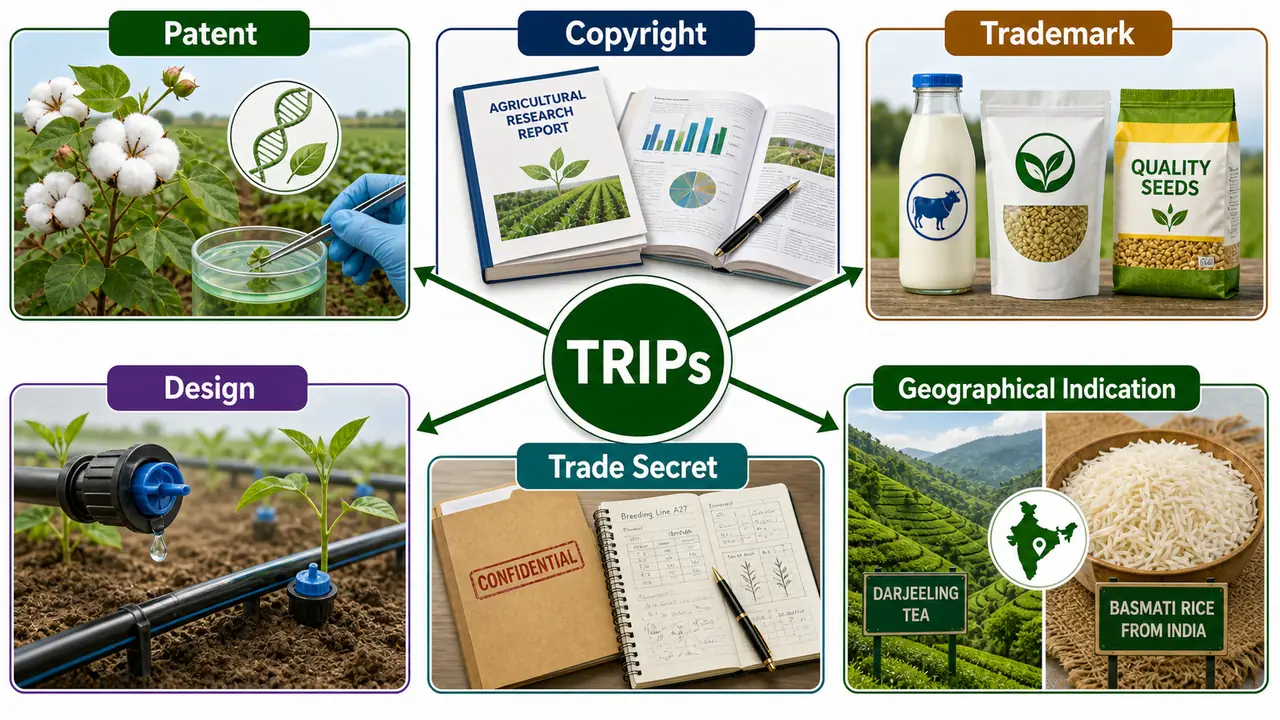
Six Forms of Intellectual Property Under TRIPs
| IPR Type | Protection Period | Key Feature | Agricultural Example |
|---|---|---|---|
| Patent | 20 years (under Patent Act, 1970) | Exclusive right to use and market an invention; must be novel, industrially applicable, and useful | Patent on Bt cotton gene technology |
| Copyright | 60 years after author's death | Protects creative expression — literary, dramatic, musical, artistic works, films, software | Copyright on agricultural research publications |
| Trademark | Renewable | Sign that distinguishes goods of one enterprise from competitors | "Amul" brand for dairy products |
| Design | — | Features of shape, pattern, configuration applied to an article | Design of a new drip irrigation emitter |
| Trade Secret | Indefinite (as long as secret is maintained) | Confidential research/business information; no registration needed | A seed company's proprietary breeding formula |
| Geographical Indication | 10 years (renewable) | Place name identifying product quality linked to origin | Darjeeling Tea, Basmati Rice, Malabar Pepper |
TIP
IPR types under TRIPs — Mnemonic "PCTTDG": Patent (20 yrs), Copyright (60 yrs after death), Trademark (renewable), Trade secret (indefinite), Design, Geographical Indication (10 yrs renewable).
Patent Requirements
| Criterion | Meaning | Agricultural Example |
|---|---|---|
| Novel | Not previously known or published | A newly developed drought-tolerant wheat gene |
| Industrial Application | Can be made or used in industry | Gene can be incorporated into seed production |
| Useful | Solves a specific problem | Increases wheat yield under water stress |
Exam Tips and Mnemonics
| Topic | Tip |
|---|---|
| GATT | 1947, Geneva; India was a founding member (23 original parties) |
| WTO | 1 Jan 1995, Geneva; 164 members; replaced GATT after Dunkel Draft |
| AoA Three Pillars | "MAD" — Market Access, Agricultural (Domestic) Support, Export Subsidy (or simply Market-Domestic-Export) |
| Tariff Reduction | Developed: 36%/6 yrs; Developing: 24%/10 yrs; LDCs: exempt |
| De Minimis | 5% for developed, 10% for developing — "Developing gets double" |
| Subsidy Boxes | Green = exempt, Blue = exempt, Amber = reduce. "Traffic light — green go, amber stop" |
| India's AMS | Below 10% de minimis — no reduction needed |
| SPS Bodies | Codex (food), WOAH (animal), IPPC (plant) — "CAP for SPS" |
| Patent Duration | 20 years; Copyright = 60 years after death |
| GI Act | 1999 — "Last year of 20th century" |
Summary Cheat Sheet
| Concept / Topic | Key Details / Explanation |
|---|---|
| Bretton Woods | 1944, New Hampshire, USA; 44 allied nations; also established IMF and World Bank |
| GATT | Est. 1947 at Geneva; set of rules for multilateral trade; India was founding member (23 original parties) |
| Dunkel Draft | Named after Arthur Dunkel (GATT DG); signed at Marrakesh, Morocco in 1994 |
| WTO | Est. 1 January 1995 at Geneva; replaced GATT; 164 members; permanent institution with binding dispute settlement |
| Ministerial Conference | Highest decision-making body of WTO; meets once in 2 years |
| General Council | Day-to-day work; also acts as Trade Policy Review Body and Dispute Settlement Body |
| WTO vs GATT | GATT = rules only; WTO = permanent institution + binding dispute settlement (negative consensus) |
| AoA (Agreement on Agriculture) | Part of Uruguay Round; effective 1 Jan 1995; first time agriculture under multilateral rules |
| AoA Three Pillars | Market Access, Domestic Support, Export Subsidy |
| Tariff reduction | Developed: 36% / 6 years; Developing: 24% / 10 years; LDCs: exempt |
| AMS reduction | Developed: 20% / 6 yrs; Developing: 13.3% / 10 yrs |
| De Minimis threshold | Developed: 5%; Developing: 10% of production value — below this, no reduction needed |
| India's position | AMS below 10% de minimis; no export subsidies; no reduction obligation |
| Green Box | Minimal trade distortion; fully exempt — research, training, food security stocks, environmental programmes |
| Blue Box | Tied to production-limiting programmes; exempt — payments linked to fixed area/yields |
| Amber Box | Trade-distorting; subject to reduction — input subsidies, MSP procurement above market price |
| Traffic Light Mnemonic | Green = go freely, Blue = caution (exempt), Amber = stop and reduce |
| SPS Agreement | Sanitary and Phytosanitary measures; 3 bodies: Codex (food), WOAH (animal), IPPC (plant) |
| TRIPs | Minimum standards for IP protection; 6 forms: Patent (20 yrs), Copyright (60 yrs after death), Trademark (renewable), Trade Secret (indefinite), Design, GI (10 yrs renewable) |
| Patent requirements | Must be novel, industrially applicable, and useful |
| GI Act | 1999 — protects regional agricultural products (e.g., Darjeeling Tea, Basmati Rice) |
| Export subsidy cuts | Developed: 36% value, 21% volume; Developing: 24% value, 14% volume |