🎛 Marketing Functions, Producer's Surplus & Market Information
Learn the classification of marketing functions (Thomsen and Kohls-Uhl), marketable vs marketed surplus, types of market information, and criteria for good market information.
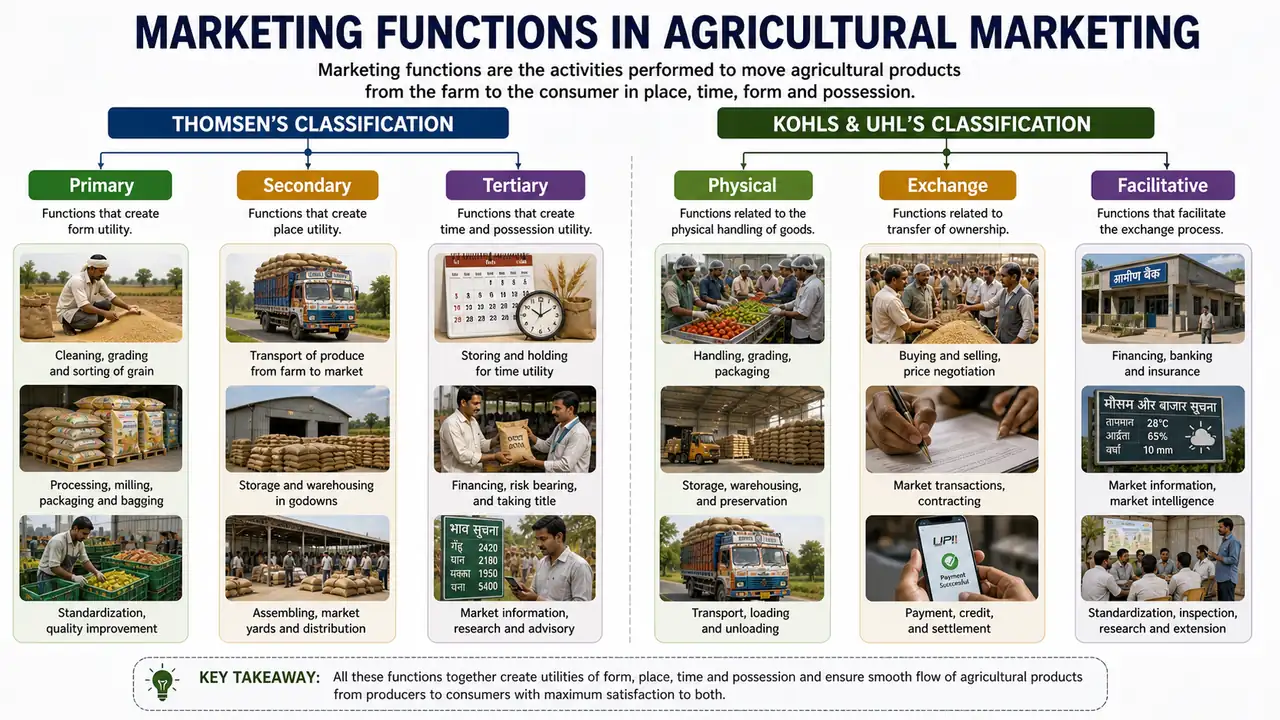
When a rice farmer in West Bengal harvests paddy, the grain must be cleaned, graded, packed, transported to a mandi, stored in a warehouse, and finally sold to a miller or consumer. Each of these steps is a marketing function -- and each one adds cost as well as value to the product.
What is a Marketing Function?
A marketing function is any single activity performed in carrying a product from the point of production to the ultimate consumer.
Each function operates along one or more of three dimensions: time, space, and form.
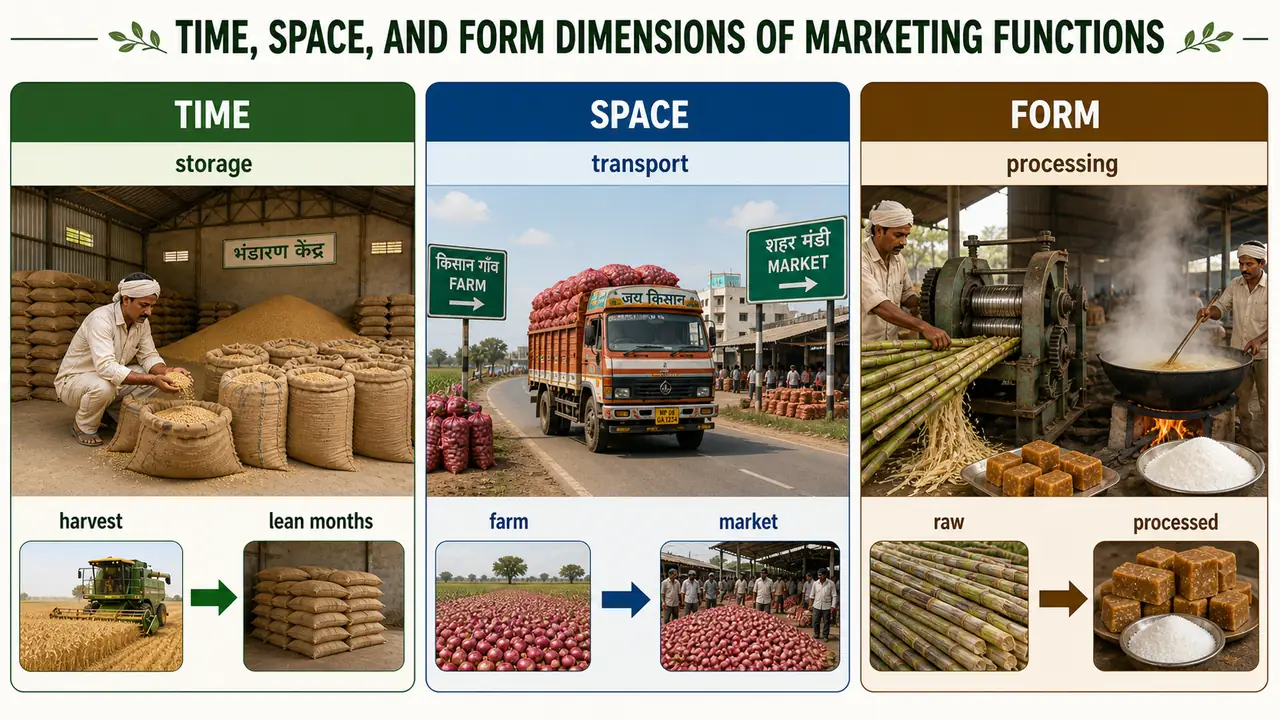
| Dimension | Marketing Function | Example |
|---|---|---|
| Time | Storage | Storing wheat after harvest for sale during lean months |
| Space | Transportation | Moving onions from Nashik to Mumbai |
| Form | Processing | Converting sugarcane into jaggery or sugar |
Classification of Marketing Functions
Two major classifications are frequently tested in exams:
Pro Content Locked
Upgrade to Pro to access this lesson and all other premium content.
Charged once for one year · ₹1188 total
Save ₹100/month vs ₹2388/year launch price
- All Agriculture & Banking Courses
- AI Lesson Questions (100/day)
- AI Doubt Solver (50/day)
- Glows & Grows Feedback (30/day)
- AI Section Quiz (20/day)
- 22-Language Translation (100/day)
- Recall Questions (20/day)
- AI Quiz (15/day)
- AI Quiz Paper Analysis (100/day)
- AI Step-by-Step Explanations (100/day)
- Spaced Repetition Recall (FSRS)
- AI Tutor
- Immersive Text Questions
- Audio Lessons — Hindi & English
- Mock Tests & Previous Year Papers
- Summary & Mind Maps
- XP, Levels, Leaderboard & Badges
- Generate New Classrooms
- Voice AI Teacher (AgriDots Live)
- AI Revision Assistant
- Knowledge Gap Analysis
- Interactive Revision (LangGraph)
🔒 Secure one-time yearly payment via Razorpay · No hidden fees
When a rice farmer in West Bengal harvests paddy, the grain must be cleaned, graded, packed, transported to a mandi, stored in a warehouse, and finally sold to a miller or consumer. Each of these steps is a marketing function -- and each one adds cost as well as value to the product.
What is a Marketing Function?
A marketing function is any single activity performed in carrying a product from the point of production to the ultimate consumer.
Each function operates along one or more of three dimensions: time, space, and form.
| Dimension | Marketing Function | Example |
|---|---|---|
| Time | Storage | Storing wheat after harvest for sale during lean months |
| Space | Transportation | Moving onions from Nashik to Mumbai |
| Form | Processing | Converting sugarcane into jaggery or sugar |
Classification of Marketing Functions
Two major classifications are frequently tested in exams:
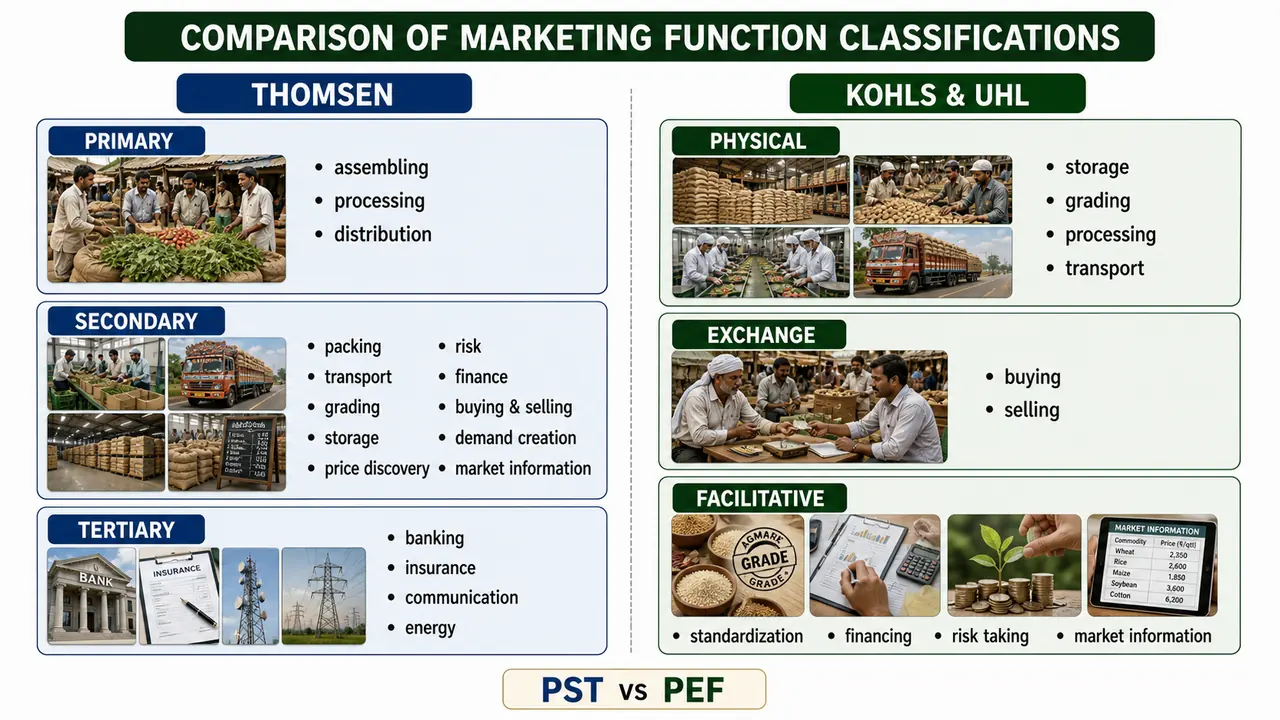
1. Thomsen's Classification
| Category | Functions | Agricultural Example |
|---|---|---|
| Primary | Assembling/Procurement, Processing, Distribution | Collecting milk from villages, pasteurizing it, distributing to retail outlets |
| Secondary | Packing, Transportation, Grading & Standardization, Storage & Warehousing, Price Discovery, Risk Taking, Financing, Buying & Selling, Demand Creation, Market Information | Grading mangoes by size and quality for export; insuring stored grain against fire |
| Tertiary | Banking, Insurance, Communications (Post & Telecom), Energy (Electricity) | Bank credit for a warehouse; electricity for a cold storage unit |
2. Kohls and Uhl's Classification
| Category | Functions | What It Covers |
|---|---|---|
| Physical functions | Storage & Warehousing, Grading, Processing, Transportation | Physical handling of the product |
| Exchange functions | Buying, Selling | Transfer of ownership |
| Facilitative functions | Standardization of Grades, Financing, Risk Taking, Market Information | Enable smooth execution of physical and exchange functions |
IMPORTANT
Exam Tip: Thomsen divides functions into Primary, Secondary, Tertiary. Kohls and Uhl divide them into Physical, Exchange, Facilitative. Both classifications are frequently asked. Remember: "Thomsen = PST" and "Kohls = PEF".
From Marketing Functions to Market Supply
Producer's Surplus
In a developing economy like India, the producer's surplus determines how much food and raw material is available for the non-farming population. It is a critical indicator of food security and market supply.
Two Types of Producer's Surplus
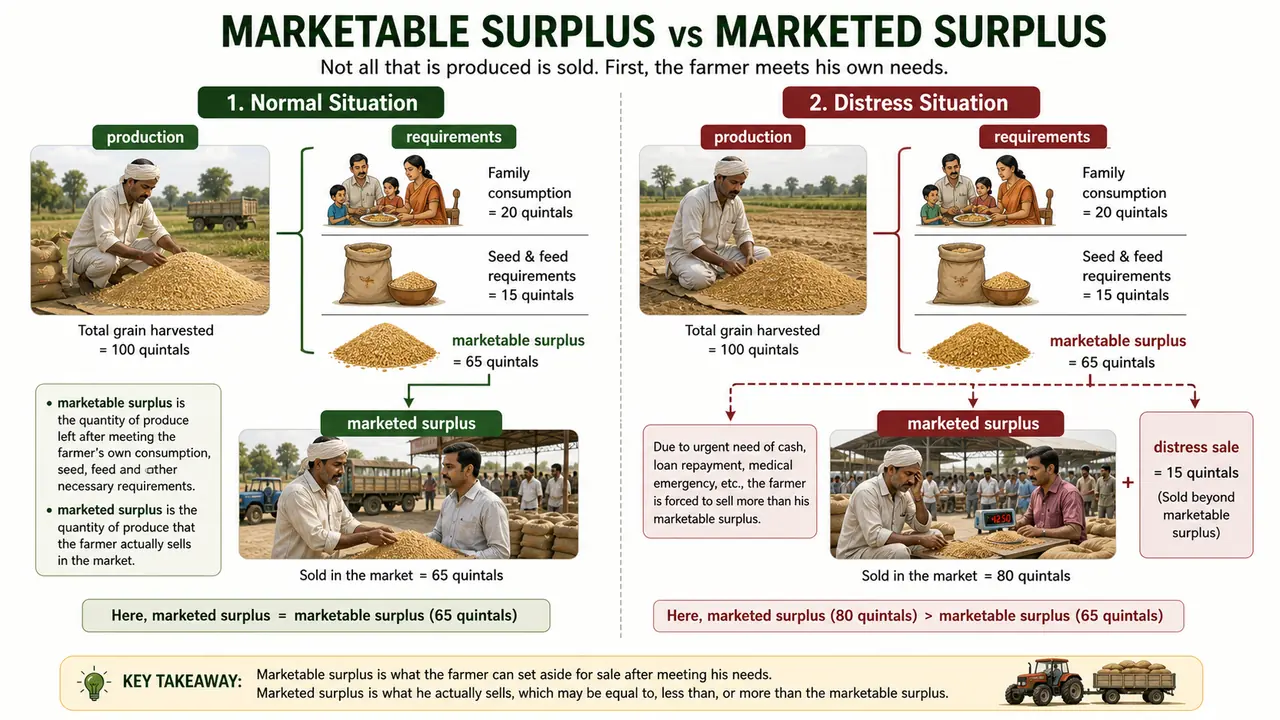
| Type | Definition | Nature | Formula |
|---|---|---|---|
| Marketable surplus | Quantity that can be made available to non-farm population | Theoretical -- the maximum that could potentially enter the market | MS = P - C |
| Marketed surplus | Quantity the farmer actually sells in the market, irrespective of his requirements | Practical -- what actually reaches the market | Observed from actual sales |
Where:
- P = Total production
- C = Total requirements (family consumption + farm needs for seeds and cattle feed + payment to labour in kind + payments to artisans + rent to landlord + social and religious payments)
IMPORTANT
Marketable surplus = theoretical (what can be sold) = P - C. Marketed surplus = actual (what is sold). Marketed surplus can be more, less, or equal to marketable surplus.
Relationship Between Marketed and Marketable Surplus
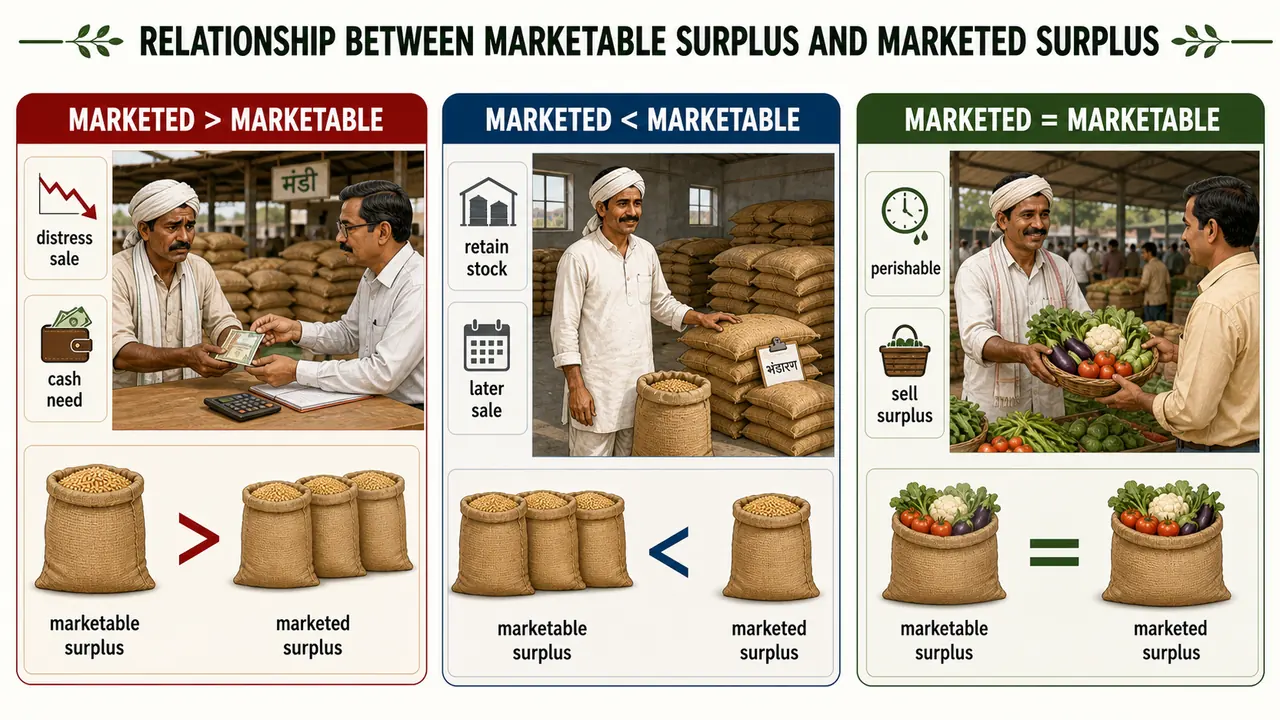
| Situation | When It Happens | Who / What | Explanation |
|---|---|---|---|
| Marketed surplus > Marketable surplus | Farmer retains less than actual requirements | Small and marginal farmers with pressing cash needs | This is distress or forced sale. The farmer sells even the grain needed for family consumption to meet cash obligations. Quantity of distress sale increases when prices fall (backward-bending supply curve). |
| Marketed surplus < Marketable surplus | Farmer retains some surplus | Large farmers with better retention capacity | They hold produce hoping for higher prices later. Also, farmers may substitute one crop for another in consumption when relative prices change. |
| Marketed surplus = Marketable surplus | Farmer retains exactly what is needed | Average farmers and perishable commodities | Perishable goods cannot be stored, so the farmer sells whatever is surplus. |
TIP
Exam Favourite: "Distress sale" occurs when marketed surplus exceeds marketable surplus. This typically happens with small farmers and shows a backward-bending supply curve -- lower prices lead to more (not less) quantity sold.
Information as a Marketing Function
Market Information
Market information is an important marketing function that ensures smooth and efficient operation of the marketing system.
Meaning
Market information includes all facts, estimates, opinions, and other intelligence that affect the marketing of goods and services. Accurate, adequate, and timely information facilitates decisions about when and where to market products.
It creates a competitive market process and prevents monopoly or profiteering.
Importance of Market Information
| User Group | How Market Information Helps | Example |
|---|---|---|
| Farmer-producers | Improves decision-making on when, where, and through whom to sell produce and buy inputs | Farmer checks e-NAM prices before deciding whether to sell at local mandi or a distant one |
| Market middlemen | Helps plan purchase, storage, and sale; reveals market pulse (active/sluggish), temperature (prices rising/falling), and pressure (supply adequate/scarce) | A rice trader decides to stock grain after learning that arrivals will decline next month |
| Cooperative societies | Advises members on optimal time to sell | Milk cooperative guides farmers on seasonal price trends |
| Processors | Plans purchases to run plant continuously and profitably | Sugar mill schedules crushing season based on cane arrival data |
| General economy | Promotes competitive market process; prevents profiteering; enables forward trading | Commodity exchange uses real-time data for price discovery |
| Government | Frames agricultural policy on regulation, buffer stocking, import-export, MSP, and procurement | Government sets wheat MSP based on cost of production and market price data |
Two Types of Market Information
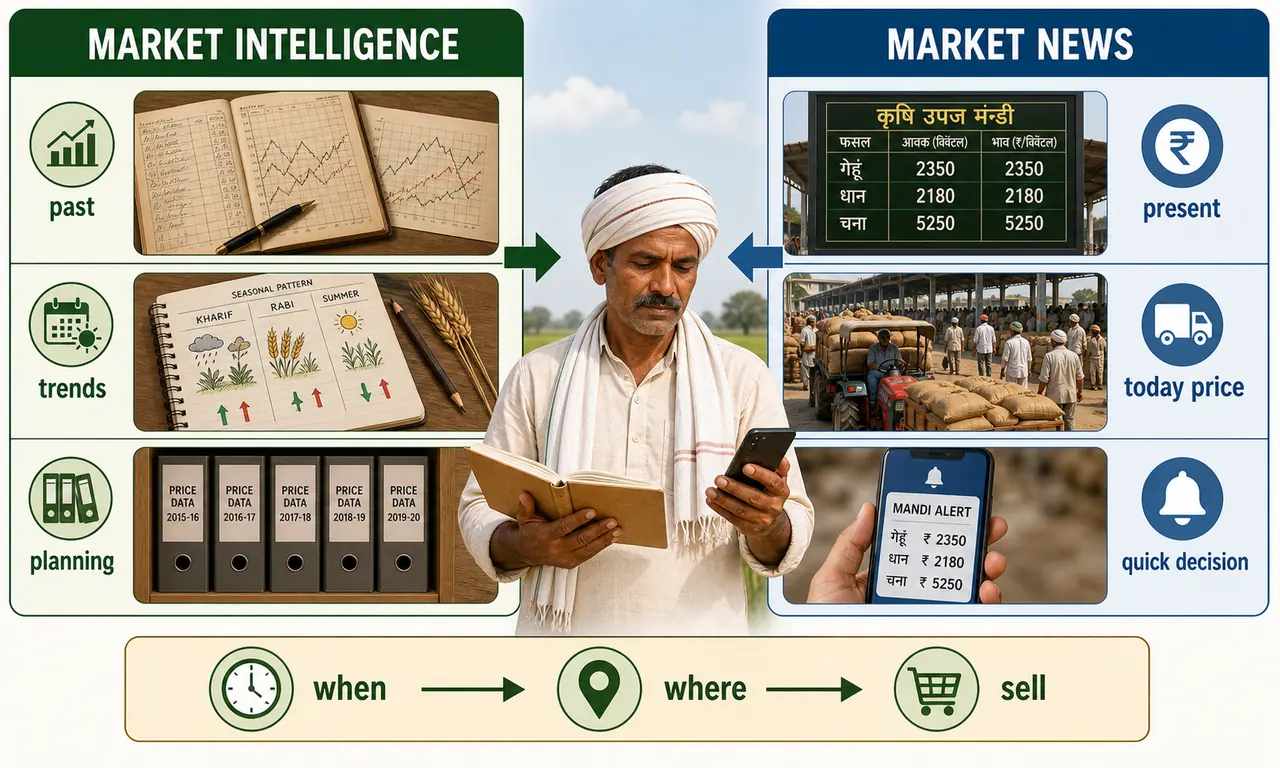
| Type | Time Focus | Nature | What It Includes | Use |
|---|---|---|---|---|
| Market intelligence | Past | Historical | Past prices, arrivals over time, trends, seasonal patterns | Analyzing trends to predict future; long-term planning |
| Market news | Present | Current | Current prices, arrivals, changes in market conditions | Immediate decisions on when and where to sell |
TIP
Market intelligence = looking in the rearview mirror (past data). Market news = looking through the windshield (current data). Both are needed for good driving (decision-making).
Market news quickly becomes obsolete and needs frequent updating. Real-time platforms like e-NAM and mobile apps have greatly improved speed and reach.
Criteria for Good Market Information
Good market information must satisfy seven criteria:
| Criterion | What It Means | Agricultural Example |
|---|---|---|
| Comprehensive | Covers all relevant commodities, markets, and data points | Price data for all major mandis, not just a few |
| Accuracy | Free from errors, based on verified data | Actual transaction prices, not estimated ones |
| Relevance | Pertinent to the user's needs | A cotton farmer needs cotton prices, not rice prices |
| Confidentiality | Sensitive business data is protected | Individual trader's volume not disclosed publicly |
| Trustworthiness | Source is credible and unbiased | Government-published Agmarknet data vs unverified WhatsApp forwards |
| Equal and easy accessibility | All participants, including small farmers, can access it | e-NAM app available in local languages on mobile phones |
| Timeliness | Delivered quickly enough to be actionable | Real-time price display at mandi gate, not data from last week |
TIP
Mnemonic for 7 criteria -- "CART-CET": Comprehensive, Accuracy, Relevance, Trustworthiness, Confidentiality, Equal accessibility, Timeliness.
Summary Cheat Sheet
| Concept / Topic | Key Details / Explanation |
|---|---|
| Marketing Function | Any single activity in moving product from production to consumer; operates along time, space, and form |
| Time dimension | Storage — e.g., storing wheat after harvest for lean months |
| Space dimension | Transportation — e.g., moving onions from Nashik to Mumbai |
| Form dimension | Processing — e.g., converting sugarcane into jaggery |
| Thomsen's Classification | Primary (assembling, processing, distribution), Secondary (12 support functions), Tertiary (banking, insurance, communications, energy) |
| Kohls & Uhl Classification | Physical (storage, grading, processing, transport), Exchange (buying, selling), Facilitative (standardization, financing, risk, information) |
| Exam Mnemonics | Thomsen = PST, Kohls = PEF |
| Marketable Surplus (MS) | Theoretical — quantity that can be made available; formula: MS = P − C |
| Marketed Surplus | Practical — quantity actually sold; can be >, <, or = marketable surplus |
| C (requirements) | Family consumption + seeds + cattle feed + labour payment in kind + artisan payments + rent + social/religious payments |
| Distress / Forced Sale | Marketed surplus > Marketable surplus; small/marginal farmers sell even family consumption grain; increases when prices fall (backward-bending supply curve) |
| Marketed < Marketable | Large farmers hold produce hoping for higher prices later |
| Marketed = Marketable | Average farmers and perishable commodities (cannot store) |
| Market Information | Facts, estimates, opinions affecting marketing; must be accurate, adequate, and timely |
| Market Intelligence | Past/historical data — trends, seasonal patterns; used for long-term planning |
| Market News | Current data — today's prices, arrivals; quickly becomes obsolete |
| 7 Criteria for Good Info | CART-CET — Comprehensive, Accuracy, Relevance, Trustworthiness, Confidentiality, Equal accessibility, Timeliness |
| e-NAM role | Improved speed and reach of real-time market information |
| Who uses market info | Farmer-producers, middlemen, cooperatives, processors, government, general economy |