👩👩👦👦 Cooperative Sector Institutions in Agricultural Marketing
NAFED, NCDC, TRIFED, agricultural input acts, and the world's largest grain storage plan in the cooperative sector with key facts for competitive exams
Why Cooperatives Matter in Agriculture
A small groundnut farmer in Gujarat cannot negotiate a fair price alone against large traders. But when 500 farmers form a cooperative, they can pool their produce, access better markets, and bargain collectively. This is the power of the cooperative movement in agricultural marketing. India has built a strong institutional framework to support these cooperatives at the national level.
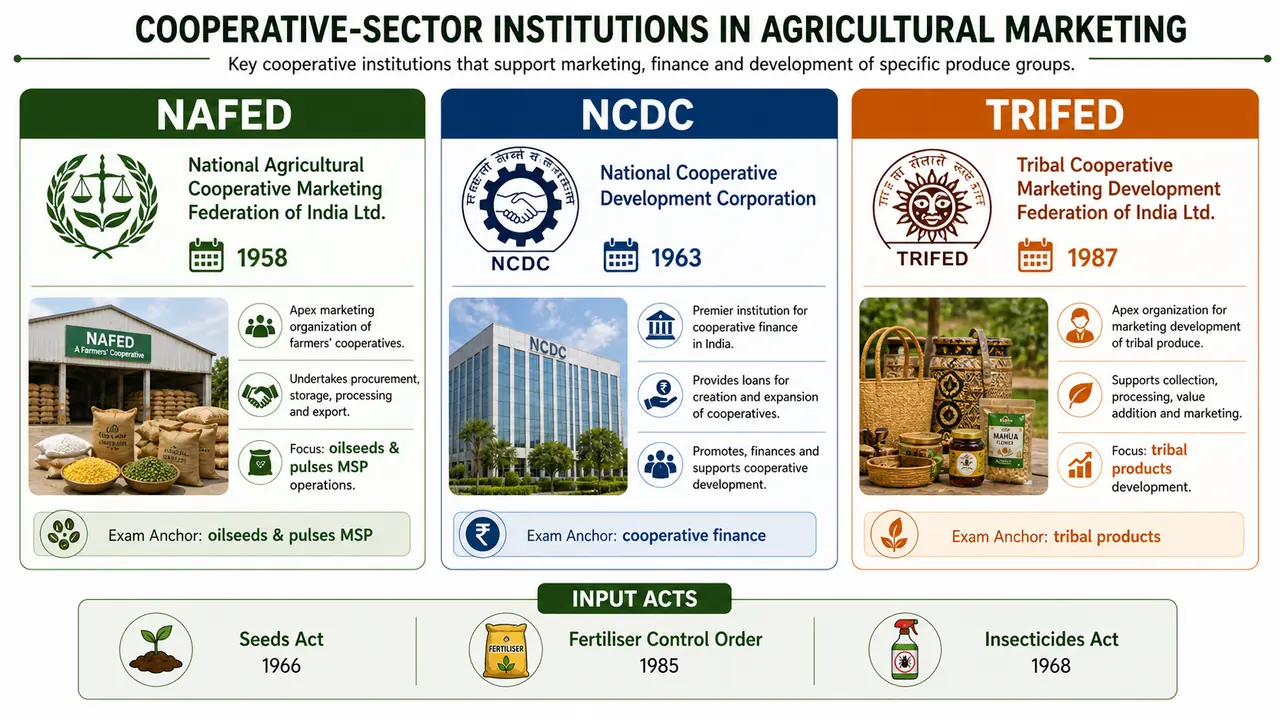
NAFED — National Agricultural Cooperative Marketing Federation
| Feature | Detail |
|---|---|
| Established | 2nd October 1958 |
| Registered Under | Multi State Co-operative Societies Act |
| Headquarters | New Delhi |
| Status | Apex organization for marketing cooperatives in India |
| Members | Agricultural farmers (main members), State Level Marketing Federations, NCDC |
| Nodal Agency Role | MSP operations for oilseeds and pulses since 1991 |
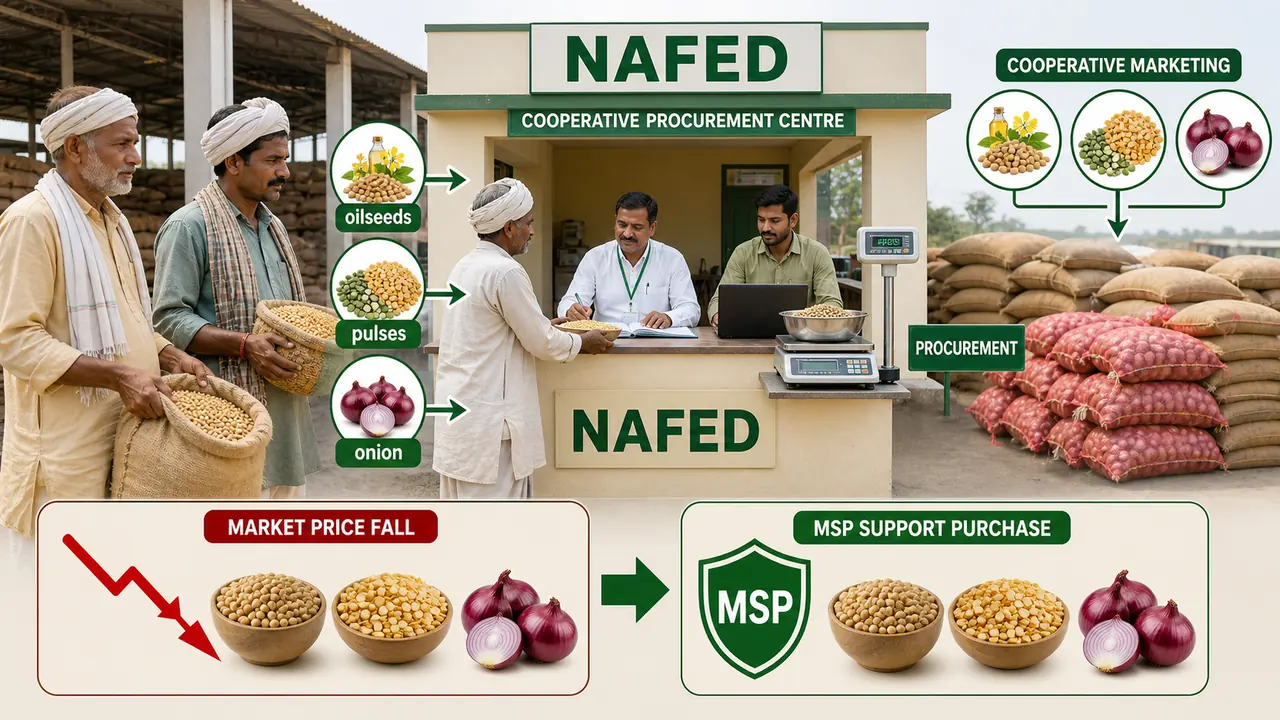
Key Functions
- Objective: Promote cooperative marketing of agricultural produce to benefit farmers
- Handles procurement, processing, distribution, export and import of selected agricultural commodities — making it a multi-commodity cooperative
- Since 1991, designated as the nodal agency for price support operations for oilseeds and pulses. When market prices fall below MSP, NAFED steps in to purchase from farmers, preventing distress sales
- Also undertakes price support operations for perishable commodities like onion — critical because onion prices are highly volatile
- Agricultural farmers have authority through the General Body, ensuring the institution remains farmer-centric
IMPORTANT
Pro Content Locked
Upgrade to Pro to access this lesson and all other premium content.
Charged once for one year · ₹1188 total
Save ₹100/month vs ₹2388/year launch price
- All Agriculture & Banking Courses
- AI Lesson Questions (100/day)
- AI Doubt Solver (50/day)
- Glows & Grows Feedback (30/day)
- AI Section Quiz (20/day)
- 22-Language Translation (100/day)
- Recall Questions (20/day)
- AI Quiz (15/day)
- AI Quiz Paper Analysis (100/day)
- AI Step-by-Step Explanations (100/day)
- Spaced Repetition Recall (FSRS)
- AI Tutor
- Immersive Text Questions
- Audio Lessons — Hindi & English
- Mock Tests & Previous Year Papers
- Summary & Mind Maps
- XP, Levels, Leaderboard & Badges
- Generate New Classrooms
- Voice AI Teacher (AgriDots Live)
- AI Revision Assistant
- Knowledge Gap Analysis
- Interactive Revision (LangGraph)
🔒 Secure one-time yearly payment via Razorpay · No hidden fees
Why Cooperatives Matter in Agriculture
A small groundnut farmer in Gujarat cannot negotiate a fair price alone against large traders. But when 500 farmers form a cooperative, they can pool their produce, access better markets, and bargain collectively. This is the power of the cooperative movement in agricultural marketing. India has built a strong institutional framework to support these cooperatives at the national level.
NAFED — National Agricultural Cooperative Marketing Federation
| Feature | Detail |
|---|---|
| Established | 2nd October 1958 |
| Registered Under | Multi State Co-operative Societies Act |
| Headquarters | New Delhi |
| Status | Apex organization for marketing cooperatives in India |
| Members | Agricultural farmers (main members), State Level Marketing Federations, NCDC |
| Nodal Agency Role | MSP operations for oilseeds and pulses since 1991 |
Key Functions
- Objective: Promote cooperative marketing of agricultural produce to benefit farmers
- Handles procurement, processing, distribution, export and import of selected agricultural commodities — making it a multi-commodity cooperative
- Since 1991, designated as the nodal agency for price support operations for oilseeds and pulses. When market prices fall below MSP, NAFED steps in to purchase from farmers, preventing distress sales
- Also undertakes price support operations for perishable commodities like onion — critical because onion prices are highly volatile
- Agricultural farmers have authority through the General Body, ensuring the institution remains farmer-centric
IMPORTANT
NAFED = Apex cooperative for marketing | Est. 1958 | HQ: New Delhi | Nodal agency for oilseeds & pulses MSP operations since 1991. Example: When soybean prices crash in MP after a bumper harvest, NAFED procures at MSP to protect farmers.
NCDC — National Cooperative Development Corporation
| Feature | Detail |
|---|---|
| Established | Act of Parliament in 1962; came into force in 1963 |
| Type | Statutory Corporation |
| Ministry | Ministry of Agriculture & Farmers Welfare |
| Headquarters | New Delhi |
| Role | Financial backbone of the cooperative movement |
Key Functions
- Promotes, strengthens, and develops farmer cooperatives for marketing, processing, and storage of agricultural products
- Supports supply of agricultural inputs and essential consumer goods in rural areas
- Provides financial assistance (loans, subsidies, grants) to cooperative societies through or on the guarantee of state governments
- Funds infrastructure like warehouses, cold storages, processing plants, and marketing facilities
Agricultural Example: NCDC provides a loan to a dairy cooperative in Rajasthan for building a milk chilling plant, channeled through the state government for accountability.
TRIFED — Tribal Cooperative Marketing Federation
| Feature | Detail |
|---|---|
| Established | 1987 |
| Ministry | Ministry of Tribal Affairs, GoI |
| Role | Marketing development of tribal products and handicrafts |
- Ensures tribal communities receive fair prices for their produce — including forest products like honey, lac, gum, mahua, tendu leaves, and handicrafts
- Connects tribal producers to mainstream markets, improving livelihoods of indigenous communities
Agricultural Example: TRIFED helps tribal women in Jharkhand sell tamarind and sal seeds at fair prices instead of being exploited by local middlemen.
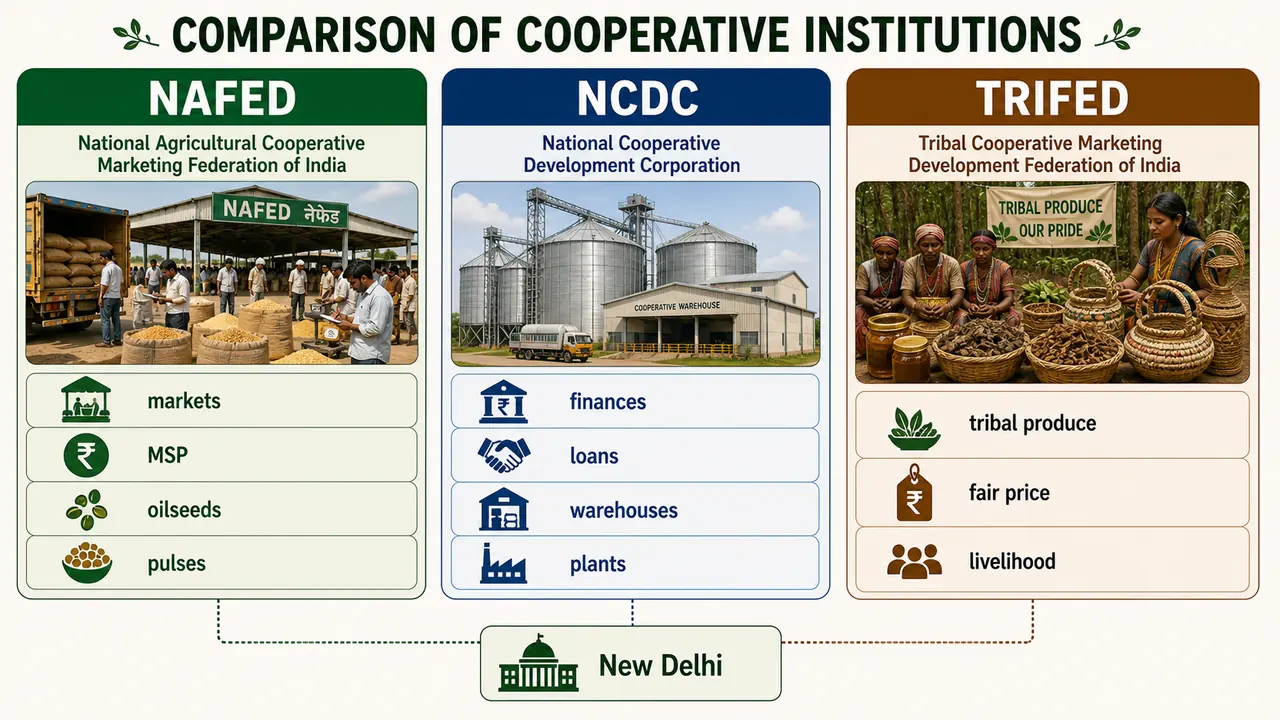
Comparison of Cooperative Institutions
| Feature | NAFED | NCDC | TRIFED |
|---|---|---|---|
| Year | 1958 | 1962 (Act); 1963 (force) | 1987 |
| Ministry | Agriculture & Farmers Welfare | Agriculture & Farmers Welfare | Tribal Affairs |
| Primary Role | Marketing of farm produce | Financial support to cooperatives | Marketing of tribal products |
| Type | Cooperative Federation | Statutory Corporation | Cooperative Federation |
| Key Activity | MSP procurement (oilseeds, pulses) | Loans and grants for infrastructure | Fair price linkage for tribal produce |
| HQ | New Delhi | New Delhi | New Delhi |
TIP
Mnemonic — NNT: NAFED markets it, NCDC finances it, TRIFED serves tribals. All three are headquartered in New Delhi.
Cooperative Marketing and Input Regulation
Agriculture Input-Related Acts
These acts regulate the quality, distribution, and pricing of agricultural inputs such as seeds, fertilizers, pesticides, and machinery. They ensure that farmers receive genuine, quality inputs at fair prices — essential for maintaining productivity and profitability.
| Input | Governing Act | Purpose |
|---|---|---|
| Seeds | Seeds Act, 1966 | Quality control and certification |
| Fertilizers | Fertiliser (Control) Order, 1985 | Regulate price, distribution, and quality |
| Pesticides | Insecticides Act, 1968 | Registration, labelling, and safe use |
| Agricultural Machinery | — | BIS standards for quality assurance |
Agricultural Example: Under the Seeds Act, a farmer buying certified wheat seeds (e.g., HD-2967) is assured of minimum germination percentage and genetic purity.
Cooperative Expansion Through Storage Infrastructure
World's Largest Grain Storage Plan in Cooperative Sector
The Storage Crisis
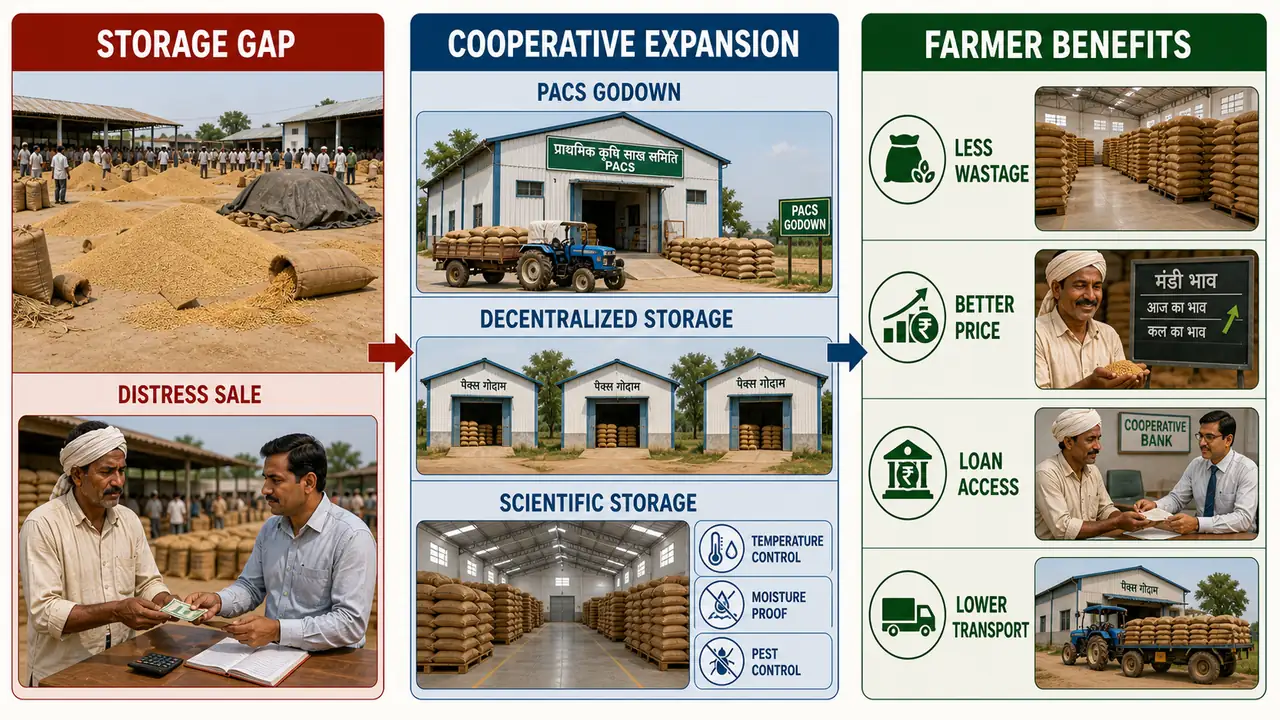
India produces about 310 million tonnes of foodgrains annually, but the country's current godown facilities can store only about 145 million tonnes — just 47% of the produce. This means over half of India's food production is vulnerable to post-harvest losses from rain, pests, and moisture.
WARNING
India can currently store only 47% of its food grain production. Over half the produce is at risk of post-harvest losses — a critical food security challenge.
The Plan
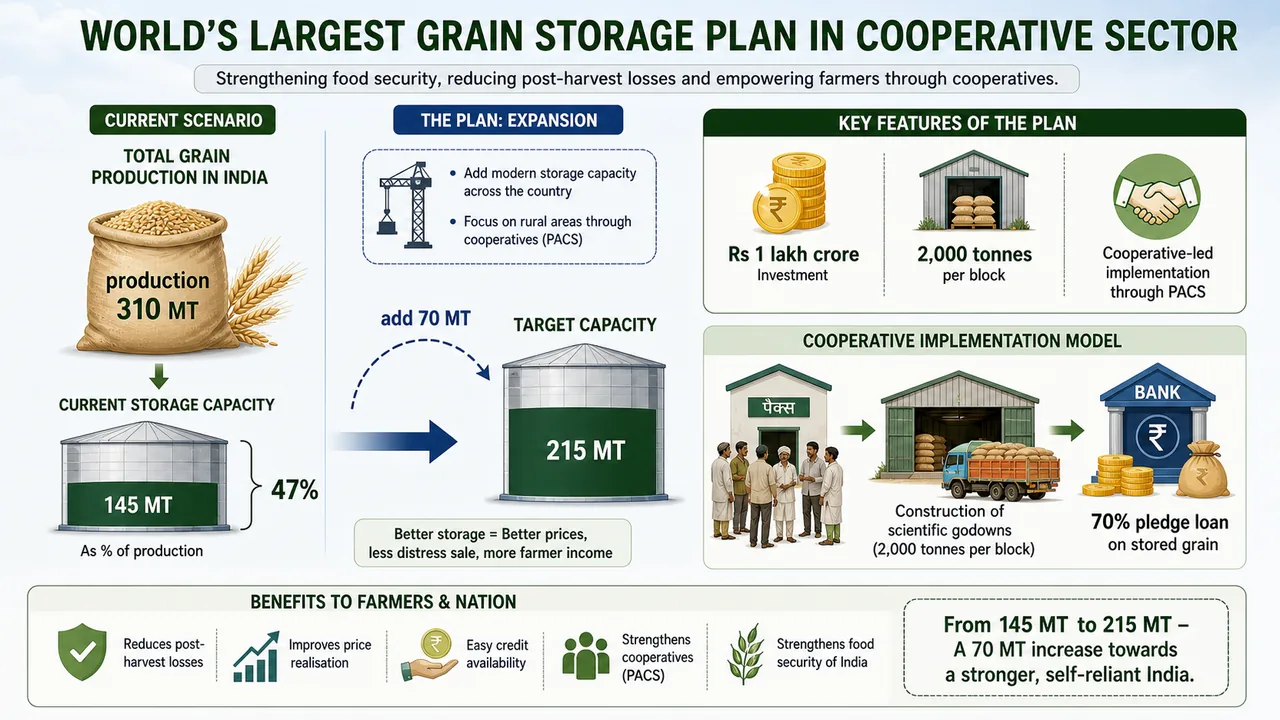
- The Union Cabinet announced a Rs 1 lakh crore scheme to increase foodgrain storage capacity by 70 million tonnes in the cooperative sector over five years (June 2023)
- Total storage capacity will rise from 145 MT to 215 MT
- A godown of 2,000 tonnes capacity will be built in every block across India
- With over 1,00,000 PACS and more than 13 crore farmer members, PACS will become the backbone of decentralized storage
IMPORTANT
This is the "World's Largest Grain Storage Plan in Cooperative Sector" — announced June 2023. Target: 70 MT additional storage via cooperatives. Current: 145 MT. New total: 215 MT.
Storage Capacity at a Glance
| Parameter | Value |
|---|---|
| Annual foodgrain production | 310 MT |
| Current storage capacity | 145 MT (47%) |
| Additional capacity planned | 70 MT |
| New total capacity | 215 MT |
| Investment | Rs 1 lakh crore |
| Timeline | 5 years (from June 2023) |
| Godown size per block | 2,000 tonnes |
| Number of PACS | 1,00,000+ |
| Farmer members | 13 crore+ |
Implementation Strategy
- Convergence of schemes: Agriculture Infrastructure Fund, Agricultural Marketing Infrastructure Scheme, Mission for Integrated Development of Horticulture, Sub Mission on Agricultural Mechanization, PM Formalization of Micro Food Processing Enterprises Scheme, PM Kisan Sampada Yojana, NFSA allocation, and MSP procurement operations
- Inter-Ministerial Committee comprising Ministry of Agriculture, Ministry of Consumer Affairs, and Ministry of Food Processing Industries will oversee coordination
- Pilot project in at least 10 selected districts across different states before nationwide rollout
- National Level Coordination Committee will oversee implementation
- Dedicated portal for linking PACS with central and state governments — rolled out within 45 days of Cabinet approval
- Implementation to commence within 45 days of Cabinet approval
Major Benefits
| Benefit | How It Helps |
|---|---|
| Reduces FCI burden | Decentralized storage means FCI does not manage everything centrally |
| Boosts cooperative sector | PACS become financially stronger and more relevant |
| Reduces wastage | Better storage = less spoilage from rain, pests, moisture |
| Prevents distress sale | Farmers can store produce and sell when prices are favorable |
| Pledge financing | Farmers get up to 70% loans against stored produce |
| Cuts transport costs | Storage closer to farms reduces hauling distance |
| Reduces import dependence | Better storage of domestic produce reduces need for imports |
| Creates rural employment | Construction, management, and operation of facilities generate jobs |
Agricultural Example: A paddy farmer in Chhattisgarh stores his harvest in the local PACS godown instead of selling immediately at low post-harvest prices. He pledges the stored grain, takes a 70% loan for his rabi season expenses, and sells the paddy three months later when prices improve by Rs 200/quintal.
Exam Tips
- NAFED is the apex cooperative for marketing — this word "apex" appears in almost every exam question about NAFED
- NCDC is the financial backbone — it gives money to cooperatives, not markets produce
- TRIFED is under Ministry of Tribal Affairs, not Agriculture — this is a common trick question
- The grain storage plan targets 70 MT additional (not total) — read the question carefully
- PACS stands for Primary Agricultural Credit Societies — they are the grassroots unit of the cooperative structure
Grassroots Cooperative Delivery
PACS — Primary Agricultural Credit Societies
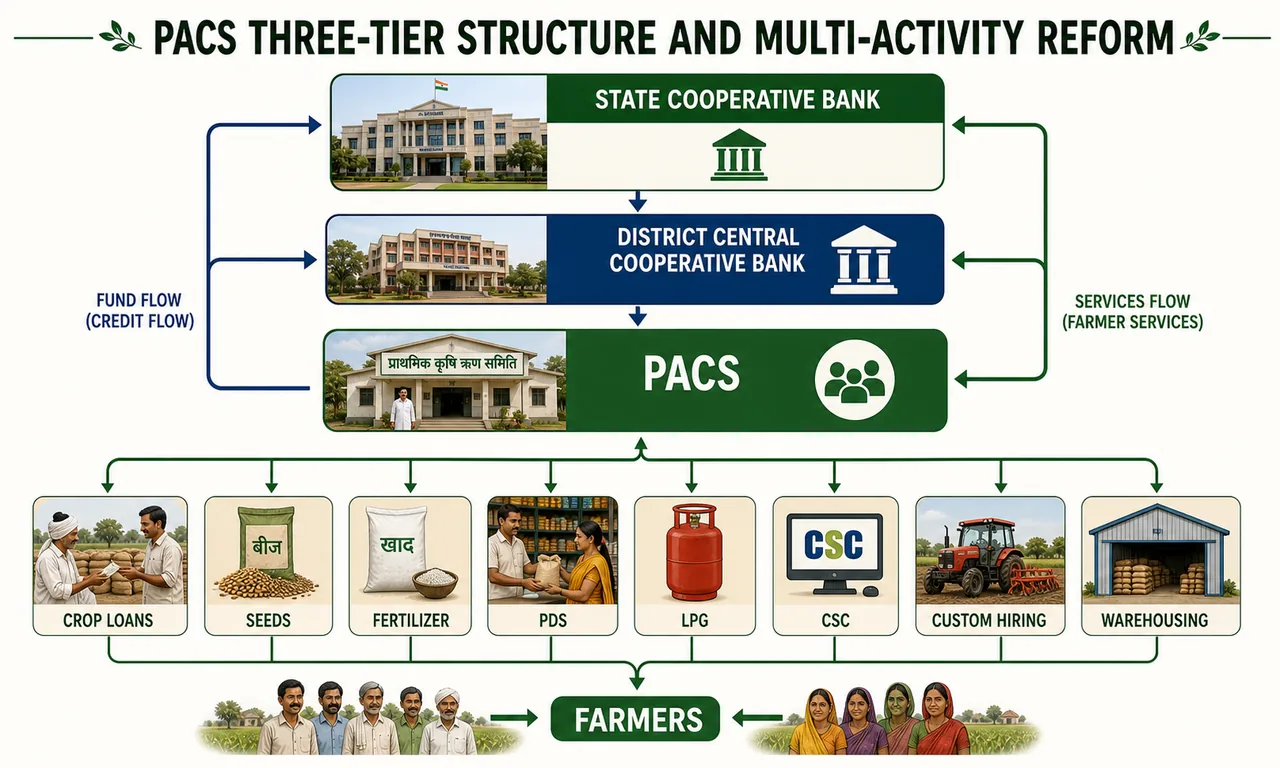
Primary Agricultural Credit Societies (PACS) are the grassroots-level institutions in India's cooperative credit structure. They form the base of the three-tier short-term cooperative credit pyramid and are the closest cooperative institution to the farmer.
Three-Tier Short-Term Cooperative Credit Structure
| Level | Institution | Role |
|---|---|---|
| State/National | State Cooperative Banks (StCBs) | Apex-level coordination and refinance |
| District | District Central Cooperative Banks (DCCBs) | Channel funds between StCBs and PACS |
| Village/Grassroots | PACS | Direct credit delivery to farmers |
IMPORTANT
This three-tier structure is one of the most frequently asked topics in banking and agriculture exams. Always remember the flow: StCB → DCCB → PACS.
Key Features
| Feature | Detail |
|---|---|
| Total PACS in India | ~1,00,000+ (over 97,000) |
| Total farmer members | 13 crore+ |
| Operating level | Village and block level |
| Primary function | Short-term crop loans to member farmers |
| Additional functions | Distribution of seeds, fertilizers, pesticides; procurement for FCI/state agencies |
Recent Reforms — Multi-Activity PACS
The government has issued model bye-laws to transform PACS from single-purpose credit societies into multi-activity centres:
| New Activity | Purpose |
|---|---|
| Fair Price Shops (PDS) | Public distribution of subsidized food |
| LPG distribution | Last-mile delivery of cooking gas |
| Common Service Centers (CSCs) | Digital services for rural citizens |
| Custom Hiring Centers | Farm equipment rental for small farmers |
| Warehousing and storage | Linked to e-NWR for commodity-backed financing |
| Pradhan Mantri Kisan Samriddhi Kendras | One-stop shop for farmer needs |
TIP
Exam fact: Over 35,293 PACS now function as Pradhan Mantri Kisan Samriddhi Kendras. The modernization drive includes computerization of all PACS across India.
PACS Computerization
- Central scheme to digitize all ~1 lakh PACS across India
- Provides software, hardware, and connectivity to PACS
- Enables real-time data on credit, procurement, and distribution
- Links PACS to national-level cooperative databases
NOTE
PACS are the most important cooperative institution for exams because they directly interact with farmers. Questions test the three-tier structure, total count, and recent multi-activity reforms.
Summary Cheat Sheet
| Concept / Topic | Key Details / Explanation |
|---|---|
| NAFED | National Agricultural Cooperative Marketing Federation; est. 2 October 1958; HQ: New Delhi |
| NAFED status | Apex cooperative for marketing; registered under Multi State Co-operative Societies Act |
| NAFED nodal role | MSP operations for oilseeds and pulses since 1991; also handles onion price support |
| NAFED members | Agricultural farmers (main), State Marketing Federations, NCDC |
| NCDC | National Cooperative Development Corporation; est. by Act of Parliament in 1962, came into force 1963 |
| NCDC role | Financial backbone of cooperative movement; provides loans, subsidies, grants to cooperatives |
| NCDC ministry | Ministry of Agriculture & Farmers Welfare; HQ: New Delhi |
| TRIFED | Tribal Cooperative Marketing Federation; est. 1987; under Ministry of Tribal Affairs |
| TRIFED role | Marketing of tribal products — honey, lac, gum, mahua, tendu leaves, handicrafts |
| Mnemonic — NNT | NAFED markets, NCDC finances, TRIFED serves tribals; all HQ in New Delhi |
| TRIFED trick question | Under Ministry of Tribal Affairs, NOT Agriculture |
| Seeds Act | 1966 — quality control and certification of seeds |
| Insecticides Act | 1968 — registration, labelling, safe use of pesticides |
| Fertiliser Control Order | 1985 — regulate price, distribution, quality of fertilizers |
| India's grain production | ~310 MT annually |
| Current storage capacity | 145 MT (47%) — over half at risk of post-harvest losses |
| Grain Storage Plan | Rs 1 lakh crore; 70 MT additional capacity via cooperatives; 5-year timeline from June 2023 |
| New total capacity | 215 MT (145 + 70) |
| Godown per block | 2,000 tonnes capacity in every block across India |
| PACS | 1,00,000+ Primary Agricultural Credit Societies with 13 crore+ farmer members |
| PACS level | Village/grassroots — base of cooperative credit pyramid |
| Three-tier structure | StCB → DCCB → PACS |
| PACS primary function | Short-term crop loans to member farmers |
| PACS additional functions | Seed/fertilizer distribution, FCI procurement, Fair Price Shops, LPG, CSCs |
| PACS modernization | Multi-activity PACS under model bye-laws; computerization of all ~1 lakh PACS |
| Kisan Samriddhi Kendras | 35,293 PACS functioning as PM Kisan Samriddhi Kendras |
| Pledge financing | Farmers can get up to 70% loans against stored produce (via e-NWR) |
| Storage plan benefit | Reduces FCI burden, prevents distress sale, cuts transport costs, creates rural employment |