📋 Marketing Functions — Classification Systems
Three major classification systems of agricultural marketing functions by Thomsen, Kohls & Uhl, and Huegy & Mitchell with agricultural examples and exam tips
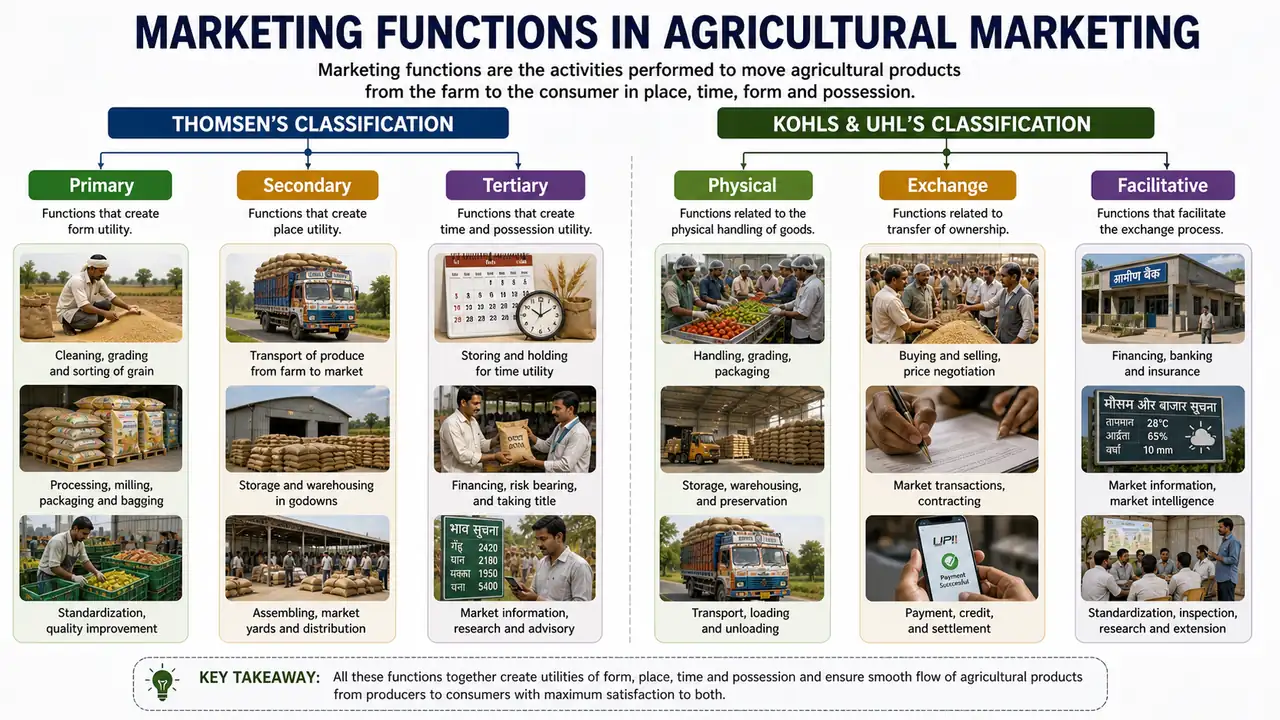
Why Classify Marketing Functions?
When a wheat farmer in Punjab harvests his crop, it passes through many hands before reaching a consumer's kitchen — storage, grading, transport, buying, selling, financing, and more. Each of these activities is a marketing function. Classifying them helps us understand, organize, and improve the agricultural marketing system.
Three scholars have given widely recognized classification systems. Let us study them from simplest to most detailed.
1. Kohls and Uhl Classification (Most Asked in Exams)
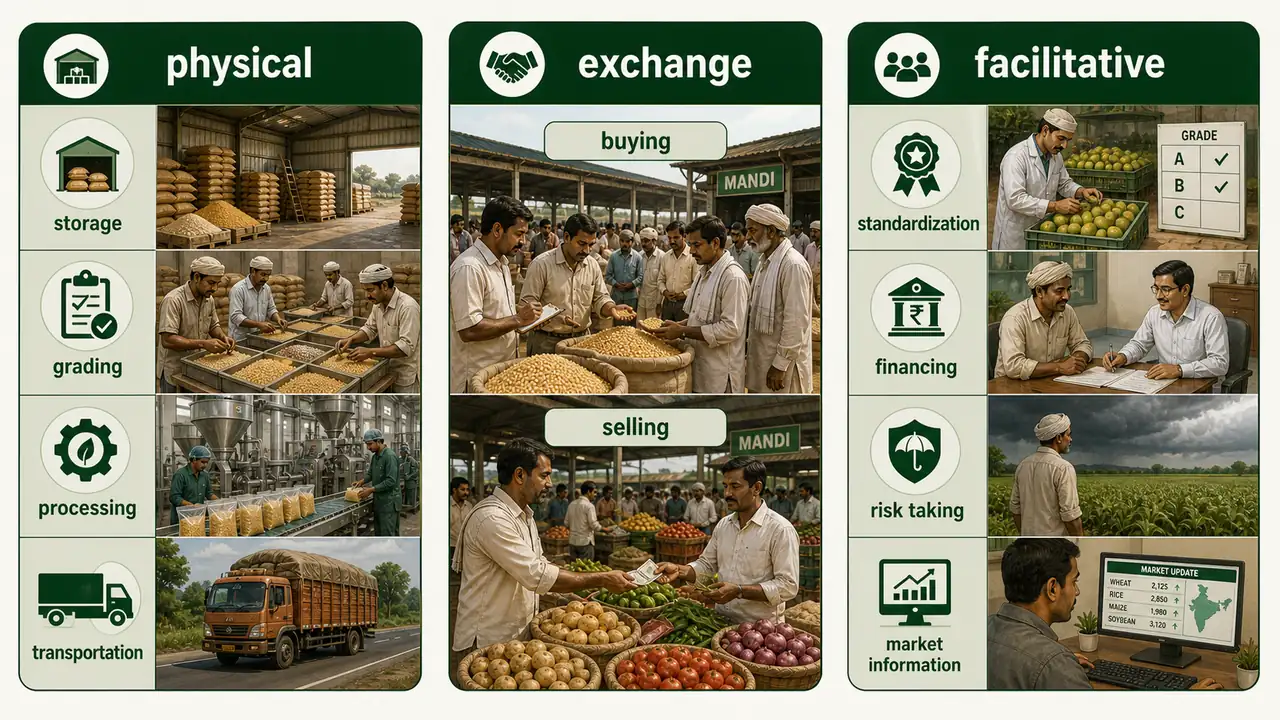
Kohls and Uhl grouped all marketing functions into three neat categories based on their nature.
| Category | Functions | Agricultural Example |
|---|---|---|
| Physical Functions | Storage & Warehousing, Grading, Processing, Transportation | Storing paddy in CWC godowns; grading mangoes by size; milling wheat into flour; trucking onions from Nashik to Delhi |
| Exchange Functions | Buying, Selling | A wholesaler buying groundnut at the mandi; a retailer selling rice to a consumer |
| Facilitative Functions | Standardization of Grades, Financing, Risk Taking, Dissemination of Market Information | Agmark grading for spices; crop loans from NABARD; hedging cotton prices on NCDEX; e-NAM price data |
TIP
Pro Content Locked
Upgrade to Pro to access this lesson and all other premium content.
Charged once for one year · ₹1188 total
Save ₹100/month vs ₹2388/year launch price
- All Agriculture & Banking Courses
- AI Lesson Questions (100/day)
- AI Doubt Solver (50/day)
- Glows & Grows Feedback (30/day)
- AI Section Quiz (20/day)
- 22-Language Translation (100/day)
- Recall Questions (20/day)
- AI Quiz (15/day)
- AI Quiz Paper Analysis (100/day)
- AI Step-by-Step Explanations (100/day)
- Spaced Repetition Recall (FSRS)
- AI Tutor
- Immersive Text Questions
- Audio Lessons — Hindi & English
- Mock Tests & Previous Year Papers
- Summary & Mind Maps
- XP, Levels, Leaderboard & Badges
- Generate New Classrooms
- Voice AI Teacher (AgriDots Live)
- AI Revision Assistant
- Knowledge Gap Analysis
- Interactive Revision (LangGraph)
🔒 Secure one-time yearly payment via Razorpay · No hidden fees
Why Classify Marketing Functions?
When a wheat farmer in Punjab harvests his crop, it passes through many hands before reaching a consumer's kitchen — storage, grading, transport, buying, selling, financing, and more. Each of these activities is a marketing function. Classifying them helps us understand, organize, and improve the agricultural marketing system.
Three scholars have given widely recognized classification systems. Let us study them from simplest to most detailed.
1. Kohls and Uhl Classification (Most Asked in Exams)
Kohls and Uhl grouped all marketing functions into three neat categories based on their nature.
| Category | Functions | Agricultural Example |
|---|---|---|
| Physical Functions | Storage & Warehousing, Grading, Processing, Transportation | Storing paddy in CWC godowns; grading mangoes by size; milling wheat into flour; trucking onions from Nashik to Delhi |
| Exchange Functions | Buying, Selling | A wholesaler buying groundnut at the mandi; a retailer selling rice to a consumer |
| Facilitative Functions | Standardization of Grades, Financing, Risk Taking, Dissemination of Market Information | Agmark grading for spices; crop loans from NABARD; hedging cotton prices on NCDEX; e-NAM price data |
TIP
Mnemonic — PEF: Physical (move/transform goods), Exchange (buy/sell), Facilitative (everything that makes trading easier). This is the most commonly asked classification in exams and IBPS exams.
2. Thomsen's Classification
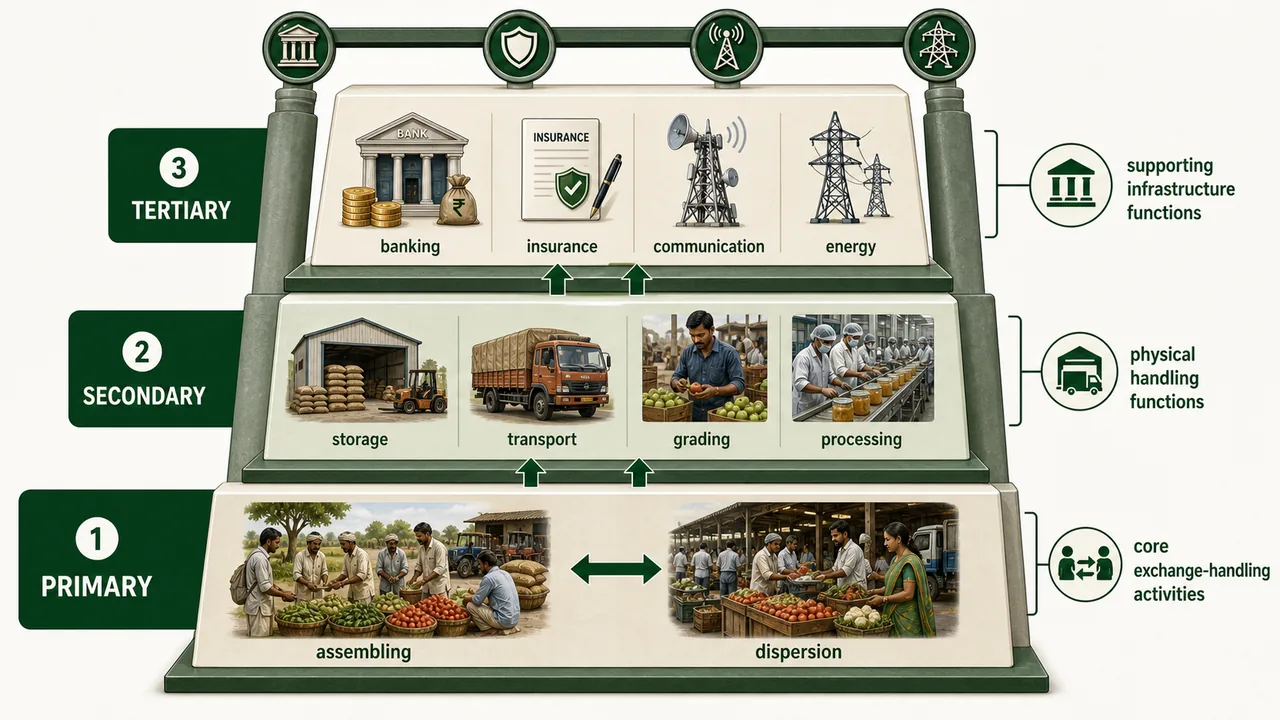
Thomsen used a hierarchy — primary, secondary, and tertiary — based on how directly the function relates to the core marketing process.
| Category | Functions | Agricultural Example |
|---|---|---|
| Primary Functions | Assembling/Procurement, Processing, Dispersion/Distribution | Village-level collection of milk by cooperative; oil extraction from mustard seeds; distributing atta through PDS |
| Secondary Functions | Packing/Packaging, Transportation, Grading/Standardization, Storage/Warehousing, Price Determination, Risk Taking, Financing, Buying & Selling, Demand Creation, Market Information | Jute bags for wheat; cold chain for grapes; Agmark standards; FCI godowns; MSP fixation by CACP; crop insurance; NABARD refinance; mandi auctions; brand promotion of GI-tagged Darjeeling tea; AGMARKNET data |
| Tertiary Functions | Banking, Insurance, Communications, Supply of Energy | Bank loans for agri-marketing; PMFBY crop insurance; telecom for price alerts; electricity for cold storage |
IMPORTANT
Primary = core activities (assembling, processing, distribution). Secondary = support functions that add value. Tertiary = infrastructure services (banking, insurance, communication, energy) that enable the entire system.
Exam Tip: Thomsen's tertiary functions are infrastructure services that exist outside the marketing chain but are essential for it. Think of them as the "backbone" — without electricity, no cold storage; without banking, no financing.
3. Huegy and Mitchell Classification
Huegy and Mitchell introduced a unique third dimension — market management — covering organizational and administrative aspects not found in other classifications.
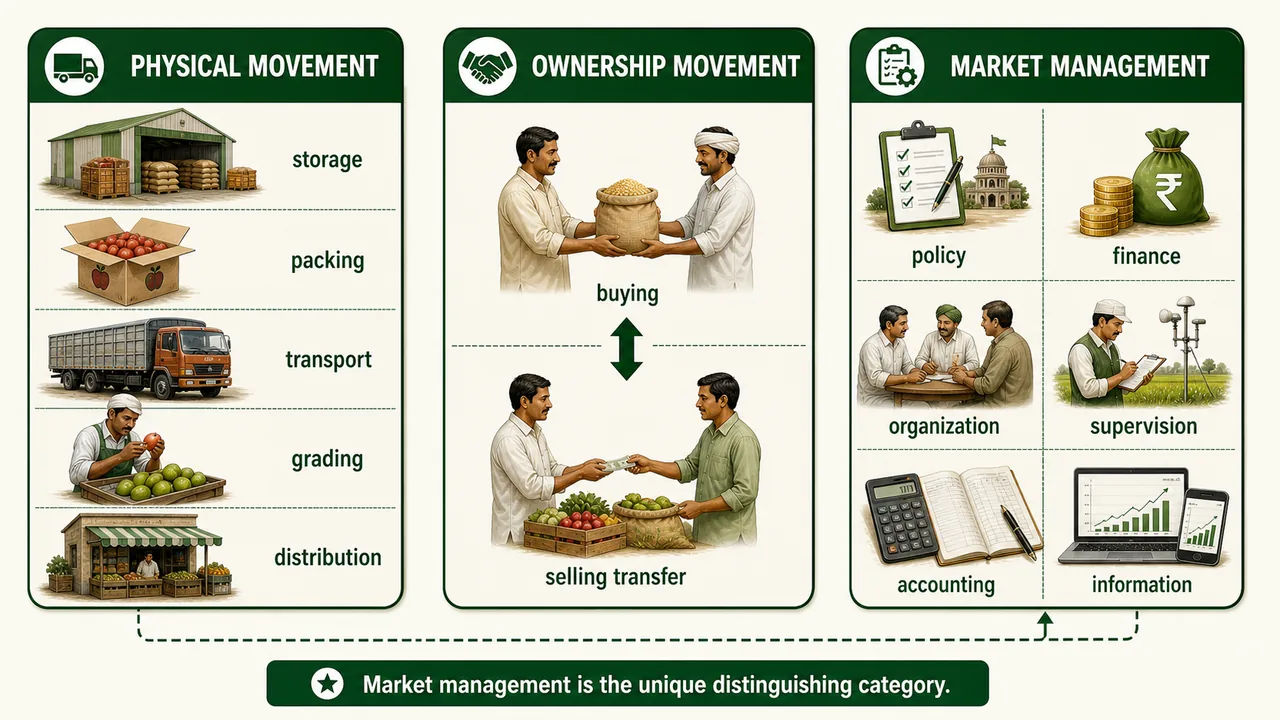
| Category | Functions | Agricultural Example |
|---|---|---|
| Physical Movement Functions | Storage, Packing, Transportation, Grading, Distribution | Warehousing turmeric in Sangli; packing basmati rice for export; rail transport of foodgrains; grading cotton by staple length |
| Ownership Movement Functions | Determining Need, Creating Demand, Finding Buyers & Sellers, Negotiating Price, Rendering Advice, Transferring Title | Assessing urban demand for organic vegetables; advertising GI-tagged spices; e-NAM connecting buyers and sellers; mandi auction bidding; extension officers advising farmers; sale deed for warehouse receipts |
| Market Management Functions | Formulating Policies, Financing, Providing Organization, Supervision, Accounting, Securing Information | APMC market regulation; NABARD refinance; setting up FPOs; FSSAI supervision; mandi fee accounting; AGMARKNET data collection |
NOTE
Huegy & Mitchell's market management category is what makes their classification unique. It captures the planning, financing, and administrative work that keeps the marketing system running smoothly — something the other two systems do not explicitly address.
Comparison of All Three Systems
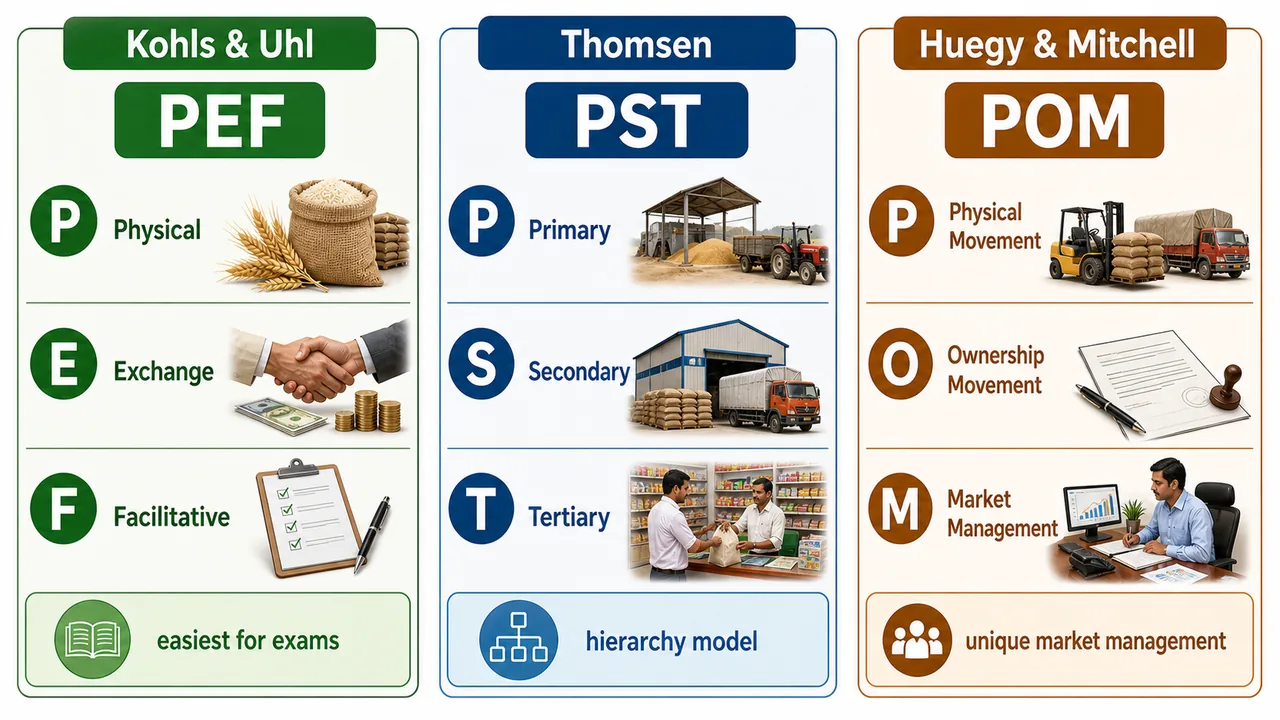
| Aspect | Thomsen | Kohls & Uhl | Huegy & Mitchell |
|---|---|---|---|
| Basis of Classification | Hierarchy (primary, secondary, tertiary) | Nature of function (physical, exchange, facilitative) | Type of movement (physical, ownership, management) |
| Number of Categories | 3 | 3 | 3 |
| Unique Feature | Includes infrastructure (tertiary) | Cleanest separation of buying/selling from physical handling | Includes market management |
| Most Asked in Exams | Moderate | Highest | Lower |
| Agricultural Relevance | Broad coverage | Practical and easy to apply | Best for understanding market regulation |
Exam Tips and Mnemonics
| System | Mnemonic | Key Words to Remember |
|---|---|---|
| Thomsen | PST — Primary, Secondary, Tertiary | "Think of a 3-storey building: ground floor does the work, first floor supports, top floor provides utilities" |
| Kohls & Uhl | PEF — Physical, Exchange, Facilitative | "PEF = Paddy (physical), Exchange (buy-sell), Facilitate (make it easier)" |
| Huegy & Mitchell | POM — Physical, Ownership, Management | "POM = move the Product, transfer Ownership, Manage the market" |
TIP
If the exam asks "Which classification includes market management as a category?" the answer is always Huegy & Mitchell. If it asks about facilitative functions, the answer is Kohls & Uhl.
Summary Cheat Sheet
| Concept / Topic | Key Details / Explanation |
|---|---|
| Why classify? | Helps understand, organize, and improve the agricultural marketing system |
| Kohls & Uhl — basis | Nature of function: Physical, Exchange, Facilitative |
| Physical Functions | Storage & Warehousing, Grading, Processing, Transportation |
| Exchange Functions | Buying and Selling (transfer of ownership) |
| Facilitative Functions | Standardization of Grades, Financing, Risk Taking, Market Information |
| Kohls Mnemonic | PEF — Physical, Exchange, Facilitative |
| Thomsen — basis | Hierarchy: Primary, Secondary, Tertiary |
| Primary Functions | Assembling/Procurement, Processing, Distribution |
| Secondary Functions | Packing, Transport, Grading, Storage, Price Discovery, Risk Taking, Financing, Buying & Selling, Demand Creation, Market Info |
| Tertiary Functions | Banking, Insurance, Communications, Energy — infrastructure backbone |
| Thomsen Mnemonic | PST — Primary, Secondary, Tertiary |
| Huegy & Mitchell — basis | Type of movement: Physical, Ownership, Management |
| Physical Movement | Storage, Packing, Transportation, Grading, Distribution |
| Ownership Movement | Determining need, creating demand, finding buyers/sellers, negotiating price, rendering advice, transferring title |
| Market Management (unique) | Formulating policies, financing, providing organization, supervision, accounting, securing information |
| What makes H&M unique | Market Management category — planning, financing, administration; absent in other two systems |
| Exam: "market management" | Answer is always Huegy & Mitchell |
| Exam: "facilitative functions" | Answer is always Kohls & Uhl |
| Exam: "tertiary/infrastructure" | Answer is always Thomsen |
| All three systems | Each has exactly 3 categories; all cover the same marketing activities but grouped differently |
Lesson Doubts
Ask questions, get expert answers