🏦 Marketing Institutions and Hedging
Public sector institutions (DMI, CACP, FCI, CCI, JCI), commodity boards, cooperative sector institutions (NCDC, NAFED, TRIFED), warehousing corporations, and the concept of hedging in agricultural markets
Why Marketing Institutions Matter
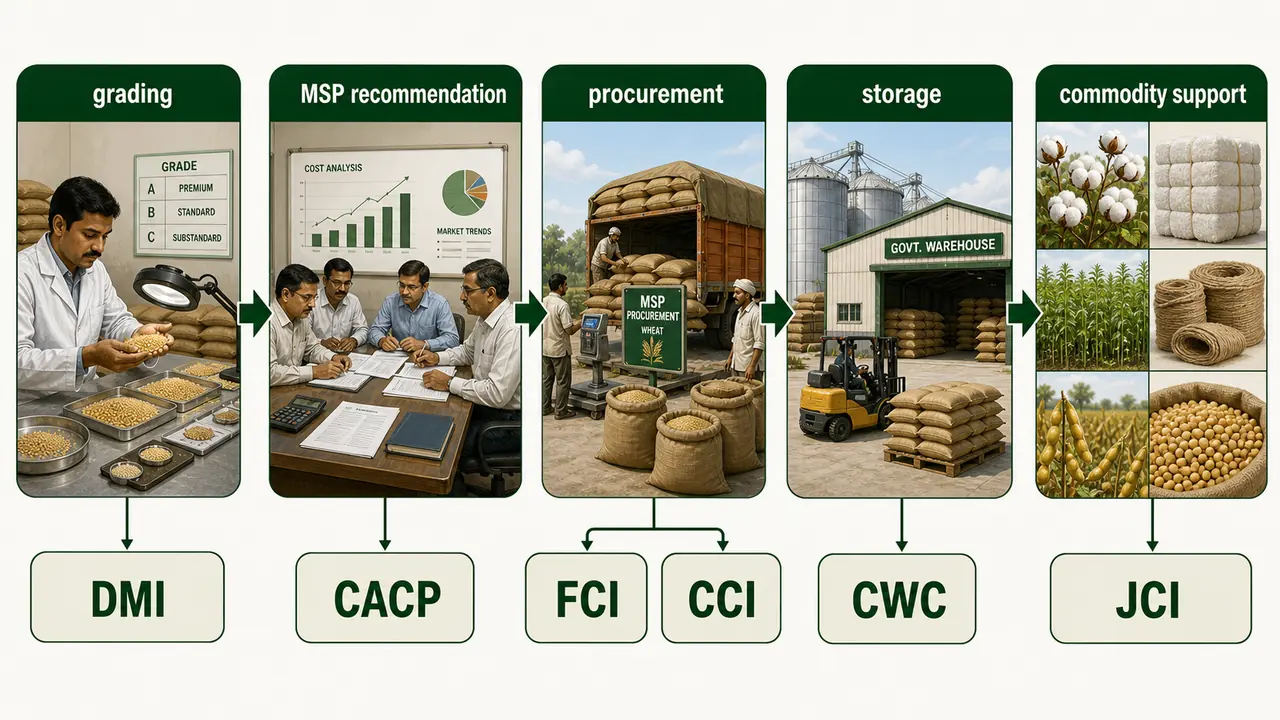
Consider a cotton farmer in Maharashtra. Who grades his cotton? (DMI). Who recommends the MSP? (CACP). Who procures it at MSP? (CCI). Who stores it? (CWC). Who helps him hedge against price fall? (NCDEX). Behind every step in the agricultural marketing chain, there is an institution. Understanding these institutions is essential for both exams and real-world agricultural knowledge.
Public Institutions Across the Marketing Chain
A. Public Sector Institutions
Core Institutions
| Institution | Full Form | Key Role | Agricultural Example |
|---|---|---|---|
| DMI | Directorate of Marketing and Inspection | Grading, standardization (Agmark), market surveys | Certifying Agmark grade for turmeric powder |
| CACP | Commission for Agricultural Costs and Prices | Recommends MSP for 23 crops | Recommending wheat MSP based on cost of production |
| FCI | Food Corporation of India | Procurement, storage, distribution of foodgrains under PDS | Procuring paddy at MSP from Punjab farmers |
| CCI | Cotton Corporation of India | Procurement and marketing of cotton | Buying raw cotton at MSP in Gujarat |
| JCI | Jute Corporation of India | Procurement and marketing of raw jute | Buying jute at MSP in West Bengal |
TIP
Pro Content Locked
Upgrade to Pro to access this lesson and all other premium content.
Charged once for one year · ₹1188 total
Save ₹100/month vs ₹2388/year launch price
- All Agriculture & Banking Courses
- AI Lesson Questions (100/day)
- AI Doubt Solver (50/day)
- Glows & Grows Feedback (30/day)
- AI Section Quiz (20/day)
- 22-Language Translation (100/day)
- Recall Questions (20/day)
- AI Quiz (15/day)
- AI Quiz Paper Analysis (100/day)
- AI Step-by-Step Explanations (100/day)
- Spaced Repetition Recall (FSRS)
- AI Tutor
- Immersive Text Questions
- Audio Lessons — Hindi & English
- Mock Tests & Previous Year Papers
- Summary & Mind Maps
- XP, Levels, Leaderboard & Badges
- Generate New Classrooms
- Voice AI Teacher (AgriDots Live)
- AI Revision Assistant
- Knowledge Gap Analysis
- Interactive Revision (LangGraph)
🔒 Secure one-time yearly payment via Razorpay · No hidden fees
Why Marketing Institutions Matter
Consider a cotton farmer in Maharashtra. Who grades his cotton? (DMI). Who recommends the MSP? (CACP). Who procures it at MSP? (CCI). Who stores it? (CWC). Who helps him hedge against price fall? (NCDEX). Behind every step in the agricultural marketing chain, there is an institution. Understanding these institutions is essential for both exams and real-world agricultural knowledge.
Public Institutions Across the Marketing Chain
A. Public Sector Institutions
Core Institutions
| Institution | Full Form | Key Role | Agricultural Example |
|---|---|---|---|
| DMI | Directorate of Marketing and Inspection | Grading, standardization (Agmark), market surveys | Certifying Agmark grade for turmeric powder |
| CACP | Commission for Agricultural Costs and Prices | Recommends MSP for 23 crops | Recommending wheat MSP based on cost of production |
| FCI | Food Corporation of India | Procurement, storage, distribution of foodgrains under PDS | Procuring paddy at MSP from Punjab farmers |
| CCI | Cotton Corporation of India | Procurement and marketing of cotton | Buying raw cotton at MSP in Gujarat |
| JCI | Jute Corporation of India | Procurement and marketing of raw jute | Buying jute at MSP in West Bengal |
TIP
Mnemonic — "DCFCJ": DMI grades it, CACP prices it, FCI stores it, CCI and JCI buy cotton and jute. These five form the backbone of public sector agricultural marketing.
Specialized Commodity Boards
India has several commodity-specific boards that promote production, processing, and marketing of their respective crops.
| Board | Commodity | Key Function |
|---|---|---|
| Tea Board | Tea | Promotion, quality control, export development |
| Rubber Board | Rubber | Research, development, price stabilization |
| Coffee Board | Coffee | Marketing, quality improvement, auction |
| Spices Board | Spices | Export promotion, quality certification |
| Coconut Board | Coconut | Technology transfer, marketing support |
| Tobacco Board | Tobacco | Auction, export promotion |
| Cardamom Board | Cardamom | Grading, auction, research |
| Arecanut Board | Arecanut | Marketing, price information |
| Coir Board | Coir | Export promotion, training |
| Silk Board | Silk | Sericulture development, marketing |
| Oilseeds & Vegetable Oils Board | Oilseeds | Production and price support |
| NHB | National Horticulture Board | Horticulture infrastructure, cold chain |
| NDDB | National Dairy Development Board | Dairy development (Operation Flood legacy) |
Exam Tip: Boards like Tea, Coffee, Rubber, and Spices are associated with plantation crops grown in specific regions. NHB covers fruits and vegetables. NDDB is the dairy giant behind Amul's cooperative model.
Other Important Public Institutions
| Institution | Full Form | Role |
|---|---|---|
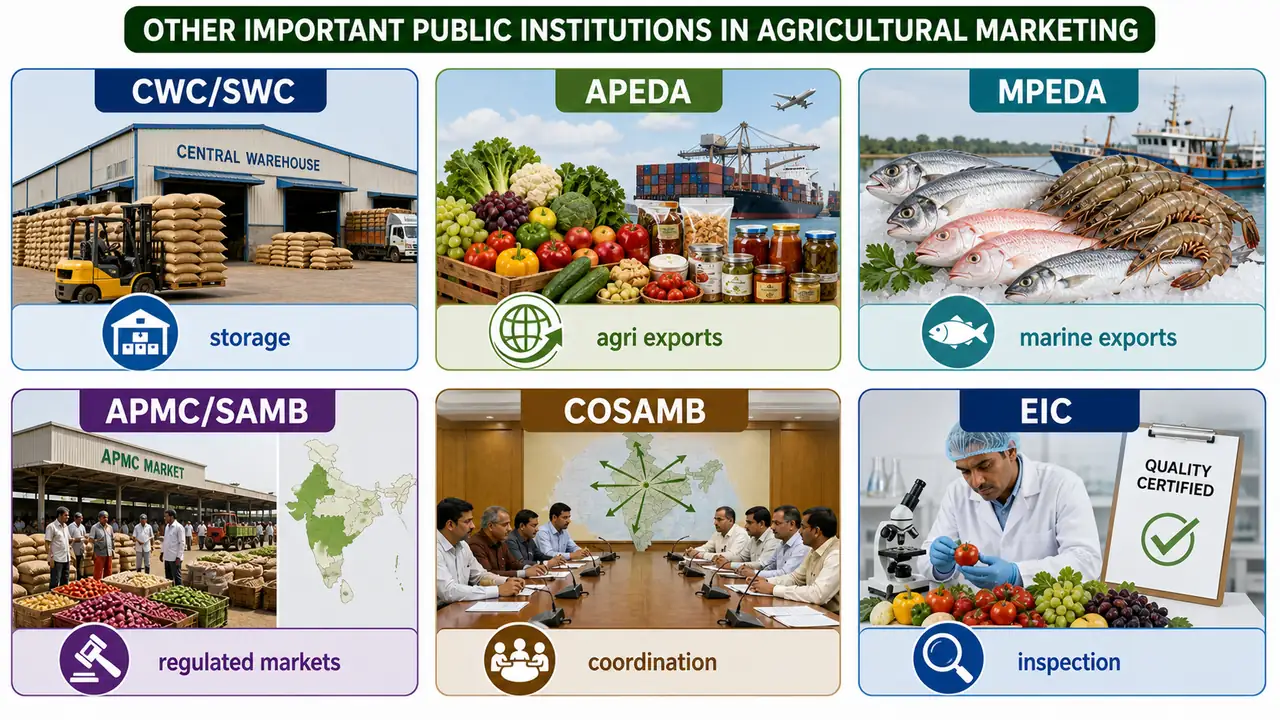
| CWC | Central Warehousing Corporation | Scientific storage at national level |
| SWCs | State Warehousing Corporations | State-level warehousing |
| STC | State Trading Corporation | State-controlled trade in select commodities |
| APEDA | Agricultural and Processed Food Export Development Authority | Promotes agri-exports (basmati rice, mangoes, spices) |
| Export Inspection Council | — | Quality inspection for export products |
| MPEDA | Marine Products Export Development Authority | Promotes seafood exports |
| SEPC | Silk Export Promotion Council | Silk exports |
| CEPCI | Cashewnut Export Promotion Council of India | Cashew exports |
| APMCs | Agricultural Produce Market Committees | State-level regulated markets |
| SAMBs | State Agricultural Marketing Boards | Coordinate APMCs at state level |
| COSAMB | Council of State Agricultural Marketing Boards | National coordination of state marketing boards |
| — | State Directorates of Agricultural Marketing | Implement marketing policies at state level |
| — | Research Institutions & Agricultural Universities | Market research and extension |
NOTE
APEDA handles export of processed foods, fresh fruits, and vegetables. MPEDA handles marine products. Together they cover most of India's agricultural export promotion. These two are frequently tested in exams.
Cooperative Marketing Architecture
B. Cooperative Sector Institutions
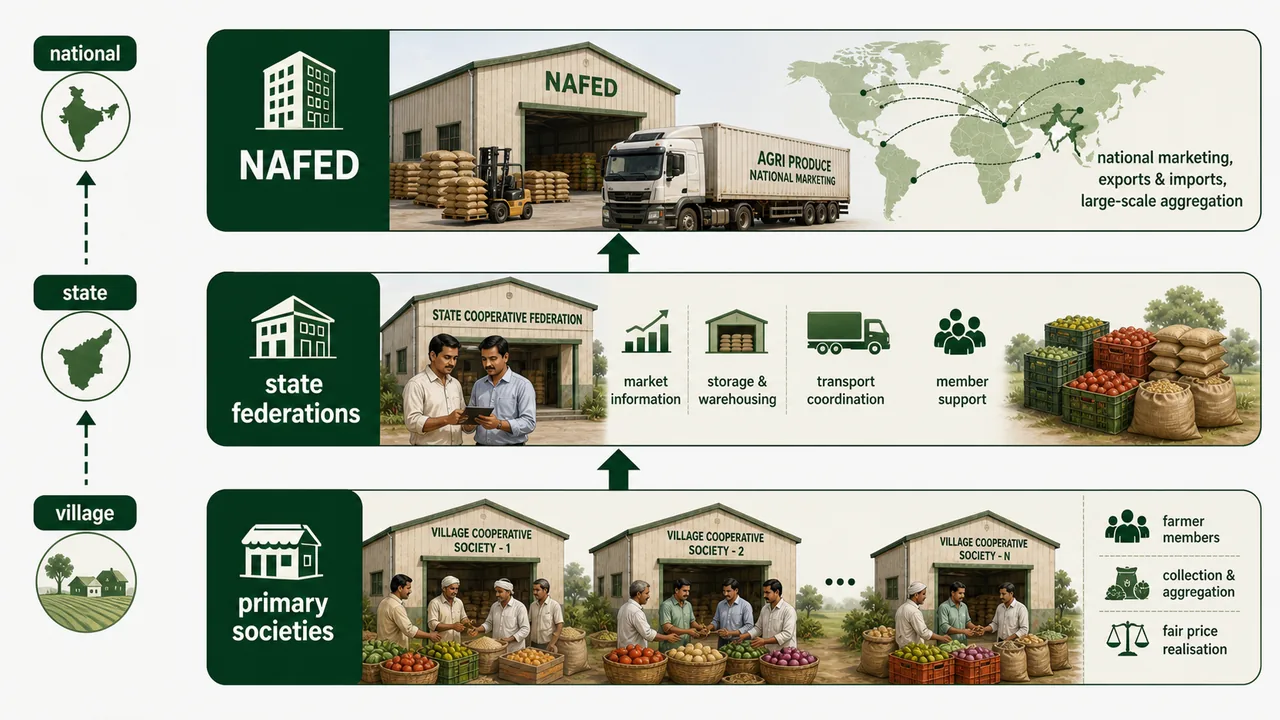
Cooperatives bring farmers together for collective marketing strength. The cooperative marketing structure has three tiers — village, state, and national.
| Institution | Full Form | Level | Key Role |
|---|---|---|---|
| Primary Agricultural Cooperative Marketing Societies | — | Village/Block | First point of aggregation for farm produce |
| State Cooperative Marketing Federations | — | State | Coordinate primary societies, handle state-level trade |
| NAFED | National Agricultural Cooperative Marketing Federation | National | Apex cooperative for marketing; MSP operations for oilseeds and pulses |
| NCDC | National Cooperative Development Corporation | National | Financial assistance to cooperatives |
| TRIFED | Tribal Cooperative Marketing Federation | National | Marketing of tribal products and forest produce |
| NTGF | National Cooperative Tobacco Growers Federation | National | Tobacco growers' marketing cooperative |
| NCCF | National Consumers Cooperative Federation | National | Consumer cooperative for essential commodities |
| Special Commodity Cooperative Organizations | Sugarcane, Cotton, Milk | Varies | Commodity-specific cooperatives (e.g., sugar mills, Amul) |
IMPORTANT
Three-tier cooperative marketing structure: Primary societies (village) -> State federations -> National federation (NAFED). This mirrors the three-tier Panchayati Raj structure and is frequently asked in exams.
From Institutions to Price-Risk Management
Hedging in Agricultural Markets
What Is Hedging?
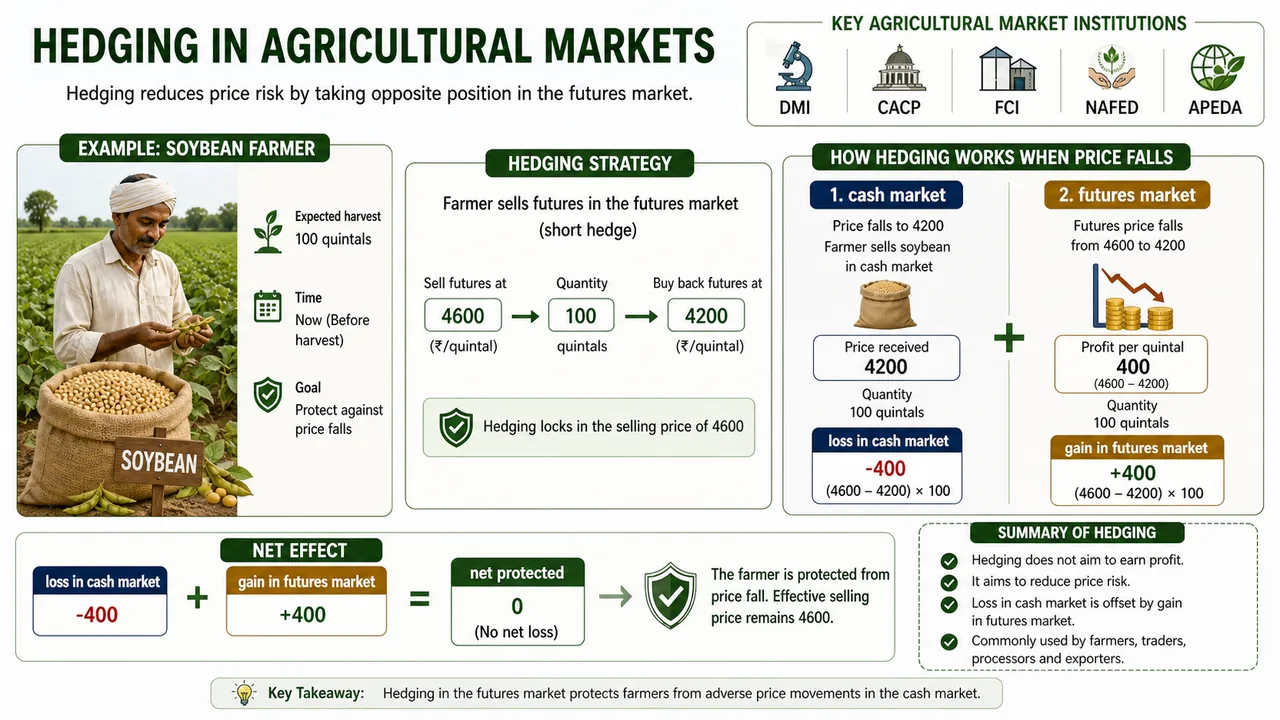
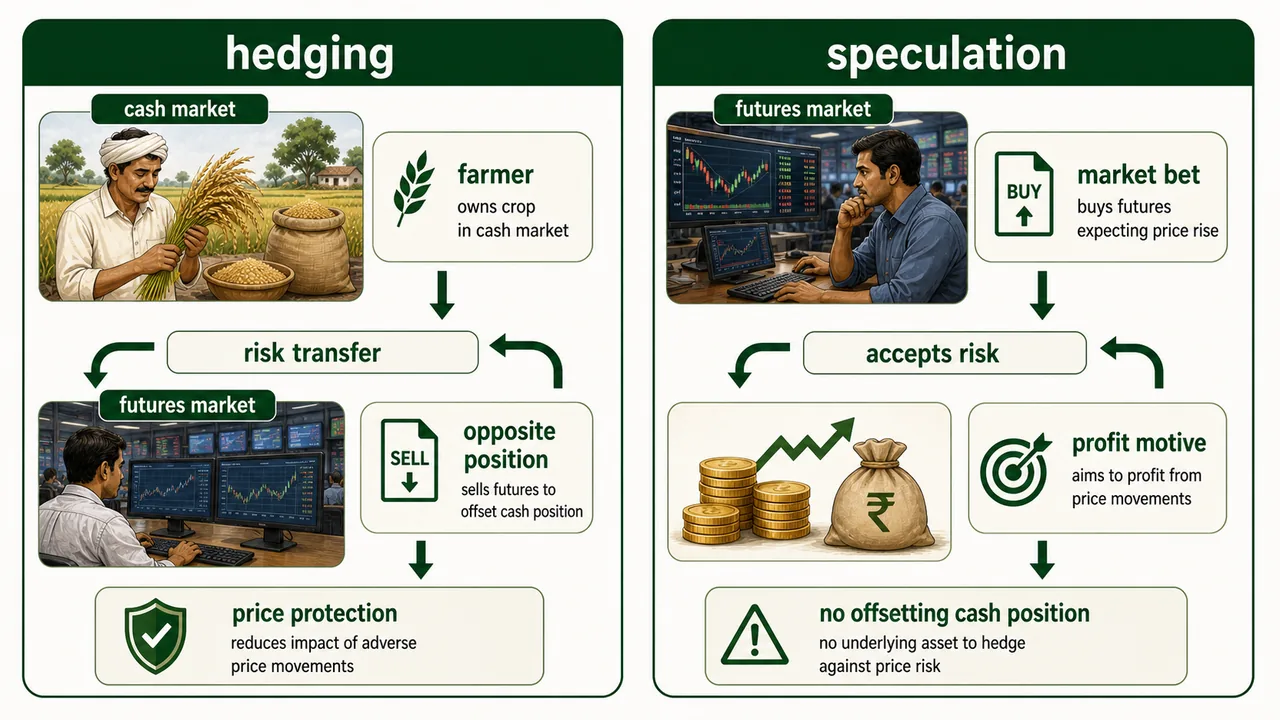
A soybean farmer in Madhya Pradesh fears that prices will crash by the time his crop is ready in November. To protect himself, he sells soybean futures on NCDEX today at the current price. If prices do fall by November, his loss in the physical market is offset by his gain in the futures market. This is hedging.
- Hedging is a trading technique of transferring the price risk from one party to another
- It protects traders and farmers from extreme price crashes
- Definition: "Hedging is executing opposite sales or purchases in the futures market to offset the purchases or sales of physical products made in the cash market"
How Hedging Works — Step by Step
| Step | Cash Market (Physical) | Futures Market |
|---|---|---|
| October (sowing) | Farmer has soybean crop growing (long position) | Farmer sells soybean futures at Rs 4,000/quintal (short position) |
| November (harvest) | Market price falls to Rs 3,500/quintal — farmer sells in mandi | Farmer buys back futures at Rs 3,500 — earns Rs 500/quintal profit |
| Net Result | Loss of Rs 500/quintal | Gain of Rs 500/quintal |
| Overall | Break-even — price risk eliminated |
NOTE
Hedging involves taking an equal but opposite position in the futures market. If a farmer holds stock (long in cash market), he sells futures (short in futures market). The key principle: what you lose in one market, you gain in the other.
Key Points for Exams
| Aspect | Detail |
|---|---|
| Purpose | Transfer price risk, not to make profit |
| Mechanism | Opposite positions in cash and futures markets |
| Who uses it | Farmers, traders, processors, exporters |
| Indian exchanges | NCDEX (National Commodity & Derivatives Exchange), MCX (Multi Commodity Exchange) |
| Commodities hedged | Soybean, cotton, chana, guar, mustard, turmeric, etc. |
Exam Tip: Hedging is NOT speculation. A hedger wants to avoid risk; a speculator accepts risk hoping for profit. If the exam asks about transferring price risk, the answer is always hedging.
Summary Cheat Sheet
| Concept / Topic | Key Details / Explanation |
|---|---|
| DMI | Directorate of Marketing & Inspection; grading, standardization (Agmark), market surveys |
| CACP | Commission for Agricultural Costs & Prices; recommends MSP for 23 crops |
| FCI | Food Corporation of India; nodal agency for procurement, storage, PDS distribution of cereals |
| CCI | Cotton Corporation of India; cotton price support and supply to textile mills |
| JCI | Jute Corporation of India; jute price support in eastern India |
| Mnemonic — DCFCJ | DMI grades, CACP prices, FCI stores, CCI (cotton), JCI (jute) |
| Tea, Rubber, Coffee, Spices Boards | Commodity-specific boards for production, processing, marketing of plantation crops |
| NHB | National Horticulture Board — fruits and vegetables infrastructure |
| NDDB | National Dairy Development Board — dairy development, Operation Flood legacy |
| CWC | Central Warehousing Corporation; scientific storage at national level |
| SWCs | State-level warehousing; capital 50:50 (state + CWC) |
| APEDA | Promotes agri-exports (basmati rice, mangoes, spices); also monitors sugar imports |
| MPEDA | Marine Products Export Development Authority; promotes seafood exports |
| APMCs / SAMBs / COSAMB | Regulated markets at state level, boards, and national coordination |
| NAFED | Apex cooperative for marketing; est. 1958; nodal for oilseeds & pulses MSP since 1991 |
| NCDC | National Cooperative Development Corporation; est. 1962; financial backbone of cooperatives |
| TRIFED | Est. 1987; under Ministry of Tribal Affairs; marketing of tribal products |
| Three-tier cooperative structure | Primary societies (village) → State federations → NAFED (national) |
| Hedging (definition) | Transferring price risk by taking opposite positions in cash and futures markets |
| Hedging mechanism | Long in cash market → short in futures; loss in one market offset by gain in the other |
| Hedging ≠ Speculation | Hedger avoids risk; speculator accepts risk hoping for profit |
| Indian exchanges | NCDEX (National Commodity & Derivatives Exchange), MCX (Multi Commodity Exchange) |
| Commodities hedged | Soybean, cotton, chana, guar, mustard, turmeric, etc. |
Lesson Doubts
Ask questions, get expert answers