🧑🌾 Direct Marketing Channels in Agriculture
Innovative direct marketing channels — Apni Mandi (Punjab, 1987), Hadaspar Market (Pune), Rythu Bazars (Andhra Pradesh), Uzhavar Sandies (Tamil Nadu), Krushak Bazars (Odisha), and the concept of marketing channels
The Problem with Traditional Marketing
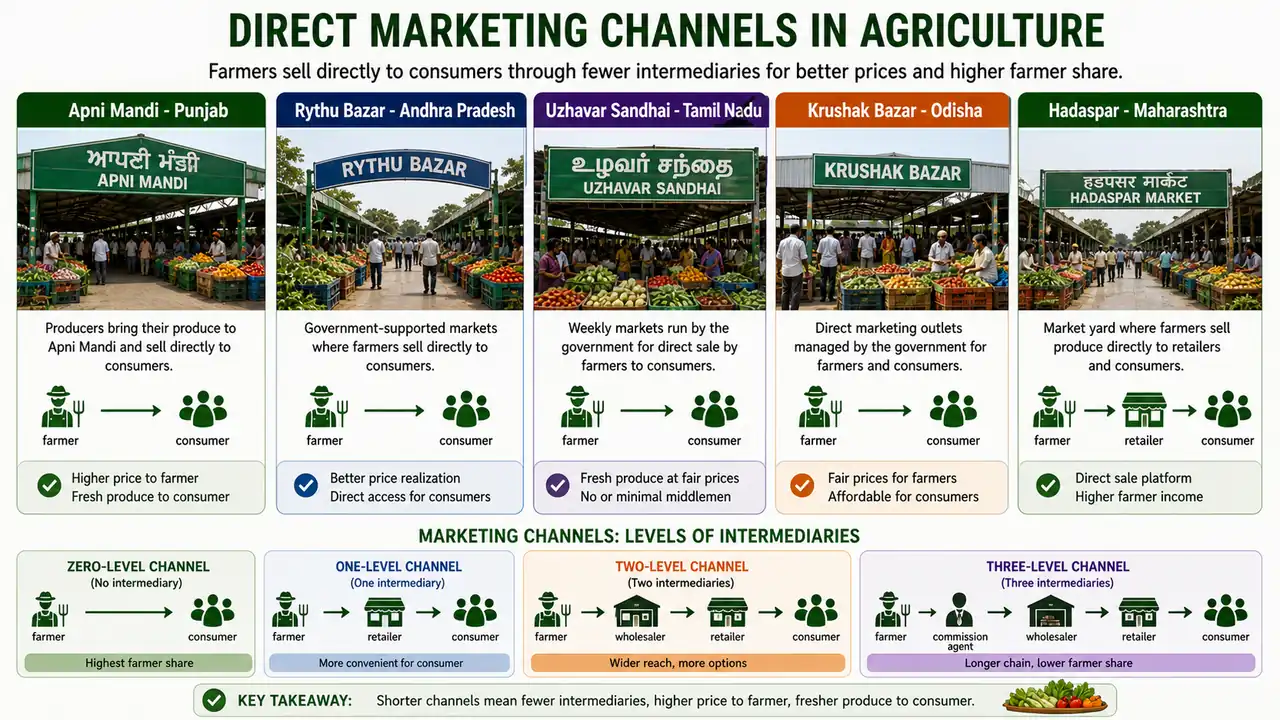
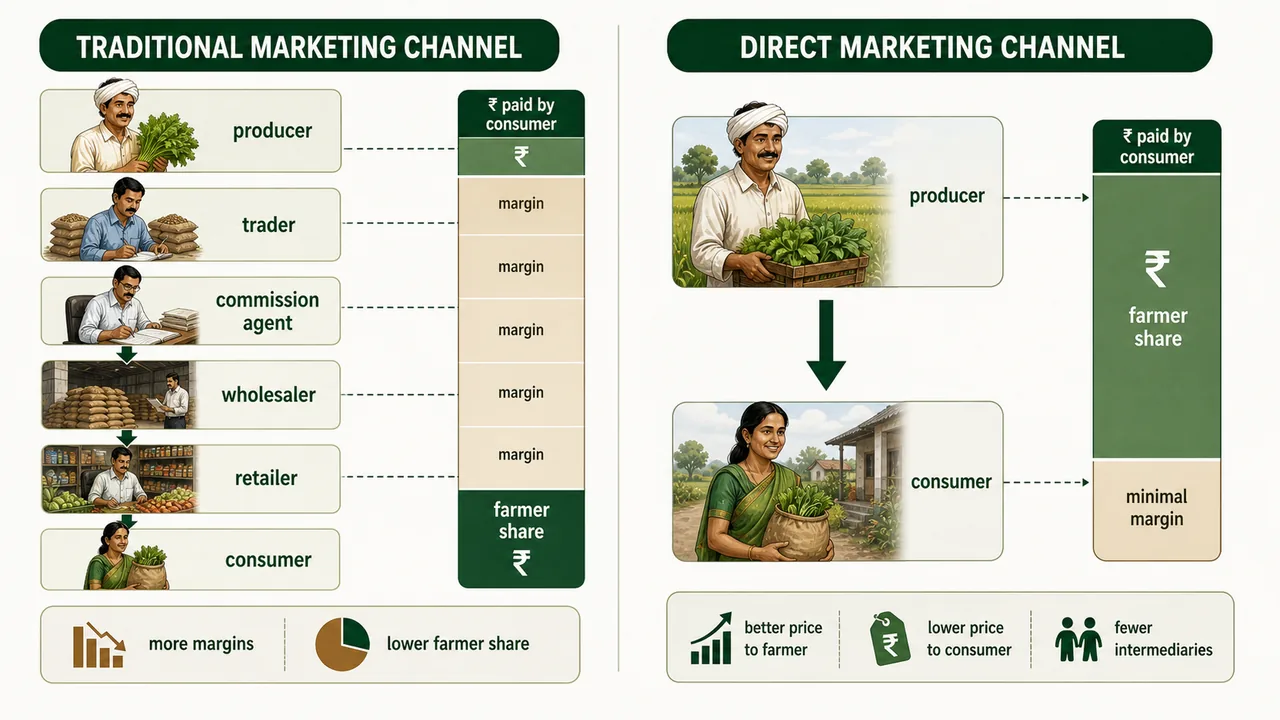
A vegetable farmer in Tamil Nadu grows tomatoes. In the traditional marketing chain, his produce passes through a village trader, a commission agent at the mandi, a wholesaler, and finally a retailer before reaching the consumer. At each stage, a margin is added. The farmer who sold at Rs 10/kg watches the consumer pay Rs 40/kg — the farmer received only 25% of the consumer's rupee. Direct marketing was introduced to cut out these intermediaries and let the farmer sell directly to the consumer.
What Is a Marketing Channel?
According to Moore et al., the chain of intermediaries through whom various foodgrains pass from producers to consumers constitutes their marketing channels.
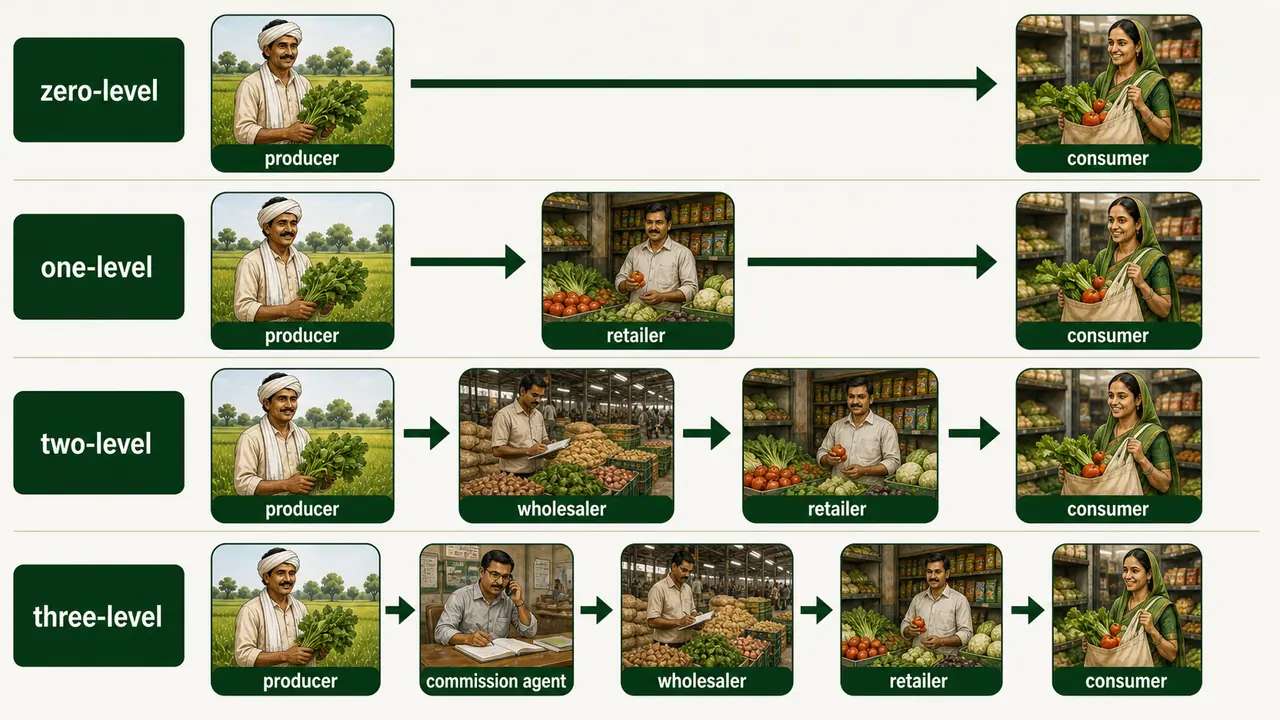
Common Marketing Channels for Agricultural Produce
| Channel | Path | Example |
|---|---|---|
| Zero-level (Direct) | Producer -> Consumer | Farmer selling vegetables at Apni Mandi |
| One-level | Producer -> Retailer -> Consumer | Farmer selling to a local fruit shop |
| Two-level | Producer -> Wholesaler -> Retailer -> Consumer | Wheat from Punjab mandi to Delhi retailer |
| Three-level | Producer -> Commission Agent -> Wholesaler -> Retailer -> Consumer | Typical APMC mandi channel for most crops |
TIP
Pro Content Locked
Upgrade to Pro to access this lesson and all other premium content.
Charged once for one year · ₹1188 total
Save ₹100/month vs ₹2388/year launch price
- All Agriculture & Banking Courses
- AI Lesson Questions (100/day)
- AI Doubt Solver (50/day)
- Glows & Grows Feedback (30/day)
- AI Section Quiz (20/day)
- 22-Language Translation (100/day)
- Recall Questions (20/day)
- AI Quiz (15/day)
- AI Quiz Paper Analysis (100/day)
- AI Step-by-Step Explanations (100/day)
- Spaced Repetition Recall (FSRS)
- AI Tutor
- Immersive Text Questions
- Audio Lessons — Hindi & English
- Mock Tests & Previous Year Papers
- Summary & Mind Maps
- XP, Levels, Leaderboard & Badges
- Generate New Classrooms
- Voice AI Teacher (AgriDots Live)
- AI Revision Assistant
- Knowledge Gap Analysis
- Interactive Revision (LangGraph)
🔒 Secure one-time yearly payment via Razorpay · No hidden fees
The Problem with Traditional Marketing
A vegetable farmer in Tamil Nadu grows tomatoes. In the traditional marketing chain, his produce passes through a village trader, a commission agent at the mandi, a wholesaler, and finally a retailer before reaching the consumer. At each stage, a margin is added. The farmer who sold at Rs 10/kg watches the consumer pay Rs 40/kg — the farmer received only 25% of the consumer's rupee. Direct marketing was introduced to cut out these intermediaries and let the farmer sell directly to the consumer.
What Is a Marketing Channel?
According to Moore et al., the chain of intermediaries through whom various foodgrains pass from producers to consumers constitutes their marketing channels.
Common Marketing Channels for Agricultural Produce
| Channel | Path | Example |
|---|---|---|
| Zero-level (Direct) | Producer -> Consumer | Farmer selling vegetables at Apni Mandi |
| One-level | Producer -> Retailer -> Consumer | Farmer selling to a local fruit shop |
| Two-level | Producer -> Wholesaler -> Retailer -> Consumer | Wheat from Punjab mandi to Delhi retailer |
| Three-level | Producer -> Commission Agent -> Wholesaler -> Retailer -> Consumer | Typical APMC mandi channel for most crops |
TIP
Exam Tip: The fewer the intermediaries, the higher the farmer's share in the consumer's rupee. Direct marketing = zero-level channel = maximum benefit to both farmer and consumer.
Innovative Direct Marketing Channels asked in exams, 2022
These are government-supported initiatives where farmers sell directly to consumers without middlemen. Each state gave its own name to the concept.
State Models of Direct Marketing
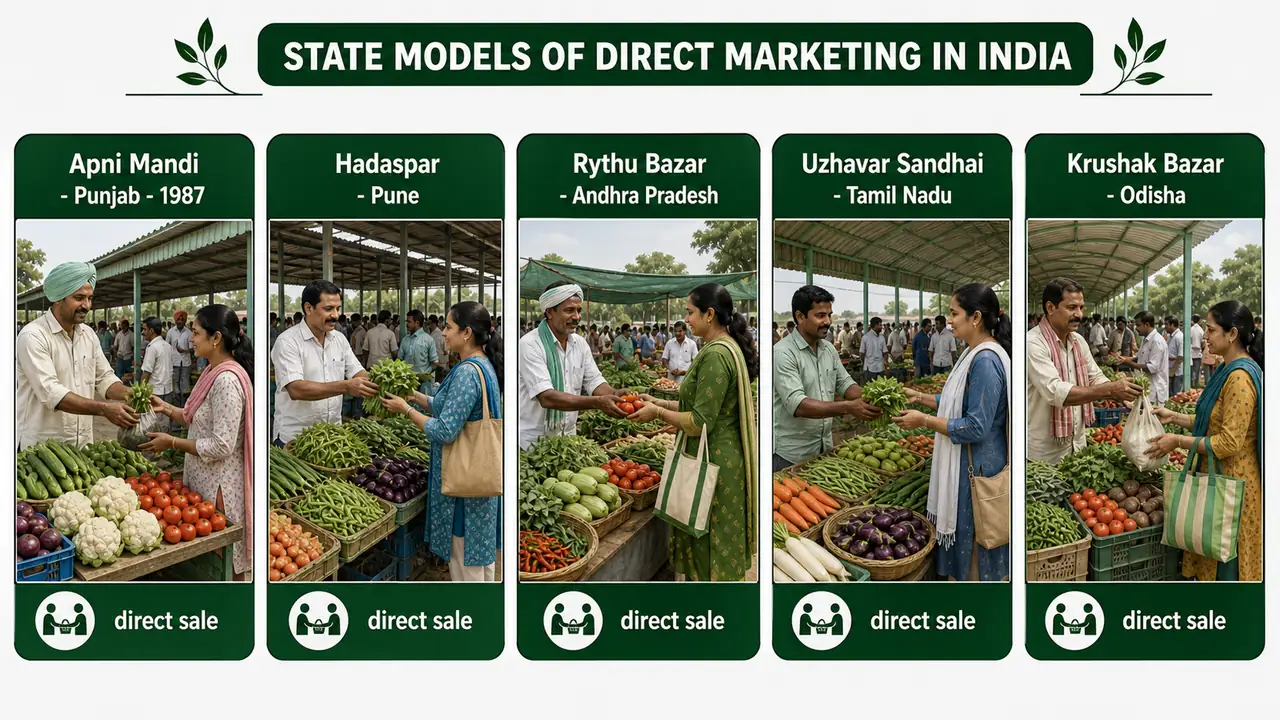
1. Apni Mandi / Kisan Mandi (Punjab)
- Establishes direct contact between the farmer-producer and the consumer
- The system eliminates middlemen completely
- The first Apni Mandi was started in Punjab by the Punjab Mandi Board at Chandigarh in February 1987
- Farmers bring fresh fruits, vegetables, and other produce to designated urban spaces and sell at prices they decide
- Benefit: Farmers earn 15-20% more than mandi prices; consumers pay 15-20% less than retail prices
IMPORTANT
Apni Mandi (Punjab, 1987) is the most frequently asked direct marketing channel in IBPS AFO, NABARD, and FCI exams. It was the pioneer model that inspired similar markets in other states.
2. Hadaspar Vegetable Market (Maharashtra)
- A model market for direct marketing of vegetables in Pune city
- There are no commission agents or middlemen in this market
- The market has modern weighing machines for fair and transparent weighing
- Buyers purchase vegetables in lots of 100 kgs or 100 numbers
- Agricultural significance: Pune's proximity to vegetable-growing areas (Junnar, Khed, Ambegaon) makes direct marketing viable and reduces transport costs
3. Rythu Bazars (Andhra Pradesh)
- Established in major cities of Andhra Pradesh
- "Rythu" means farmer in Telugu
- Primary objective: provide a direct link between farmers and consumers in the marketing of fruits, vegetables, and other essential food items
- Government provides infrastructure — sheds, platforms, water, electricity — at no cost to farmers
- Agricultural significance: Reduced post-harvest losses of perishable vegetables by shortening the supply chain
4. Uzhavar Sandies (Tamil Nadu)
- Uzhavar Sandies (Farmers' Markets) were established in selected municipal and panchayat areas of Tamil Nadu by the state government
- "Uzhavar" means farmer and "Sandhai" means market in Tamil
- Farmers sell directly at government-designated spots, typically early morning
- Agricultural significance: Especially beneficial for small and marginal farmers growing vegetables who cannot afford mandi commissions
5. Krushak Bazar (Odisha)
- On the lines of Rythu Bazars (AP) and Uzhavar Sandies (TN)
- Government of Odisha established Krushak Bazars in the year 2000-01
- "Krushak" means farmer in Odia
- Purpose: empower farmer-producers to compete effectively in the open market without middlemen
- Agricultural significance: Helped tribal and small farmers in Odisha's interior districts access urban consumers directly
Comparing the State Models
Comparison of Direct Marketing Channels
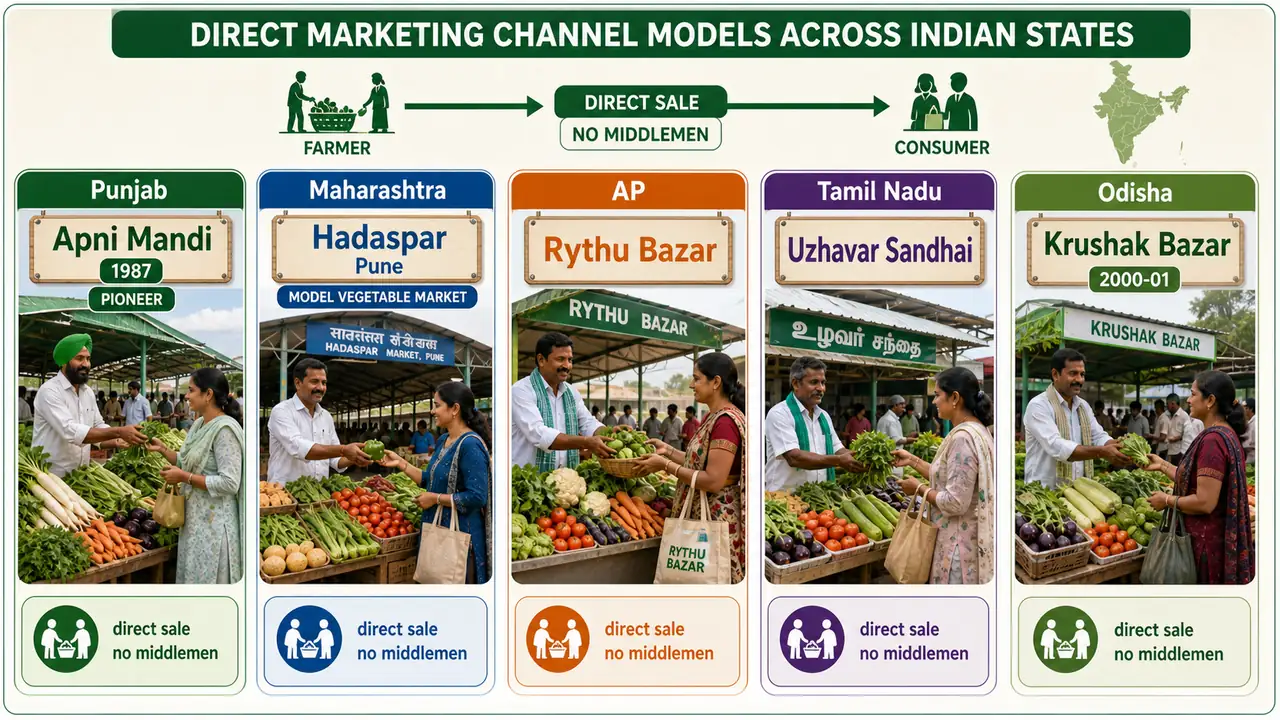
| Channel | State | Year | Local Name Meaning | Key Feature |
|---|---|---|---|---|
| Apni Mandi | Punjab | 1987 | "Our Market" (Punjabi) | Pioneer model; started by Punjab Mandi Board |
| Hadaspar Market | Maharashtra (Pune) | — | Named after Hadaspar area | Model vegetable market; lots of 100 kg |
| Rythu Bazars | Andhra Pradesh | — | "Farmer Markets" (Telugu) | Government-built infrastructure for farmers |
| Uzhavar Sandies | Tamil Nadu | — | "Farmer Markets" (Tamil) | Early morning markets in municipal areas |
| Krushak Bazars | Odisha | 2000-01 | "Farmer Markets" (Odia) | Focus on empowering small farmers |
| Shetkari Bazar | Maharashtra | — | "Farmer Market" (Marathi) | Similar to Rythu Bazars model |
Why Direct Marketing Works
Benefits of Direct Marketing
| Benefit | For Farmer | For Consumer |
|---|---|---|
| Better price realization | Eliminates middleman margins — farmer gets 80-90% of consumer price | Pays less than retail price |
| Reduced post-harvest losses | Shorter chain = less handling damage | Fresher produce |
| Transparency | Farmer sets own price | Direct quality check possible |
| Reduced exploitation | No forced sales to moneylenders or traders | No adulteration risk |
| Quick payment | Cash on the spot | No credit complications |
Exam Tips and Mnemonics
TIP
Mnemonic for state-wise mapping — "PARROT":
- Punjab = Apni Mandi
- Andhra Pradesh = Rythu Bazar
- Remember Hadaspar = Maharashtra (Pune)
- Remember Tamil Nadu = Uzhavar Sandies
- Odisha = Krushak Bazar
- The pioneer = Punjab, 1987
- If the exam says "first direct marketing initiative in India," the answer is Apni Mandi, Punjab, 1987
- All these markets share one common feature: no middlemen between farmer and consumer
- The local names all mean "Farmer's Market" in the respective regional language
Summary Cheat Sheet
| Concept / Topic | Key Details / Explanation |
|---|---|
| Marketing Channel (Moore et al.) | Chain of intermediaries from producers to consumers |
| Zero-level (Direct) | Producer → Consumer; maximum benefit to farmer and consumer |
| One-level | Producer → Retailer → Consumer |
| Two-level | Producer → Wholesaler → Retailer → Consumer |
| Three-level | Producer → Commission Agent → Wholesaler → Retailer → Consumer (typical APMC channel) |
| Direct Marketing | Eliminates all middlemen; farmer gets 80-90% of consumer price |
| Apni Mandi | Punjab, started February 1987 by Punjab Mandi Board at Chandigarh; pioneer model; most asked in IBPS AFO, NABARD, and FCI exams |
| Hadaspar Market | Pune, Maharashtra; model vegetable market; no middlemen; lots of 100 kg or 100 numbers |
| Rythu Bazars | Andhra Pradesh; "Rythu" = farmer (Telugu); govt. provides infrastructure free |
| Uzhavar Sandies | Tamil Nadu; "Uzhavar" = farmer, "Sandhai" = market (Tamil); early morning markets in municipal areas |
| Krushak Bazars | Odisha, established 2000-01; "Krushak" = farmer (Odia); empowers small and tribal farmers |
| Shetkari Bazar | Maharashtra; "Shetkari" = farmer (Marathi); similar to Rythu Bazars |
| Common feature | All direct markets = no middlemen; local names all mean "Farmer's Market" |
| Mnemonic — PARROT | Punjab = Apni Mandi, AP = Rythu Bazar, HaRdaspar = Maharashtra, Tamil Nadu = UzhavaR, Odisha = Krushak, The pioneer = Punjab 1987 |
| Benefit: Better price | Farmer gets more (eliminates margins), consumer pays less than retail |
| Benefit: Reduced losses | Shorter chain = less handling damage = fresher produce |
| Benefit: Transparency | Farmer sets own price; consumer checks quality directly |
| Benefit: Quick payment | Cash on the spot; no credit complications |
| First direct marketing | Apni Mandi, Punjab, 1987 — India's first direct marketing initiative |
Lesson Doubts
Ask questions, get expert answers