🏪 Government Schemes for Agricultural Marketing & Infrastructure
Complete guide to major central government schemes for agricultural marketing and infrastructure — AIF, Operation Greens, GrAMs, FPO scheme, PM Dhan-Dhaanya Krishi Yojana, and e-NWR — with latest updates, key figures, and exam-focused comparison tables.
Why Government Schemes Matter in Agricultural Marketing
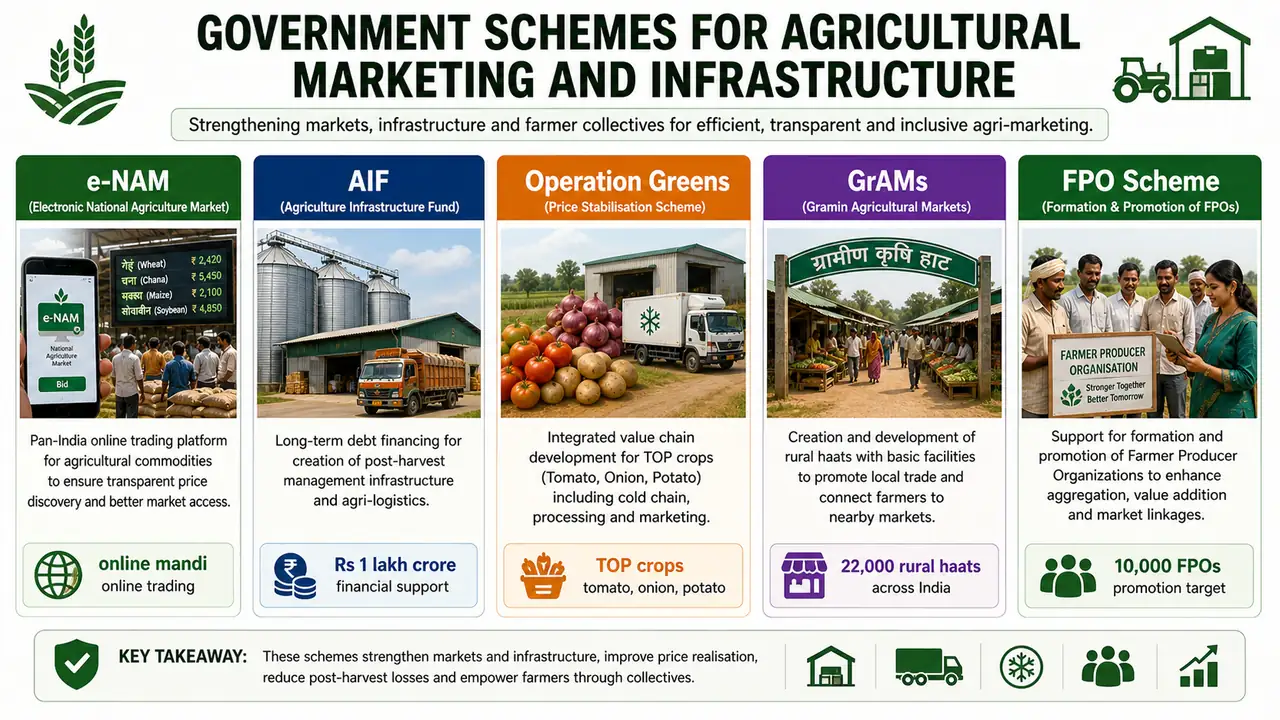
India's agricultural marketing suffers from high intermediary margins, poor cold chain infrastructure, weak bargaining power of small farmers, and distress sale after harvest. The Central Government launched several flagship schemes to address these:
| Problem | Scheme |
|---|---|
| Lack of post-harvest infrastructure | AIF (Agriculture Infrastructure Fund) |
| Price crash for perishables (tomato, onion, potato) | Operation Greens |
| Farmers cut off from retail buyers | GrAMs (Gramin Agricultural Markets) |
| Weak farmer collective bargaining | FPO Scheme (10,000 FPOs) |
| Distress sale after storage | e-NWR + warehouse pledge finance |
1. AIF -- Agriculture Infrastructure Fund
Overview
AIF is a medium to long-term debt financing facility for investment in viable agricultural post-harvest management infrastructure and community farming assets.
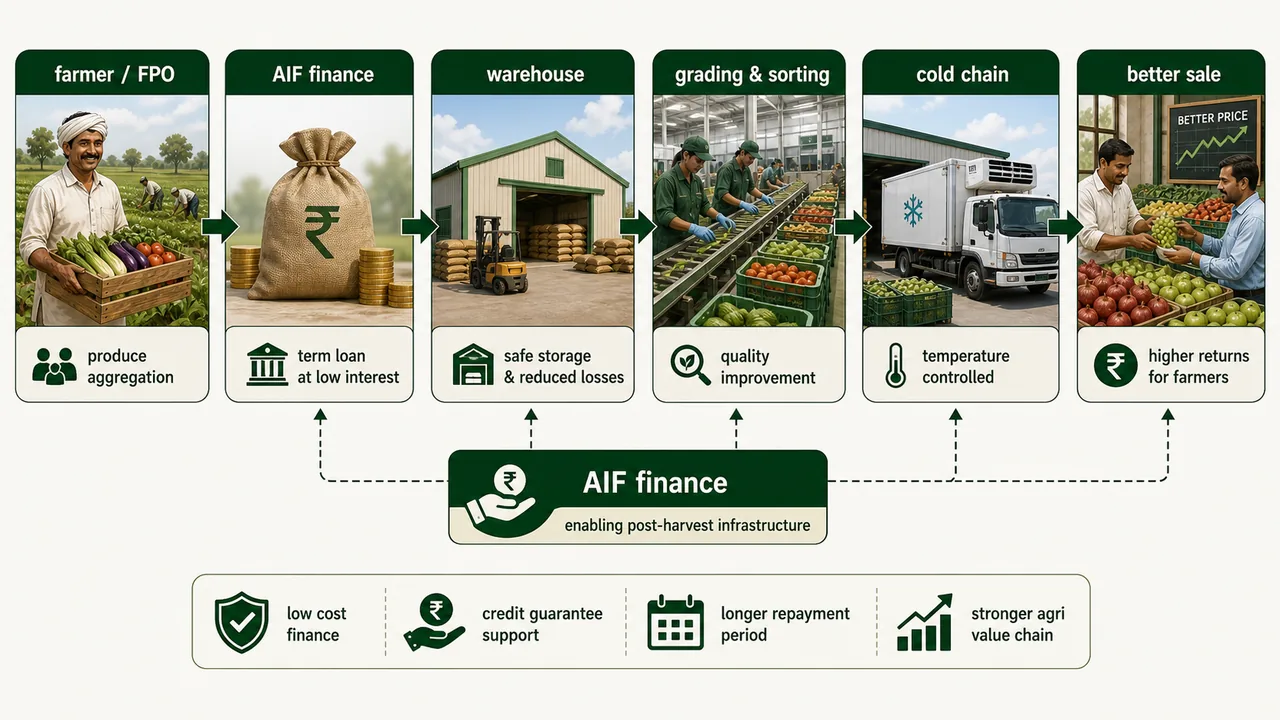
| Feature | Detail |
|---|---|
| Launch | 15 May 2020 (Aatmanirbhar Bharat Package) |
| Total outlay | Rs 1 lakh crore |
| Disbursement period | 2020-21 to 2025-26 (extended to 2032-33 in revised guidelines) |
| Interest subvention | 3% per annum on loans (capped at Rs 2 crore per project) |
| Credit guarantee | Via CGTMSE for loans up to Rs 2 crore |
| Budget 2026-27 allocation | Rs 910 crore |
| Nodal ministry | Ministry of Agriculture & Farmers Welfare |
| Managed by | Participating banks (20+ banks + NBFC-MFIs) |
Why AIF Matters
AIF matters because farmers often lose value not at production stage but after harvest, when they lack storage, grading, cold chain, or first-mile logistics. The fund tries to solve that gap through cheaper long-term infrastructure finance rather than through direct commodity price support.
Pro Content Locked
Upgrade to Pro to access this lesson and all other premium content.
Charged once for one year · ₹1188 total
Save ₹100/month vs ₹2388/year launch price
- All Agriculture & Banking Courses
- AI Lesson Questions (100/day)
- AI Doubt Solver (50/day)
- Glows & Grows Feedback (30/day)
- AI Section Quiz (20/day)
- 22-Language Translation (100/day)
- Recall Questions (20/day)
- AI Quiz (15/day)
- AI Quiz Paper Analysis (100/day)
- AI Step-by-Step Explanations (100/day)
- Spaced Repetition Recall (FSRS)
- AI Tutor
- Immersive Text Questions
- Audio Lessons — Hindi & English
- Mock Tests & Previous Year Papers
- Summary & Mind Maps
- XP, Levels, Leaderboard & Badges
- Generate New Classrooms
- Voice AI Teacher (AgriDots Live)
- AI Revision Assistant
- Knowledge Gap Analysis
- Interactive Revision (LangGraph)
🔒 Secure one-time yearly payment via Razorpay · No hidden fees
Why Government Schemes Matter in Agricultural Marketing
India's agricultural marketing suffers from high intermediary margins, poor cold chain infrastructure, weak bargaining power of small farmers, and distress sale after harvest. The Central Government launched several flagship schemes to address these:
| Problem | Scheme |
|---|---|
| Lack of post-harvest infrastructure | AIF (Agriculture Infrastructure Fund) |
| Price crash for perishables (tomato, onion, potato) | Operation Greens |
| Farmers cut off from retail buyers | GrAMs (Gramin Agricultural Markets) |
| Weak farmer collective bargaining | FPO Scheme (10,000 FPOs) |
| Distress sale after storage | e-NWR + warehouse pledge finance |
1. AIF -- Agriculture Infrastructure Fund
Overview
AIF is a medium to long-term debt financing facility for investment in viable agricultural post-harvest management infrastructure and community farming assets.
| Feature | Detail |
|---|---|
| Launch | 15 May 2020 (Aatmanirbhar Bharat Package) |
| Total outlay | Rs 1 lakh crore |
| Disbursement period | 2020-21 to 2025-26 (extended to 2032-33 in revised guidelines) |
| Interest subvention | 3% per annum on loans (capped at Rs 2 crore per project) |
| Credit guarantee | Via CGTMSE for loans up to Rs 2 crore |
| Budget 2026-27 allocation | Rs 910 crore |
| Nodal ministry | Ministry of Agriculture & Farmers Welfare |
| Managed by | Participating banks (20+ banks + NBFC-MFIs) |
Why AIF Matters
AIF matters because farmers often lose value not at production stage but after harvest, when they lack storage, grading, cold chain, or first-mile logistics. The fund tries to solve that gap through cheaper long-term infrastructure finance rather than through direct commodity price support.
Eligible Entities
| Category | Examples |
|---|---|
| Farmer groups | FPOs, Primary Agricultural Credit Societies (PACS), Self Help Groups (SHGs), Joint Liability Groups (JLGs) |
| Cooperatives | Multi-state cooperatives, state cooperative marketing federations |
| Entrepreneurs | Agri-entrepreneurs, Start-ups in agri-processing |
| State agencies | State governments, State Agricultural Marketing Boards (SAMBs) |
| Central agencies | NAFED, FCI (for specific projects) |
Eligible Projects (Infrastructure Types)
| Category | Examples |
|---|---|
| Cold chain | Cold rooms, reefer vans, pack houses with controlled atmosphere |
| Warehousing | Silos, godowns, scientific storage |
| Sorting & grading | Grading lines, cleaning units, weighbridges |
| Primary processing | Cleaning, drying, milling (primary level only) |
| Logistics | Mobile pre-cooling units, transport refrigeration |
| Community assets | Custom hiring centres for farm machinery |
Latest Developments in AIF
| Development | Detail |
|---|---|
| PACS convergence | PACS (Primary Agricultural Credit Societies) included as eligible entities; major push for village-level infrastructure |
| Extended to 2032-33 | Original 2025-26 sunset extended; long-term capital available |
| PM KUSUM linkage | Solar cold storage and solar-powered warehouses eligible under AIF + PM KUSUM convergence |
| Agri Stack integration | AIF portal integrated with Agri Stack (farmers' digital identity) for faster loan processing |
| Rs 910 crore (Budget 2026-27) | Interest subvention budget reflects scale of loans outstanding |
| 1 lakh+ projects sanctioned | Across states with Maharashtra, UP, MP leading in number of projects |
TIP
Exam numbers: AIF launch 15 May 2020. Outlay Rs 1 lakh crore. Interest subvention 3%. Credit guarantee up to Rs 2 crore via CGTMSE. Eligible: FPOs, PACS, SHGs, cooperatives, agri-entrepreneurs.
2. Operation Greens
Overview
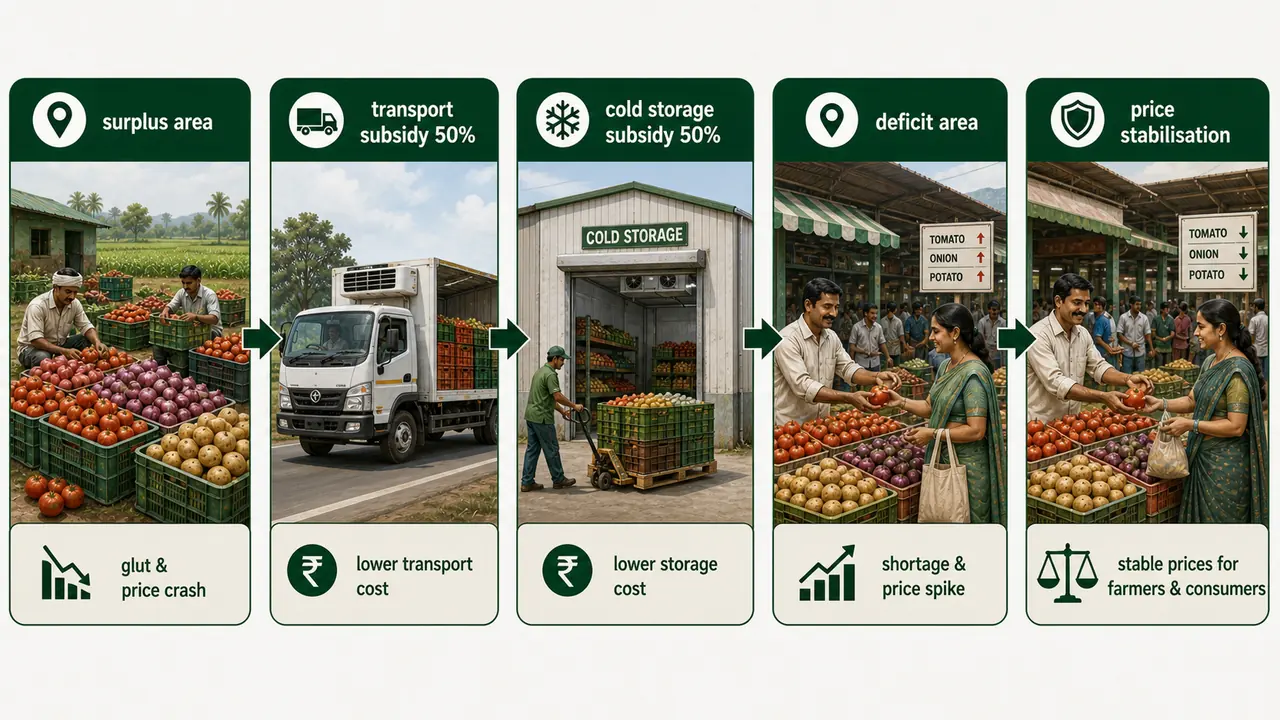
Operation Greens was launched to stabilise the supply and prices of TOP crops (Tomato, Onion, Potato) and later extended to cover 22 perishable crops.
| Feature | Detail |
|---|---|
| Launch | Budget 2018-19 |
| Nodal ministry | Ministry of Food Processing Industries (MoFPI) |
| Implementing agency | NAFED |
| Original scope | TOP crops: Tomato, Onion, Potato |
| Extended scope | 22 perishable crops (Aatmanirbhar Bharat, 2020) |
| Outlay | Rs 500 crore (original); extended budget under AMIF |
| Subsidy | 50% on transport from surplus to deficit area; 50% on storage (cold storage hire charges) |
Why Operation Greens Matters
Operation Greens addresses a classic perishables problem: farmers face price crashes in bumper seasons while consumers face sharp inflation during shortages. The scheme is built to smooth that gap by supporting storage and movement instead of leaving perishables trapped in local gluts.
TOP Crops (Original 3)
| Crop | Price Volatility Issue |
|---|---|
| Tomato (T) | Perishable, bumper crops crash prices; off-season shortage spikes prices |
| Onion (O) | Export-import cycles cause extreme volatility; political sensitivity |
| Potato (P) | Cold storage dependency; winter glut vs summer shortage |
22 Perishable Crops (Extended Scope)
Fruits: Mango, Banana, Guava, Kiwi, Lychee, Papaya, Citrus, Pineapple, Pomegranate, Jackfruit
Vegetables: French Beans, Bitter Gourd, Brinjal, Capsicum, Carrot, Cauliflower, Drumstick, Garlic, Onion, Potato, Tomato, Leafy vegetables
How Operation Greens Works
Surplus production identified → NAFED intervenes as buyer/coordinator
→ Transport subsidy: 50% of cost of transporting from surplus to deficit state
→ Storage subsidy: 50% of cold storage charges for 3 months
→ Surplus sold in deficit markets at reasonable prices
TIP
Mnemonic: "TOP" = Tomato, Onion, Potato. Launched Budget 2018-19. Subsidy = 50% transport + 50% storage. Extended to 22 crops under Aatmanirbhar Bharat.
3. GrAMs -- Gramin Agricultural Markets
Overview
GrAMs (Gramin Agricultural Markets) are rural retail markets upgraded to enable direct farmer-to-consumer/buyer sales, bypassing APMCs.
| Feature | Detail |
|---|---|
| Launch | Budget 2018-19 |
| Number of haats | 22,000 rural haats upgraded to GrAMs |
| APMC exemption | GrAMs are exempt from APMC Act -- no mandi tax, no commission agents |
| Sales model | Direct farmer-to-consumer/buyer |
| Development fund | Rs 2,000 crore from MGNREGS + RIDF (Rural Infrastructure Development Fund via NABARD) |
| Nodal agency | Ministry of Agriculture; NABARD for RIDF funding |
Why GrAMs Matter
GrAMs matter because small farmers often cannot benefit from distant wholesale mandis. By upgrading local haats and exempting them from APMC-style charges, the scheme tries to create a simpler direct-marketing space closer to the village.
Key Features
- Located within 5 km of farm clusters — reduces transport cost for small farmers
- Physical infrastructure upgraded: sheds, weighing facilities, sanitation, roads
- Electronic connectivity: linked to e-NAM for price transparency
- No APMC levy — farmers retain more of sale price
- Weekly/bi-weekly markets at existing haat locations
NOTE
Difference from APMCs: APMCs are regulated wholesale markets with licensed traders, commission agents, and mandi fees. GrAMs are exempt from APMC regulation, designed for direct farm-gate retail sales.
TIP
Exam facts: GrAMs = 22,000 rural haats. Launch = Budget 2018-19. Exempt from APMC Act. Funding = MGNREGS + RIDF (NABARD).
4. FPO Scheme -- Formation & Promotion of 10,000 FPOs
Overview
FPOs (Farmer Producer Organisations) are producer-owned collectives that aggregate small farmers for better input purchasing, processing, and marketing power.
| Feature | Detail |
|---|---|
| Launch | 29 February 2020 |
| Target | 10,000 new FPOs over 5 years (2019-20 to 2023-24) |
| Total outlay | Rs 6,865 crore |
| Equity grant per FPO | Up to Rs 15 lakh (in 3 tranches based on performance) |
| Credit guarantee | Up to Rs 2 crore (via NABSanrakshan -- NABARD's guarantee fund) |
| Project Management Agency (PMA) | NABARD, SFAC, NCDC + 6 other CBBOs |
| Cluster-Based Business Organizations (CBBOs) | 9 implementing agencies incl. NABARD, SFAC, NCDC |
| Minimum members | 300 farmers per FPO (plains); 100 farmers (hilly/tribal/NE areas) |
| Cluster approach | One FPO per 1,000--3,000 ha cluster |
Why the FPO Scheme Matters
The FPO scheme matters because small and marginal farmers are usually too fragmented to negotiate well, invest in post-harvest assets, or access better markets on their own. The scheme strengthens collective bargaining by turning many small sellers into one organized market actor.
Equity Grant Structure (3 Tranches)
| Tranche | Condition | Amount |
|---|---|---|
| 1st | FPO formation + opening bank account | Rs 3 lakh |
| 2nd | Achieving membership target + business plan | Rs 5 lakh |
| 3rd | Completing audit + achieving turnover milestone | Rs 7 lakh |
| Total | Rs 15 lakh |
What FPOs Can Do
- Bulk purchase of seeds, fertilisers, pesticides (lower input cost)
- Collective marketing of produce (higher price realization)
- Access AIF loans for post-harvest infrastructure
- Sell on e-NAM via FPO module
- Apply for Operation Greens benefits
- Lease or own custom hiring centres for farm machinery
Latest Developments in FPO Scheme
| Development | Detail |
|---|---|
| AIF + FPO convergence | FPOs are priority eligible entities under AIF for warehousing and cold chain projects |
| e-NAM FPO module | FPOs can sell directly on e-NAM without individual farmer registration |
| Budget 2023-24 push | Focus on formation of 500+ FPOs in aspirational districts |
| Cooperative-FPO convergence | PACS-based FPOs promoted; PACS can register as FPO under NCDC route |
| Digital onboarding | FPOs given digital IDs under Agri Stack; linked to PM-KISAN, soil health card databases |
| NABSanrakshan | NABARD's credit guarantee fund specifically for FPO loans (up to Rs 2 crore per FPO) |
TIP
Exam facts: Launch = 29 Feb 2020. Target = 10,000 FPOs. Outlay = Rs 6,865 crore. Equity grant = Rs 15 lakh (3 tranches). Credit guarantee = Rs 2 crore (NABSanrakshan). Agencies = NABARD, SFAC, NCDC (9 total CBBOs). Min members = 300 (plains), 100 (hills/NE).
5. PM Dhan-Dhaanya Krishi Yojana
PM Dhan-Dhaanya Krishi Yojana targets India's lowest-productivity agricultural districts for focused intervention.
| Feature | Detail |
|---|---|
| Launch | Budget 2025-26 |
| Allocation | Rs 1,250 crore |
| Target districts | 100 aspirational agricultural districts |
| Focus areas | Productivity improvement, post-harvest infrastructure, credit access |
| Nodal ministry | Ministry of Agriculture & Farmers Welfare |
Key objectives:
- Boost crop productivity in chronically low-output districts
- Build post-harvest storage and processing infrastructure at district level
- Expand formal credit access to underserved farming communities
- Convergence with AIF, FPO scheme, and e-NAM for integrated support
TIP
Exam angle: PM Dhan-Dhaanya = 100 aspirational agri-districts + Rs 1,250 crore (Budget 2025-26). Modelled on Aspirational Districts Programme. Marketing link: post-harvest infra + credit access in low-productivity areas.
6. e-NWR -- Electronic Negotiable Warehouse Receipt
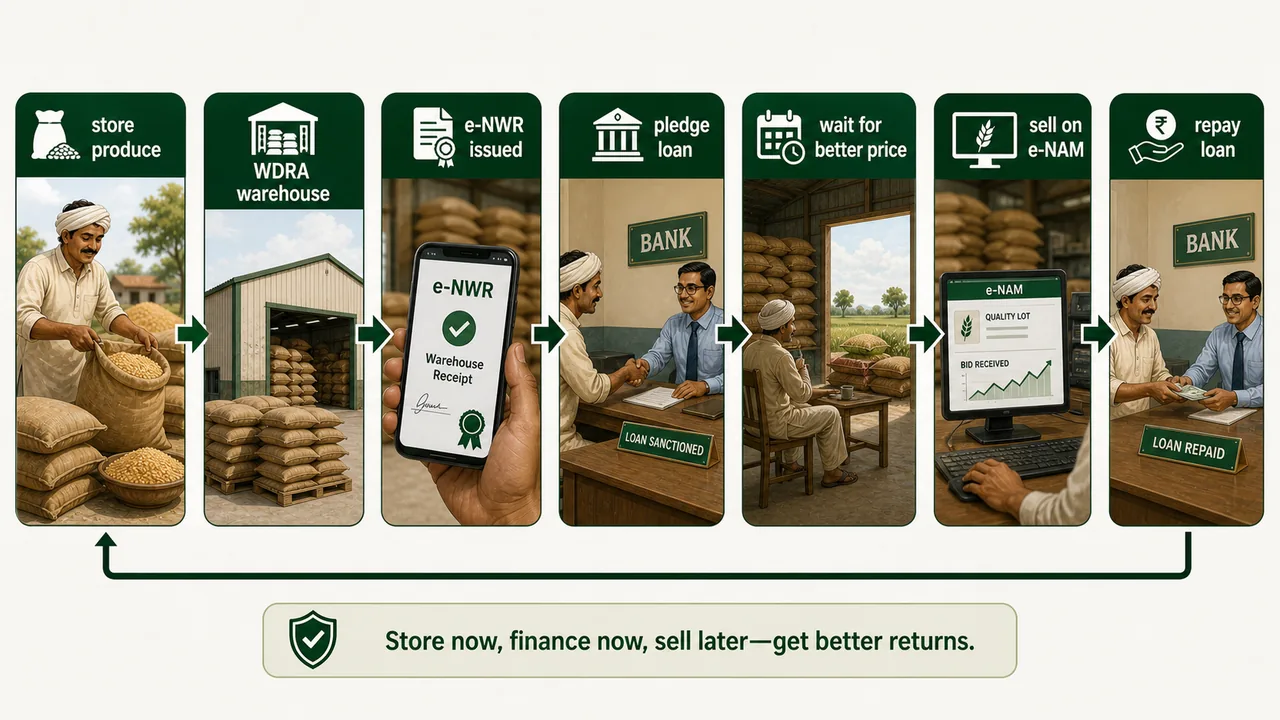
e-NWR is a digital warehouse receipt issued against stored commodities that can be used as collateral to obtain loans — enabling farmers to avoid distress selling.
| Feature | Detail |
|---|---|
| Regulatory body | WDRA (Warehouse Development and Regulatory Authority) |
| Enabling act | Warehousing (Development & Regulation) Act, 2007 |
| Type | Negotiable instrument — transferable, tradeable |
| Mechanism | Farmer deposits commodity → WDRA-registered warehouse issues e-NWR → Bank accepts as collateral → Pledge loan disbursed |
| e-NAM link | e-NWR holders can sell on e-NAM without transporting produce to mandi (e-NAM Warehouse Module) |
Why e-NWR Matters
e-NWR matters because distress sale is often a liquidity problem, not just a marketing problem. If a farmer gets credit against stored produce, he no longer has to sell immediately after harvest when prices are weakest.
How e-NWR stops distress selling:
Harvest → Farmer needs cash → Instead of distress sale at low price:
→ Deposit at WDRA warehouse → Get e-NWR → Pledge to bank → Get 70-80% of commodity value as loan
→ Wait for better price → Sell on e-NAM → Repay loan → Profit
Key benefits:
- Pledge financing: collateral-based loan without selling commodity
- Price risk reduction: farmer waits for favourable market conditions
- Digital & transferable: e-NWR can be sold/transferred like a commodity
- Integration with e-NAM: remote bidding on warehoused produce
NOTE
WDRA vs e-NAM: WDRA regulates warehouses and issues e-NWRs. e-NAM provides the trading platform. Together they create a full pledge-finance-and-sell ecosystem without farm-to-mandi transport.
TIP
Exam angle: e-NWR = digital WR + pledge loan + e-NAM sale. Regulated by WDRA. Reduces distress selling. Component 1 of e-NAM's warehouse module. Act: Warehousing (D&R) Act, 2007.
Scheme Comparison Table
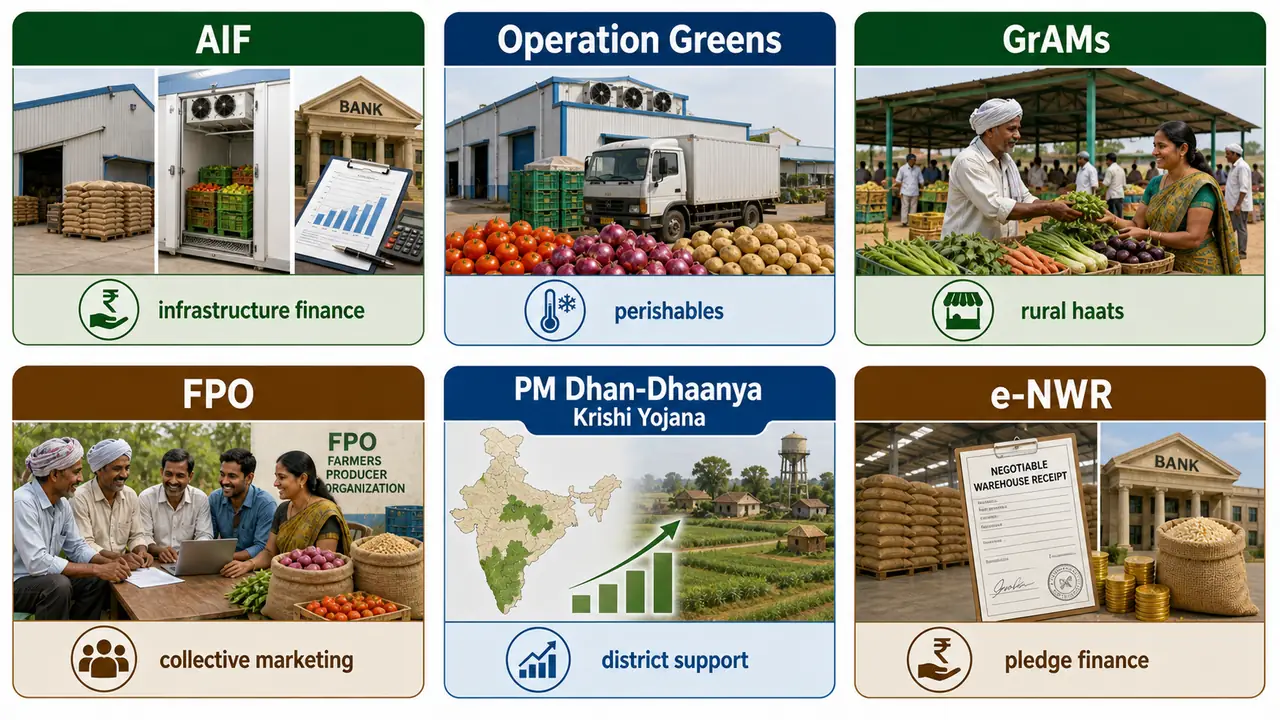
| Scheme | Launch | Ministry | Focus | Key Number |
|---|---|---|---|---|
| AIF | 15 May 2020 | Agri & FW | Post-harvest infra financing | Rs 1 lakh crore; 3% subvention |
| Operation Greens | Budget 2018-19 | Food Processing | Price stabilisation (TOP → 22 crops) | 50% transport + 50% storage |
| GrAMs | Budget 2018-19 | Agri & FW | Direct farm-gate rural markets | 22,000 haats; APMC-exempt |
| FPO Scheme | 29 Feb 2020 | Agri & FW | Farmer collective formation | 10,000 FPOs; Rs 15 lakh grant |
| PM Dhan-Dhaanya KY | Budget 2025-26 | Agri & FW | Low-productivity aspirational districts | 100 districts; Rs 1,250 crore |
| e-NWR | WDR Act 2007 | WDRA | Pledge financing against stored commodity | Negotiable; linked to e-NAM warehouse module |
Summary Cheat Sheet
| Concept | Key Detail |
|---|---|
| AIF launch | 15 May 2020 (Aatmanirbhar Bharat) |
| AIF outlay | Rs 1 lakh crore |
| AIF subvention | 3% interest; credit guarantee Rs 2 crore (CGTMSE) |
| AIF Budget 2026-27 | Rs 910 crore |
| Operation Greens | Budget 2018-19; TOP → 22 crops; 50% transport + 50% storage |
| GrAMs | Budget 2018-19; 22,000 haats; APMC-exempt; MGNREGS + RIDF funding |
| FPO Scheme launch | 29 Feb 2020 |
| FPO target | 10,000 FPOs; outlay Rs 6,865 crore |
| FPO equity grant | Up to Rs 15 lakh (3 tranches) |
| FPO credit guarantee | Rs 2 crore via NABSanrakshan (NABARD) |
| FPO agencies | NABARD, SFAC, NCDC (9 CBBOs total) |
| FPO min members | 300 (plains); 100 (hills/NE/tribal) |
| PM Dhan-Dhaanya KY | Budget 2025-26; 100 aspirational agri-districts; Rs 1,250 crore |
| e-NWR | Digital WR by WDRA; pledge loan against stored commodity; integrates with e-NAM warehouse module |
Lesson Doubts
Ask questions, get expert answers