📘 Farm Management — Essential Terms and Definitions
Understand the core farm-management terms that guide land use, resource classification, cost measurement, and efficiency decisions on a real farm.
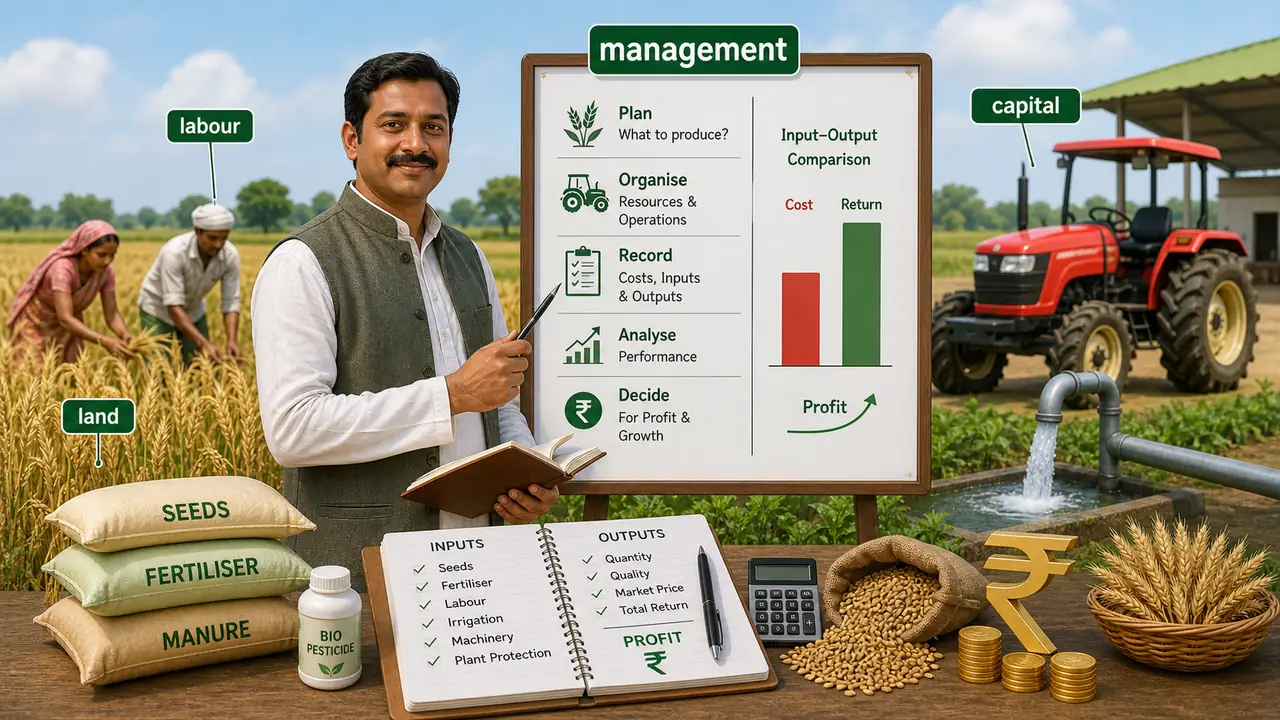
Imagine a wheat farmer in Punjab deciding how much urea to buy, whether to lease extra land, and when to sell the harvest. Every one of these decisions uses the terms defined below. Understanding them is the first step toward scientific farm management.
The same farmer may own some land, lease some land, buy seeds as physical resources, and hire labour as a service. If these basic terms are not clear, later topics such as cost of cultivation, efficiency, and optimum input use start looking harder than they really are.
Farm, Holding and Enterprise
Farm
A farm is a defined piece of land where crop and livestock enterprises operate under a common management with specific boundaries.
Example: A 10-hectare plot in Haryana where a farmer grows wheat in Rabi and paddy in Kharif under single management is one farm.
Pro Content Locked
Upgrade to Pro to access this lesson and all other premium content.
₹99 charged monthly · Cancel anytime
- All Agriculture & Banking Courses
- AI Lesson Questions (100/day)
- AI Doubt Solver (50/day)
- Glows & Grows Feedback (30/day)
- AI Section Quiz (20/day)
- 22-Language Translation (100/day)
- Recall Questions (20/day)
- AI Quiz (15/day)
- AI Quiz Paper Analysis (100/day)
- AI Step-by-Step Explanations (100/day)
- Spaced Repetition Recall (FSRS)
- AI Tutor
- Immersive Text Questions
- Audio Lessons — Hindi & English
- Mock Tests & Previous Year Papers
- Summary & Mind Maps
- XP, Levels, Leaderboard & Badges
- Generate New Classrooms
- Voice AI Teacher (AgriDots Live)
- AI Revision Assistant
- Knowledge Gap Analysis
- Interactive Revision (LangGraph)
🔒 Secure via Razorpay · Cancel anytime · No hidden fees
Imagine a wheat farmer in Punjab deciding how much urea to buy, whether to lease extra land, and when to sell the harvest. Every one of these decisions uses the terms defined below. Understanding them is the first step toward scientific farm management.
The same farmer may own some land, lease some land, buy seeds as physical resources, and hire labour as a service. If these basic terms are not clear, later topics such as cost of cultivation, efficiency, and optimum input use start looking harder than they really are.
Farm, Holding and Enterprise
Farm
A farm is a defined piece of land where crop and livestock enterprises operate under a common management with specific boundaries.
Example: A 10-hectare plot in Haryana where a farmer grows wheat in Rabi and paddy in Kharif under single management is one farm.
Agricultural Holding
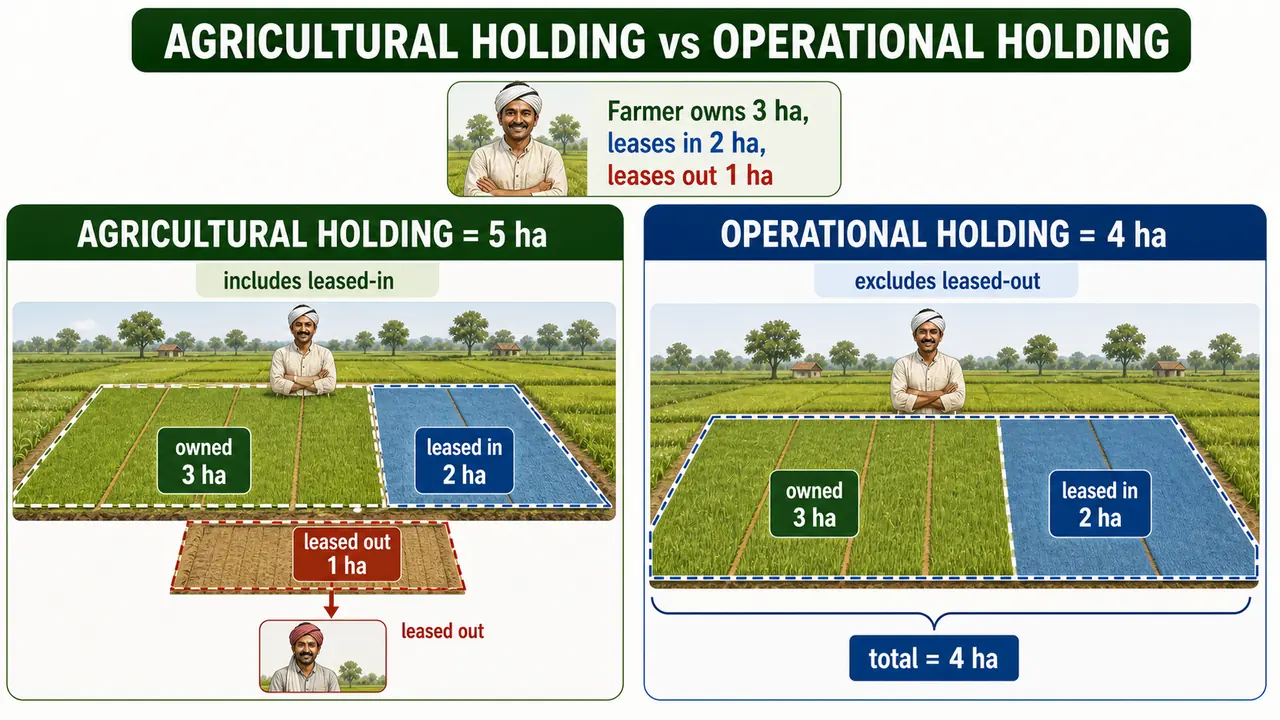
The total area of cultivable land held by an individual, joint family, or group of farmers on a joint basis. The land may be owned, leased, or a mix of both.
Example: A farmer owns 3 hectares and leases 2 hectares from a neighbour. The agricultural holding is 5 hectares.
Operational Holding
The total land area held under single management for cultivation, excluding any land leased out to another person.
Example: If the same farmer leases out 1 hectare of owned land to someone else, the operational holding is 4 hectares (5 minus 1).
| Term | Includes Leased-in Land? | Excludes Leased-out Land? |
|---|---|---|
| Agricultural Holding | Yes | No |
| Operational Holding | Yes | Yes |
Exam Tip: "Operational = what you actually Operate." If you leased it out, you are not operating it.
Enterprise
A single crop or livestock commodity being produced on a farm. A farm may run multiple enterprises simultaneously.
Example: On one farm — wheat enterprise, mustard enterprise, and dairy enterprise can coexist.
Units of Accounting
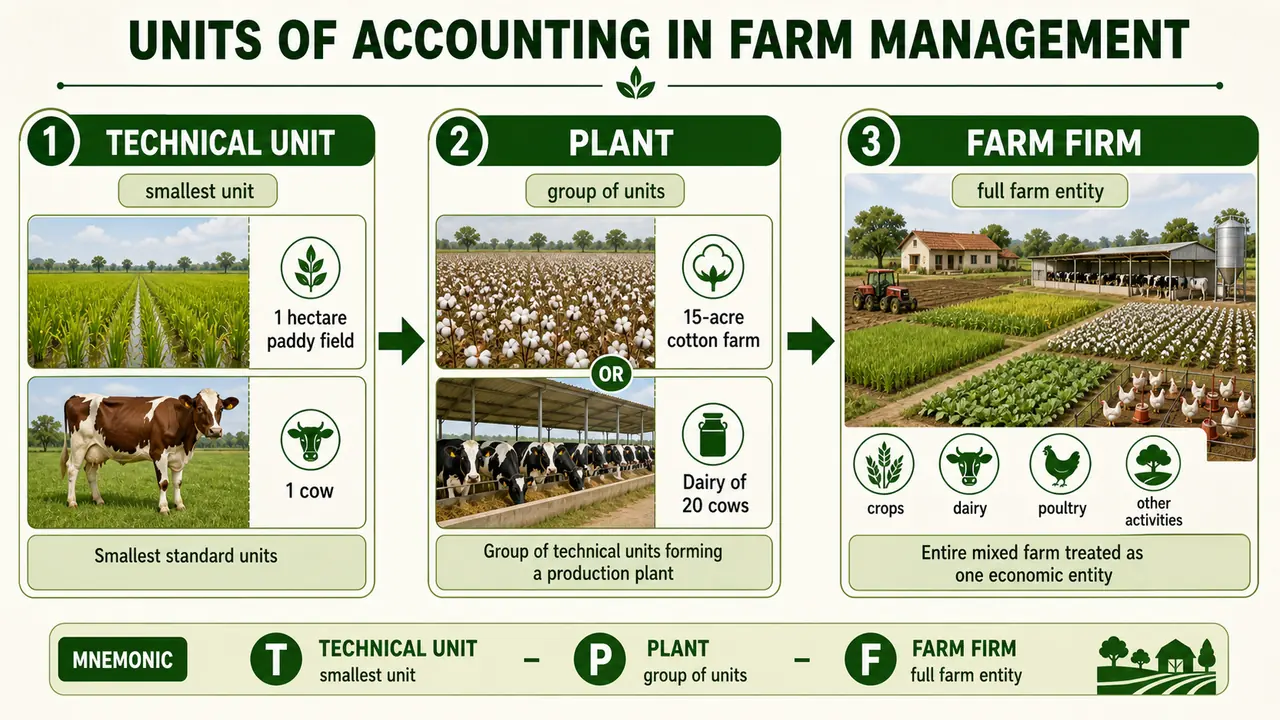
Accurate measurement of inputs and outputs depends on choosing the right accounting unit.
| Unit | Definition | Agricultural Example |
|---|---|---|
| Technical Unit | Smallest standard unit for calculating input-output coefficients | 1 hectare of paddy, 1 cow |
| Plant | Group of technical units forming a larger working unit | A 15-acre cotton farm, a dairy of 20 cows |
| Farm Firm (Economic Unit) | The entire farm treated as one entity for calculating total costs and returns | A mixed farm with crops + dairy + poultry |
Mnemonic — T-P-F: "Tiny unit, Pooled units, Full farm."
Resources and Their Classification
Resources are the inputs used in the production process. They can be classified in several ways.
Resources vs Resource Services
This is one of the most important distinctions in farm management because the exam often asks whether the farmer is using a physical input itself or only the service that input provides.
| Resources | Resource services |
|---|---|
| Any commodity or goods used by the farm in production | Any act or performance that one party can offer to another |
| Physical, material, and tangible | Neither material nor tangible |
| May get consumed or physically enter the production process and become part of the output | Only the service is used in production, not a physical product being transformed |
| Can often be stored if they are physical goods | Cannot be stored; services are perishable |
| Examples: seeds, manures, fertilizers, plant-protection chemicals, herbicides, irrigation water, feed, veterinary medicines, fuel | Examples: services of land, labour, machinery, implements, livestock, and farm buildings |
Exam Tip: Seeds and fertilizer are resources. The work done by labour, machinery, or land is a resource service.
Fixed vs Variable Resources
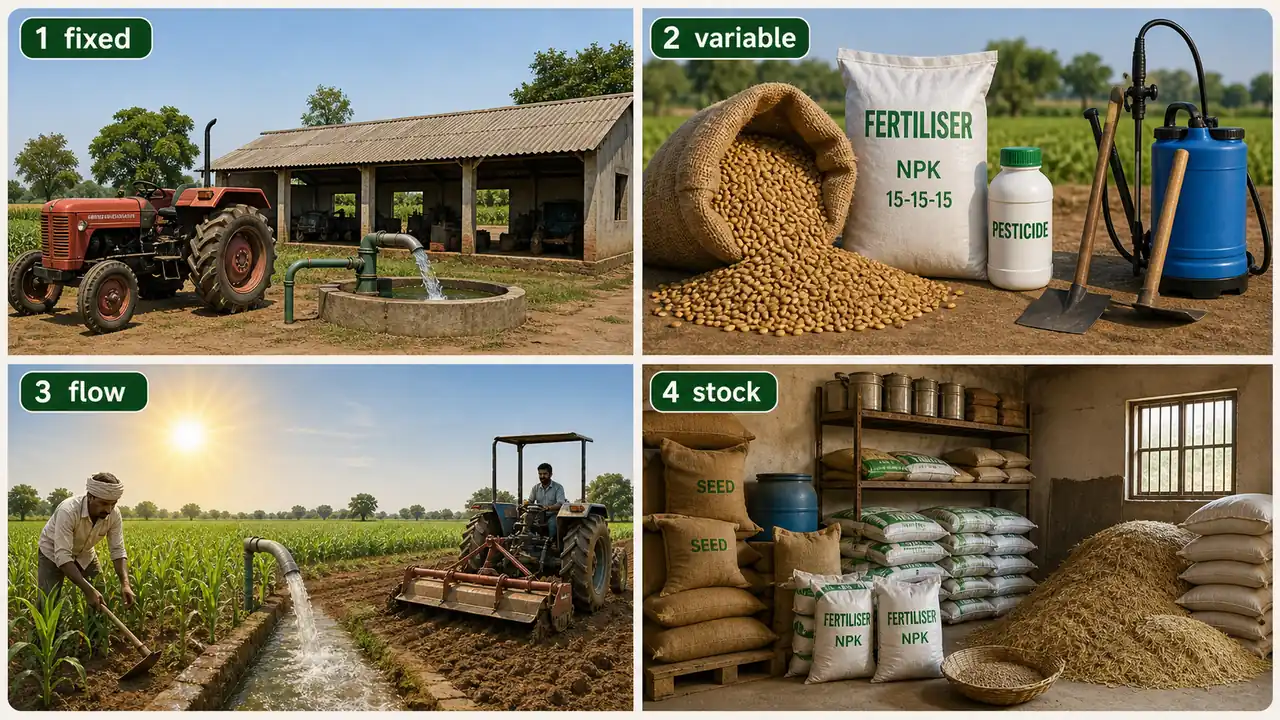
| Feature | Fixed Resources | Variable Resources |
|---|---|---|
| Change with output level? | No | Yes |
| Associated cost type | Fixed costs | Variable costs |
| Exist in short run? | Yes | Yes |
| Exist in long run? | No (all become variable) | Yes |
| Agricultural examples | Land, tractor, farm building, tubewell | Seeds, fertilizers, pesticides, hired labour, FYM |
Example: Whether a farmer grows 20 quintals or 40 quintals of wheat on the same field, the land rent stays the same (fixed), but fertilizer and seed costs rise with output (variable).
Exam Tip: "In the long run, all resources are variable — given enough time, even land area and machinery can be changed."
Flow vs Stock Resources
| Feature | Flow Resources | Stock Resources |
|---|---|---|
| Can be stored? | No — lost if not used | Yes — can be stored for later |
| Agricultural examples | Labour hours, sunshine, daily tractor use | Seeds, fertilizers, feed, pesticides |
- Some resources act as both flow and stock depending on the time period. A tractor provides a flow of services each day but a stock of services over its 10-year lifespan.
- A farm building gives a flow of shelter each year but a stock of services over 50 years.
Mono-period vs Poly-period Resources
| Feature | Mono-period Resources | Poly-period Resources |
|---|---|---|
| Duration | Used up in one production cycle | Provide services for several years |
| Agricultural examples | Seeds, fertilizers, fuel, feed, pesticides | Land, tractor, pump-set, livestock, buildings |
Mnemonic: "Mono = one season, Poly = many seasons."
Production Concepts
Production
The process of transforming inputs (resources) into outputs (products).
Example: A farmer uses seeds, water, fertilizer, and labour to grow paddy — this transformation is production.
Product
The good or service that results from the production process.
Example: Harvested wheat grain, milk from a cow, eggs from poultry.
Transformation Period (Production Period)
The time required for a resource to be completely transformed into a product.
| Resource Type | Transformation Period | Example |
|---|---|---|
| Quick-use inputs | Short (one season) | Seeds, fertilizer, fuel |
| Durable assets | Long (many years) | Machinery, buildings |
| Permanent assets | Never fully transformed | Land |
The variation in transformation periods creates complexity in decision-making — a farmer plans differently for inputs consumed in one season versus assets lasting decades.
Cost Concepts
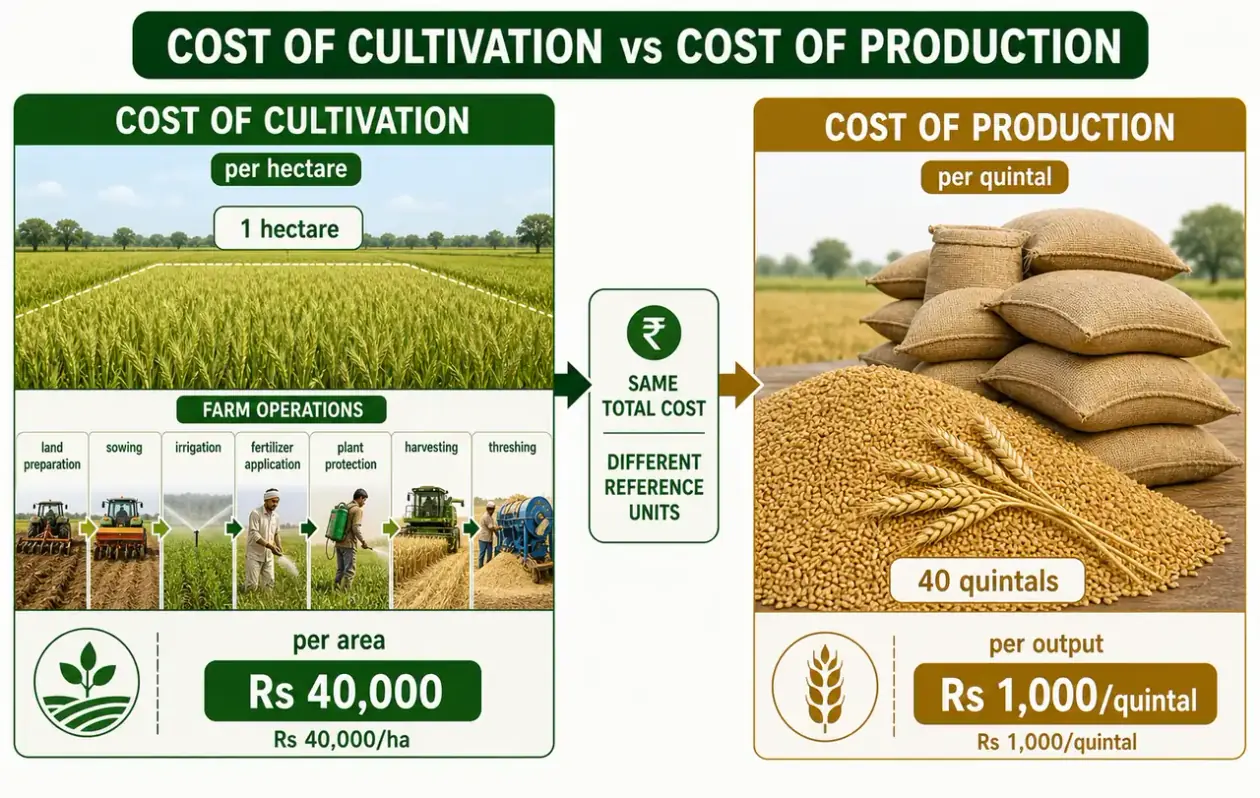
Cost of Cultivation vs Cost of Production
| Feature | Cost of Cultivation | Cost of Production |
|---|---|---|
| Reference unit | Per unit area (per hectare or per acre) | Per unit output (per quintal or per kg) |
| Covers | All operations from land preparation to threshing and transport home | Same operations, but expressed per unit of commodity produced |
| Use | Comparing costs across farms or regions | Comparing efficiency of production |
Example: If growing wheat on 1 hectare costs Rs 40,000 and yields 40 quintals:
- Cost of cultivation = Rs 40,000 per hectare
- Cost of production = Rs 1,000 per quintal
Exam Tip: "CultiVation = per area (think Vasudha, meaning earth/land). Production = per product unit."
Efficiency Measures
Technical Efficiency
The ratio of physical output to physical input (also called Average Physical Product).
Technical Efficiency = Y / X
Where Y = Total output, X = Quantity of input.
Example: If 100 kg of urea produces 3,000 kg of wheat, technical efficiency = 3,000 / 100 = 30 kg wheat per kg urea.
Economic Efficiency
The ratio of value of output to value of input.
Economic Efficiency = (Y × Py) / (X × Px)
Where Py = price of output, Px = price of input.
Example: If 3,000 kg wheat sells at Rs 25/kg (Rs 75,000) and 100 kg urea costs Rs 6/kg (Rs 600), economic efficiency = 75,000 / 600 = 125.
| Efficiency Type | Measures | Formula |
|---|---|---|
| Technical Efficiency | Physical productivity | Output quantity / Input quantity |
| Economic Efficiency | Value productivity | Value of output / Value of input |
Optimum
The ideal condition where costs are minimized and profits are maximized. Reaching the optimum is the ultimate goal of every farm management decision.
Time Concepts: Short Run and Long Run
| Feature | Short Run | Long Run |
|---|---|---|
| Inputs changeable | Only variable inputs | All inputs |
| Fixed inputs | At least one exists | None — all are variable |
| Production flexibility | Limited | Full |
| Agricultural example | Within one crop season, land area is fixed | Over several years, a farmer can buy/sell land and machinery |
| Related law | Law of Diminishing Returns | Returns to Scale |
Exam Tip: The short run is not a fixed calendar period — it depends on which input is fixed. One crop cycle is a common short-run period in agriculture.
Choice Indicator
A yardstick, index, or criterion that shows which alternative among two or more will maximize a given objective. Choice indicators are typically expressed as ratios.
| Choice Indicator | What It Compares | Use |
|---|---|---|
| Substitution ratio | Physical rate at which one input replaces another | Input combination decisions |
| Price ratio | Relative prices of inputs or outputs | Profit maximization decisions |
Example: If 1 kg of DAP can replace 2 kg of SSP in maintaining the same yield, the substitution ratio is 1:2. Comparing this with the price ratio helps the farmer choose the cheaper option.
Economy and Economic System
- Economy: A system that provides people with means to work and earn a living — includes farms, agribusinesses, markets, and rural institutions.
- Economic System: The institutional framework within which society carries out economic activities — determines resource allocation, production decisions, and distribution of goods.
Farm Entrepreneur vs Farm Manager
| Feature | Farm Entrepreneur | Farm Manager |
|---|---|---|
| Role | Thinks of, organizes, and operates the business | Manages or supervises on behalf of the entrepreneur |
| Risk bearing | Bears all losses and gains | Generally not responsible for gains or losses |
| Decision authority | Makes key strategic decisions | Executes plans set by the entrepreneur |
| Employment | Self-employed (owner) | Hired and salaried |
Mnemonic: "Entrepreneur = Earns or loses. Manager = Merely manages."
Summary Cheat Sheet
| Concept / Topic | Key Details / Explanation |
|---|---|
| Farm | A piece of land with specific boundaries under common management for crop and livestock enterprises |
| Agricultural Holding | Total cultivable land held by a person (includes owned + leased-in land) |
| Operational Holding | Land actually operated = Agricultural Holding minus land leased out |
| Enterprise | A single crop or livestock commodity produced on a farm (e.g., wheat enterprise, dairy enterprise) |
| Technical Unit | Smallest standard unit for input-output coefficients (e.g., 1 hectare, 1 cow) |
| Plant | Group of technical units forming a larger working unit (e.g., a 15-acre cotton farm) |
| Farm Firm | Entire farm as one economic entity for calculating total costs and returns |
| Fixed Resources | Do not change with output level; e.g., land, tractor, buildings. In the long run, all become variable |
| Variable Resources | Change with output level; e.g., seeds, fertilizers, pesticides, hired labour |
| Flow Resources | Cannot be stored; lost if unused (e.g., labour hours, sunshine) |
| Stock Resources | Can be stored for later use (e.g., seeds, fertilizers, feed) |
| Mono-period Resources | Used up in one production cycle (seeds, fuel, fertilizer) |
| Poly-period Resources | Provide services for several years (land, tractor, pump-set, buildings) |
| Production | Transformation of inputs (resources) into outputs (products) |
| Cost of Cultivation | Cost per unit area (per hectare); covers land preparation to threshing |
| Cost of Production | Cost per unit output (per quintal); measures production efficiency |
| Technical Efficiency | Y / X = Output quantity / Input quantity (physical productivity) |
| Economic Efficiency | (Y x Py) / (X x Px) = Value of output / Value of input |
| Optimum | Ideal condition where costs are minimized and profits are maximized |
| Short Run | At least one input is fixed; governed by Law of Diminishing Returns |
| Long Run | All inputs are variable; governed by Returns to Scale |
| Choice Indicator | A ratio (substitution ratio, price ratio) used to select the best alternative |
| Farm Entrepreneur | Bears all risk (gains and losses); makes strategic decisions; self-employed owner |
| Farm Manager | Hired and salaried; manages on behalf of entrepreneur; does not bear risk |
| T-P-F Mnemonic | Technical unit (tiny) to Plant (pooled) to Farm firm (full farm) |