👨👨👧👦 Types of Farming — Classification by Enterprise Composition
Learn the five types of farming — Diversified, Specialised, Mixed, Dry, and Ranching — with income criteria, agricultural examples, advantages, disadvantages, and exam-ready comparison tables.
Opening Example
Consider two neighbouring farmers in Uttar Pradesh. Farmer A grows wheat, mustard, keeps two buffaloes, and sells vegetables — no single enterprise earns him more than 40% of his income. Farmer B grows only sugarcane near a sugar mill, and sugarcane alone provides 80% of his income. Farmer A practises diversified farming; Farmer B practises specialised farming. The way we classify farms based on what they produce and in what proportions is called the type of farming.
Definition
According to Johnson:
"When farms in a group are quite similar in the kinds and proportions of the crops and livestock that are produced and in the methods and practices followed in production, that group is described as a Type of Farming."
Understanding the type of farming helps in agricultural planning, policy-making, and designing targeted extension services for each farming group.
Factors Affecting Type of Farming
Several factors shape what a farmer grows and how the farm is organized:
Pro Content Locked
Upgrade to Pro to access this lesson and all other premium content.
₹99 charged monthly · Cancel anytime
- All Agriculture & Banking Courses
- AI Lesson Questions (100/day)
- AI Doubt Solver (50/day)
- Glows & Grows Feedback (30/day)
- AI Section Quiz (20/day)
- 22-Language Translation (100/day)
- Recall Questions (20/day)
- AI Quiz (15/day)
- AI Quiz Paper Analysis (100/day)
- AI Step-by-Step Explanations (100/day)
- Spaced Repetition Recall (FSRS)
- AI Tutor
- Immersive Text Questions
- Audio Lessons — Hindi & English
- Mock Tests & Previous Year Papers
- Summary & Mind Maps
- XP, Levels, Leaderboard & Badges
- Generate New Classrooms
- Voice AI Teacher (AgriDots Live)
- AI Revision Assistant
- Knowledge Gap Analysis
- Interactive Revision (LangGraph)
🔒 Secure via Razorpay · Cancel anytime · No hidden fees
Opening Example
Consider two neighbouring farmers in Uttar Pradesh. Farmer A grows wheat, mustard, keeps two buffaloes, and sells vegetables — no single enterprise earns him more than 40% of his income. Farmer B grows only sugarcane near a sugar mill, and sugarcane alone provides 80% of his income. Farmer A practises diversified farming; Farmer B practises specialised farming. The way we classify farms based on what they produce and in what proportions is called the type of farming.
Definition
According to Johnson:
"When farms in a group are quite similar in the kinds and proportions of the crops and livestock that are produced and in the methods and practices followed in production, that group is described as a Type of Farming."
Understanding the type of farming helps in agricultural planning, policy-making, and designing targeted extension services for each farming group.
Factors Affecting Type of Farming
Several factors shape what a farmer grows and how the farm is organized:
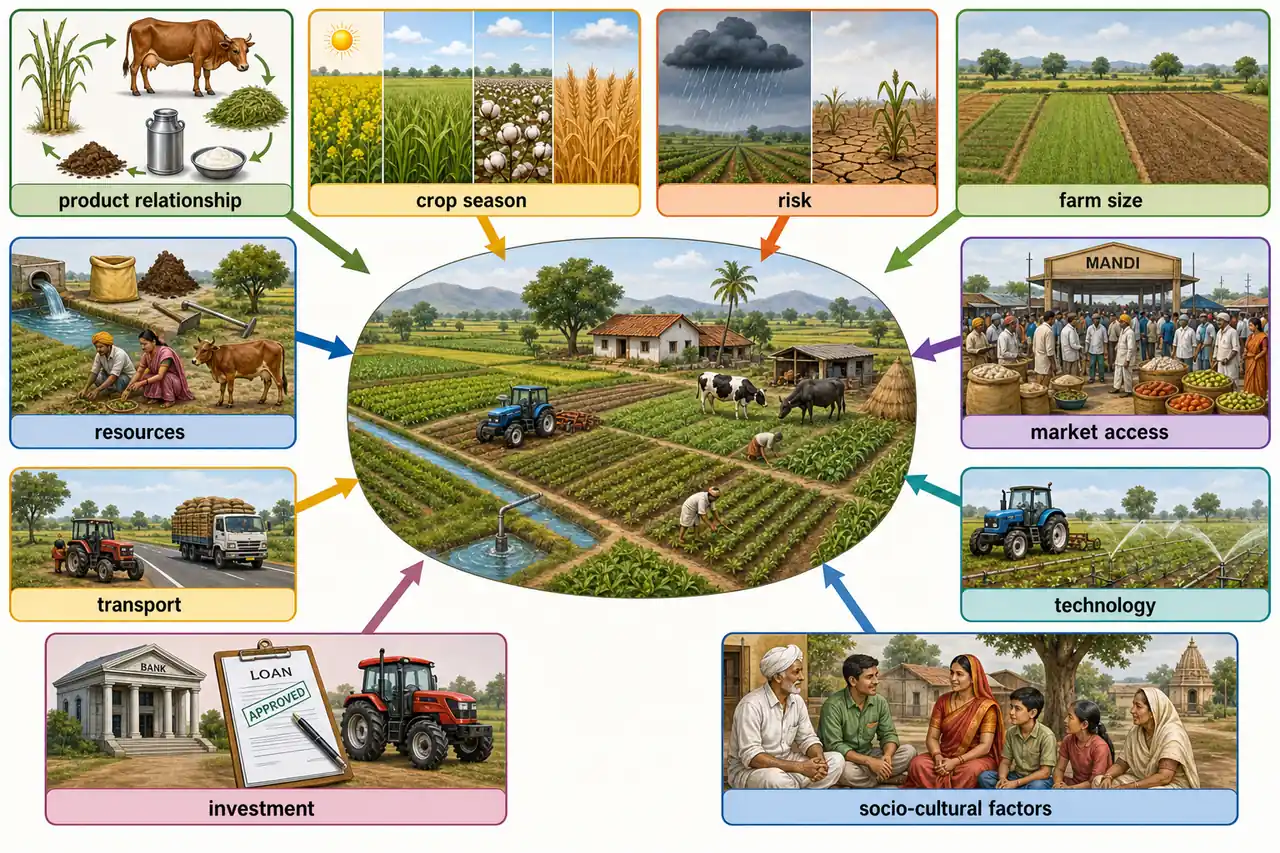
| Factor | How It Influences Farming Type |
|---|---|
| Product relationship | Complementary, supplementary, or competitive relationships among crops and livestock |
| Crop season length | Short seasons limit crop choice; long seasons allow flexibility |
| Risk and uncertainty | Drought-prone areas push farmers toward diversification |
| Farm size | Small farms tend to diversify; large farms can specialise |
| Resources available | Land, labour, capital, and water dictate feasible enterprises |
| Market prices | Higher prices for a commodity encourage specialisation in it |
| Transport and market access | Perishable crops need nearby markets or cold storage |
| Technology | Mechanisation enables larger-scale specialised operations |
| Investment size | Orchards, dairy units require long-term commitment |
| Business skill | Complex enterprises need skilled management |
| Land value | High land value pushes toward high-value crops (vegetables, flowers) |
| Socio-cultural factors | Religious beliefs and customs influence crop and livestock choices |
Five Types of Farming
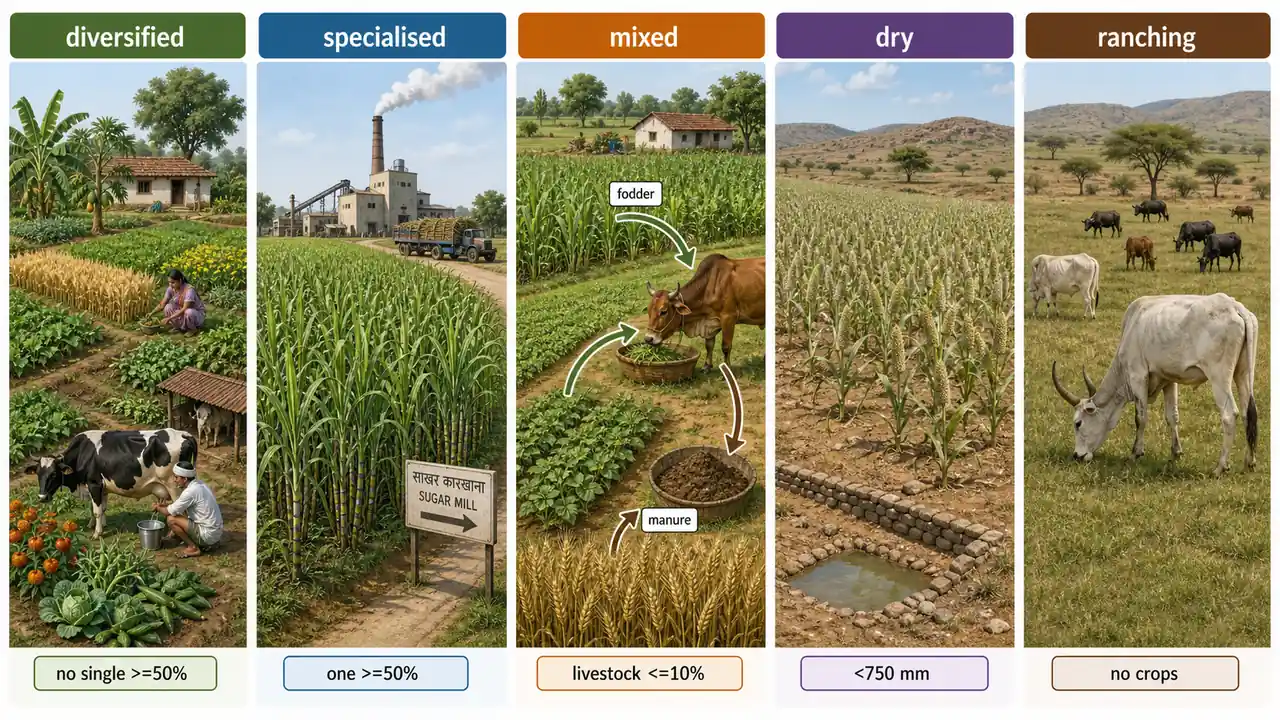
Based on methods, practices, and the proportion of crops and livestock, farming is classified into five types:
- Diversified Farming
- Specialised Farming
- Mixed Farming
- Dry Farming
- Ranching
Mnemonic — "DSMDR": Don't Stop Making Daily Runs (Diversified, Specialised, Mixed, Dry, Ranching)
1. Diversified Farming
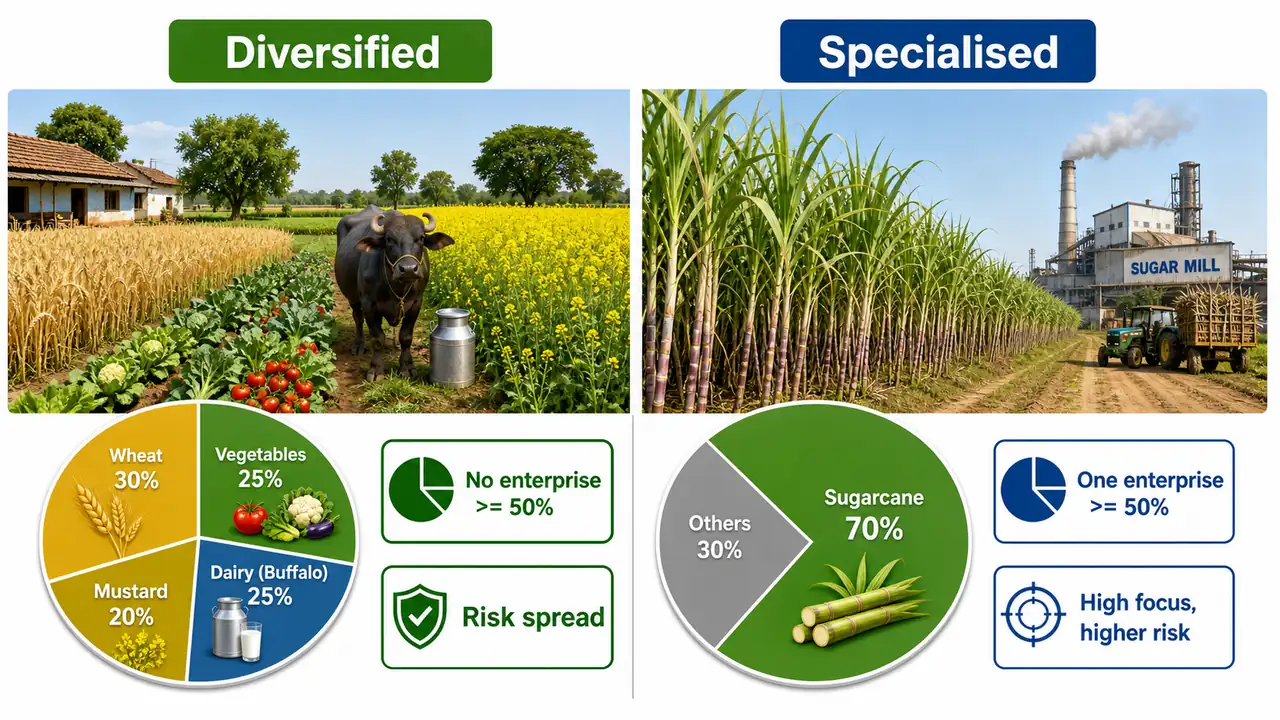
A farm where no single enterprise contributes 50% or more of total farm income is called a diversified (or general) farm.
Agricultural example: A farmer in Bihar grows rice (30% income), wheat (25% income), keeps a cow for milk (20%), and grows vegetables (25%). No single enterprise dominates.
"A good farmer is one who does not put all the eggs in one basket." — This proverb captures the core philosophy of diversification.
Subsistence farming and marginal farming are forms of diversified farming where the primary goal is household food security rather than commercial profit.
Advantages
| Advantage | Explanation |
|---|---|
| Better land use | Crop rotation uses different soil nutrients across seasons |
| Year-round labour use | Different enterprises have different peak seasons, reducing seasonal unemployment |
| Efficient capital use | Machinery and tools serve multiple enterprises |
| Reduced risk | If one crop fails, others provide a safety net |
| Regular income | Different crops mature at different times, ensuring steady cash flow |
Disadvantages
| Disadvantage | Explanation |
|---|---|
| Marketing difficulty | Small quantities of many products are harder to sell without cooperatives |
| Supervision strain | Managing many enterprises stretches the farmer's attention |
| Equipment cost | Cannot justify specialised machinery for small areas under each crop |
| Undetected losses | Harder to track where money is lost across many enterprises |
2. Specialised Farming
A farm where a single enterprise contributes 50% or more of total farm income is called a specialised farm.
Agricultural examples:
- A sugarcane farm near a sugar mill where sugarcane provides 70% of income
- A tea garden in Assam where tea is the dominant enterprise
- A potato farm in Punjab where potato contributes over 60% of income
The farm is named after its dominant enterprise — tea garden, sugarcane farm, potato farm, etc.
Conditions Favouring Specialisation
- Special market outlets nearby (e.g., sugar mill, tea auction centre)
- Stable economic conditions over a long period
- Climate highly suited to one particular crop
Advantages
| Advantage | Explanation |
|---|---|
| Best land use | Soil type fully exploited (e.g., black soil for cotton) |
| Better marketing | Large quantities attract buyers and command better prices |
| Expert management | Deep knowledge of one enterprise improves decisions |
| Less equipment | Only tools for one enterprise are needed |
| Higher labour efficiency | Workers develop specialised skills |
| Easy technology adoption | Easier to adopt modern methods for one focused enterprise |
Disadvantages
| Disadvantage | Explanation |
|---|---|
| High risk | Entire income affected if the single enterprise fails |
| Resource under-utilisation | Idle periods when the enterprise does not need all resources |
| Soil degradation | Lack of crop rotation depletes specific nutrients |
| Wasted by-products | Crop residues that could feed animals go unused |
| Annual income only | Cash flow problems between harvests |
| Narrow knowledge | Farmer loses ability to manage other enterprises |
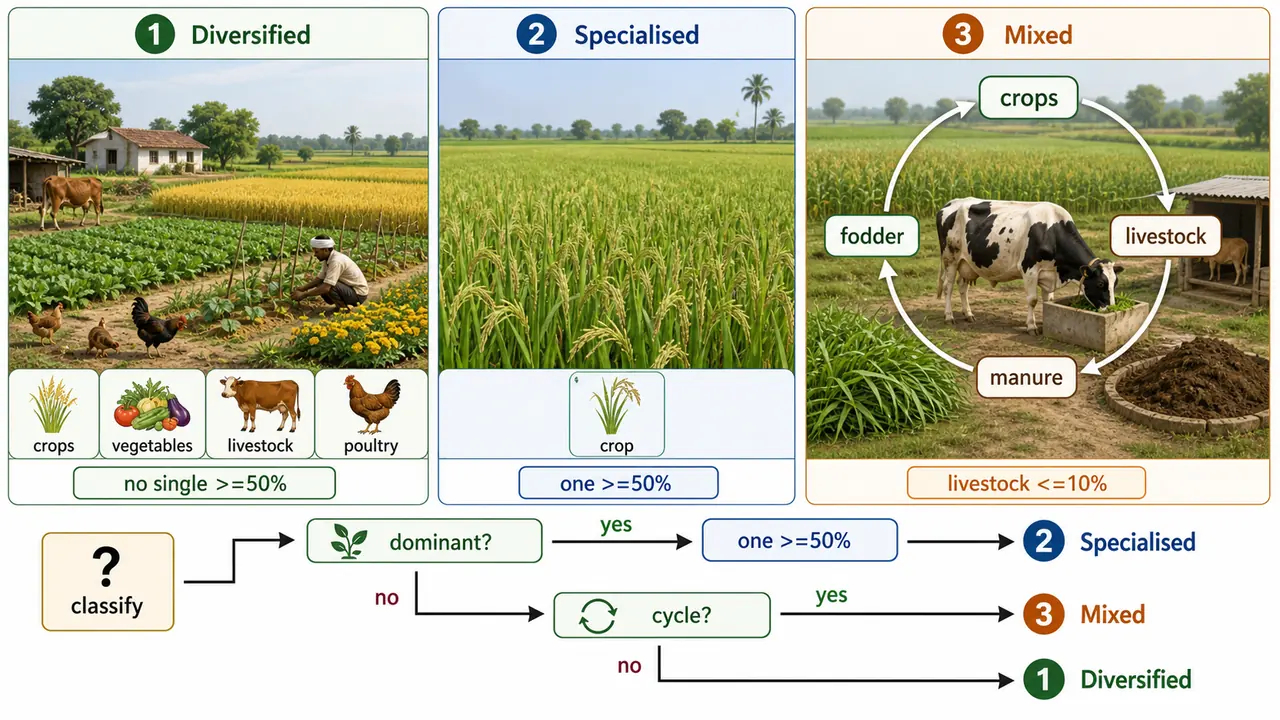
Key Distinction: Diversified = no single enterprise ≥ 50% of income. Specialised = one enterprise ≥ 50% of income.
3. Mixed Farming
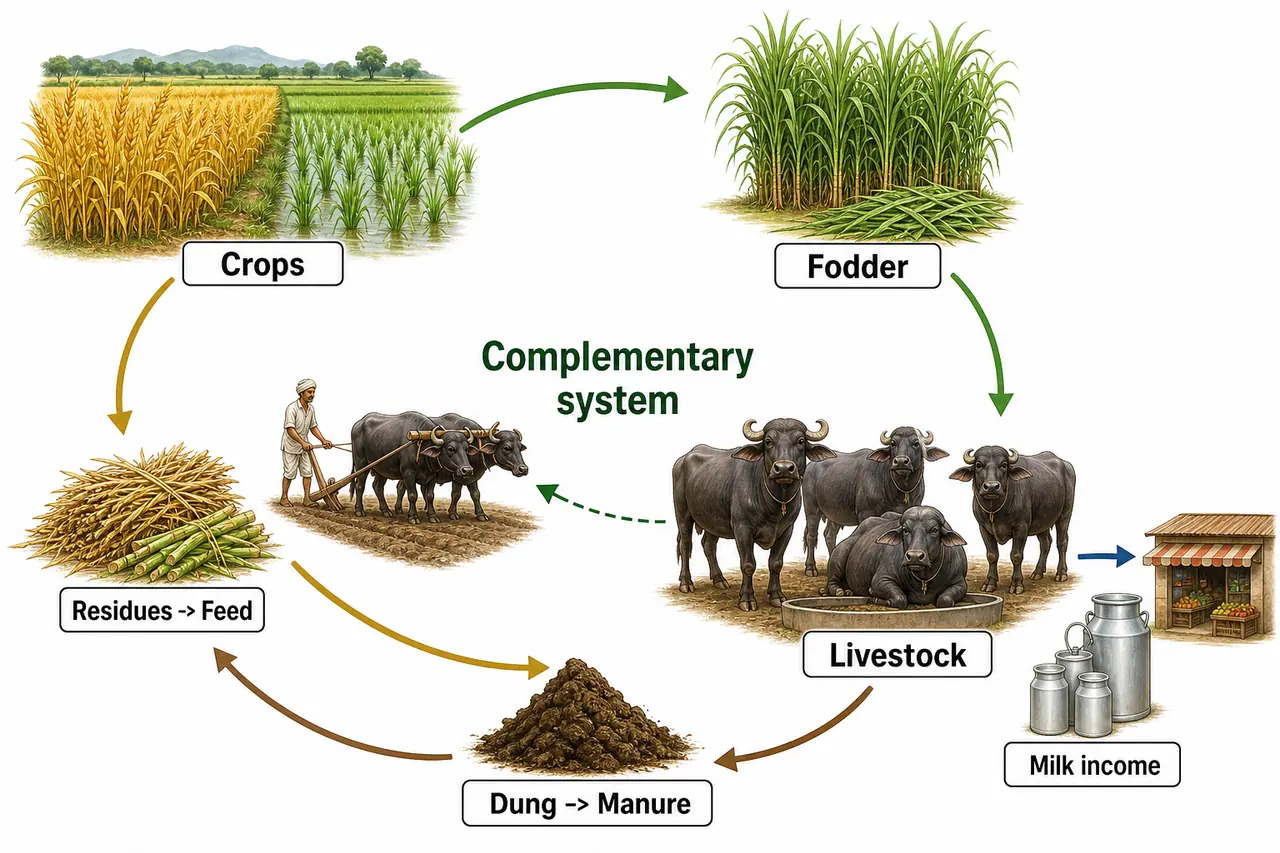
In mixed farming, crop production is combined with livestock raising or dairying. The livestock enterprise is complementary to crops — animals provide draught power and manure for crops, while crops provide feed and fodder for animals. This creates a self-sustaining cycle.
Agricultural example: A farmer in Haryana grows wheat and rice while maintaining 4-5 dairy buffaloes. Wheat straw feeds the buffaloes; buffalo dung manures the wheat fields.
Key rules:
- The subsidiary (livestock) enterprise should not exceed 10% of total income
- The subsidiary enterprise should utilise by-products of the main enterprise
- When livestock begins to compete with crops for the same resources, the relationship shifts from complementary to competitive
Note: Mixed farming is a type of diversified farming where crops and livestock are specifically interdependent. Diversified farming may involve multiple crop enterprises without any livestock.
4. Dry Farming
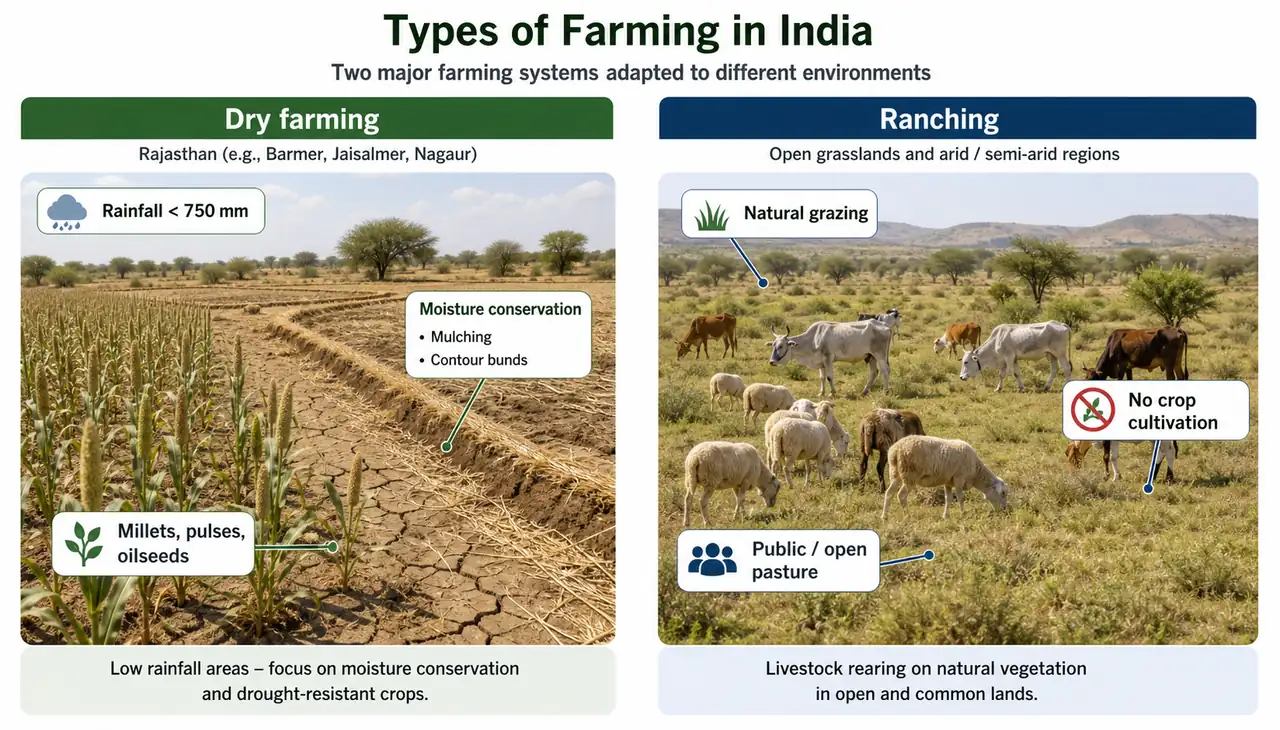
Cultivation of crops in regions with annual rainfall of less than 750 mm.
Agricultural example: Bajra and jowar cultivation in the arid zones of Rajasthan where annual rainfall is around 300-500 mm. Farmers use moisture conservation techniques to survive on limited rain.
Key Features
| Feature | Details |
|---|---|
| Regions | Arid and semi-arid areas without irrigation |
| Common crops | Millets (bajra, jowar), pulses, oilseeds (groundnut, mustard), some cotton |
| Techniques used | Mulching, contour ploughing, summer fallowing, moisture conservation |
| Crop varieties | Drought-resistant and short-duration varieties preferred |
5. Ranching
Land where no crops are cultivated and natural vegetation is used for grazing livestock is called ranch land. The person who manages such livestock is a rancher.
Agricultural example: Sheep grazing on natural pastures in the hilly tracts of Bikaner (Rajasthan) and Jammu & Kashmir. Australia's sheep ranching is world-famous.
Key Features
| Feature | Details |
|---|---|
| Land type | Too dry, rocky, or infertile for crops; supports grasses and shrubs |
| Ownership | Ranchers usually use public/government land |
| Countries | Australia, USA, Tibet, China; parts of India (Bikaner, J&K) |
| Characteristics | Large open areas, extensive livestock management, minimal crop cultivation |
Exam Fact: The practice of grazing animals on public land is called ranching. (exams 2021)
Exam Tips
- 50% rule is the dividing line between diversified and specialised farming — memorise this threshold.
- Mixed farming always involves crops + livestock together, not just multiple crops.
- Dry farming threshold: rainfall < 750 mm. Do not confuse with rainfed farming (which includes areas up to 1150 mm).
- Ranching = no crops at all; only natural grazing on public land.
Summary Comparison Table
Quick Comparison: Five Types of Farming
| Type | Key Feature | Income / Defining Criterion | Indian Example |
|---|---|---|---|
| Diversified | Multiple enterprises, no single dominance | No single enterprise ≥ 50% of income | Small farmer in Bihar growing rice, wheat, vegetables, and keeping a cow |
| Specialised | One dominant enterprise | Single enterprise ≥ 50% of income | Sugarcane farm near a sugar mill in UP |
| Mixed | Crops + Livestock interdependent | Livestock subsidiary ≤ 10% of income | Wheat-buffalo farming in Haryana |
| Dry | Low rainfall, moisture conservation | Rainfall < 750 mm | Bajra-jowar in Rajasthan |
| Ranching | Grazing on natural pastures | No crop cultivation; public land | Sheep grazing in Bikaner |
Summary Cheat Sheet
| Concept / Topic | Key Details / Explanation |
|---|---|
| Type of Farming | Classification of farms based on what they produce and in what proportions (enterprise composition) |
| Definition (Johnson) | Farms similar in kinds/proportions of crops and livestock and methods of production form a "type" |
| Factors Affecting Type | Product relationships, crop season, risk, farm size, resources, prices, transport, technology, land value |
| Diversified Farming | No single enterprise contributes >= 50% of total farm income; multiple enterprises |
| Diversified Advantages | Better land use, year-round labour, efficient capital use, reduced risk, regular income |
| Diversified Disadvantages | Marketing difficulty, supervision strain, equipment cost for small areas, undetected losses |
| Specialised Farming | Single enterprise contributes >= 50% of total farm income; farm named after dominant enterprise |
| Specialised Advantages | Best land use, better marketing, expert management, higher labour efficiency, easy tech adoption |
| Specialised Disadvantages | High risk (single enterprise failure), resource under-utilisation, soil degradation, narrow knowledge |
| 50% Rule | The dividing line: < 50% from any single enterprise = diversified; >= 50% = specialised |
| Mixed Farming | Crops + livestock combined; livestock is complementary (draught power + manure for crops; feed for animals) |
| Mixed Farming Rule | Subsidiary (livestock) enterprise should not exceed 10% of total income; uses by-products |
| Mixed vs Diversified | Mixed always involves crops + livestock interdependent; diversified may have multiple crops without livestock |
| Dry Farming | Cultivation in regions with rainfall < 750 mm; uses moisture conservation techniques |
| Dry Farming Crops | Millets (bajra, jowar), pulses, oilseeds, drought-resistant and short-duration varieties |
| Dry Farming Techniques | Mulching, contour ploughing, summer fallowing, moisture conservation |
| Ranching | No crops cultivated; natural vegetation used for grazing livestock; usually on public/government land |
| Ranching Countries | Australia, USA, Tibet, China; India: Bikaner (Rajasthan), Jammu & Kashmir |
| Conditions for Specialisation | Special market outlets nearby, stable economic conditions, climate highly suited to one crop |
| DSMDR Mnemonic | Diversified, Specialised, Mixed, Dry, Ranching |