🐔 Indigenous Poultry Farming — NABARD Model Bankable Project
NABARD model project for 100 improved indigenous broiler birds with total cost of ₹14,000, 10% margin money, 5-year repayment, and IRR >50%. Covers improved desi breeds like Vanaraja and Giriraja — essential for exams animal husbandry section.
Indigenous (desi) poultry farming is positioned for BPL families, SHGs, and landless labourers as a low-capital, high-IRR livelihood activity. Backyard indigenous poultry contributes 30–35% of India's total eggs — a statistic that regularly appears in exam questions.
- Improved varieties developed: Vanaraja, Giriraja, Girirani, Krishna-J
- Low-Input Technology (LIT) birds by CPDOs: Kalinga Brown, Kaveri, Chhabro, Chann
- CPDOs located at: Chandigarh, Bhubaneswar, Mumbai, Bengaluru
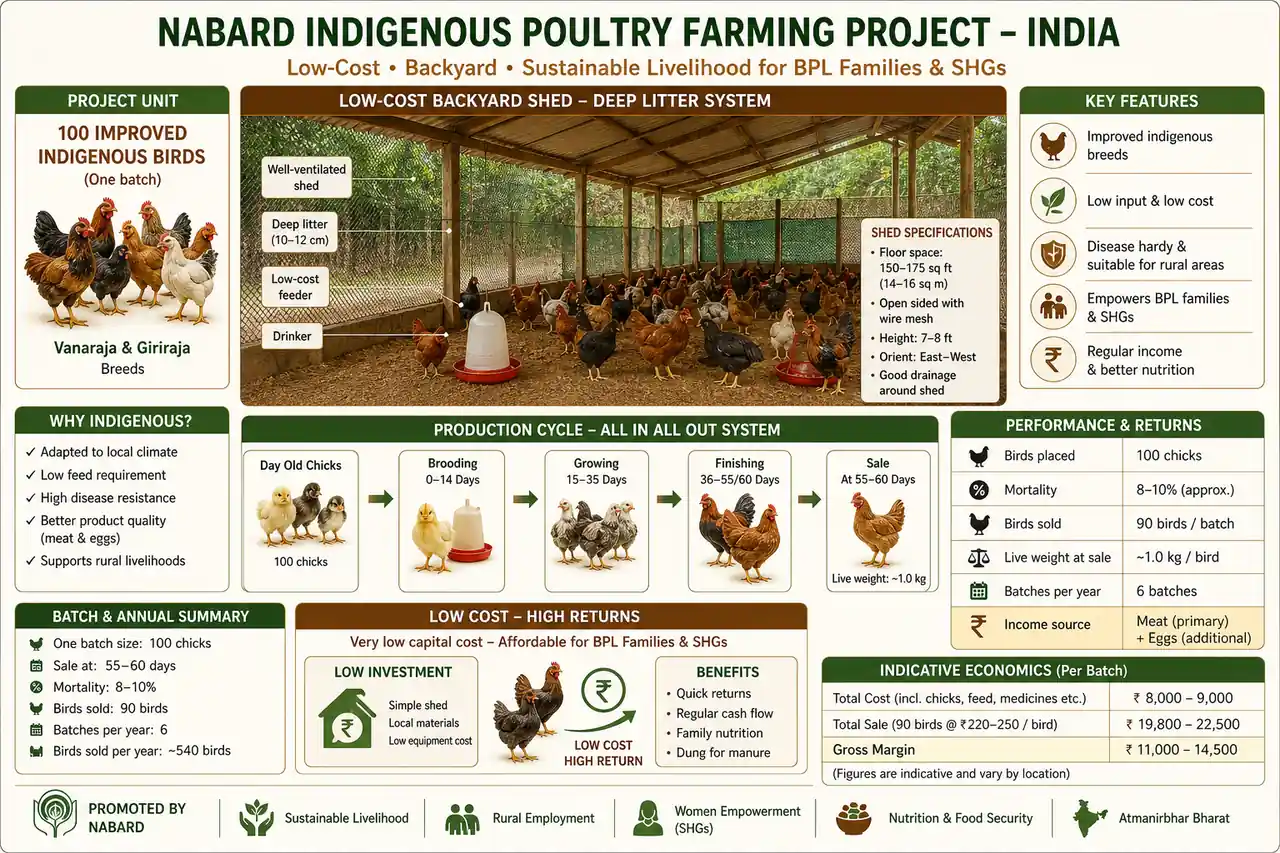
Project Overview
The model unit rears 100 improved indigenous broiler birds on an "All In All Out" batch system under deep litter. Birds are purchased as day-old chicks, reared for 55–60 days, and marketed at approximately 1 kg live weight. Up to 6 batches are run per year from Year 2 onwards.
The deep litter system on raised flooring (minimum 2 ft above ground) reduces disease risk. The shed can be built from bamboo, wood, thatch — locally available low-cost materials that keep project cost minimal.
Pro Content Locked
Upgrade to Pro to access this lesson and all other premium content.
₹99 charged monthly · Cancel anytime
- All Agriculture & Banking Courses
- AI Lesson Questions (100/day)
- AI Doubt Solver (50/day)
- Glows & Grows Feedback (30/day)
- AI Section Quiz (20/day)
- 22-Language Translation (100/day)
- Recall Questions (20/day)
- AI Quiz (15/day)
- AI Quiz Paper Analysis (100/day)
- AI Step-by-Step Explanations (100/day)
- Spaced Repetition Recall (FSRS)
- AI Tutor
- Immersive Text Questions
- Audio Lessons — Hindi & English
- Mock Tests & Previous Year Papers
- Summary & Mind Maps
- XP, Levels, Leaderboard & Badges
- Generate New Classrooms
- Voice AI Teacher (AgriDots Live)
- AI Revision Assistant
- Knowledge Gap Analysis
- Interactive Revision (LangGraph)
🔒 Secure via Razorpay · Cancel anytime · No hidden fees
Indigenous (desi) poultry farming is positioned for BPL families, SHGs, and landless labourers as a low-capital, high-IRR livelihood activity. Backyard indigenous poultry contributes 30–35% of India's total eggs — a statistic that regularly appears in exam questions.
- Improved varieties developed: Vanaraja, Giriraja, Girirani, Krishna-J
- Low-Input Technology (LIT) birds by CPDOs: Kalinga Brown, Kaveri, Chhabro, Chann
- CPDOs located at: Chandigarh, Bhubaneswar, Mumbai, Bengaluru
Project Overview
The model unit rears 100 improved indigenous broiler birds on an "All In All Out" batch system under deep litter. Birds are purchased as day-old chicks, reared for 55–60 days, and marketed at approximately 1 kg live weight. Up to 6 batches are run per year from Year 2 onwards.
The deep litter system on raised flooring (minimum 2 ft above ground) reduces disease risk. The shed can be built from bamboo, wood, thatch — locally available low-cost materials that keep project cost minimal.
Financial Structure
| Component | Amount (Rs.) |
|---|---|
| Shed (100 sq ft, mud wall + thatched roof) | 5,000 |
| Equipment (feeders, waterers) | 1,500 |
| Capital Cost | 6,500 |
| Cost of 1st batch (100 DOC @ ₹25 each) | 2,500 |
| Feed cost (1st batch) | 5,000 |
| Recurring Cost | 7,500 |
| Total Project Cost | 14,000 |
| Margin Money (10%) | 1,400 |
| Bank Loan (90%) | 12,600 |
NOTE
The total project cost of just ₹14,000 makes this one of the smallest NABARD model bankable projects. Despite the tiny investment, the IRR exceeds 50% — making it the highest-returning project per rupee invested in this series.
Technical Parameters
| Parameter | Value |
|---|---|
| Breed type | Improved Indigenous (Vanaraja, Giriraja etc.) |
| Birds per batch | 100 |
| Rearing period | 55–60 days |
| Live weight at sale | 1 kg/bird |
| Feed consumption | 2.50 kg/bird |
| Mortality | 8–10% |
| Cost of DOC | ₹25/chick |
| Cost of feed | ₹25/kg |
| Sale price | ₹150/kg live weight |
| Floor space | 1 sq ft/bird |
| Batches per year | 6 (Year 1: 6 purchased, 5 sold) |
| Interest rate | 12% per annum |
NOTE
Exam trap: 90 birds are sold per batch (100 purchased minus 8–10% mortality). Calculations based on 100 birds sold instead of 90 will give wrong income figures in case-based MCQs.
Income & Repayment
| Year | Income (Rs.) | Expenses (Rs.) | Gross Surplus (Rs.) |
|---|---|---|---|
| 1 | 67,500 | 61,500 | 6,000 |
| 2 | 81,000 | 61,500 | 19,500 |
| 3 | 81,000 | 61,500 | 19,500 |
Income per year (Year 2+): 6 batches × 90 birds × 1 kg × ₹150 = ₹81,000
- Repayment period: 5 years
- BCR: 1.24:1 at 15% discount factor
- IRR: >50%
The very high IRR reflects the rapid capital turnover — 6 complete production cycles per year from a tiny ₹6,500 capital base. Under National Livestock Mission (NLM), chicks are distributed to BPL beneficiaries after rearing in mother units to 4 weeks under the Rural Backyard Poultry Development (RBPD) scheme.
Sources & References
Primary source for this lesson is NABARD's official Model Bankable Projects portal.[1] Lesson-specific report copy used for this topic.[2]
References
2 sources • [1] [2]
References
Used for: Official NABARD portal for model bankable project documents and updates.
Used for: Reference copy used in this lesson for project parameters and worked figures.
The figures in this lesson reflect the cost norms and technical parameters as published in the NABARD document. Actual costs may vary by state, season, and year of implementation. Always refer to the latest NABARD circular for current norms.
Summary Cheat Sheet
| Concept / Topic | Key Details / Explanation |
|---|---|
| Unit size | 100 improved indigenous broiler birds per batch, "All In All Out" deep litter system |
| Improved breeds | Vanaraja, Giriraja, Girirani, Krishna-J |
| Low-Input Technology (LIT) birds | Kalinga Brown, Kaveri, Chhabro, Chann — by CPDOs |
| CPDO locations | Chandigarh, Bhubaneswar, Mumbai, Bengaluru |
| Capital Cost | ₹6,500 (shed ₹5,000 + equipment ₹1,500) |
| Total Project Cost | ₹14,000 (one of the smallest NABARD MBPs) |
| Margin Money | 10% = ₹1,400 |
| Bank Loan | 90% = ₹12,600 |
| Rearing period | 55–60 days per batch |
| Live weight at sale | 1 kg/bird |
| Feed consumption | 2.50 kg/bird |
| Mortality | 8–10% → 90 birds sold per batch (not 100) |
| Cost of DOC | ₹25/chick |
| Cost of feed | ₹25/kg |
| Sale price | ₹150/kg live weight |
| Floor space | 1 sq ft/bird |
| Batches per year | 6 (Year 2 onwards) |
| Annual income (Year 2+) | 6 batches × 90 birds × 1 kg × ₹150 = ₹81,000 |
| Interest rate | 12% per annum |
| Repayment period | 5 years |
| BCR | 1.24:1 at 15% discount factor |
| IRR | >50% (highest per-rupee return in the series) |
| Backyard poultry share | 30–35% of India's total egg production |
| Scheme for BPL | Rural Backyard Poultry Development (RBPD) under National Livestock Mission (NLM) |
| Shed material | Bamboo, wood, thatch — locally available low-cost materials |
Lesson Doubts
Ask questions, get expert answers