🐮 Indigenous Cow Farming — NABARD Model Bankable Project
NABARD model project for 2 indigenous cows (Gir, Sahiwal, or Graded) with total cost of ₹68,100, 10% margin money, and 6-year repayment. Tests breed knowledge, low-input advantages, and comparison with crossbred cattle for exams.
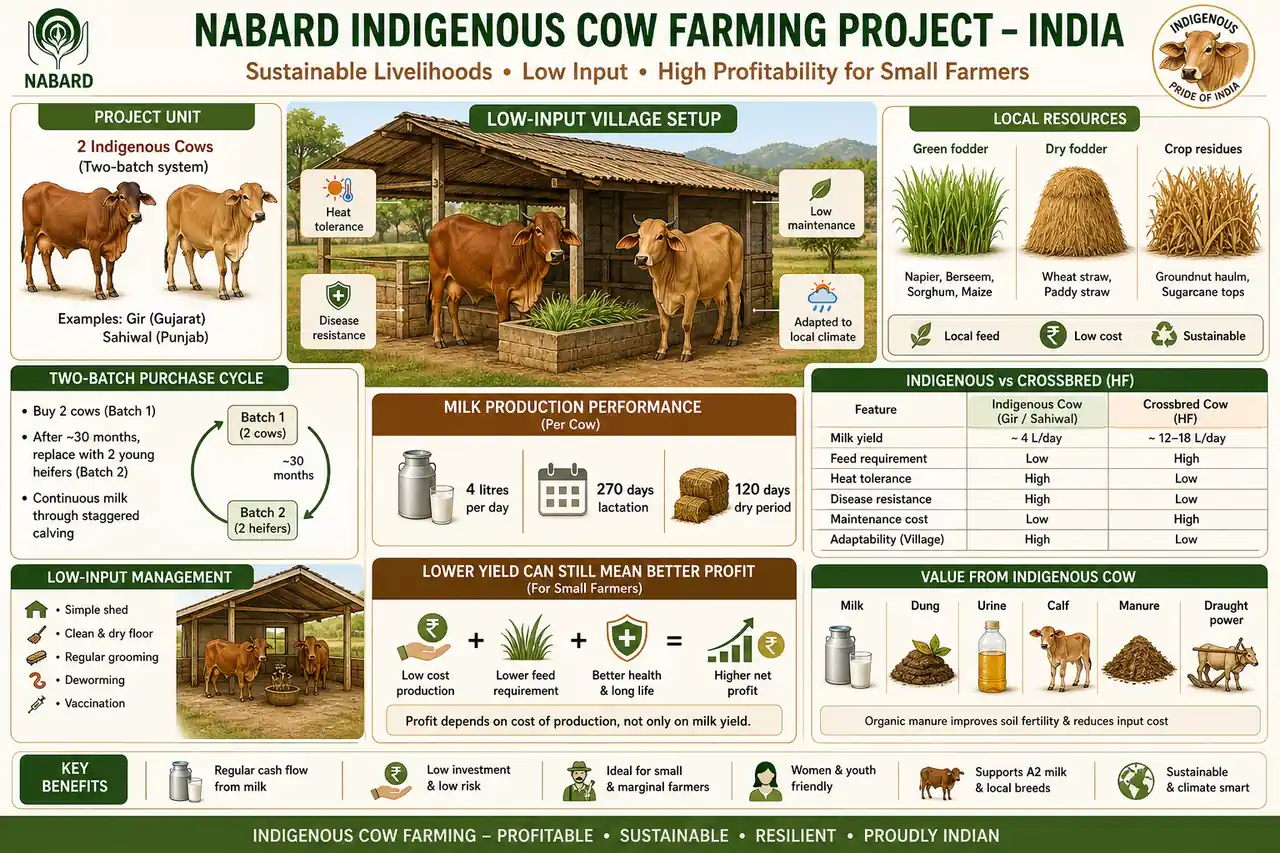
Indigenous cow farming targets small and marginal farmers who cannot manage the high-input requirements of crossbred cattle. Despite lower yield, indigenous breeds are often more profitable at low input levels — this paradox is a favourite exam discussion point.
- Total milk production in 2015-16: 155.50 million metric tonnes
- Average yield: Crossbred 7.02 kg/day, Indigenous cows 2.36 kg/day, Buffaloes 4.89 kg/day
- Women constitute 69% of the workforce in the livestock sector
Project Overview
The model unit has 2 indigenous cows purchased in 2 batches at an interval of 4–6 months to ensure continuous milk flow. Freshly calved animals in 2nd or 3rd lactation are preferred as they are already proven producers.
Key assumption: Green fodder is grown on field bunds (zero cost), and calf rearing cost is offset by sale/retention value of calves — both simplify the economics for small farmers.
Pro Content Locked
Upgrade to Pro to access this lesson and all other premium content.
₹99 charged monthly · Cancel anytime
- All Agriculture & Banking Courses
- AI Lesson Questions (100/day)
- AI Doubt Solver (50/day)
- Glows & Grows Feedback (30/day)
- AI Section Quiz (20/day)
- 22-Language Translation (100/day)
- Recall Questions (20/day)
- AI Quiz (15/day)
- AI Quiz Paper Analysis (100/day)
- AI Step-by-Step Explanations (100/day)
- Spaced Repetition Recall (FSRS)
- AI Tutor
- Immersive Text Questions
- Audio Lessons — Hindi & English
- Mock Tests & Previous Year Papers
- Summary & Mind Maps
- XP, Levels, Leaderboard & Badges
- Generate New Classrooms
- Voice AI Teacher (AgriDots Live)
- AI Revision Assistant
- Knowledge Gap Analysis
- Interactive Revision (LangGraph)
🔒 Secure via Razorpay · Cancel anytime · No hidden fees
Indigenous cow farming targets small and marginal farmers who cannot manage the high-input requirements of crossbred cattle. Despite lower yield, indigenous breeds are often more profitable at low input levels — this paradox is a favourite exam discussion point.
- Total milk production in 2015-16: 155.50 million metric tonnes
- Average yield: Crossbred 7.02 kg/day, Indigenous cows 2.36 kg/day, Buffaloes 4.89 kg/day
- Women constitute 69% of the workforce in the livestock sector
Project Overview
The model unit has 2 indigenous cows purchased in 2 batches at an interval of 4–6 months to ensure continuous milk flow. Freshly calved animals in 2nd or 3rd lactation are preferred as they are already proven producers.
Key assumption: Green fodder is grown on field bunds (zero cost), and calf rearing cost is offset by sale/retention value of calves — both simplify the economics for small farmers.
Why Indigenous Over Crossbred?
| Feature | Indigenous Breeds | Crossbred (HF/Jersey) |
|---|---|---|
| Milk yield | Lower (2–4 litres/day) | Higher (7–12 litres/day) |
| Disease resistance | Better | Needs more vet care |
| Input management | Low input system | High input required |
| Climate adaptability | Excellent | Sensitive |
| Draught work | Suitable | Not suitable |
NOTE
Exam trap: Indigenous cows are preferred by resource-poor small farmers not because they yield more milk, but because they survive and produce profitably in low-input conditions. This distinction is frequently tested.
Financial Structure
| Component | Amount (Rs.) |
|---|---|
| Cost of 2 cows (@ ₹31,000 each + transport ₹1,000) | 64,000 |
| Equipment (2 × ₹1,000) | 2,000 |
| Capital Cost | 64,000 |
| Feed for 1st batch, 1st month | 1,080 |
| Insurance | 3,000 |
| Recurring Cost | 4,080 |
| Total Project Cost | 68,100 |
| Margin Money (10%) | 6,800 |
| Bank Loan (90%) | 61,300 |
Technical Parameters
| Parameter | Value |
|---|---|
| Breeds | Gir, Sahiwal, Graded indigenous |
| No. of animals | 2 cows |
| Cost per animal | ₹31,000 |
| Average milk yield | 4 litres/day |
| Lactation days | 270 days |
| Dry days | 120 days |
| Milk selling price | ₹27/litre |
| Concentrate feed cost | ₹18/kg |
| Insurance premium | 5% per annum |
| Repayment period | 6 years |
| Interest rate | 12% per annum |
NOTE
The dry period for indigenous cows is 120 days vs 150 days for Graded Murrah Buffaloes. Examiners test this number frequently alongside lactation periods.
Income & Repayment
| Year | Milk Sales (Rs.) | Gross Surplus (Rs.) | Net Surplus |
|---|---|---|---|
| 1 | 45,900 | 19,460 | 2,204 |
| 2 | 55,080 | 20,720 | 3,664 |
| 3 | 55,620 | 21,260 | 4,024 |
| 4 | 55,620 | 21,260 | 4,524 |
| 5 | 57,240 | 22,880 | 6,964 |
- Repayment period: 6 years (longer than buffalo unit due to lower income)
- BCR: 1.09:1 at 15% discount factor
- IRR: >33%
The 10% margin money (vs 25% for buffalo) reflects the smaller scale and the policy intent to make indigenous cow farming accessible to BPL and marginal farmers. Training contact: NDRI, Karnal.
Sources & References
Primary source for this lesson is NABARD's official Model Bankable Projects portal.[1] Lesson-specific report copy used for this topic.[2]
References
2 sources • [1] [2]
References
Used for: Official NABARD portal for model bankable project documents and updates.
Used for: Reference copy used in this lesson for project parameters and worked figures.
The figures in this lesson reflect the cost norms and technical parameters as published in the NABARD document. Actual costs may vary by state, season, and year of implementation. Always refer to the latest NABARD circular for current norms.
Summary Cheat Sheet
| Concept / Topic | Key Details / Explanation |
|---|---|
| Unit size | 2 indigenous cows, purchased in 2 batches at 4–6 month interval |
| Breeds covered | Gir, Sahiwal, Graded indigenous |
| Cost per animal | ₹31,000 + ₹1,000 transport per cow |
| Total Project Cost | ₹68,100 (capital ₹64,000 + recurring ₹4,080) |
| Margin Money | 10% = ₹6,800 (lower than dairy buffalo due to small scale and BPL targeting) |
| Bank Loan | 90% = ₹61,300 |
| Milk yield | 4 litres/day/animal |
| Lactation days | 270 days |
| Dry days | 120 days (vs 150 for Graded Murrah — frequently tested distinction) |
| Milk selling price | ₹27/litre |
| Insurance premium | 5% per annum on animal cost |
| Interest rate | 12% per annum |
| Repayment period | 6 years (longer than buffalo due to lower income) |
| BCR | 1.09:1 at 15% discount factor |
| IRR | >33% |
| Indigenous vs Crossbred | Indigenous: better disease resistance, low-input, climate adaptable, suitable for draught; Crossbred: higher yield but high-input, climate sensitive |
| Why small farmers prefer indigenous | Survive and produce profitably in low-input conditions — not because they yield more milk |
| Green fodder cost | Assumed zero — grown on field bunds |
| Women in livestock sector | 69% of the workforce |
| Average yields (2015-16) | Crossbred: 7.02 kg/day · Indigenous: 2.36 kg/day · Buffalo: 4.89 kg/day |
| Training contact | NDRI, Karnal |
Lesson Doubts
Ask questions, get expert answers