🌾 Combine Harvester Financing — NABARD Model Scheme
NABARD's bankable model for financing combine harvesters (wheel type and track type) for custom hiring. Covers machine types, cost of operation, rental income, and financial viability — essential for exams mechanization questions.
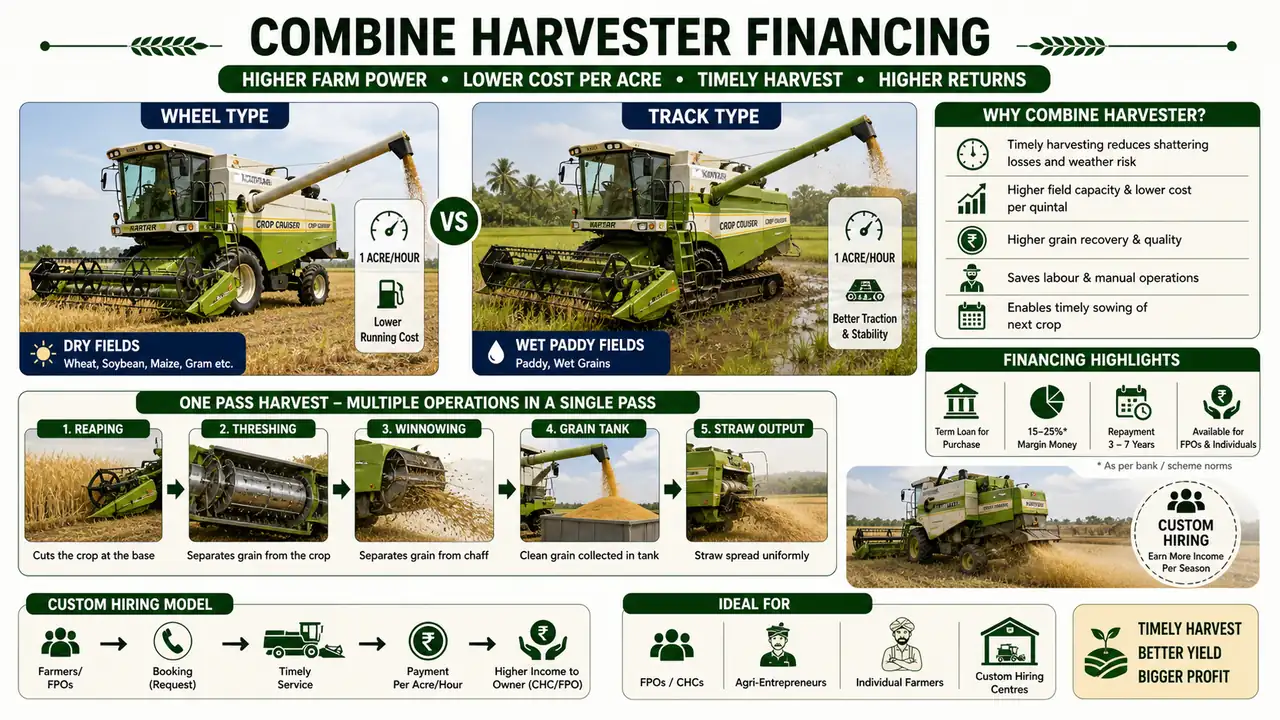
Why Combine Harvesters?
Harvesting is the most labour-intensive agricultural operation — and it must happen at the right time. Late harvest directly reduces yield and quality. As rural labour becomes scarcer and costlier, mechanised harvesting is no longer optional.
India had ~50,000 combine harvesters at the time of this scheme, concentrated in mechanised states like Punjab and Gujarat. Most of the country relied on machines transported from these states — expensive and time-delayed. The NABARD scheme aims to make harvesters locally available, reducing custom hiring costs and enabling timely harvest.
NOTE
Exam fact: Around 90% of combine harvester operations in India are done through custom hiring — not own-farm use. This makes viability dependent entirely on rental income, not farm size.
How a Combine Harvester Works
A combine merges three separate operations into one pass:
Pro Content Locked
Upgrade to Pro to access this lesson and all other premium content.
₹99 charged monthly · Cancel anytime
- All Agriculture & Banking Courses
- AI Lesson Questions (100/day)
- AI Doubt Solver (50/day)
- Glows & Grows Feedback (30/day)
- AI Section Quiz (20/day)
- 22-Language Translation (100/day)
- Recall Questions (20/day)
- AI Quiz (15/day)
- AI Quiz Paper Analysis (100/day)
- AI Step-by-Step Explanations (100/day)
- Spaced Repetition Recall (FSRS)
- AI Tutor
- Immersive Text Questions
- Audio Lessons — Hindi & English
- Mock Tests & Previous Year Papers
- Summary & Mind Maps
- XP, Levels, Leaderboard & Badges
- Generate New Classrooms
- Voice AI Teacher (AgriDots Live)
- AI Revision Assistant
- Knowledge Gap Analysis
- Interactive Revision (LangGraph)
🔒 Secure via Razorpay · Cancel anytime · No hidden fees
Why Combine Harvesters?
Harvesting is the most labour-intensive agricultural operation — and it must happen at the right time. Late harvest directly reduces yield and quality. As rural labour becomes scarcer and costlier, mechanised harvesting is no longer optional.
India had ~50,000 combine harvesters at the time of this scheme, concentrated in mechanised states like Punjab and Gujarat. Most of the country relied on machines transported from these states — expensive and time-delayed. The NABARD scheme aims to make harvesters locally available, reducing custom hiring costs and enabling timely harvest.
NOTE
Exam fact: Around 90% of combine harvester operations in India are done through custom hiring — not own-farm use. This makes viability dependent entirely on rental income, not farm size.
How a Combine Harvester Works
A combine merges three separate operations into one pass:
- Reaping — cutting crop at the base
- Threshing — separating grain from straw in the drum
- Winnowing — blowing away chaff with a fan, collecting clean grain
The clean grain goes into a tank, then is unloaded via a pipe into a trailer. Coverage: 1 acre per hour for both types.
Two Types: Wheel vs Track
| Feature | Wheel Type | Track Type |
|---|---|---|
| Cost | ₹16,00,000 | ₹24,00,000 |
| Fuel consumption | 6 litres/hour | 8 litres/hour |
| Lubricant consumption | 0.18 litres/hour | 0.24 litres/hour |
| Rental rate | ₹2,000/hour | ₹2,700/hour |
| Life (hours) | 6,000 hours | 6,000 hours |
| Depreciation | 11.7%/year | 11.7%/year |
| Suited for | Normal terrain | Wetlands, uneven fields |
Track type costs 50% more but earns 35% higher rental — the economics are comparable.
Usage Assumptions (Both Types)
| Parameter | Value |
|---|---|
| Own farm use | 50 hours/year |
| Custom hiring | 650 hours/year |
| Total annual usage | 700 hours/year |
| Skilled operator wages | ₹1,200/day |
| Semi-skilled assistant wages | ₹800/day |
| Interest rate on loan | 12.5% |
| Bank loan (both types) | 85% of cost |
Cost of Operation — Wheel Type (₹/year)
| Cost Head | Amount (₹) |
|---|---|
| Interest | 1,70,000 |
| Insurance & taxes (2.5%) | 40,000 |
| Depreciation (11.7%) | 1,86,667 |
| Total Fixed Costs | 3,96,667 |
| Fuel (6 L/hr × 700 hr × ₹55) | 2,31,000 |
| Lubricants | 25,200 |
| Repairs & maintenance (12%) | 1,92,000 |
| Manpower | 1,16,667 |
| Total Variable Costs | 5,64,867 |
| Total Cost | 9,61,534 |
| Cost per hour | ₹1,374/hour |
| Rental income | ₹2,000/hr × 700 hr = ₹14,00,000 |
| Net income/year | ₹4,38,200 |
Cost of Operation — Track Type (₹/year)
| Cost Head | Amount (₹) |
|---|---|
| Total Fixed Costs | 5,95,000 |
| Total Variable Costs | 7,46,267 |
| Total Cost | 13,41,267 |
| Cost per hour | ₹1,916/hour |
| Rental income | ₹2,700/hr × 700 hr = ₹18,90,000 |
| Net income/year | ₹5,48,800 |
Financial Indicators
| Indicator | Wheel Type | Track Type |
|---|---|---|
| NPV @ 15% | ₹10,17,951 | ₹9,80,051 |
| BCR | 1.17 : 1 | 1.12 : 1 |
| IRR | 46% | 34% |
| Average DSCR | 1.71 : 1 | 1.43 : 1 |
Wheel type is more financially efficient — lower cost, similar rental income per hour results in higher IRR (46% vs 34%) and better DSCR.
Repayment Schedule
Wheel type: Loan = ₹13,60,000 (85% of ₹16 lakh), repaid over 8 years Track type: Loan = ₹20,40,000 (85% of ₹24 lakh), repaid over 8 years
Both have 1 year of interest-only in Year 1 (no principal repayment).
NOTE
Exam trap: Bank loan for combine harvesters is 85% of cost — higher than the typical 75% for most agricultural schemes. This reflects the high capital cost and strong revenue-generating capacity of custom-hire equipment.
Linked Schemes & Policy Context
- Sub Mission on Agricultural Mechanization (SMAM) — provides subsidy to farmers and entrepreneurs for purchasing farm machinery including combine harvesters
- Custom Hiring Centres (CHC) — often include combine harvesters as part of a larger equipment pool
- Pradhan Mantri Kisan Sampada Yojana — post-harvest infrastructure, indirectly supports mechanisation
NOTE
Must remember for exam: Wheel type combine — ₹16 lakh cost, ₹2,000/hr rental, IRR 46%, DSCR 1.71. Track type — ₹24 lakh cost, ₹2,700/hr rental, IRR 34%, DSCR 1.43. Loan = 85% for both.
Sources & References
Primary source for this lesson is NABARD's official Model Bankable Projects portal.[1] Lesson-specific report copy used for this topic.[2]
References
2 sources • [1] [2]
References
Used for: Official NABARD portal for model bankable project documents and updates.
Used for: Reference copy used in this lesson for project parameters and worked figures.
The figures in this lesson reflect the cost norms and technical parameters as published in the NABARD document. Actual costs may vary by state, season, and year of implementation. Always refer to the latest NABARD circular for current norms.
Summary Cheat Sheet
| Concept / Topic | Key Details / Explanation |
|---|---|
| Custom hiring share | ~90% of combine harvester operations in India done through custom hiring |
| Coverage | 1 acre per hour (both wheel and track type) |
| Three operations merged | Reaping + Threshing + Winnowing in one pass |
| Wheel type cost | ₹16,00,000 |
| Track type cost | ₹24,00,000 |
| Bank loan (both types) | 85% of cost (higher than typical 75%) |
| Interest rate | 12.5% per annum |
| Repayment period | 8 years (both types, 1-year grace) |
| Annual usage | Own farm: 50 hrs + Custom hiring: 650 hrs = 700 hrs/year |
| Wheel type rental rate | ₹2,000/hour |
| Track type rental rate | ₹2,700/hour |
| Wheel type fuel | 6 litres/hour |
| Track type fuel | 8 litres/hour |
| Machine life | 6,000 hours (both types) |
| Depreciation | 11.7%/year (both types) |
| Wheel type cost per hour | ₹1,374/hour |
| Track type cost per hour | ₹1,916/hour |
| Wheel type net income/year | ₹4,38,200 |
| Track type net income/year | ₹5,48,800 |
| Wheel type IRR | 46% |
| Track type IRR | 34% |
| Wheel type DSCR | 1.71:1 |
| Track type DSCR | 1.43:1 |
| Wheel type BCR | 1.17:1 |
| Track type BCR | 1.12:1 |
| Which is better financially | Wheel type — higher IRR, DSCR, BCR despite lower absolute income |
| Track type advantage | Suited for wetlands and uneven terrain |
| Linked scheme | SMAM (Sub Mission on Agricultural Mechanization) — provides subsidy for purchase |
Lesson Doubts
Ask questions, get expert answers