🏪 Rural Godown (Grain Storage) — NABARD Model Scheme
NABARD's bankable model for constructing rural grain storage godowns of 50–2026 MT capacity. Covers construction standards, capital cost norms, income from rental and own produce, and financial viability — key for exams.
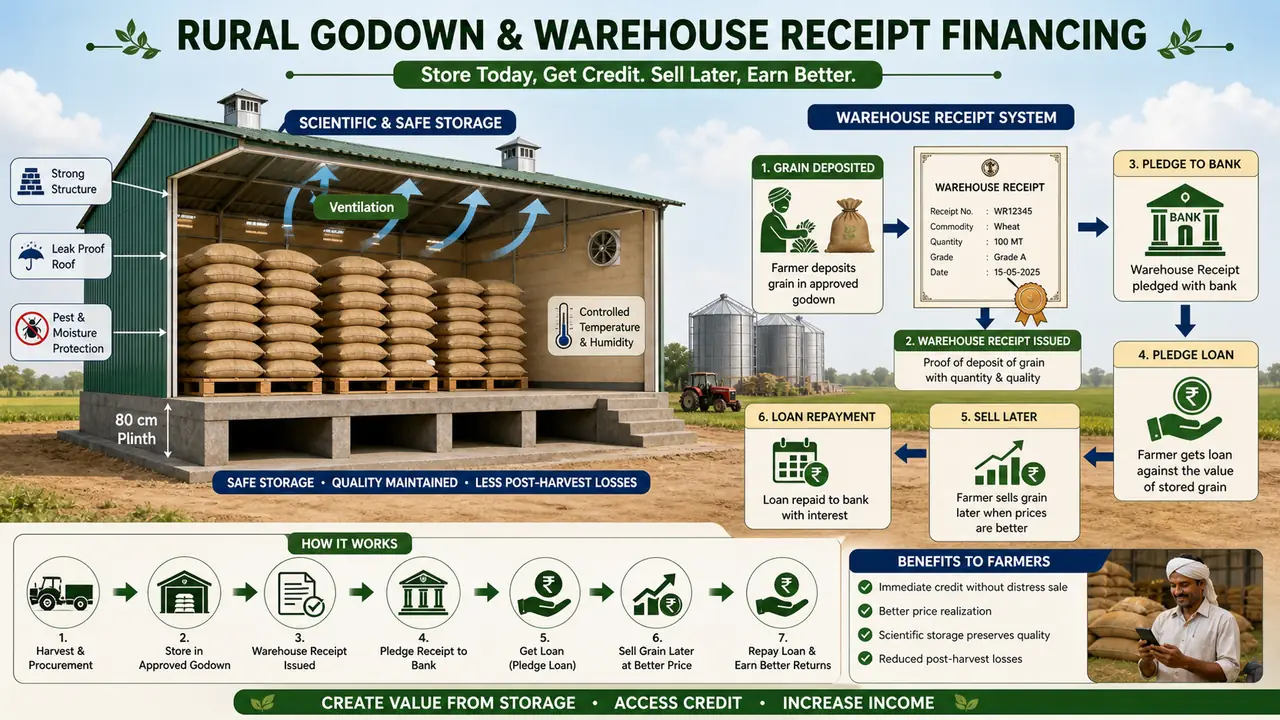
Why Rural Godowns?
Small and marginal farmers — who constitute the majority of India's farming community — are forced to sell produce immediately after harvest at distress prices. The problem: no storage near production areas. This creates a vicious cycle where farmers borrow at high interest before harvest, then sell cheap to repay loans.
Rural godowns break this cycle by enabling:
- Price realisation — store and sell when prices rise
- Pledge loans — warehouse receipts enable credit from banks against stored produce
- Rental income — unused capacity rented to other farmers
NOTE
Exam anchor: The primary purpose of rural godowns is not just storage — it's price risk management for small/marginal farmers. The Negotiable Warehouse Receipts (NWR) system links godowns to institutional credit.
Capacity Categories
| Category | Capacity Range |
|---|---|
| Small | 50, 100, 200, 250 MT |
| Medium | 500, 1000, 2000 MT |
| Large | Above 2000 MT |
For 1000 MT and above, godowns must be divided into compartments. Height of a road-fed godown: 5.6 m. Ideal stack size: 9.15 m × 6.1 m × 4.57 m.
Pro Content Locked
Upgrade to Pro to access this lesson and all other premium content.
₹99 charged monthly · Cancel anytime
- All Agriculture & Banking Courses
- AI Lesson Questions (100/day)
- AI Doubt Solver (50/day)
- Glows & Grows Feedback (30/day)
- AI Section Quiz (20/day)
- 22-Language Translation (100/day)
- Recall Questions (20/day)
- AI Quiz (15/day)
- AI Quiz Paper Analysis (100/day)
- AI Step-by-Step Explanations (100/day)
- Spaced Repetition Recall (FSRS)
- AI Tutor
- Immersive Text Questions
- Audio Lessons — Hindi & English
- Mock Tests & Previous Year Papers
- Summary & Mind Maps
- XP, Levels, Leaderboard & Badges
- Generate New Classrooms
- Voice AI Teacher (AgriDots Live)
- AI Revision Assistant
- Knowledge Gap Analysis
- Interactive Revision (LangGraph)
🔒 Secure via Razorpay · Cancel anytime · No hidden fees
Why Rural Godowns?
Small and marginal farmers — who constitute the majority of India's farming community — are forced to sell produce immediately after harvest at distress prices. The problem: no storage near production areas. This creates a vicious cycle where farmers borrow at high interest before harvest, then sell cheap to repay loans.
Rural godowns break this cycle by enabling:
- Price realisation — store and sell when prices rise
- Pledge loans — warehouse receipts enable credit from banks against stored produce
- Rental income — unused capacity rented to other farmers
NOTE
Exam anchor: The primary purpose of rural godowns is not just storage — it's price risk management for small/marginal farmers. The Negotiable Warehouse Receipts (NWR) system links godowns to institutional credit.
Capacity Categories
| Category | Capacity Range |
|---|---|
| Small | 50, 100, 200, 250 MT |
| Medium | 500, 1000, 2000 MT |
| Large | Above 2000 MT |
For 1000 MT and above, godowns must be divided into compartments. Height of a road-fed godown: 5.6 m. Ideal stack size: 9.15 m × 6.1 m × 4.57 m.
Location Requirements
The structure must be sited on raised, well-drained land. Mandatory minimum distances:
| Hazard Source | Minimum Distance |
|---|---|
| Kilns, slaughterhouses, tanneries | 500 m |
| Dairies and poultry farms | 300 m |
| Factories, hay stacks, petrol pumps | 150 m |
| Trees (to prevent rodent access) | 3 m |
Construction Standards
Key structural requirements that prevent storage losses:
- Plinth height: 80 cm above finished ground level (keeps moisture and rodents out)
- Rat guard: 15–18 cm RCC projection at plinth level at 0.75–0.8 m height
- Platform width: Minimum 2.45 m for road-fed godowns (for loading/unloading trucks)
- Ventilators: Fixed 15 cm below top edge of wall for air circulation
- DPC: Damp Proof Course with water-proofing compound — minimum 40 mm (brick), 50 mm (stone)
- Roof: Single-span structural steel or tubular trusses at 5.6 m tie level
NOTE
Exam trap: The 80 cm plinth height and 2.45 m platform width are specific numbers tested in exams. The plinth protects against moisture ingress and rodents — not just floods.
Capital Cost Norm
| Godown Size | Construction Cost |
|---|---|
| Up to 2000 MT | ₹2,800 per MT |
| Above 2000 MT | ₹2,000 per MT |
This cost includes land, land development, preliminary & pre-operative expenses, and miscellaneous provisions. Land cost is treated as margin money (not included in bank loan).
Example — 50 MT godown: 50 × ₹2,800 = ₹1,40,000 total capital cost.
Financial Assumptions & Income Model
| Assumption | Value |
|---|---|
| Own produce storage | 20% of capacity |
| Rental storage | Up to 70% of capacity |
| Max capacity utilisation | 90% |
| Rental charges | ₹3.50/bag/month (75 kg bag) = ₹455/MT |
| Storage duration (max) | 10 months |
| Price margin (own produce) | ₹200/bag = ₹2,600/MT |
| Financing | Bank loan 75%, Interest 12%, Repayment 10 years (1 year grace) |
50 MT godown — stabilised annual income (Year 3+):
- Rental income: ₹1.59 lakh
- Own produce margin: ₹0.26 lakh
- Total: ₹4.19 lakh/year (post full utilisation)
Financial Indicators by Scale
| Capacity | IRR | NPW (₹ lakh) | DSCR | BCR |
|---|---|---|---|---|
| 50 MT | 23% | 0.31 | 1.64 | 1.33:1 |
| 100 MT | 23% | 0.62 | 2.04 | 1.33:1 |
| 250 MT | 23% | 1.54 | 2.00 | 1.38:1 |
| 500 MT | 23% | 3.08 | 2.18 | 1.42:1 |
| 1000 MT | 23% | 6.17 | 2.32 | 1.48:1 |
Key insight: IRR stays constant at 23% across all scales — larger units are more financially efficient (higher DSCR and BCR) because fixed cost per MT falls.
Repayment (50 MT Model)
- Loan: ₹1.05 lakh (75% of ₹1.40 lakh)
- Grace period: 1 year (interest only)
- Repayment from Year 2: ₹10,000/year principal + interest
- Average DSCR: 1.64 — comfortable debt servicing
Linked Schemes
- Pradhan Mantri Gram Sadak Yojana (PMGSY) — approach road connectivity
- Warehouse Development and Regulatory Authority (WDRA) — regulates negotiable warehouse receipts
- Gramin Bhandaran Yojana — capital subsidy (25–33.33%) for rural godown construction (key NABARD-linked scheme)
NOTE
Must remember: Gramin Bhandaran Yojana provides capital subsidy for rural godowns — 25% for general and 33.33% for SC/ST/NE/cooperative/women borrowers. This scheme is directly financed through NABARD.
Sources & References
Primary source for this lesson is NABARD's official Model Bankable Projects portal.[1] Lesson-specific report copy used for this topic.[2]
References
2 sources • [1] [2]
References
Used for: Official NABARD portal for model bankable project documents and updates.
Used for: Reference copy used in this lesson for project parameters and worked figures.
The figures in this lesson reflect the cost norms and technical parameters as published in the NABARD document. Actual costs may vary by state, season, and year of implementation. Always refer to the latest NABARD circular for current norms.
Summary Cheat Sheet
| Concept / Topic | Key Details / Explanation |
|---|---|
| Purpose | Price risk management for small/marginal farmers; enables pledge loans via Negotiable Warehouse Receipts (NWR) |
| Capacity categories | Small: 50/100/200/250 MT · Medium: 500/1000/2000 MT · Large: >2000 MT |
| Capital cost norm | Up to 2000 MT: ₹2,800/MT; Above 2000 MT: ₹2,000/MT |
| Example — 50 MT cost | 50 × ₹2,800 = ₹1,40,000 |
| Bank loan / Margin Money | Bank loan: 75%; land cost treated as margin money |
| Interest rate | 12% per annum |
| Repayment period | 10 years with 1-year grace |
| Plinth height | 80 cm above finished ground level (moisture and rodent protection) |
| Platform width | Minimum 2.45 m for road-fed godowns |
| Rat guard | 15–18 cm RCC projection at 0.75–0.8 m height |
| Godown height (road-fed) | 5.6 m tie level |
| Ideal stack size | 9.15 m × 6.1 m × 4.57 m |
| Min distance from kilns/slaughterhouses | 500 m |
| Min distance from dairies/poultry farms | 300 m |
| Min distance from factories/haystacks | 150 m |
| Min distance from trees | 3 m (rodent access prevention) |
| Own produce storage | 20% of capacity |
| Rental storage | Up to 70% of capacity (max utilisation 90%) |
| Rental charges | ₹3.50/bag/month (75 kg bag) = ₹455/MT |
| Max storage duration | 10 months |
| Price margin (own produce) | ₹200/bag = ₹2,600/MT |
| IRR (all scales) | 23% (constant across all sizes) |
| BCR | 50 MT: 1.33; 1000 MT: 1.48 (larger = better) |
| DSCR (50 MT) | 1.64 |
| Gramin Bhandaran Yojana | Capital subsidy: 25% (general); 33.33% (SC/ST/NE/cooperative/women) — financed through NABARD |
| NWR regulator | WDRA (Warehouse Development and Regulatory Authority) |
Lesson Doubts
Ask questions, get expert answers