🪱 Vermicompost Production Unit — NABARD Model Scheme
NABARD's bankable model for setting up a 200 MT/year vermicompost production unit. Covers earthworm biology, production cycles, capital cost, operational cost, income projections, and repayment schedule — all high-frequency topics in exams and exams.
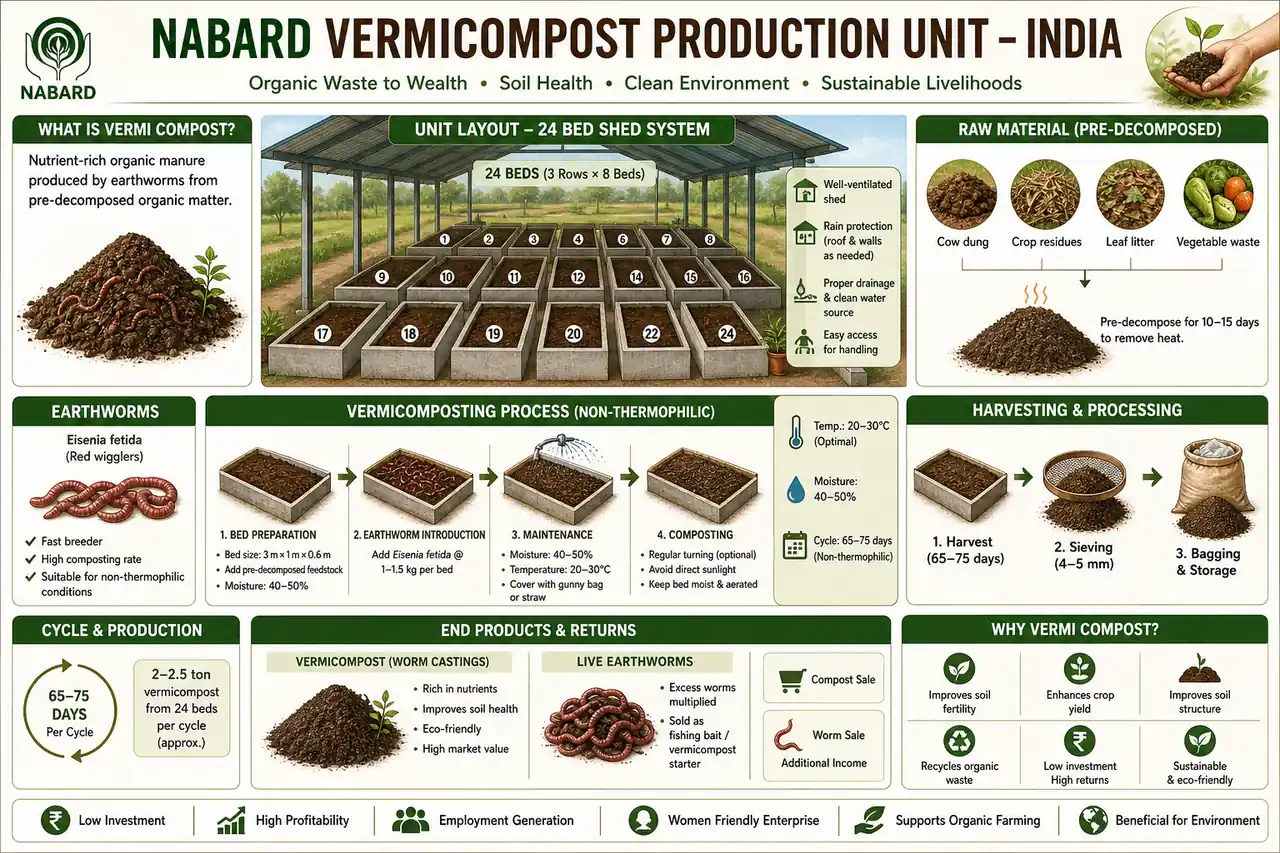
What is Vermicompost?
Vermicompost is organic matter transformed through the digestive action of earthworms. The USDA (effective Oct 21, 2002) defines it as earthworm castings produced non-thermophilically — meaning no heat is generated, unlike conventional composting. This is key: vermicomposting works at 20–30°C, not the 55–65°C of hot composting.
The process combines two mechanisms: enzymatic activity from gut microorganisms + physical grinding by earthworms. This dual action produces compost far faster than passive pit composting.
Why it matters for soil: Vermicompost improves soil structure, increases water and nutrient holding capacity, supplies plant growth hormones, and produces crops with better keeping quality.
Earthworm Species Used
India has ~350 species of earthworms. The commercially relevant ones are:
- Eisenia fetida — red wiggler, most common
- Eudrilus eugeniae — African nightcrawler
- Perionyx excavatus — Indian blue worm
Worms reach reproductive maturity at ~6 weeks, then lay one egg capsule every 7–10 days. Each capsule yields 3–7 worms. Fully grown worms can be dried to produce worm meal — a protein-rich (70%) animal feed ingredient.
Pro Content Locked
Upgrade to Pro to access this lesson and all other premium content.
₹99 charged monthly · Cancel anytime
- All Agriculture & Banking Courses
- AI Lesson Questions (100/day)
- AI Doubt Solver (50/day)
- Glows & Grows Feedback (30/day)
- AI Section Quiz (20/day)
- 22-Language Translation (100/day)
- Recall Questions (20/day)
- AI Quiz (15/day)
- AI Quiz Paper Analysis (100/day)
- AI Step-by-Step Explanations (100/day)
- Spaced Repetition Recall (FSRS)
- AI Tutor
- Immersive Text Questions
- Audio Lessons — Hindi & English
- Mock Tests & Previous Year Papers
- Summary & Mind Maps
- XP, Levels, Leaderboard & Badges
- Generate New Classrooms
- Voice AI Teacher (AgriDots Live)
- AI Revision Assistant
- Knowledge Gap Analysis
- Interactive Revision (LangGraph)
🔒 Secure via Razorpay · Cancel anytime · No hidden fees
What is Vermicompost?
Vermicompost is organic matter transformed through the digestive action of earthworms. The USDA (effective Oct 21, 2002) defines it as earthworm castings produced non-thermophilically — meaning no heat is generated, unlike conventional composting. This is key: vermicomposting works at 20–30°C, not the 55–65°C of hot composting.
The process combines two mechanisms: enzymatic activity from gut microorganisms + physical grinding by earthworms. This dual action produces compost far faster than passive pit composting.
Why it matters for soil: Vermicompost improves soil structure, increases water and nutrient holding capacity, supplies plant growth hormones, and produces crops with better keeping quality.
Earthworm Species Used
India has ~350 species of earthworms. The commercially relevant ones are:
- Eisenia fetida — red wiggler, most common
- Eudrilus eugeniae — African nightcrawler
- Perionyx excavatus — Indian blue worm
Worms reach reproductive maturity at ~6 weeks, then lay one egg capsule every 7–10 days. Each capsule yields 3–7 worms. Fully grown worms can be dried to produce worm meal — a protein-rich (70%) animal feed ingredient.
NOTE
Exam trap: Vermicomposting is non-thermophilic (ambient temperature). Conventional compost is thermophilic (high heat). This distinction is commonly tested.
Technical Parameters
| Parameter | Value |
|---|---|
| Bed dimensions | 15 m × 1.5 m × 0.6 m (per bed) |
| Number of beds | 24 beds (total volume: 324 m³) |
| Earthworm stocking rate | 1 kg per m³ of bed volume (~350 worms/m³) |
| Moisture content | 40–50% |
| Operating temperature | 20–30°C |
| Cycle duration | 65–75 days per cycle |
| Cycles per year | 6–7 |
| Conversion rate (recovery) | 30% of input organic matter |
| Land required | 0.5–0.6 acre |
The bed width is capped at 1.5 m — wider beds make it hard to reach the centre. Height is capped at 0.6 m — greater height causes heat build-up that kills worms.
Project Scale & Capital Cost (200 TPA Unit)
The model unit produces 200 tonnes per annum (TPA) of vermicompost.
| Component | Cost (₹) |
|---|---|
| Levelling + fencing | 32,500 |
| Vermicompost bed sheds (560 m² + 30 m²) | 5,90,000 |
| Godown/store-cum-office (50 m²) | 2,50,000 |
| Machinery (shredder, sieving machine, etc.) | 1,03,600 |
| Borewell + water supply | 75,000 |
| Electrical installation | 10,000 |
| Furniture & fixtures | 25,000 |
| Earthworms (324 kg @ ₹300/kg) | 97,200 |
| Total Capital Cost | ₹11,83,300 |
NOTE
The capital cost rule of thumb: ₹5,000–₹6,000 per tonne of production capacity. For 200 TPA, expect ~₹12–13 lakh in capital.
Operational Cost & Income
Annual operational cost (from Year 2): ₹3,42,080
Key recurring costs: agricultural waste transport, cow dung, 2 permanent skilled labourers (₹6,000/month each), day labour, electricity, maintenance.
Income streams:
- Vermicompost sale @ ₹4,500/MT → 180 MT × ₹4,500 = ₹8,10,000/year
- Worm sale @ ₹200/kg (5 kg per MT of compost) → ₹1,80,000/year
- Total income (Year 2+): ₹9,90,000
Net income (Year 2+): ₹9,90,000 − ₹3,42,080 = ₹6,47,920/year
Operational cost of production: less than ₹2/kg — selling at ₹4–4.50/kg makes it profitable.
Financing Structure
| Item | Amount |
|---|---|
| Total Financial Outlay (TFO) | ₹13,50,000 (capital + 2 cycles operational + lease) |
| Margin Money (25%) | ₹3,37,500 |
| Bank Loan (75%) | ₹10,12,500 |
| Interest Rate | 13% p.a. |
| Repayment Period | 6 years |
Financial Indicators
| Indicator | Value |
|---|---|
| NPV | ₹7.62 lakh |
| BCR | 1.23 : 1 |
| IRR | 34% |
| Discounting Rate | 15% |
An IRR of 34% well exceeds the 15% discount rate — confirms strong viability.
Linked Schemes & Exam Anchors
- National Mission for Sustainable Agriculture (NMSA) — promotes organic inputs including vermicompost
- Paramparagat Krishi Vikas Yojana (PKVY) — cluster-based organic farming, vermicompost is a key input
- PM-PRANAM — incentivises states to reduce chemical fertiliser use, promoting bio-alternatives
NOTE
Must remember: Vermicompost production cost < ₹2/kg; selling price ₹4–4.50/kg; 200 TPA unit needs ₹13.5 lakh TFO; IRR = 34%; repayment in 6 years. These numbers appear directly in exam MCQs.
Sources & References
Primary source for this lesson is NABARD's official Model Bankable Projects portal.[1] Lesson-specific report copy used for this topic.[2]
References
2 sources • [1] [2]
References
Used for: Official NABARD portal for model bankable project documents and updates.
Used for: Reference copy used in this lesson for project parameters and worked figures.
The figures in this lesson reflect the cost norms and technical parameters as published in the NABARD document. Actual costs may vary by state, season, and year of implementation. Always refer to the latest NABARD circular for current norms.
Summary Cheat Sheet
| Concept / Topic | Key Details / Explanation |
|---|---|
| Vermicompost definition | Earthworm castings produced non-thermophilically (USDA, Oct 2002) — no heat, works at 20–30°C |
| Key earthworm species | Eisenia fetida, Eudrilus eugeniae, Perionyx excavatus |
| Reproductive maturity | ~6 weeks; one egg capsule every 7–10 days; 3–7 worms per capsule |
| Unit capacity | 200 TPA (tonnes per annum) |
| Bed dimensions | 15 m × 1.5 m × 0.6 m per bed; 24 beds total |
| Moisture content | 40–50% |
| Operating temperature | 20–30°C (non-thermophilic) |
| Cycle duration | 65–75 days per cycle; 6–7 cycles/year |
| Conversion rate | 30% of input organic matter recovered as compost |
| Land required | 0.5–0.6 acre |
| Earthworm stocking rate | 1 kg per m³ bed volume (~350 worms/m³) |
| Total Capital Cost | ₹11,83,300 |
| Total Financial Outlay (TFO) | ₹13,50,000 (capital + 2 cycles operational + lease) |
| Margin Money | 25% = ₹3,37,500 |
| Bank Loan | 75% = ₹10,12,500 |
| Interest rate | 13% per annum |
| Repayment period | 6 years |
| Vermicompost sale price | ₹4,500/MT → 180 MT × ₹4,500 = ₹8,10,000/year |
| Worm sale income | 5 kg worms per MT × ₹200/kg → ₹1,80,000/year |
| Total annual income (Year 2+) | ₹9,90,000 |
| Net annual income (Year 2+) | ₹6,47,920 |
| Production cost | <₹2/kg; selling at ₹4–4.50/kg |
| Capital cost thumb rule | ₹5,000–₹6,000 per tonne of capacity |
| BCR | 1.23:1 |
| IRR | 34% |
| NPV | ₹7.62 lakh |
| Linked schemes | NMSA, PKVY, PM-PRANAM |
| Thermophilic vs non-thermophilic | Conventional compost = thermophilic (55–65°C); Vermicompost = non-thermophilic (20–30°C) |
Lesson Doubts
Ask questions, get expert answers