🧊 Fish Cold Storage Units (1000–3000 MT)
NABARD model bankable project for fish cold storage covering three capacity models. Essential for exams — unit costs, financial viability indicators, and subsidy terms are frequently tested.
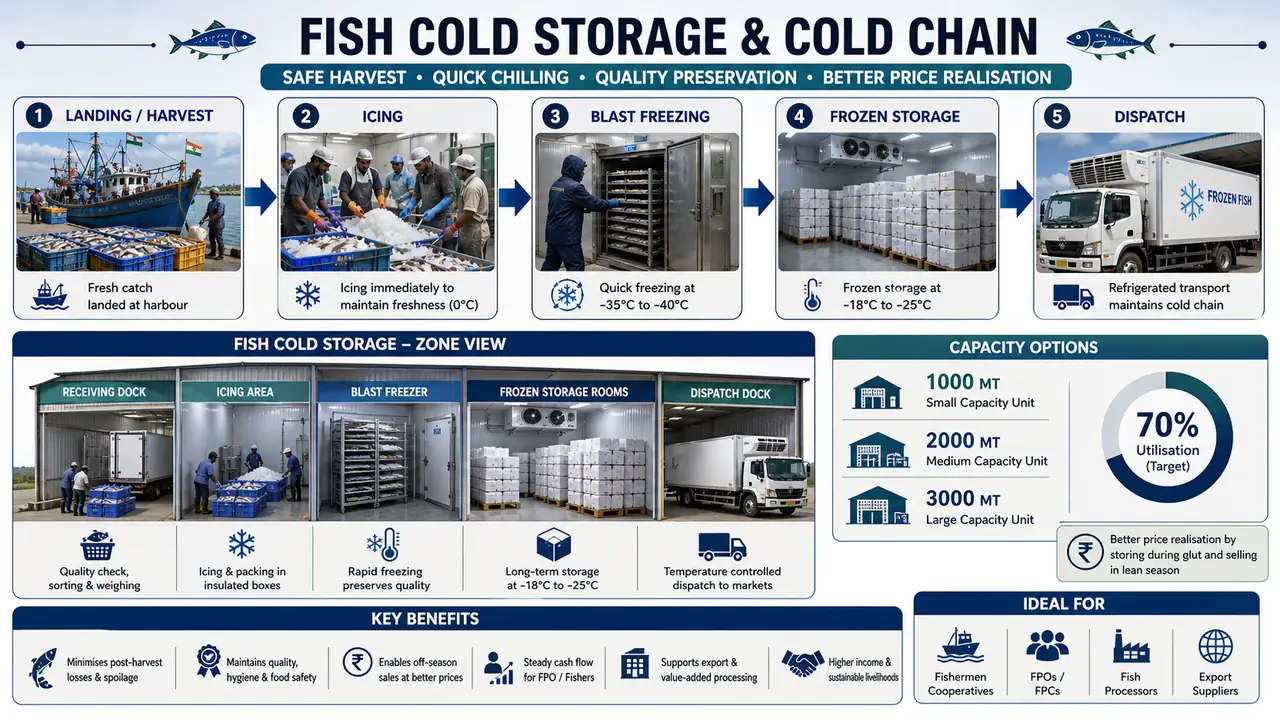
What is a Fish Cold Storage Unit?
Cold storage units for fish maintain temperatures between -18°C to -25°C for frozen fish and 0°C to 4°C for chilled fish. They are critical infrastructure for preventing post-harvest losses, which are significant in the fisheries sector. NABARD promotes three standard capacity models: 1000 MT, 2000 MT, and 3000 MT.
The unit serves as a buffer between landing/harvest and market demand, allowing fishermen to sell at remunerative prices rather than distress-selling during peak catch seasons.
Project Models at a Glance
| Parameter | 1000 MT | 2000 MT | 3000 MT |
|---|---|---|---|
| Capital Cost (Rs. Lakh) | ~190 | ~370 | ~600.5 |
| Margin Money | 25% | 25% | 25% |
| Bank Loan | 75% | 75% | 75% |
| Rent Charged | Rs. 50/pallet/day | Rs. 50/pallet/day | Rs. 50/pallet/day |
| Repayment Period | 6 years + 1 yr grace | 6 years + 1 yr grace | 6 years + 1 yr grace |
NOTE
Pro Content Locked
Upgrade to Pro to access this lesson and all other premium content.
₹99 charged monthly · Cancel anytime
- All Agriculture & Banking Courses
- AI Lesson Questions (100/day)
- AI Doubt Solver (50/day)
- Glows & Grows Feedback (30/day)
- AI Section Quiz (20/day)
- 22-Language Translation (100/day)
- Recall Questions (20/day)
- AI Quiz (15/day)
- AI Quiz Paper Analysis (100/day)
- AI Step-by-Step Explanations (100/day)
- Spaced Repetition Recall (FSRS)
- AI Tutor
- Immersive Text Questions
- Audio Lessons — Hindi & English
- Mock Tests & Previous Year Papers
- Summary & Mind Maps
- XP, Levels, Leaderboard & Badges
- Generate New Classrooms
- Voice AI Teacher (AgriDots Live)
- AI Revision Assistant
- Knowledge Gap Analysis
- Interactive Revision (LangGraph)
🔒 Secure via Razorpay · Cancel anytime · No hidden fees
What is a Fish Cold Storage Unit?
Cold storage units for fish maintain temperatures between -18°C to -25°C for frozen fish and 0°C to 4°C for chilled fish. They are critical infrastructure for preventing post-harvest losses, which are significant in the fisheries sector. NABARD promotes three standard capacity models: 1000 MT, 2000 MT, and 3000 MT.
The unit serves as a buffer between landing/harvest and market demand, allowing fishermen to sell at remunerative prices rather than distress-selling during peak catch seasons.
Project Models at a Glance
| Parameter | 1000 MT | 2000 MT | 3000 MT |
|---|---|---|---|
| Capital Cost (Rs. Lakh) | ~190 | ~370 | ~600.5 |
| Margin Money | 25% | 25% | 25% |
| Bank Loan | 75% | 75% | 75% |
| Rent Charged | Rs. 50/pallet/day | Rs. 50/pallet/day | Rs. 50/pallet/day |
| Repayment Period | 6 years + 1 yr grace | 6 years + 1 yr grace | 6 years + 1 yr grace |
NOTE
Margin money is 25% (not 10%) for this model. Banks may offer 10–25% margin range as per RBI guidelines — the 25% figure is what NABARD assumes in its model scheme for cold storages. This distinction is exam-relevant.
Why 25% Margin Money?
Cold storages are capital-intensive with relatively long payback periods. Higher margin money reduces bank risk exposure. NABARD's model fixes margin at 25% to demonstrate the project is robust even with conservative assumptions. In subsidy-linked schemes, bank loan is compulsory to avail subsidy — entrepreneurs cannot use personal funds alone.
Capacity Utilisation Assumptions
The cold storage business is seasonal. NABARD uses a blended utilisation rate to compute realistic income:
- Peak season (Aug–Dec): 90% utilisation
- Lean season: 60% utilisation
- Average utilisation: 70%
- First year: Only 40% (ramp-up period)
This is why Year 1 revenue is roughly half of steady-state. Exams may ask WHY first-year income is lower — it is not lower prices, it is lower occupancy.
Financial Viability Indicators
| Indicator | 1000 MT | 2000 MT | 3000 MT | Threshold |
|---|---|---|---|---|
| NPW @ 15% DF (Rs. Lakh) | 253.8 | 577.6 | 869.89 | Must be +ve |
| IRR | 42% | 50% | 49% | Above 15% |
| BCR | 2.4:1 | 3.0:1 | 3.1:1 | Above 1.0 |
| DSCR | 2.2 | 2.1 | 2.0 | Above 1.5 |
NOTE
All three models show IRR well above 40%, making them among the most financially attractive NABARD model projects. Higher capacity (3000 MT) gives the best BCR (3.1) but slightly lower IRR than 2000 MT — this is because capital costs scale up faster than revenue at very large sizes.
Revenue and Cost Structure (2000 MT Model — Steady State)
| Item | Rs. Lakh/year |
|---|---|
| Revenue (70% utilisation) | 252.00 |
| Electricity charges | 45.00 |
| Salaries & wages | 21.24 |
| Repairs & maintenance | 8.00 |
| Miscellaneous | 10.00 |
| Total Operating Cost | 84.24 |
| Profit before interest & depreciation | 167.76 |
Linked Government Schemes
- NFD (National Fisheries Development Board): Provides capital subsidy for cold chain infrastructure in fisheries.
- PMMSY (Pradhan Mantri Matsya Sampada Yojana): Subsidy available for cold storage, ice plants, and refrigerated transport.
- MIDH / NHM: For horticultural produce cold storages (separate but often cited alongside fish cold storage in exams).
NOTE
Under most government subsidy schemes, availing bank loan is compulsory to claim subsidy. This is a classic exam trap — subsidy is NOT available on self-financed projects.
Technical Parameters
- Interest on term loan: 12% p.a. (model assumption)
- Interest on working capital: 14% p.a.
- Depreciation: 10% on civil structures; 13.9% on machinery
- Manpower: Manager, Supervisor, Accountant, Technician, Watchman — product loading/unloading is manual; internal movement is mechanised (forklifts, stackers)
Key Exam Facts
- Repayment: 6 years including 1-year grace period
- Average capacity utilisation assumed: 70%
- Margin money: 25% of project cost
- Rent: Rs. 50 per pallet per day
- IRR ranges: 42%–50% across models
- DSCR above 2.0 in all models (well above 1.5 threshold)
Sources & References
Primary source for this lesson is NABARD's official Model Bankable Projects portal.[1] Lesson-specific report copy used for this topic.[2]
References
2 sources • [1] [2]
References
Used for: Official NABARD portal for model bankable project documents and updates.
Used for: Reference copy used in this lesson for project parameters and worked figures.
The figures in this lesson reflect the cost norms and technical parameters as published in the NABARD document. Actual costs may vary by state, season, and year of implementation. Always refer to the latest NABARD circular for current norms.
Summary Cheat Sheet
| Concept / Topic | Key Details / Explanation |
|---|---|
| Three model sizes | 1000 MT, 2000 MT, 3000 MT |
| Temperature range | Frozen fish: -18°C to -25°C; Chilled fish: 0°C to 4°C |
| Capital Cost | 1000 MT: ~₹190L · 2000 MT: ~₹370L · 3000 MT: ~₹600.5L |
| Margin Money | 25% (all models) |
| Bank Loan | 75% (all models) |
| Rental charge | ₹50/pallet/day (all models) |
| Repayment period | 6 years + 1-year grace (all models) |
| Capacity utilisation | Peak (Aug–Dec): 90% · Lean: 60% · Average: 70% · Year 1: 40% |
| Interest on term loan | 12% per annum |
| Interest on working capital | 14% per annum |
| Depreciation | Civil: 10%; Machinery: 13.9% |
| IRR | 1000 MT: 42% · 2000 MT: 50% · 3000 MT: 49% |
| BCR | 1000 MT: 2.4:1 · 2000 MT: 3.0:1 · 3000 MT: 3.1:1 |
| DSCR | 1000 MT: 2.2 · 2000 MT: 2.1 · 3000 MT: 2.0 (all well above 1.5) |
| NPW @ 15% | 1000 MT: ₹253.8L · 2000 MT: ₹577.6L · 3000 MT: ₹869.89L |
| Why Year 1 income is lower | Lower occupancy (40%), not lower prices — ramp-up period |
| Subsidy condition | Bank loan is compulsory to claim subsidy — self-financed projects not eligible |
| Linked schemes | NFDB, PMMSY (Pradhan Mantri Matsya Sampada Yojana), MIDH/NHM |
| Best IRR model | 2000 MT (50%) |
| Best BCR model | 3000 MT (3.1:1) |
Lesson Doubts
Ask questions, get expert answers