🐟 Composite Fish Culture (Polyculture in Ponds)
NABARD model bankable project for composite fish culture in freshwater ponds using multiple compatible species simultaneously. Covers stocking ratios, feeding, production economics, and loan terms for exams preparation.
What is Composite Fish Culture?
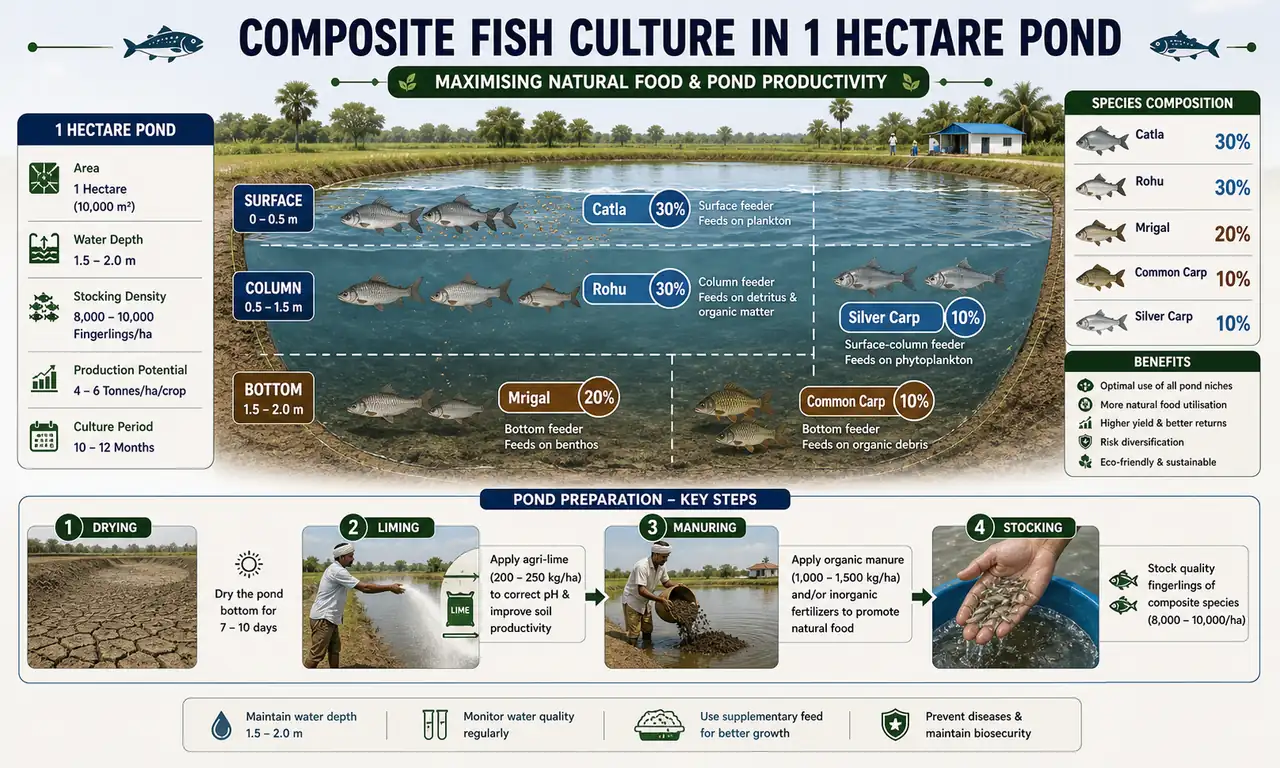
Composite Fish Culture (also called polyculture) is a technology where more than one compatible fish species are cultured simultaneously in the same pond. Each species occupies a different ecological niche (surface, middle, bottom water column), maximising utilisation of natural food organisms without interspecies competition.
This is the most popular freshwater fish farming method in India and is suitable for any perennial pond maintaining water depth of at least 1 metre (ideal: 2 metres).
Why Polyculture? The Ecological Logic
Natural ponds have food resources at different water layers:
- Surface feeders: Catla — feeds on phytoplankton at surface
- Column feeders: Rohu — feeds on decaying vegetation in mid-water
- Bottom feeders: Mrigal, Common Carp — feed on detritus and benthic organisms
By stocking all three layers, the farmer extracts maximum value from a single water body. This is NOT random mixing — species ratios are scientifically determined to avoid competition.
Pro Content Locked
Upgrade to Pro to access this lesson and all other premium content.
₹99 charged monthly · Cancel anytime
- All Agriculture & Banking Courses
- AI Lesson Questions (100/day)
- AI Doubt Solver (50/day)
- Glows & Grows Feedback (30/day)
- AI Section Quiz (20/day)
- 22-Language Translation (100/day)
- Recall Questions (20/day)
- AI Quiz (15/day)
- AI Quiz Paper Analysis (100/day)
- AI Step-by-Step Explanations (100/day)
- Spaced Repetition Recall (FSRS)
- AI Tutor
- Immersive Text Questions
- Audio Lessons — Hindi & English
- Mock Tests & Previous Year Papers
- Summary & Mind Maps
- XP, Levels, Leaderboard & Badges
- Generate New Classrooms
- Voice AI Teacher (AgriDots Live)
- AI Revision Assistant
- Knowledge Gap Analysis
- Interactive Revision (LangGraph)
🔒 Secure via Razorpay · Cancel anytime · No hidden fees
What is Composite Fish Culture?
Composite Fish Culture (also called polyculture) is a technology where more than one compatible fish species are cultured simultaneously in the same pond. Each species occupies a different ecological niche (surface, middle, bottom water column), maximising utilisation of natural food organisms without interspecies competition.
This is the most popular freshwater fish farming method in India and is suitable for any perennial pond maintaining water depth of at least 1 metre (ideal: 2 metres).
Why Polyculture? The Ecological Logic
Natural ponds have food resources at different water layers:
- Surface feeders: Catla — feeds on phytoplankton at surface
- Column feeders: Rohu — feeds on decaying vegetation in mid-water
- Bottom feeders: Mrigal, Common Carp — feed on detritus and benthic organisms
By stocking all three layers, the farmer extracts maximum value from a single water body. This is NOT random mixing — species ratios are scientifically determined to avoid competition.
Standard Species Combination
| Species | Feeding Habit | Stocking Ratio |
|---|---|---|
| Catla (Catla catla) | Surface (phytoplankton) | ~30% |
| Rohu (Labeo rohita) | Column (vegetation) | ~30% |
| Mrigal (Cirrhinus mrigala) | Bottom (detritus) | ~20% |
| Common Carp | Bottom | ~10% |
| Silver Carp | Surface/column | ~10% |
Total stocking density: typically 5,000–10,000 fingerlings/ha depending on management intensity.
Pond Preparation Steps
- Dewatering and sun-drying — eliminates predatory and weed fish
- Liming — corrects soil pH (acidic soils are unproductive)
- Fertilisation — organic (cow dung @ 5,000 kg/ha) + inorganic (urea + SSP) to promote phytoplankton bloom
- Stocking fingerlings — after pond water turns greenish (plankton bloom established)
Liming doses by soil pH:
| Soil pH | Lime Required (kg/ha) |
|---|---|
| 4.5–5.0 | 2,000 |
| 5.1–6.5 | 1,000 |
| 6.6–7.5 | 500 |
| 7.6–8.5 | 200 |
| 8.6–9.5 | Nil |
NOTE
The normal liming dose is 200–250 kg/ha for near-neutral ponds. The 2,000 kg/ha dose is only for very acidic soils (pH 4.5–5.0). Exam questions often test whether you know the normal vs. corrective dose.
Feeding and Manuring
- Supplementary feed: Rice bran + oil cake (4:1 ratio)
- Feeding rate: 5–6% of body weight up to 500 g; reduce to 3.5% from 500 g–1 kg
- Organic manuring: Monthly @ 1,000 kg/ha
- Inorganic fertilisation: Alternating monthly with organic — adjust based on pond productivity
Production and Harvest
- Culture duration: 12 months (one crop/year)
- Average harvest weight: 1–1.5 kg/fish
- Expected production: 3,000–5,000 kg/ha/year (3–5 tonnes/ha)
- Harvesting by partial dewatering and repeated netting
Financial Structure (1 Hectare Model)
| Component | Details |
|---|---|
| Pond development (new) | Rs. 60,000–80,000 |
| Recurring cost (inputs/year) | Rs. 30,000–50,000 |
| Margin money | 5% (small), 10% (medium), 15% (large farmer) |
| Subsidy availability | Yes — under PMMSY/FFDA for pond development, first-year inputs |
| Repayment | 5–7 years with 1-year grace |
NOTE
Subsidy is available per category of farmer — small farmers get the highest subsidy rate. The FFDA (Fish Farmers Development Agency) and BFFDA (Brackishwater) are the nodal agencies at district level for implementing subsidy schemes. This institutional linkage is frequently tested.
Linked Government Schemes
- PMMSY (Pradhan Mantri Matsya Sampada Yojana): 40–60% subsidy on pond development for eligible farmers
- FFDA/BFFDA: District-level implementation, training, and subsidy disbursal
- NFDB (National Fisheries Development Board): Technical support and infrastructure financing
Key Exam Facts
- Composite fish culture = polyculture of compatible species in all water strata
- Normal liming dose: 200–250 kg/ha
- Production target: 3–5 tonnes/ha/year
- Feeding rate: 5–6% body weight (up to 500 g); 3.5% thereafter
- Margin: 5% (small farmer) to 25% (company/partnership firm)
- Minimum pond depth: 1 metre; ideal: 2 metres
Sources & References
Primary source for this lesson is NABARD's official Model Bankable Projects portal.[1] Lesson-specific report copy used for this topic.[2]
References
2 sources • [1] [2]
References
Used for: Official NABARD portal for model bankable project documents and updates.
Used for: Reference copy used in this lesson for project parameters and worked figures.
The figures in this lesson reflect the cost norms and technical parameters as published in the NABARD document. Actual costs may vary by state, season, and year of implementation. Always refer to the latest NABARD circular for current norms.
Summary Cheat Sheet
| Concept / Topic | Key Details / Explanation |
|---|---|
| Composite fish culture | Polyculture of compatible species in all water layers simultaneously — most popular freshwater method in India |
| Minimum pond depth | 1 metre; ideal: 2 metres |
| Surface feeders | Catla (phytoplankton), Silver Carp |
| Column feeders | Rohu (decaying vegetation) |
| Bottom feeders | Mrigal, Common Carp (detritus/benthic) |
| Standard stocking ratio | Catla ~30%, Rohu ~30%, Mrigal ~20%, Common Carp ~10%, Silver Carp ~10% |
| Stocking density | 5,000–10,000 fingerlings/ha |
| Culture duration | 12 months (1 crop/year) |
| Production target | 3–5 tonnes/ha/year |
| Harvest weight | 1–1.5 kg/fish |
| Supplementary feed | Rice bran + oil cake in 4:1 ratio |
| Feeding rate | 5–6% body weight (up to 500 g); 3.5% from 500 g–1 kg |
| Organic manuring | Monthly @ 1,000 kg/ha |
| Normal liming dose | 200–250 kg/ha (near-neutral ponds) |
| Corrective liming (pH 4.5–5.0) | 2,000 kg/ha |
| Pond preparation steps | Dewatering → Liming → Fertilisation → Stocking (after greenish plankton bloom) |
| Margin money | 5% (small), 10% (medium), 15% (large farmer), 25% (company) |
| Repayment | 5–7 years with 1-year grace |
| PMMSY subsidy | 40–60% on pond development for eligible farmers |
| Nodal agencies | FFDA (freshwater) and BFFDA (brackishwater) at district level |
Lesson Doubts
Ask questions, get expert answers