🐡 Intensive Fish Culture (Carp in 1 Ha Pond)
NABARD model bankable project for intensive carp culture of Catla and Rohu in 1 hectare ponds with high stocking density and supplementary feeding. Covers capital costs, production economics, and loan terms for exams preparation.
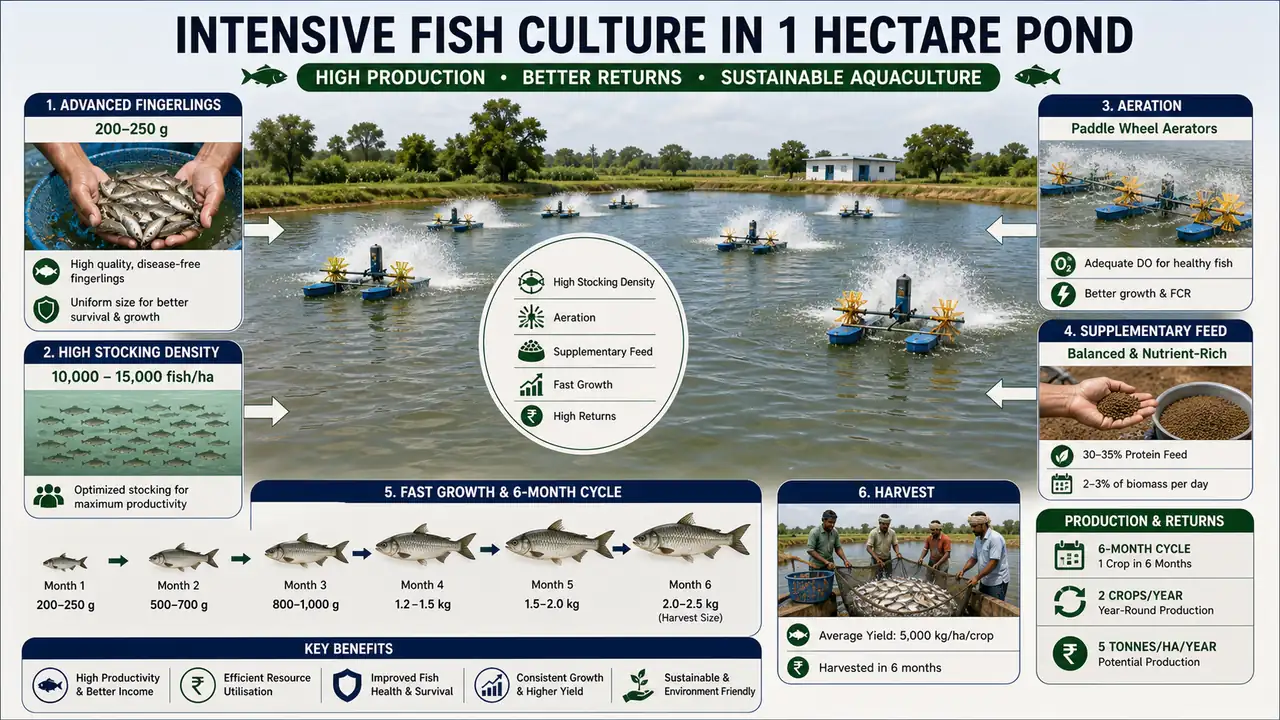
Intensive vs. Composite Fish Culture
Intensive fish culture differs from composite (extensive) culture in its much higher stocking density, greater dependence on artificial/supplementary feeding, and requirement for active aeration and water quality management. While composite culture relies heavily on pond's natural productivity, intensive culture overrides natural limits using inputs.
The NABARD model focuses on intensive Catla and Rohu culture in 1 hectare ponds — two Indian major carps that are most commercially valued in northern and eastern India.
Why These Two Species?
Catla (Catla catla) and Rohu (Labeo rohita) dominate the Indian freshwater fish market. They command premium prices, have large domestic demand, and reach marketable size (1–1.25 kg) within 6 months under intensive conditions. This 6-month crop cycle (vs. 12 months for semi-intensive) doubles the number of crops per year, improving returns.
Pro Content Locked
Upgrade to Pro to access this lesson and all other premium content.
₹99 charged monthly · Cancel anytime
- All Agriculture & Banking Courses
- AI Lesson Questions (100/day)
- AI Doubt Solver (50/day)
- Glows & Grows Feedback (30/day)
- AI Section Quiz (20/day)
- 22-Language Translation (100/day)
- Recall Questions (20/day)
- AI Quiz (15/day)
- AI Quiz Paper Analysis (100/day)
- AI Step-by-Step Explanations (100/day)
- Spaced Repetition Recall (FSRS)
- AI Tutor
- Immersive Text Questions
- Audio Lessons — Hindi & English
- Mock Tests & Previous Year Papers
- Summary & Mind Maps
- XP, Levels, Leaderboard & Badges
- Generate New Classrooms
- Voice AI Teacher (AgriDots Live)
- AI Revision Assistant
- Knowledge Gap Analysis
- Interactive Revision (LangGraph)
🔒 Secure via Razorpay · Cancel anytime · No hidden fees
Intensive vs. Composite Fish Culture
Intensive fish culture differs from composite (extensive) culture in its much higher stocking density, greater dependence on artificial/supplementary feeding, and requirement for active aeration and water quality management. While composite culture relies heavily on pond's natural productivity, intensive culture overrides natural limits using inputs.
The NABARD model focuses on intensive Catla and Rohu culture in 1 hectare ponds — two Indian major carps that are most commercially valued in northern and eastern India.
Why These Two Species?
Catla (Catla catla) and Rohu (Labeo rohita) dominate the Indian freshwater fish market. They command premium prices, have large domestic demand, and reach marketable size (1–1.25 kg) within 6 months under intensive conditions. This 6-month crop cycle (vs. 12 months for semi-intensive) doubles the number of crops per year, improving returns.
Technical Parameters
| Parameter | Value |
|---|---|
| Culture area | 1 hectare |
| Pond depth | 1.5–2.0 m (min. 1.0 m) |
| Culture period | 6 months per crop |
| Species stocked | Catla (750 nos.) + Rohu (5,500 nos.) |
| Fingerling size | 200–250 g (advanced) |
| Harvest weight | 1–1.25 kg/fish |
| Production target | 5 tonnes/ha/year (5–6 tonnes possible) |
NOTE
The stocking ratio is heavily Rohu-dominant (5,500 Rohu vs. 750 Catla). Rohu is a mid-water column feeder suitable for intensive systems; Catla is a fast-growing surface feeder. The 7:1 ratio (Rohu:Catla) optimises use of different food niches even in intensive systems.
Capital Cost (1 Ha Pond)
| Item | Amount (Rs.) |
|---|---|
| Site clearance | 4,000 |
| Pond construction (digging, bund, compaction) — 50 hrs @ Rs. 1,500/hr | 75,000 |
| Diesel pump set (5 HP) | 60,000 |
| Inlet/outlet sluices | 5,000 |
| Store room/office (500 sq ft @ Rs. 300/sq ft) | 1,50,000 |
| Nets and implements | 5,000 |
| Miscellaneous | 3,500 |
| Total Capital Cost | Rs. 3,02,500 (~Rs. 3.03 lakh) |
Operational Cost (Per Crop — 6 Months)
| Item | Amount (Rs.) |
|---|---|
| Drying, desilting, ploughing, watering | 10,000 |
| Lime (500 kg) | 2,500 |
| Single Super Phosphate (250 kg) | 1,250 |
| Urea (125 kg) | 625 |
| Poultry litter (5 tonnes) | 5,000 |
| Fish seed — Catla (750) + Rohu (5,500) @ Rs. 10–15 each | ~62,500 |
NOTE
Fish seed for intensive culture uses 200–250 g advanced fingerlings (not small fry). This higher seed cost is justified because advanced fingerlings have better survival rates and reach market size faster. Buying smaller seed would reduce seed cost but increase culture duration and risk — a classic cost-vs-time tradeoff exam question.
Income and Profitability
- Production: 5 tonnes/ha/crop × 2 crops/year = 5 tonnes/ha/year
- Farm gate price: Rs. 60–80/kg (varies by region and season)
- Gross income: ~Rs. 3–4 lakh/ha/year
- Net income after costs: Significant surplus above loan repayment obligations
Financing Terms
| Parameter | Value |
|---|---|
| Margin money | 5% (small), 10% (medium), 15% (large farmer), 25% (company) |
| Subsidy | Available under PMMSY for pond development, new pond construction, first-year inputs |
| Repayment | 5–7 years with 1-year moratorium |
| Nodal agency | FFDA/BFFDA at district level |
Linked Government Schemes
- PMMSY (Pradhan Mantri Matsya Sampada Yojana): Up to 40% subsidy for General category, 60% for SC/ST/women — on capital investment for pond development
- FFDA: District-level training and credit linkage
- KCC (Kisan Credit Card): Available for recurring costs in fish culture since 2018–19
NOTE
KCC for fishermen was extended in 2018–19 to include fish farmers. This is a high-frequency exam fact — KCC was traditionally agricultural, and the extension to fisheries and animal husbandry is a recent policy change regularly tested.
Key Exam Facts
- Production: 5 tonnes/ha/year (6-month crop cycle, 2 crops/year)
- Harvest weight: 1–1.25 kg in 6 months
- Capital cost: ~Rs. 3.03 lakh for 1 ha
- Species: Catla (surface) + Rohu (mid-water) — Indian major carps
- Margin: 5–25% depending on farmer category
- Poultry litter used as organic fertiliser (5 tonnes/crop/ha)
Sources & References
Primary source for this lesson is NABARD's official Model Bankable Projects portal.[1] Lesson-specific report copy used for this topic.[2]
References
2 sources • [1] [2]
References
Used for: Official NABARD portal for model bankable project documents and updates.
Used for: Reference copy used in this lesson for project parameters and worked figures.
The figures in this lesson reflect the cost norms and technical parameters as published in the NABARD document. Actual costs may vary by state, season, and year of implementation. Always refer to the latest NABARD circular for current norms.
Summary Cheat Sheet
| Concept / Topic | Key Details / Explanation |
|---|---|
| Species stocked | Catla (750 nos., surface feeder) + Rohu (5,500 nos., mid-water feeder) — ratio ~7:1 Rohu:Catla |
| Culture area | 1 hectare |
| Pond depth | 1.5–2.0 m (minimum 1.0 m) |
| Culture period | 6 months per crop (vs 12 months for composite) |
| Fingerling size | 200–250 g advanced fingerlings (not small fry — higher survival, faster growth) |
| Harvest weight | 1–1.25 kg/fish in 6 months |
| Production target | 5 tonnes/ha/year (2 crops × 5 tonnes; 5–6 tonnes possible) |
| Total Capital Cost | ₹3,02,500 (~₹3.03 lakh) |
| Key capital items | Pond construction ₹75,000 + Store room ₹1,50,000 + Diesel pump (5 HP) ₹60,000 |
| Organic fertiliser | Poultry litter 5 tonnes/crop/ha |
| Lime per crop | 500 kg |
| Margin money | 5% (small), 10% (medium), 15% (large), 25% (company) |
| Repayment | 5–7 years with 1-year moratorium |
| KCC for fishermen | Extended to fish farmers in 2018–19 — recurring costs covered |
| PMMSY subsidy | Up to 40% (General); 60% (SC/ST/women) on capital investment |
| Intensive vs composite | Intensive: higher stocking density, artificial feeding, aeration; targets 5 t/ha vs 3–5 t/ha for composite |
| Farm gate price | ₹60–80/kg |
| Gross income | ~₹3–4 lakh/ha/year |
Lesson Doubts
Ask questions, get expert answers