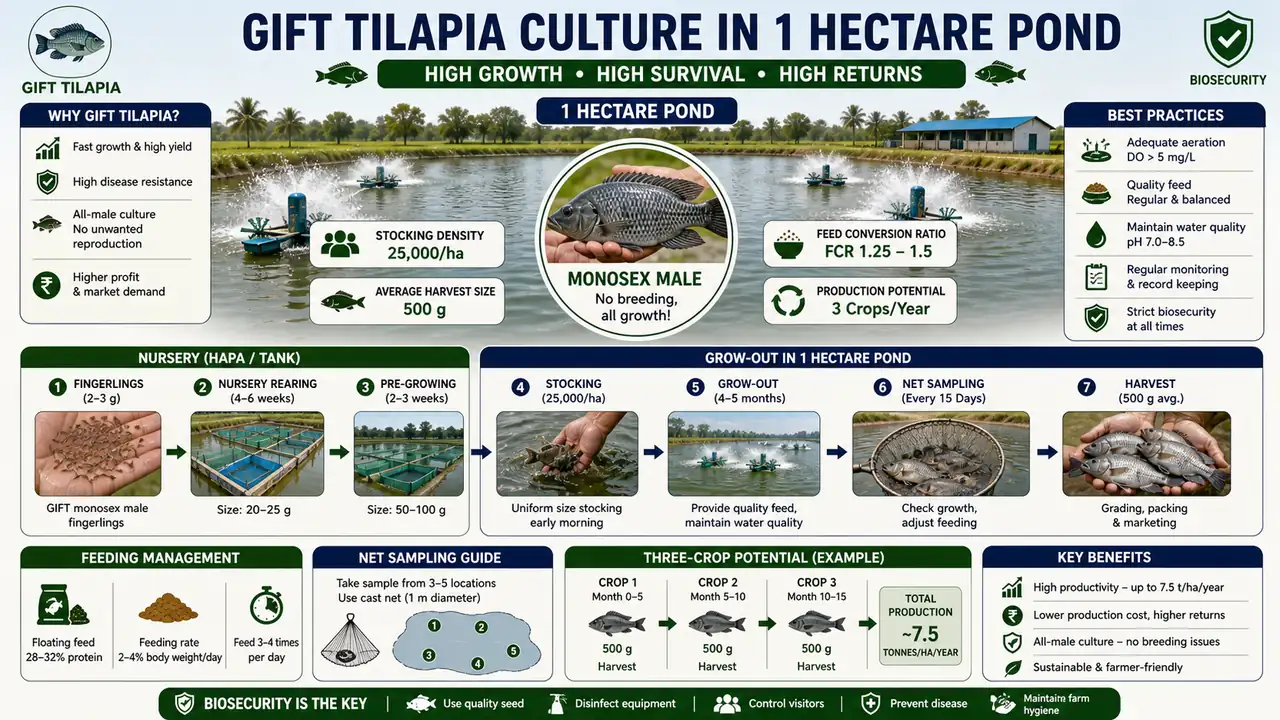
🐠 GIFT Tilapia Culture — 1 Ha Pond
NABARD model bankable project for GIFT (Genetically Improved Farmed Tilapia) culture in 1 hectare pond. Covers biosecurity mandates, monosex culture, 3-crop potential, capital cost of ₹8.71 lakh, and financial indicators for exams.
Tilapia — the "aquatic chicken" — is the second most farmed fish in the world with global production of 4.0 million tonnes (value ~$3 billion). GIFT (Genetically Improved Farmed Tilapia) is scientifically proven superior to freshwater carps and has high export potential to the US, Africa, and Japan.
- Oreochromis mossambicus was introduced to India in 1952 but became a pest due to prolific breeding
- India now permits only all-male (monosex) or hybrid Tilapia culture to prevent uncontrolled breeding
- State governments are empowered for Monitoring, Controlling and Surveillance (MCS) since December 2011
Why Monosex Culture?
Only all-male tilapia are permitted in India because:
- Males grow faster and more uniformly
- Eliminates prolific breeding that leads to stunted, overcrowded populations
- Allows 3 crops per year in perennial ponds (6-month crop cycle)
NOTE
Pro Content Locked
Upgrade to Pro to access this lesson and all other premium content.
₹99 charged monthly · Cancel anytime
- All Agriculture & Banking Courses
- AI Lesson Questions (100/day)
- AI Doubt Solver (50/day)
- Glows & Grows Feedback (30/day)
- AI Section Quiz (20/day)
- 22-Language Translation (100/day)
- Recall Questions (20/day)
- AI Quiz (15/day)
- AI Quiz Paper Analysis (100/day)
- AI Step-by-Step Explanations (100/day)
- Spaced Repetition Recall (FSRS)
- AI Tutor
- Immersive Text Questions
- Audio Lessons — Hindi & English
- Mock Tests & Previous Year Papers
- Summary & Mind Maps
- XP, Levels, Leaderboard & Badges
- Generate New Classrooms
- Voice AI Teacher (AgriDots Live)
- AI Revision Assistant
- Knowledge Gap Analysis
- Interactive Revision (LangGraph)
🔒 Secure via Razorpay · Cancel anytime · No hidden fees
Tilapia — the "aquatic chicken" — is the second most farmed fish in the world with global production of 4.0 million tonnes (value ~$3 billion). GIFT (Genetically Improved Farmed Tilapia) is scientifically proven superior to freshwater carps and has high export potential to the US, Africa, and Japan.
- Oreochromis mossambicus was introduced to India in 1952 but became a pest due to prolific breeding
- India now permits only all-male (monosex) or hybrid Tilapia culture to prevent uncontrolled breeding
- State governments are empowered for Monitoring, Controlling and Surveillance (MCS) since December 2011
Why Monosex Culture?
Only all-male tilapia are permitted in India because:
- Males grow faster and more uniformly
- Eliminates prolific breeding that leads to stunted, overcrowded populations
- Allows 3 crops per year in perennial ponds (6-month crop cycle)
NOTE
Exam trap: India mandates monosex (all-male) or hybrid tilapia — wild-type mixed-sex culture is not permitted. Farm licensing by State Fisheries Dept. is compulsory. Outlet water must be screened before release.
Technical Parameters
| Parameter | Value |
|---|---|
| Pond depth | 1.5–2 m (min 1 m) |
| Stocking density | 3–5 nos./m² grow-out (25,000/ha) |
| Nursery rearing | 50–75 fry/m² in hapas for 1 month |
| Harvest time | 6 months per crop |
| Crops per year | 3 crops (perennial ponds) |
| Average weight at harvest | 500 g in 5–6 months |
| Production | 8–10 tonnes/ha/crop |
| FCR | 1.25–1.5 (commercial pellet feed preferred) |
| Sale price | ₹50/kg (model) |
Salinity tolerance: can be cultured in brackish water up to 12–15 ppt.
Capital Cost (1 Ha)
| Component | Cost (₹) |
|---|---|
| Site clearance | 4,000 |
| Pond construction (50 hrs × ₹1,500) | 75,000 |
| 5 HP diesel pump set | 60,000 |
| Inlet/outlet sluices | 10,000 |
| Store/office room (400 sq ft) | 1,20,000 |
| Biosecurity measures | 75,000 |
| Nets, implements, miscellaneous | 25,000 |
| Total Capital Cost (A) | ₹3,69,000 |
Operational cost per crop (6 months):
| Item | Cost (₹) |
|---|---|
| Pond preparation (lime, fertilisers) | 19,375 |
| Fish seed — 25,000 @ ₹3 | 75,000 |
| Fish feed — 13,125 kg @ ₹28/kg | 3,67,500 |
| Watch, ward & feeding (6 months) | 21,000 |
| Harvesting charges | 9,375 |
| Miscellaneous | 10,000 |
| Total Operational Cost (B) | ₹5,02,250 |
Total project cost (A+B): ₹8,71,250
Production & Income
| Parameter | Value |
|---|---|
| Survival rate | 75% → 18,750 fish |
| Average harvest weight | 500 g |
| Production per crop | 9,375 kg |
| Sale price | ₹50/kg |
| Income per crop | ₹4,68,750 |
| Income (3 crops/year from Year 2) | ₹14,06,250/year |
Financial Analysis
| Indicator | Value |
|---|---|
| Total Financial Outlay | ₹8.71 lakh |
| Margin (15%) | ₹1.31 lakh |
| Bank Loan | ₹7.41 lakh |
| Rate of Interest | 12% |
| Repayment Period | 6–8 years (1 year grace) |
| NPW @ 15% | ₹17.85 lakh |
| BCR | 1.31 : 1 |
| IRR | > 50% |
NOTE
GIFT Tilapia has the highest BCR (1.31) among NABARD freshwater fish models — reflecting its high stocking density, fast growth, 3-crop potential, and low FCR. High NPW of ₹17.85 lakh on just ₹8.71 lakh investment signals strong exam-worthy viability.
Biosecurity Mandates (Exam Important)
- Bund height must prevent fish escape even during flooding
- Sluice gates must have appropriate mesh to prevent escape of fish/eggs/fry
- Bird-scaring devices/fencing: mandatory
- Outlet water must be screened and treated before release into natural water bodies
- Farm must maintain daily records for inspection by State Government officials
- Farmers must obtain State Fisheries Department license before starting Tilapia culture
Sources & References
Primary source for this lesson is NABARD's official Model Bankable Projects portal.[1] Lesson-specific report copy used for this topic.[2]
References
2 sources • [1] [2]
References
Used for: Official NABARD portal for model bankable project documents and updates.
Used for: Reference copy used in this lesson for project parameters and worked figures.
The figures in this lesson reflect the cost norms and technical parameters as published in the NABARD document. Actual costs may vary by state, season, and year of implementation. Always refer to the latest NABARD circular for current norms.
Summary Cheat Sheet
| Concept / Topic | Key Details / Explanation |
|---|---|
| Species | GIFT Tilapia (Oreochromis niloticus) — "aquatic chicken", 2nd most farmed fish globally |
| Global production | 4.0 million tonnes (~$3 billion value) |
| First introduction to India | O. mossambicus in 1952 — became pest due to prolific breeding |
| India's current mandate | Only all-male (monosex) or hybrid tilapia permitted — wild-type mixed-sex not allowed |
| Farm area | 1 hectare |
| Pond depth | 1.5–2 m (min 1 m) |
| Stocking density | 3–5/m² grow-out = 25,000/ha |
| Nursery rearing | 50–75 fry/m² in hapas for 1 month |
| Culture period | 6 months per crop |
| Crops per year | 3 crops (perennial ponds) |
| Harvest weight | 500 g in 5–6 months |
| Survival rate | 75% → 18,750 fish/crop |
| Production per crop | 9,375 kg (8–10 t/ha/crop) |
| FCR | 1.25–1.5 |
| Seed cost | 25,000 @ ₹3/seed = ₹75,000 |
| Feed cost | 13,125 kg @ ₹28/kg = ₹3,67,500 |
| Sale price | ₹50/kg |
| Income per crop | ₹4,68,750 |
| Annual income (3 crops, Year 2) | ₹14,06,250 |
| Total Capital Cost (A) | ₹3,69,000 |
| Total Operational Cost/crop (B) | ₹5,02,250 |
| Total Project Cost (A+B) | ₹8,71,250 |
| Margin Money | 15% = ₹1.31 lakh |
| Bank Loan | ₹7.41 lakh |
| Interest rate | 12% |
| Repayment period | 6–8 years with 1-year grace |
| NPW @ 15% | ₹17.85 lakh |
| BCR | 1.31:1 (highest among NABARD freshwater fish models) |
| IRR | >50% |
| Salinity tolerance | Up to 12–15 ppt brackish water |
| Licensing | State Fisheries Department license compulsory before starting culture |
| MCS authority | State governments (since December 2011) |
| Biosecurity mandates | Bird scaring mandatory; outlet water screened; daily farm records maintained |
Lesson Doubts
Ask questions, get expert answers