🦠 Spirulina Cultivation — NABARD Model
NABARD model bankable project for commercial Spirulina cultivation. Covers 20-pond unit design, 60–70% protein content, BIS IS 12895:1990 food grade standard, total investment of ₹12.88 lakh, IRR of 29%, and subsidy details for exams.
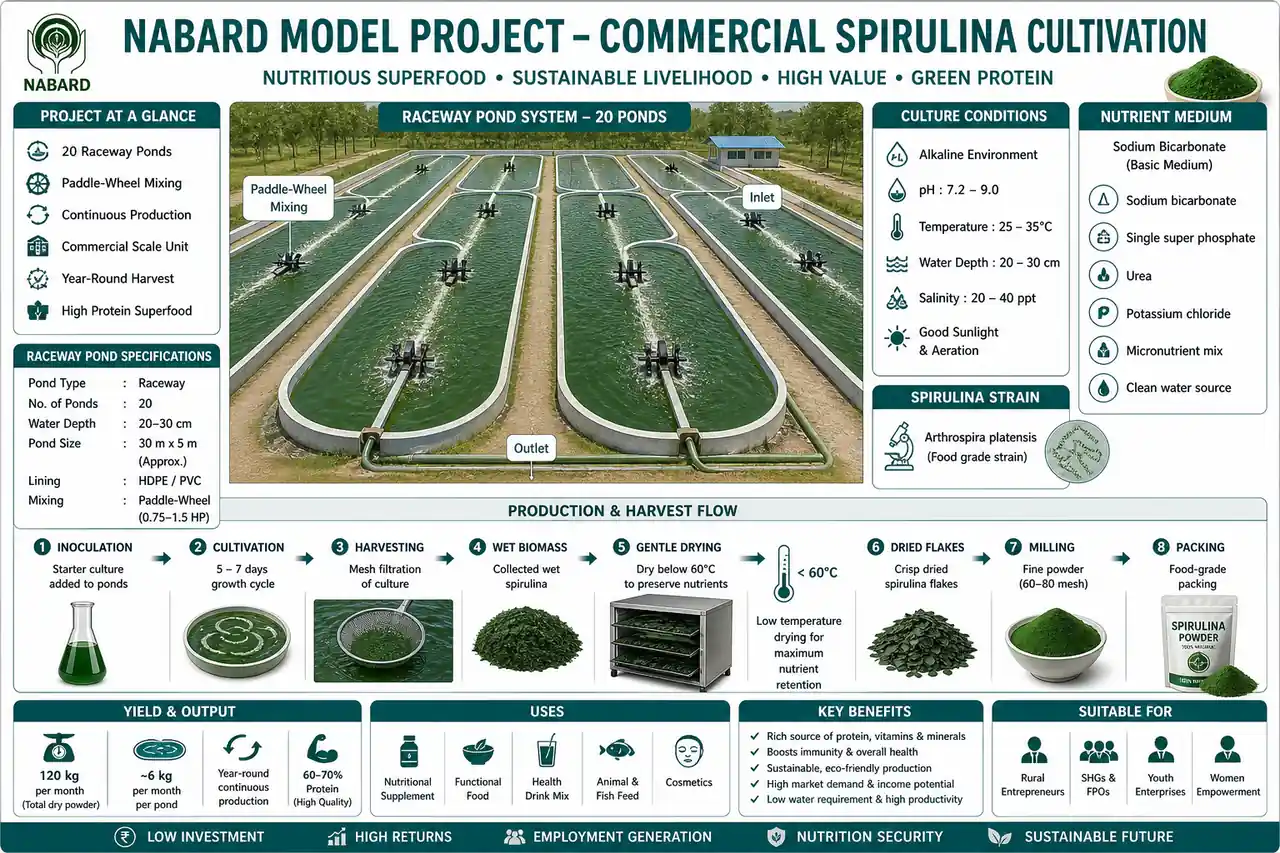
Spirulina is a filamentous blue-green alga (cyanobacterium) — technically not a plant but a prokaryote. It contains 60–70% protein by dry weight, making it the richest natural protein source known. It also provides β-carotene, phycocyanin, B vitamins, gamma-linolenic acid (GLA), and iron. The UN World Food Conference (1974) declared Spirulina the "best food for the future."
- Three Indian species: Spirulina platensis, S. fusiformis, S. maxima (family Spirulinaceae)
- S. fusiformis dominates Indian commercial cultivation — thrives in alkaline water
- BIS food-grade standard: IS 12895:1990
- Unlike other algae, Spirulina does not require sterilised medium — its high-pH/alkaline environment inhibits competitors
Culture Conditions
| Parameter | Optimal Range |
|---|---|
| pH | 7.2–9.0 (highly alkaline — key differentiator) |
| Temperature | 30–35°C |
| Water depth in raceway | 20–30 cm (shallow — maximises light penetration) |
| Light intensity | 25,000–35,000 lux |
| CO₂ source | Sodium bicarbonate (NaHCO₃) — main carbon source |
| Agitation | Continuous paddle-wheel stirring |
| Culture medium | Zarrouk's medium or modified alkaline medium |
NOTE
Pro Content Locked
Upgrade to Pro to access this lesson and all other premium content.
₹99 charged monthly · Cancel anytime
- All Agriculture & Banking Courses
- AI Lesson Questions (100/day)
- AI Doubt Solver (50/day)
- Glows & Grows Feedback (30/day)
- AI Section Quiz (20/day)
- 22-Language Translation (100/day)
- Recall Questions (20/day)
- AI Quiz (15/day)
- AI Quiz Paper Analysis (100/day)
- AI Step-by-Step Explanations (100/day)
- Spaced Repetition Recall (FSRS)
- AI Tutor
- Immersive Text Questions
- Audio Lessons — Hindi & English
- Mock Tests & Previous Year Papers
- Summary & Mind Maps
- XP, Levels, Leaderboard & Badges
- Generate New Classrooms
- Voice AI Teacher (AgriDots Live)
- AI Revision Assistant
- Knowledge Gap Analysis
- Interactive Revision (LangGraph)
🔒 Secure via Razorpay · Cancel anytime · No hidden fees
Spirulina is a filamentous blue-green alga (cyanobacterium) — technically not a plant but a prokaryote. It contains 60–70% protein by dry weight, making it the richest natural protein source known. It also provides β-carotene, phycocyanin, B vitamins, gamma-linolenic acid (GLA), and iron. The UN World Food Conference (1974) declared Spirulina the "best food for the future."
- Three Indian species: Spirulina platensis, S. fusiformis, S. maxima (family Spirulinaceae)
- S. fusiformis dominates Indian commercial cultivation — thrives in alkaline water
- BIS food-grade standard: IS 12895:1990
- Unlike other algae, Spirulina does not require sterilised medium — its high-pH/alkaline environment inhibits competitors
Culture Conditions
| Parameter | Optimal Range |
|---|---|
| pH | 7.2–9.0 (highly alkaline — key differentiator) |
| Temperature | 30–35°C |
| Water depth in raceway | 20–30 cm (shallow — maximises light penetration) |
| Light intensity | 25,000–35,000 lux |
| CO₂ source | Sodium bicarbonate (NaHCO₃) — main carbon source |
| Agitation | Continuous paddle-wheel stirring |
| Culture medium | Zarrouk's medium or modified alkaline medium |
NOTE
Exam trap: Spirulina culture pH is 7.2–9.0 — far more alkaline than fish pond culture (pH 7–7.5). The high alkalinity suppresses competitor organisms, reducing contamination risk. This distinction is tested in MCQs.
Unit Design — 20 Pond System
| Component | Specification |
|---|---|
| Number of ponds | 20 (raceway type) |
| Pond dimensions | 20 ft × 10 ft × 1.5 ft (each) |
| Total culture area | ~4,000 sq. ft. |
| Yield per pond | 6 kg dry powder/month |
| Total yield | 20 × 6 = 120 kg/month |
| Production Year 1 | 7 months (establishment lag) |
| Production Year 2+ | 9 months operational |
Harvest & Drying Process
- Harvesting: Biomass filtered through 30-micron nylon mesh to collect wet paste
- Washing: Paste rinsed with clean water to remove culture medium salts
- Pressing: Moisture reduced via filter press or centrifuge
- Drying: Spray drying (preferred) or solar tunnel drying — temperature kept below 60°C to preserve proteins and pigments
- Packaging: Moisture-proof pouches; food-grade as per IS 12895:1990
NOTE
Drying temperature must stay below 60°C. Above this, phycocyanin (blue pigment, high market value) and heat-sensitive B vitamins degrade. Spray drying is superior to sun drying for commercial grade — this is a high-frequency exam distinction.
Capital Cost Breakdown
| Component | Cost (₹) |
|---|---|
| Pond construction (20 ponds) | ~₹10,00,000 |
| Water treatment plant | ₹1,50,000 |
| Harvesting & drying equipment | included in total |
| Overhead tank, pump, plumbing | included |
| Working capital (first cycle — capitalised) | included |
| Total Investment | ₹12,87,500 |
Margin (10%): ₹1,28,750 Bank loan: ₹11,58,750 @ 12% ROI per annum
Income Projections
| Year | Months Production | Yield (kg) | Income @ ₹550/kg |
|---|---|---|---|
| Year 1 | 7 months | 840 kg | ₹4,62,000 |
| Year 2+ | 9 months | 1,080 kg | ₹5,94,000/year |
NOTE
Sale price used: ₹550/kg dry powder (wholesale; retail can reach ₹1,000–1,500/kg). Year 1 production is only 7 months because initial pond establishment and culture stabilisation takes ~5 months. This reduced Year 1 income is tested in financial viability MCQs.
Financial Analysis
| Indicator | Value |
|---|---|
| Total Investment | ₹12,87,500 |
| Margin | 10% (₹1,28,750) |
| Bank Loan | ₹11,58,750 |
| Rate of Interest (ROI) | 12% per annum |
| IRR | 29% |
| NPV | ₹3,02,476 |
| Repayment Period | 6 years (with 1 year capitalised interest) |
Market & Applications
| Sector | Use |
|---|---|
| Nutraceuticals | Protein supplement tablets/powder (human nutrition) |
| Aquaculture | Larval fish/shrimp feed additive (phycocyanin as attractant) |
| Poultry | Feed supplement — improves egg yolk colour |
| Cosmetics | Anti-oxidant skin creams |
| Space food | NASA-approved food for long-duration missions |
Why Spirulina for NABARD Financing?
- Low water requirement — raceways recycle water; suitable for water-scarce regions
- Fast doubling time — biomass doubles every 3–5 days under optimal conditions
- High-value product (₹550/kg) vs. fish (₹55–175/kg) — much higher return per unit land
- Margin kept low (10%) because project is nutrient-intensive and high-cost startup
- IRR of 29% justifies bank finance under NABARD's Blue Revolution / entrepreneurship schemes
Sources & References
Primary source for this lesson is NABARD's official Model Bankable Projects portal.[1] Lesson-specific report copy used for this topic.[2]
References
2 sources • [1] [2]
References
Used for: Official NABARD portal for model bankable project documents and updates.
Used for: Reference copy used in this lesson for project parameters and worked figures.
The figures in this lesson reflect the cost norms and technical parameters as published in the NABARD document. Actual costs may vary by state, season, and year of implementation. Always refer to the latest NABARD circular for current norms.
Summary Cheat Sheet
| Concept / Topic | Key Details / Explanation |
|---|---|
| Organism | Filamentous blue-green alga (cyanobacterium — prokaryote, not a plant) |
| Indian species | Spirulina platensis, S. fusiformis (dominant in India), S. maxima |
| Protein content | 60–70% by dry weight — richest natural protein source |
| BIS food-grade standard | IS 12895:1990 |
| UN declaration | UN World Food Conference (1974): "best food for the future" |
| Culture pH | 7.2–9.0 (highly alkaline — suppresses competitors; no sterilisation needed) |
| Culture temperature | 30–35°C |
| Water depth in raceway | 20–30 cm (shallow — maximises light penetration) |
| CO₂ source | Sodium bicarbonate (NaHCO₃) |
| Agitation | Continuous paddle-wheel stirring |
| Unit design | 20 raceways, each 20 ft × 10 ft × 1.5 ft |
| Yield per pond | 6 kg dry powder/month |
| Total yield | 20 × 6 = 120 kg/month |
| Production Year 1 | 7 months (5-month establishment lag) = 840 kg |
| Production Year 2+ | 9 months = 1,080 kg/year |
| Sale price | ₹550/kg dry powder (wholesale; retail ₹1,000–1,500/kg) |
| Income Year 1 | ₹4,62,000 |
| Income Year 2+ | ₹5,94,000/year |
| Total Investment | ₹12,87,500 |
| Margin Money | 10% = ₹1,28,750 (low because high-cost startup) |
| Bank Loan | ₹11,58,750 |
| Interest rate | 12% per annum |
| Repayment period | 6 years (with 1-year capitalised interest) |
| IRR | 29% |
| NPV | ₹3,02,476 |
| Drying temperature limit | Below 60°C — above this, phycocyanin and B vitamins degrade |
| Harvest mesh | 30-micron nylon mesh |
| Doubling time | Biomass doubles every 3–5 days under optimal conditions |
| Market sectors | Nutraceuticals, aquaculture feed, poultry feed (egg yolk colour), cosmetics, space food (NASA-approved) |
Lesson Doubts
Ask questions, get expert answers