🐔 Integrated Fish Farming with Poultry (Broiler) — Bihar Model
NABARD model scheme for integrating 1 ha fish pond with broiler poultry in Bihar. Covers 4 batches of 250 birds/year, poultry litter as pond fertiliser, capital cost of ₹3.98 lakh, BCR of 1.20, and Blue Revolution subsidy for exams.
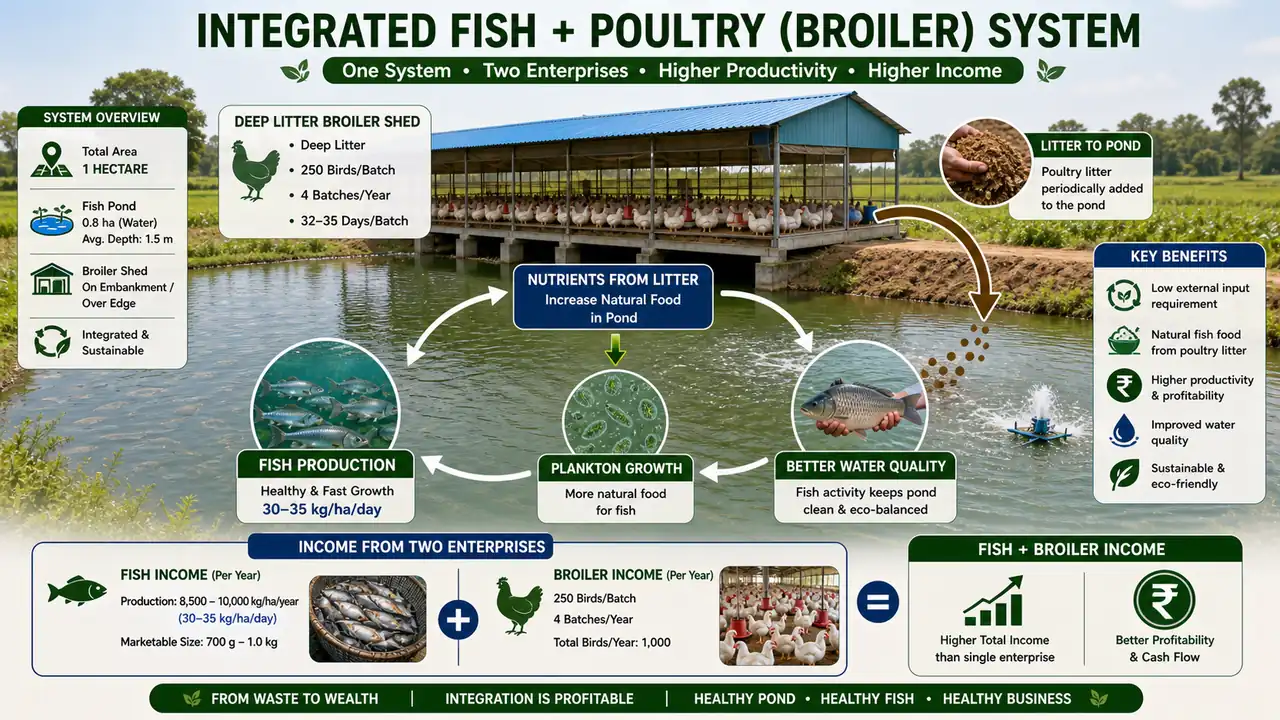
Integrated fish-poultry farming links broiler chicken rearing with fish pond cultivation. Poultry droppings fall directly into the pond from overhead houses built on the embankment, acting as organic manure that stimulates natural fish food production — reducing or eliminating chemical fertiliser costs.
- Poultry litter contains: 1.6% N, 1.5% P, 0.9% K, 2.4% Ca
- 500–600 broilers needed to adequately fertilise 1 ha of fish pond
- Litter applied at 30–35 kg/ha/day (stopped when algal bloom appears)
- Bihar State has 93,926 ha of tanks and ponds; vast scope for integrated farming
System Design
| Component | Detail |
|---|---|
| Fish pond | 1 ha; culture period 11 months |
| Fish species | IMC (Catla, Rohu, Mrigal) + Common Carp, Silver Carp |
| Fish stocking density | 5,000 fingerlings/ha (50–60 g stunted yearlings) |
| Poultry house | Thatched structure on embankment/poles over pond |
| Broiler rearing system | Deep litter preferred (higher manurial value) |
| Birds per batch | 250 |
| Batches per year | 4 (all-in all-out system) |
| Grow-out period/batch | 4–6 weeks (6–8 weeks maximum) |
| Total birds/year | 1,000 |
NOTE
Pro Content Locked
Upgrade to Pro to access this lesson and all other premium content.
₹99 charged monthly · Cancel anytime
- All Agriculture & Banking Courses
- AI Lesson Questions (100/day)
- AI Doubt Solver (50/day)
- Glows & Grows Feedback (30/day)
- AI Section Quiz (20/day)
- 22-Language Translation (100/day)
- Recall Questions (20/day)
- AI Quiz (15/day)
- AI Quiz Paper Analysis (100/day)
- AI Step-by-Step Explanations (100/day)
- Spaced Repetition Recall (FSRS)
- AI Tutor
- Immersive Text Questions
- Audio Lessons — Hindi & English
- Mock Tests & Previous Year Papers
- Summary & Mind Maps
- XP, Levels, Leaderboard & Badges
- Generate New Classrooms
- Voice AI Teacher (AgriDots Live)
- AI Revision Assistant
- Knowledge Gap Analysis
- Interactive Revision (LangGraph)
🔒 Secure via Razorpay · Cancel anytime · No hidden fees
Integrated fish-poultry farming links broiler chicken rearing with fish pond cultivation. Poultry droppings fall directly into the pond from overhead houses built on the embankment, acting as organic manure that stimulates natural fish food production — reducing or eliminating chemical fertiliser costs.
- Poultry litter contains: 1.6% N, 1.5% P, 0.9% K, 2.4% Ca
- 500–600 broilers needed to adequately fertilise 1 ha of fish pond
- Litter applied at 30–35 kg/ha/day (stopped when algal bloom appears)
- Bihar State has 93,926 ha of tanks and ponds; vast scope for integrated farming
System Design
| Component | Detail |
|---|---|
| Fish pond | 1 ha; culture period 11 months |
| Fish species | IMC (Catla, Rohu, Mrigal) + Common Carp, Silver Carp |
| Fish stocking density | 5,000 fingerlings/ha (50–60 g stunted yearlings) |
| Poultry house | Thatched structure on embankment/poles over pond |
| Broiler rearing system | Deep litter preferred (higher manurial value) |
| Birds per batch | 250 |
| Batches per year | 4 (all-in all-out system) |
| Grow-out period/batch | 4–6 weeks (6–8 weeks maximum) |
| Total birds/year | 1,000 |
NOTE
Exam trap: The deep litter system is preferred over cage system in integrated fish-poultry because deep litter has higher manurial value for the fish pond. This is the key differentiator tested in MCQs.
Technical Parameters — Fish & Poultry
| Parameter | Fish | Poultry |
|---|---|---|
| Stocking/purchase size | 50–60 g | Day-Old Chick (DOC) |
| Survival | 90% fish survival | 95% birds |
| Average weight at harvest | 600–700 g | 1.3 kg |
| Farm gate price | ₹125/kg | ₹75/kg |
| Production Year 1 | 2,500 kg fish | 1,235 kg broiler |
| Production Year 2+ | 3,000 kg fish | 1,235 kg broiler |
Financial Outlay
| Component | Cost (₹) |
|---|---|
| Total Capital Cost | ₹3.98 lakh |
| Operational Cost (one cycle — capitalised) | ₹3.03 lakh |
Includes pond development, broiler shed on embankment, 4 batches DOC + feed + medicines.
Income Projections
| Source | Annual Income |
|---|---|
| Fish (Year 1): 2,500 kg × ₹125 | ₹3,12,500 |
| Fish (Year 2+): 3,000 kg × ₹125 | ₹3,75,000 |
| Broilers: 4 batches × 250 × 95% × 1.3 kg × ₹75 | ₹92,625/year |
| Combined income (Year 2+) | ~₹4,67,625/year |
Financial Analysis
| Indicator | Value |
|---|---|
| Total Outlay (capital + operational) | ₹3.98 + ₹3.03 lakh |
| Margin (25% assumed) | Per RBI guidelines |
| BCR | 1.20 |
| NPW @ 15% DF | ₹3,38,869 |
| IRR | > 15% |
| Repayment Period | Per bank guidelines |
NOTE
Integrated fish-poultry BCR (1.20) is lower than integrated fish-dairy (2.07) because broiler farming is more input-intensive (DOC + commercial feed + medicines) while milk income is continuous. This comparison appears in NABARD exam questions.
Subsidy
- Blue Revolution (GoI): 40% of unit cost for new pond development (general); 60% for SC/ST/women/cooperatives
- Marketing: broilers sold at 4–5 weeks (1.2–1.5 kg) from nearest market/aggregator
- Fish sold fresh locally — Bihar's demand-supply gap ensures ready market
Comparison: Fish + Poultry vs. Fish + Dairy
| Feature | Fish + Poultry | Fish + Dairy |
|---|---|---|
| Capital cost | ₹3.98 lakh | ₹6.53 lakh |
| BCR | 1.20 | 2.07 |
| NPW | ₹3.39 lakh | ₹13.67 lakh |
| Income regularity | Batch (4×/year) | Daily milk income |
| Risk | Disease in birds | Seasonal milk price |
Sources & References
Primary source for this lesson is NABARD's official Model Bankable Projects portal.[1] Lesson-specific report copy used for this topic.[2]
References
2 sources • [1] [2]
References
Used for: Official NABARD portal for model bankable project documents and updates.
Used for: Reference copy used in this lesson for project parameters and worked figures.
The figures in this lesson reflect the cost norms and technical parameters as published in the NABARD document. Actual costs may vary by state, season, and year of implementation. Always refer to the latest NABARD circular for current norms.
Summary Cheat Sheet
| Concept / Topic | Key Details / Explanation |
|---|---|
| Integration principle | Poultry droppings fall into fish pond as organic manure — eliminates chemical fertiliser cost |
| Optimal flock size for 1 ha | 500–600 broilers to adequately fertilise 1 ha pond |
| Litter application rate | 30–35 kg/ha/day (stopped when algal bloom appears) |
| Poultry litter nutrients | 1.6% N, 1.5% P, 0.9% K, 2.4% Ca |
| Fish pond | 1 ha; culture period 11 months |
| Fish stocking | 5,000 fingerlings/ha at 50–60 g (stunted yearlings) |
| Fish species | IMC (Catla, Rohu, Mrigal) + Common Carp, Silver Carp |
| Broiler system | Deep litter preferred (higher manurial value than cage system) |
| Birds per batch | 250 |
| Batches per year | 4 (all-in all-out system) |
| Grow-out period | 4–6 weeks per batch |
| Total birds/year | 1,000 |
| Fish survival rate | 90%; harvest weight 600–700 g |
| Broiler survival rate | 95%; harvest weight 1.3 kg |
| Fish farm gate price | ₹125/kg |
| Broiler farm gate price | ₹75/kg |
| Fish production Year 1 | 2,500 kg |
| Fish production Year 2+ | 3,000 kg |
| Broiler income/year | 4 batches × 250 × 95% × 1.3 kg × ₹75 = ₹92,625 |
| Combined income Year 2+ | ~₹4,67,625/year |
| Total Capital Cost | ₹3.98 lakh |
| Operational Cost | ₹3.03 lakh (capitalised) |
| BCR | 1.20 |
| NPW @ 15% | ₹3,38,869 |
| IRR | >15% |
| Blue Revolution subsidy | 40% general; 60% SC/ST/women on new pond development |
| Fish-Poultry vs Fish-Dairy | Poultry: lower capital (₹3.98L), lower BCR (1.20), batch income · Dairy: higher capital (₹6.53L), higher BCR (2.07), daily milk income |
Lesson Doubts
Ask questions, get expert answers