🥜 Small Scale Cashew Processing Unit
NABARD model bankable project for a small-scale cashew processing unit with 500 MT raw cashew input capacity. Covers processing technology, financial structure, working capital requirements, and export linkages for exams.
Project Overview
India is the world's largest producer and exporter of processed cashew kernels. This NABARD model covers a small-scale cashew processing unit with an installed capacity of 500 MT of raw cashew nuts per year, yielding approximately 120 MT of processed cashew kernels annually at full capacity.
Cashew processing is a highly labour-intensive industry — the key shelling and grading steps require skilled hand labour, making it an ideal agro-processing activity for coastal Maharashtra, Goa, Karnataka, Kerala, and Andhra Pradesh.
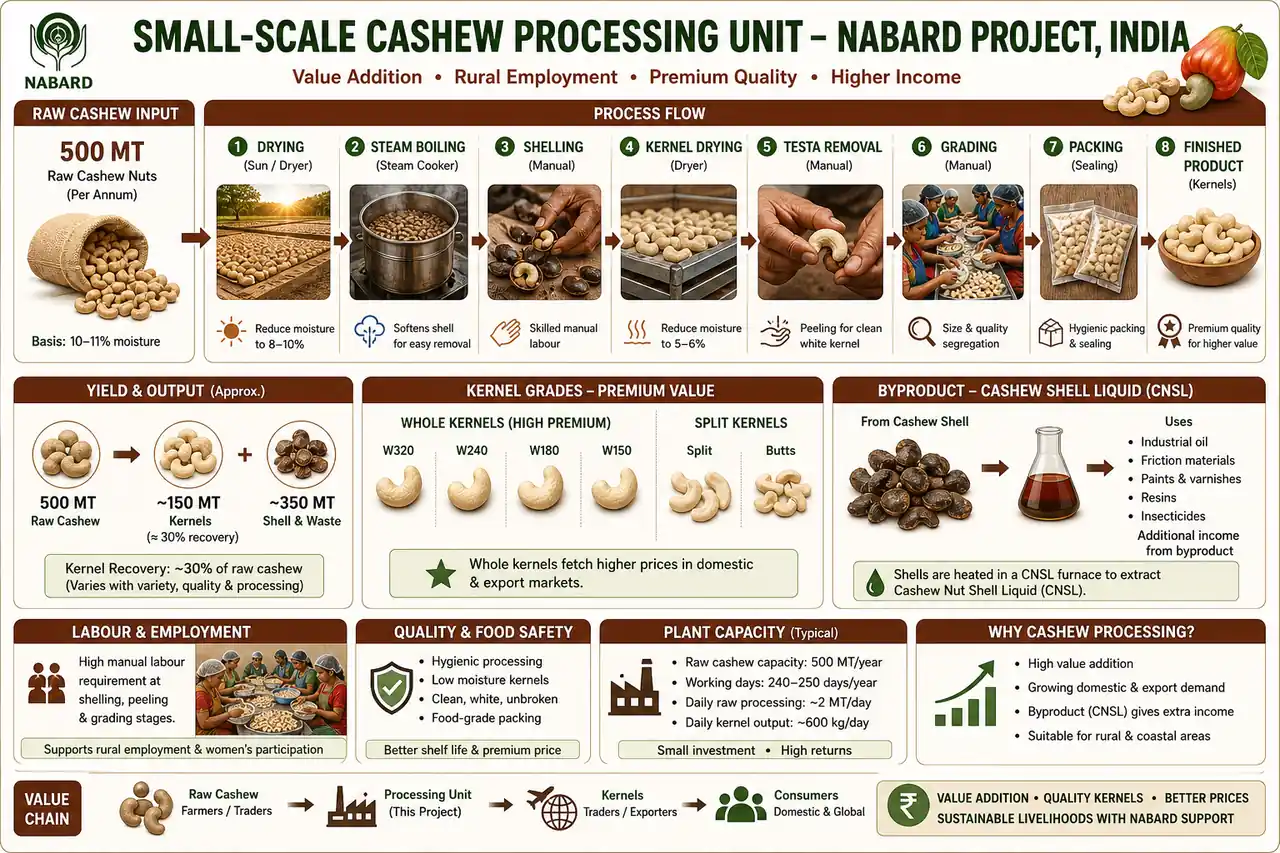
The Processing Chain: Why Recovery is Only 30%
Raw cashew nut → Drying → Steam boiling → Shell removal (manual) → Kernel drying (cabinet dryer) → Testa removal → Grading → Packing
Recovery ratios:
- Cashew kernel (whole + splits): ~30%
- Shell (for CNSL extraction): ~50%
- Process loss: ~20%
NOTE
Pro Content Locked
Upgrade to Pro to access this lesson and all other premium content.
₹99 charged monthly · Cancel anytime
- All Agriculture & Banking Courses
- AI Lesson Questions (100/day)
- AI Doubt Solver (50/day)
- Glows & Grows Feedback (30/day)
- AI Section Quiz (20/day)
- 22-Language Translation (100/day)
- Recall Questions (20/day)
- AI Quiz (15/day)
- AI Quiz Paper Analysis (100/day)
- AI Step-by-Step Explanations (100/day)
- Spaced Repetition Recall (FSRS)
- AI Tutor
- Immersive Text Questions
- Audio Lessons — Hindi & English
- Mock Tests & Previous Year Papers
- Summary & Mind Maps
- XP, Levels, Leaderboard & Badges
- Generate New Classrooms
- Voice AI Teacher (AgriDots Live)
- AI Revision Assistant
- Knowledge Gap Analysis
- Interactive Revision (LangGraph)
🔒 Secure via Razorpay · Cancel anytime · No hidden fees
Project Overview
India is the world's largest producer and exporter of processed cashew kernels. This NABARD model covers a small-scale cashew processing unit with an installed capacity of 500 MT of raw cashew nuts per year, yielding approximately 120 MT of processed cashew kernels annually at full capacity.
Cashew processing is a highly labour-intensive industry — the key shelling and grading steps require skilled hand labour, making it an ideal agro-processing activity for coastal Maharashtra, Goa, Karnataka, Kerala, and Andhra Pradesh.
The Processing Chain: Why Recovery is Only 30%
Raw cashew nut → Drying → Steam boiling → Shell removal (manual) → Kernel drying (cabinet dryer) → Testa removal → Grading → Packing
Recovery ratios:
- Cashew kernel (whole + splits): ~30%
- Shell (for CNSL extraction): ~50%
- Process loss: ~20%
NOTE
The 30% kernel recovery is a classic exam figure. It means 500 MT of raw cashew yields only ~150 MT kernel at 100% capacity. At 90% utilisation, actual production is 108 MT (whole: 86.4 MT + splits: 21.6 MT). This recovery rate is why cashew processing commands premium pricing — the input-to-output ratio is expensive.
By-Products and Value Addition
| Product | Recovery % | Market |
|---|---|---|
| Cashew kernel (whole) | ~21.6% of raw input | Domestic + export |
| Cashew kernel (splits) | ~5.4% of raw input | Domestic + export |
| Cashew Nut Shell Liquid (CNSL) | From shell | Industrial (paints, friction linings, varnishes) |
CNSL (Cashew Nut Shell Liquid) is an important industrial by-product used in brake linings, paints, and polymers. Including CNSL revenue significantly improves project viability.
Capacity and Production Data
| Parameter | Year 1 | Year 2 | Year 3 onwards |
|---|---|---|---|
| Installed capacity (raw cashew) | 500 MT | 500 MT | 500 MT |
| Capacity utilisation | 0% | 70% | 80–90% |
| Actual production (cashew kernel) | 0 | 84 MT | 96–108 MT |
| Whole cashew (MT) | 0 | 67.2 | 76.8–86.4 |
| Splits (MT) | 0 | 16.8 | 19.2–21.6 |
NOTE
Year 1 has zero production — this is because cashew processing is highly seasonal (raw cashew harvest is March–May) and Year 1 is used for plant setup. From Year 2, the unit operates at 70% utilisation, ramping to 90% from Year 3. This is different from milk processing (which starts Year 1 at 70%). The zero-Year-1 pattern is specific to cashew and is tested.
Sales Revenue (Rs. Lakh)
| Product | Year 2 (70%) | Year 3+ (90%) |
|---|---|---|
| Whole cashew kernels | 369.60 | 475.20 |
| Splits | 71.40 | 91.80 |
| Cashew shells (CNSL value) | 17.50 | 22.50 |
| Total income | 458.50 | 589.50 |
Working Capital Requirements (Rs. Lakh)
| Item | Year 2 | Year 3 |
|---|---|---|
| Raw materials stock (30 days) | 54.08 | 61.80 |
| Work in progress (7 days) | 14.27 | 16.28 |
| Finished goods (30 days) | 61.17 | 69.79 |
| Debtors (7 days) | 14.27 | 16.28 |
| Working expenses | 0.57 | 0.57 |
| Total current assets | 144.37 | 164.72 |
| Margin money for W.C. (25%) | 36.09 | 41.18 |
| Bank loan (CC limit) | 108.28 | 123.54 |
NOTE
The working capital requirement is very high relative to fixed capital — raw cashew must be bought during a short harvest season (March–May) and stored for year-round processing. This "seasonal procurement, year-round processing" model requires 30 days of raw material stock, which ties up substantial cash. Banks provide a Cash Credit (CC) limit against stock hypothecation.
Financing Structure
| Parameter | Value |
|---|---|
| Margin money (term loan) | 25% of project cost |
| Bank loan (term loan) | 75% |
| Margin money (working capital) | 25% |
| Bank loan (CC limit) | 75% of WC gap |
| Classification | MSME / Priority sector |
| Eligible lenders | Commercial banks, RRBs, Cooperative banks |
Financial Viability Indicators
| Indicator | Value | Threshold |
|---|---|---|
| NPW @ 15% DF | Rs. 124.18 lakh | Must be +ve |
| IRR | 34.27% | Above 15% |
| BCR | 1.057 | Above 1.0 |
| DSCR | 1.604 | Above 1.5 |
The DSCR of 1.604 is just above the 1.5 threshold — indicating adequate but not comfortable debt coverage. This reflects the thin margins in cashew processing due to high raw material cost and labour intensity.
Quality Standards and Export Linkage
- Agmark grading: Cashew kernels graded as Whole, Splits — colour and breakage determine grade
- CEPCI (Cashew Export Promotion Council of India): Promotes cashew export; membership required for export-oriented units
- APEDA: Facilitates export of processed nuts
- India dominates global cashew processing — processes cashew from Africa (Ivory Coast, Tanzania, Mozambique) for re-export
NOTE
India imports raw cashew from Africa and processes it for export as value-added kernels. This re-export model means Indian cashew processors are exposed to both currency risk (African sourcing) and export price competition. This global value chain aspect is tested in trade-related questions.
Linked Government Schemes
- PM FME (Pradhan Mantri Formalisation of Micro Food Enterprises): Credit-linked capital subsidy of 35% (max Rs. 10 lakh) for micro food processing enterprises
- PMKSY (Pradhan Mantri Kisan Sampada Yojana): Infrastructure grant for food processing clusters
- ASIDE / MAI schemes: Export promotion grants
Key Exam Facts
- Installed capacity: 500 MT raw cashew/year → 120 MT kernel/year
- Kernel recovery: ~30%; Shell: ~50%; Process loss: ~20%
- Year 1 production: zero; Year 2: 84 MT (70% utilisation)
- Annual income at 90% capacity: Rs. 589.50 lakh
- NPW: Rs. 124.18 lakh; IRR: 34.27%; DSCR: 1.604
- Margin money: 25%; working capital margin: 25%
- CNSL is a valuable industrial by-product from cashew shell
- Nodal export body: CEPCI (Cashew Export Promotion Council of India)
Sources & References
Primary source for this lesson is NABARD's official Model Bankable Projects portal.[1] Lesson-specific report copy used for this topic.[2]
References
2 sources • [1] [2]
References
Used for: Official NABARD portal for model bankable project documents and updates.
Used for: Reference copy used in this lesson for project parameters and worked figures.
The figures in this lesson reflect the cost norms and technical parameters as published in the NABARD document. Actual costs may vary by state, season, and year of implementation. Always refer to the latest NABARD circular for current norms.
Summary Cheat Sheet
| Concept / Topic | Key Details / Explanation |
|---|---|
| Installed capacity | 500 MT raw cashew/year → ~120 MT processed kernel/year |
| Kernel recovery | ~30% whole + splits; Shell: ~50%; Process loss: ~20% |
| Year 1 production | Zero (plant setup year; cashew harvest is March–May only) |
| Year 2 production | 84 MT kernel (70% utilisation) |
| Year 3+ production | 96–108 MT (80–90% utilisation) |
| Processing stages | Drying → Steam boiling → Shell removal (manual) → Kernel drying → Testa removal → Grading → Packing |
| Key by-product | CNSL (Cashew Nut Shell Liquid) — used in brake linings, paints, polymers |
| Annual income at 90% | ₹589.50 lakh (whole kernels + splits + CNSL) |
| Margin money (term loan) | 25% of project cost |
| Bank loan (term loan) | 75% |
| Margin money (working capital) | 25% |
| Bank loan (CC limit) | 75% of WC gap |
| WC requirement at 90% | ₹164.72 lakh (30 days raw material + 7 days WIP + 30 days finished goods) |
| IRR | 34.27% |
| BCR | 1.057 |
| DSCR | 1.604 (just above 1.5 threshold) |
| NPW @ 15% | ₹124.18 lakh |
| Seasonal procurement risk | Raw cashew bought in short harvest season (Mar–May) → 30-day raw material stock ties up large cash |
| India's global role | Imports raw cashew from Africa (Ivory Coast, Tanzania, Mozambique) → processes → exports as kernels |
| Export body | CEPCI (Cashew Export Promotion Council of India) |
| Linked scheme | PM FME — 35% credit-linked capital subsidy (max ₹10 lakh) for micro food processing |
Lesson Doubts
Ask questions, get expert answers