🍎 Medium Fruit and Vegetable Processing Unit
NABARD model bankable project for a medium-scale fruit and vegetable processing unit producing canned pulp, pickle, and jam/jelly. Covers project cost, working capital, financial indicators, and government scheme linkages for exams preparation.
Project Overview
India is the world's second largest producer of fruits and vegetables (after China), accounting for ~15% of global vegetable production. Despite this, barely 2% of perishable horticultural produce is processed into value-added products, and up to 18% is wasted post-harvest (CIPHET, Ludhiana data).
This NABARD model covers a medium-scale unit that addresses this wastage gap by converting fresh produce into shelf-stable processed products:
- Canned fruit pulp and vegetables
- Pickle (fruits and vegetables)
- Jam and Jelly
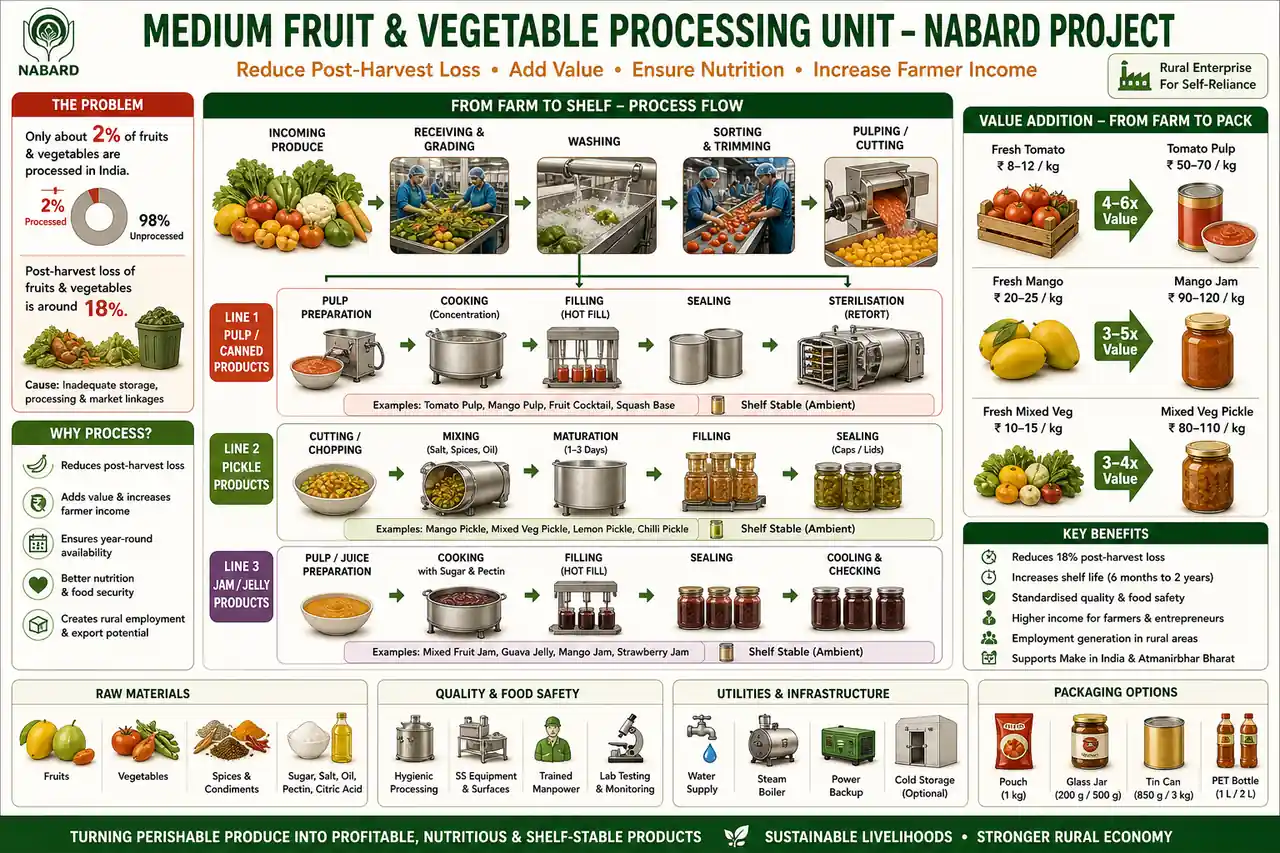
Why Only 2% Processing? The Structural Problem
The low processing rate in India stems from:
- Fragmented supply chains — small farm holdings, poor aggregation
- Lack of cold chain — spoilage between farm and factory
- Capital barriers — processing equipment is expensive for individual farmers
- Seasonality — raw material availability for only 2–4 months
This model directly addresses the capital barrier by providing a bankable project structure that banks can appraise and finance.
Pro Content Locked
Upgrade to Pro to access this lesson and all other premium content.
₹99 charged monthly · Cancel anytime
- All Agriculture & Banking Courses
- AI Lesson Questions (100/day)
- AI Doubt Solver (50/day)
- Glows & Grows Feedback (30/day)
- AI Section Quiz (20/day)
- 22-Language Translation (100/day)
- Recall Questions (20/day)
- AI Quiz (15/day)
- AI Quiz Paper Analysis (100/day)
- AI Step-by-Step Explanations (100/day)
- Spaced Repetition Recall (FSRS)
- AI Tutor
- Immersive Text Questions
- Audio Lessons — Hindi & English
- Mock Tests & Previous Year Papers
- Summary & Mind Maps
- XP, Levels, Leaderboard & Badges
- Generate New Classrooms
- Voice AI Teacher (AgriDots Live)
- AI Revision Assistant
- Knowledge Gap Analysis
- Interactive Revision (LangGraph)
🔒 Secure via Razorpay · Cancel anytime · No hidden fees
Project Overview
India is the world's second largest producer of fruits and vegetables (after China), accounting for ~15% of global vegetable production. Despite this, barely 2% of perishable horticultural produce is processed into value-added products, and up to 18% is wasted post-harvest (CIPHET, Ludhiana data).
This NABARD model covers a medium-scale unit that addresses this wastage gap by converting fresh produce into shelf-stable processed products:
- Canned fruit pulp and vegetables
- Pickle (fruits and vegetables)
- Jam and Jelly
Why Only 2% Processing? The Structural Problem
The low processing rate in India stems from:
- Fragmented supply chains — small farm holdings, poor aggregation
- Lack of cold chain — spoilage between farm and factory
- Capital barriers — processing equipment is expensive for individual farmers
- Seasonality — raw material availability for only 2–4 months
This model directly addresses the capital barrier by providing a bankable project structure that banks can appraise and finance.
Project Cost (Rs. Lakh)
| S.No. | Item | Amount (Rs. Lakh) |
|---|---|---|
| 1 | Land (0.5 acre) | 2.50 |
| 2 | Land development | 5.00 |
| 3 | Civil work (3,850 sq ft @ Rs. 600/sq ft) | 23.10 |
| 4 | Plant and machinery | 40.23 |
| 5 | Miscellaneous fixed assets | 2.00 |
| 6 | Preliminary and pre-operative expenses | 1.95 |
| TOTAL PROJECT COST | Rs. 74.78 lakh |
NOTE
Plant and machinery accounts for 54% of total project cost (Rs. 40.23 lakh of Rs. 74.78 lakh). Civil work is the second largest at Rs. 23.10 lakh (31%). This machinery-heavy structure means depreciation is a significant cost item. The total of Rs. 74.78 lakh classifies this as a small/medium MSME unit.
Key Machinery
| Machine | Capacity | Cost (Rs. Lakh) |
|---|---|---|
| Fruit washing machine | 1.5 MT/hour | 2.00 |
| Sorting/inspection conveyor belt | — | 1.75 |
| Screw feeder | 2 MT/hour | 3.33 |
| Twin pulper | 3 MT/hour | 2.70 |
| Steam jacketed kettle | — | — |
| Other machinery | — | Balance |
Total motor capacity: 55 HP (AC 3-phase motors, 2.5–7.5 HP range)
Working Capital Assessment (Rs. Lakh)
| Item | Holding Period | Year 1 | Year 2 | Year 3 |
|---|---|---|---|---|
| Raw materials stock | 7 days | 0.71 | 1.65 | 2.12 |
| Work in progress | 30 days | 4.10 | 9.57 | 12.31 |
| Finished goods | 15 days | 2.23 | 5.37 | 6.74 |
| Debtors | 30 days | 4.45 | 10.75 | 13.49 |
| Total current assets | 7.03 | 16.59 | 21.16 | |
| Margin money (25%) | 1.76 | 4.15 | 5.29 | |
| Bank loan (CC limit) | 5.28 | 12.44 | 15.87 |
NOTE
Raw material holding is only 7 days — unlike cashew (30 days), fruits and vegetables are procured frequently (perishable, cannot be stored). But work-in-progress is held for 30 days because processing (pulping, cooking, canning, sterilisation) takes time. This inverted holding pattern (short raw material, long WIP) is unique to F&V processing and is testable.
Financing Structure
| Parameter | Value |
|---|---|
| Margin money (term loan) | 25% of project cost |
| Bank loan (term loan) | 75% |
| Working capital margin | 25% |
| Bank loan (CC limit) | 75% of WC gap |
| Classification | MSME / Priority sector |
| Eligible lenders | Commercial banks, RRBs, Cooperative banks |
Subsidy/Grant: Available under government schemes (PMKSY/NHM) — capital subsidy up to 35% of project cost (subject to scheme guidelines) for eligible categories.
Financial Viability Indicators
| Indicator | Value | Threshold |
|---|---|---|
| NPW @ 15% DF | Rs. 43.96 lakh | Must be +ve |
| IRR | 36.73% | Above 15% |
| BCR | 1.09 | Above 1.0 |
| DSCR | 1.68 | Above 1.5 |
NOTE
BCR of 1.09 seems low, but the IRR of 36.73% is high — this reflects a highly capital-efficient project where returns come in quickly relative to invested capital. The DSCR of 1.68 provides reasonable cushion above the minimum 1.5 threshold. Compare with cashew (DSCR 1.604, IRR 34.27%) — F&V processing shows slightly better financial parameters despite lower scale.
Products and Shelf Life
| Product | Shelf Life | Distribution |
|---|---|---|
| Canned fruit pulp and vegetables | 12–18 months (ambient) | Wholesalers/retailers |
| Pickle | 12+ months | Retail chains |
| Jam and jelly | 12 months | Retail |
Finished goods can be stored at ambient temperature for 12–18 months — this eliminates the cold chain requirement for the finished product (unlike fresh produce), dramatically reducing distribution cost.
Quality and Regulatory Requirements
- FSSAI License: Mandatory for all food processing units
- BIS standards: IS standards applicable for canned products, jams, pickles
- Pollution Control Board NOC: Required for effluent (wash water, organic waste)
- Agmark certification: Optional but boosts market access for jams and pickles
- ETP (Effluent Treatment Plant): Mandatory for organic effluent from washing operations
Linked Government Schemes
- PMKSY (Pradhan Mantri Kisan Sampada Yojana): Up to 35% grant (50% for NE/Himalayan/difficult areas) for creation of food processing infrastructure
- PM FME: Credit-linked capital subsidy of 35% (up to Rs. 10 lakh) for micro food processing enterprises
- NHM (National Horticulture Mission): Post-harvest management infrastructure support
- APEDA: Export market development for processed horticultural products
NOTE
PMKSY (launched 2016) is the umbrella scheme for food processing under MoFPI. It subsumes earlier schemes like NHM's processing component, MFPI's Cold Chain, Agro-Processing Cluster, Creation of Backward and Forward Linkages, etc. This consolidation is frequently tested — candidates must know PMKSY replaced/subsumed multiple earlier schemes.
Key Exam Facts
- India: 2nd largest F&V producer; only 2% processed; 18% post-harvest wastage
- Total project cost: Rs. 74.78 lakh (land Rs. 2.5L + civil Rs. 23.1L + machinery Rs. 40.23L)
- Margin money: 25%; bank loan: 75%
- IRR: 36.73%; BCR: 1.09; DSCR: 1.68; NPW: Rs. 43.96 lakh
- Raw material holding: only 7 days (perishable); WIP: 30 days; debtors: 30 days
- Finished goods shelf life: 12–18 months at ambient temperature
- Key scheme: PMKSY (MoFPI) — umbrella scheme for food processing
Sources & References
Primary source for this lesson is NABARD's official Model Bankable Projects portal.[1] Lesson-specific report copy used for this topic.[2]
References
2 sources • [1] [2]
References
Used for: Official NABARD portal for model bankable project documents and updates.
Used for: Reference copy used in this lesson for project parameters and worked figures.
The figures in this lesson reflect the cost norms and technical parameters as published in the NABARD document. Actual costs may vary by state, season, and year of implementation. Always refer to the latest NABARD circular for current norms.
Summary Cheat Sheet
| Concept / Topic | Key Details / Explanation |
|---|---|
| India's F&V position | 2nd largest producer globally; only 2% processed; 18% post-harvest wastage |
| Products | Canned fruit pulp/vegetables, Pickle, Jam and Jelly |
| Total Project Cost | ₹74.78 lakh (land ₹2.5L + civil ₹23.1L + machinery ₹40.23L) |
| Plant and machinery share | 54% of total project cost (₹40.23 lakh) |
| Margin Money | 25% of project cost (term loan) |
| Bank Loan | 75% |
| WC margin | 25%; CC limit: 75% of WC gap |
| Raw material holding | 7 days (perishable — procured frequently) |
| WIP holding | 30 days (processing takes time: pulping, cooking, canning, sterilisation) |
| Finished goods holding | 15 days |
| Debtors | 30 days |
| Capacity utilisation Year 1 | Ramp-up (low) |
| Capacity utilisation Year 3+ | Full capacity |
| IRR | 36.73% |
| BCR | 1.09 |
| DSCR | 1.68 (above 1.5 threshold) |
| NPW @ 15% | ₹43.96 lakh |
| Finished goods shelf life | 12–18 months at ambient temperature (no cold chain needed for distribution) |
| Regulatory requirements | FSSAI licence + PCB NOC + BIS standards + ETP mandatory |
| Key linked scheme | PMKSY (MoFPI) — umbrella scheme for food processing; up to 35% grant (50% for NE/Himalayan) |
| PM FME | Credit-linked capital subsidy 35% (max ₹10 lakh) for micro food processing |
| Total motor capacity | 55 HP (AC 3-phase) |
Lesson Doubts
Ask questions, get expert answers