🎋 Bamboo-Based Agroforestry — NABARD Model Bankable Project
NABARD's model bankable project for tissue-culture bamboo agroforestry covering unit cost, financial viability, species selection, and lending terms. Critical for exams questions on farm forestry financing.
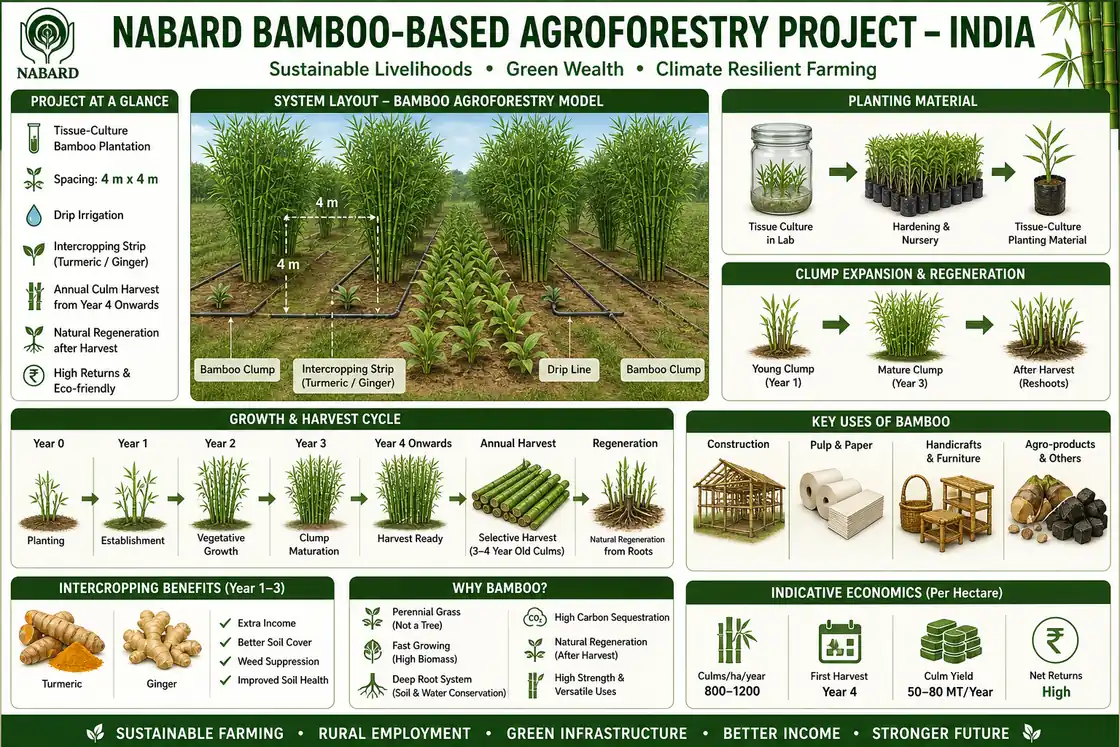
Bamboo is the fastest growing woody plant on earth — some species grow up to 1 metre per day. It is a member of the grass family (Gramineae), not a tree, which has a major implication: bamboo reaches harvestable maturity in 3–5 years, far sooner than any timber species. It can be grown on marginal and degraded lands, making it ideal for NABARD's agroforestry financing objectives.
- Bamboo regenerates naturally after harvest — no replanting needed for 50+ years
- Acts as a carbon sink and soil stabilizer, with strong environmental co-benefits
- Integrates with intercropping of turmeric, ginger, or shade-loving medicinal plants
Species & Spacing
NABARD's model focuses on tissue culture (TC) clonal material for higher uniformity and yield predictability. Key species recommended:
- Bambusa balcoa — large-diameter culms, suitable for construction
- Bambusa tulda — paper and pulp industry; common in northeast India
- Bambusa hamiltonii — multipurpose, high-altitude adaptability
| Plantation Type | Spacing | Plants/ha | First Harvest |
|---|---|---|---|
| High density | 10×4 ft | 1,000/acre | 3rd year |
| Medium density 1 | 12×6 ft | 600/acre | 4th year |
| Medium density 2 | 10×10 ft | 450/acre | 5th year |
| Low density | 15×15 ft | 200/acre | 5th year |
NOTE
Pro Content Locked
Upgrade to Pro to access this lesson and all other premium content.
₹99 charged monthly · Cancel anytime
- All Agriculture & Banking Courses
- AI Lesson Questions (100/day)
- AI Doubt Solver (50/day)
- Glows & Grows Feedback (30/day)
- AI Section Quiz (20/day)
- 22-Language Translation (100/day)
- Recall Questions (20/day)
- AI Quiz (15/day)
- AI Quiz Paper Analysis (100/day)
- AI Step-by-Step Explanations (100/day)
- Spaced Repetition Recall (FSRS)
- AI Tutor
- Immersive Text Questions
- Audio Lessons — Hindi & English
- Mock Tests & Previous Year Papers
- Summary & Mind Maps
- XP, Levels, Leaderboard & Badges
- Generate New Classrooms
- Voice AI Teacher (AgriDots Live)
- AI Revision Assistant
- Knowledge Gap Analysis
- Interactive Revision (LangGraph)
🔒 Secure via Razorpay · Cancel anytime · No hidden fees
Bamboo is the fastest growing woody plant on earth — some species grow up to 1 metre per day. It is a member of the grass family (Gramineae), not a tree, which has a major implication: bamboo reaches harvestable maturity in 3–5 years, far sooner than any timber species. It can be grown on marginal and degraded lands, making it ideal for NABARD's agroforestry financing objectives.
- Bamboo regenerates naturally after harvest — no replanting needed for 50+ years
- Acts as a carbon sink and soil stabilizer, with strong environmental co-benefits
- Integrates with intercropping of turmeric, ginger, or shade-loving medicinal plants
Species & Spacing
NABARD's model focuses on tissue culture (TC) clonal material for higher uniformity and yield predictability. Key species recommended:
- Bambusa balcoa — large-diameter culms, suitable for construction
- Bambusa tulda — paper and pulp industry; common in northeast India
- Bambusa hamiltonii — multipurpose, high-altitude adaptability
| Plantation Type | Spacing | Plants/ha | First Harvest |
|---|---|---|---|
| High density | 10×4 ft | 1,000/acre | 3rd year |
| Medium density 1 | 12×6 ft | 600/acre | 4th year |
| Medium density 2 | 10×10 ft | 450/acre | 5th year |
| Low density | 15×15 ft | 200/acre | 5th year |
NOTE
The NABARD model uses 4×4 m spacing = 625 plants/ha. This is the "Model B" (tissue culture with drip irrigation) with an economic life of 25–30 years — a common MCQ anchor point.
Yield Profile
Once bamboo enters the harvest cycle, it can be harvested annually using selective harvesting: mature poles (>1 year old) are cut while younger shoots are retained for the next season.
| Harvest Year | Yield |
|---|---|
| 1st harvest | 30 MT/acre |
| 2nd harvest | 35 MT/acre |
| 3rd harvest onwards | 40 MT/acre |
A single clump produces on average 10 culms per year under good conditions. Each clump expands from 6 culms in year 5 to 12 culms by year 8.
Unit Cost & Financial Viability (Model B — TC with Drip Irrigation, 1 ha)
Techno-Economic Parameters:
| Parameter | Value |
|---|---|
| Species | Bambusa balcoa / tulda / hamiltonii (TC) |
| Spacing | 4×4 m |
| Plants per ha | 625 |
| Economic life | 25–30 years |
| Year of first harvest | 4th year |
| Mortality replacement | 10% |
| Interest on term loan | 12% |
| Margin (of total cost) for bank loan | 10% |
Unit Cost Summary:
| Item | Cost (₹) |
|---|---|
| Site preparation, ploughing, staking | ~14,200 |
| Pit digging & refilling | ~8,400 |
| TC planting material | ~50,000 |
| FYM and fertilisers | ~15,000 |
| Drip irrigation system | ~40,000 |
| Labour (planting, maintenance) | ~30,000 |
| Total unit cost (capitalised, 4 years) | ₹1,85,000/ha |
| Bank loan (90%) | ₹1,66,500/ha |
| Promoter margin (10%) | ₹18,500/ha |
NOTE
Bamboo agroforestry has the lowest margin requirement (10%) among NABARD forestry models. This reflects the lower risk profile of bamboo — no replanting needed for 50 years and assured industrial demand. Compare this with 25% margin for food processing.
Financial Returns
With farm gate price of bamboo poles at ₹50–75 per culm:
| Indicator | Value |
|---|---|
| IRR | ~20–25% (varies by model) |
| Economic life | 25–30 years |
| BCR | > 1.0 |
The IRR computation assumes rotation of 4 years with 3 coppice cycles. Annual yield income from year 4 onwards comfortably services the loan.
Fertilisation & Agronomy
Bamboo is a heavy feeder — nitrogen and potassium are critical. Best practice:
- Apply fertiliser after each harvest (not during monsoon peak)
- Use compost/green manure + NPK chemical fertilisers
- Lime application to neutralise soil acidity where needed
- Drip irrigation significantly improves yield uniformity under the TC model
Markets & End Use
Bamboo has diversified end-use demand, which insulates farmers from price risk:
- Construction: flooring, scaffolding, roofing, housing panels
- Handicrafts: mats, baskets, toys, furniture — cottage industry employment
- Industry: paper pulp, particle board, MDF (Medium Density Fibreboard)
- Food: bamboo shoots (edible, export potential to East Asia)
- Environment: prevents landslides, soil erosion, riverbank stabilisation
NOTE
The National Bamboo Mission (NBM) under the Ministry of Agriculture & Farmers' Welfare promotes bamboo cultivation with subsidies of up to 50% of project cost for SC/ST beneficiaries and 33% for general category. NABARD provides refinance to banks financing bamboo projects. This scheme is frequently tested in context of government support for non-timber forest products (NTFPs).
Lending Terms
- Loan type: Term loan under farm forestry / agroforestry
- Repayment: Linked to harvest cycles — bullet/annual repayment after first harvest in year 4
- Security: Hypothecation of standing crop + land mortgage
- Refinance: NABARD provides refinance to commercial banks and RRBs for farm forestry
- Priority sector: Qualifies as agriculture (tree crops on agricultural land)
Sources & References
Primary source for this lesson is NABARD's official Model Bankable Projects portal.[1] Lesson-specific report copy used for this topic.[2]
References
2 sources • [1] [2]
References
Used for: Official NABARD portal for model bankable project documents and updates.
Used for: Reference copy used in this lesson for project parameters and worked figures.
The figures in this lesson reflect the cost norms and technical parameters as published in the NABARD document. Actual costs may vary by state, season, and year of implementation. Always refer to the latest NABARD circular for current norms.
Summary Cheat Sheet
| Concept / Topic | Key Details / Explanation |
|---|---|
| Plant family | Gramineae (grass family) — not a tree; hence Bamboo Amendment Act 2017: no felling permit needed |
| Growth rate | Fastest growing woody plant; some species grow up to 1 metre/day |
| Harvest maturity | 3–5 years (far sooner than timber species) |
| Regeneration | Regenerates naturally after harvest — no replanting for 50+ years |
| NABARD model type | Model B — Tissue Culture (TC) with drip irrigation, 1 ha unit |
| Recommended species | Bambusa balcoa (construction), Bambusa tulda (paper/pulp), Bambusa hamiltonii (multipurpose) |
| Spacing | 4×4 m = 625 plants/ha |
| Economic life | 25–30 years |
| First harvest year | 4th year |
| Mortality replacement | 10% |
| Total Unit Cost (capitalised, 4 years) | ₹1,85,000/ha |
| Bank Loan | 90% = ₹1,66,500/ha |
| Margin Money | 10% = ₹18,500/ha (lowest among NABARD forestry models) |
| Interest rate | 12% |
| Yield (1st harvest) | 30 MT/acre; 2nd: 35 MT/acre; 3rd+: 40 MT/acre |
| Culms per clump | 6 (year 5) → 12 (year 8); ~10 culms/clump/year average |
| Farm gate price | ₹50–75 per culm |
| IRR | ~20–25% |
| Repayment | Bullet/annual repayment linked to harvest cycles (after year 4) |
| End-uses | Construction, handicrafts, paper pulp, MDF, bamboo shoots (export), soil conservation |
| National Bamboo Mission subsidy | 50% for SC/ST; 33% for general category |
| Intercropping | Turmeric, ginger, shade-loving medicinal plants |
| Key exam fact | Bamboo reclassified as grass under 2017 amendment — no transit permit needed for transport |
Lesson Doubts
Ask questions, get expert answers