🌳 Poplar Plantation — NABARD Model Bankable Project
NABARD's model bankable project for commercial poplar plantation covering unit cost of ₹1,52,900/ha, 6-year rotation, financial viability, and industrial end-use in plywood, matches, and sports goods. Key for exams forestry questions.
Poplar (Populus spp.) is one of India's most commercially important fast-growing timber species, particularly dominant in the Indo-Gangetic plains of Punjab, Haryana, and western Uttar Pradesh. Its wood combines light weight with workability, making it the preferred raw material for matchsticks, plywood, sports goods, and paper pulp. NABARD finances poplar plantation as a bankable agroforestry investment.
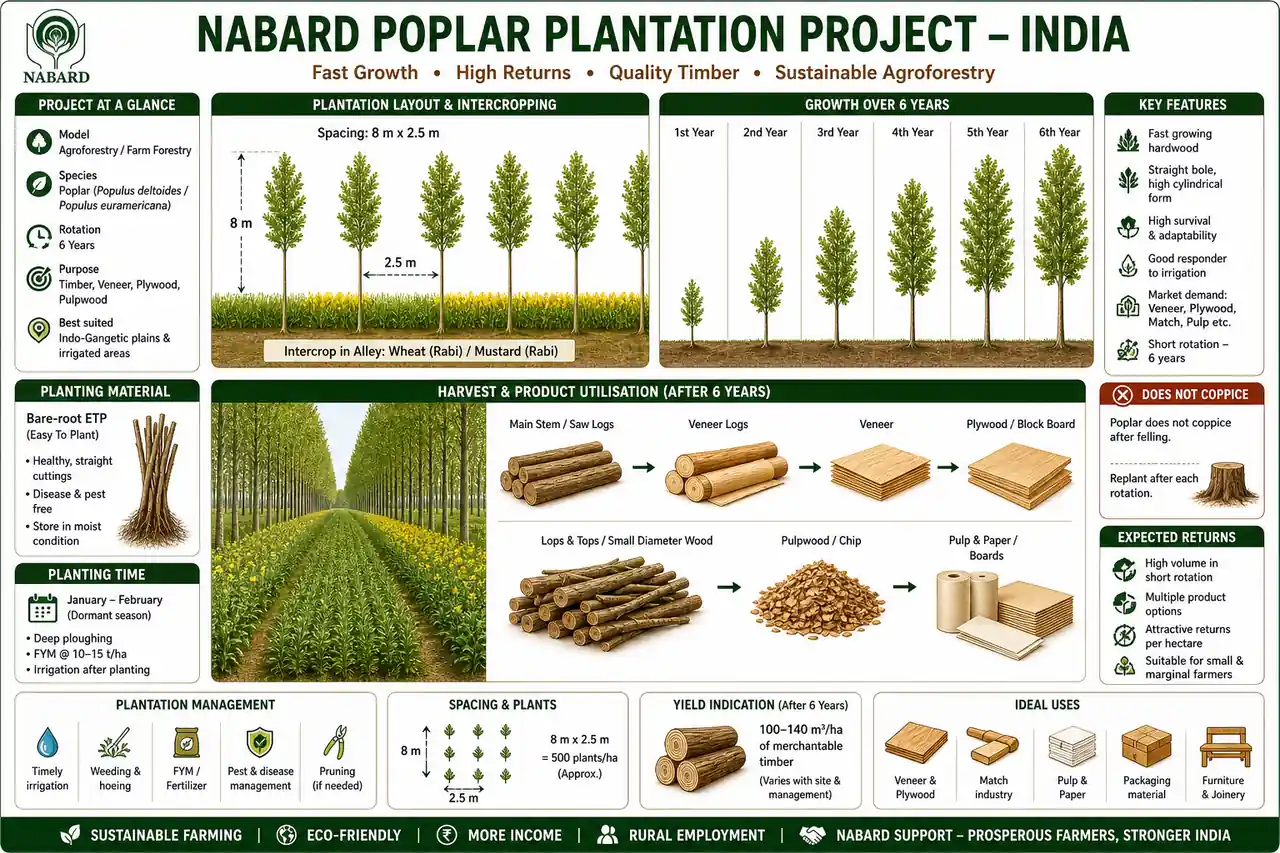
- Poplar produces pealable wood at 20–25 m³/ha/year over a 6-year rotation
- Intercropping with wheat, mustard, or vegetables is possible in the first 3–4 years
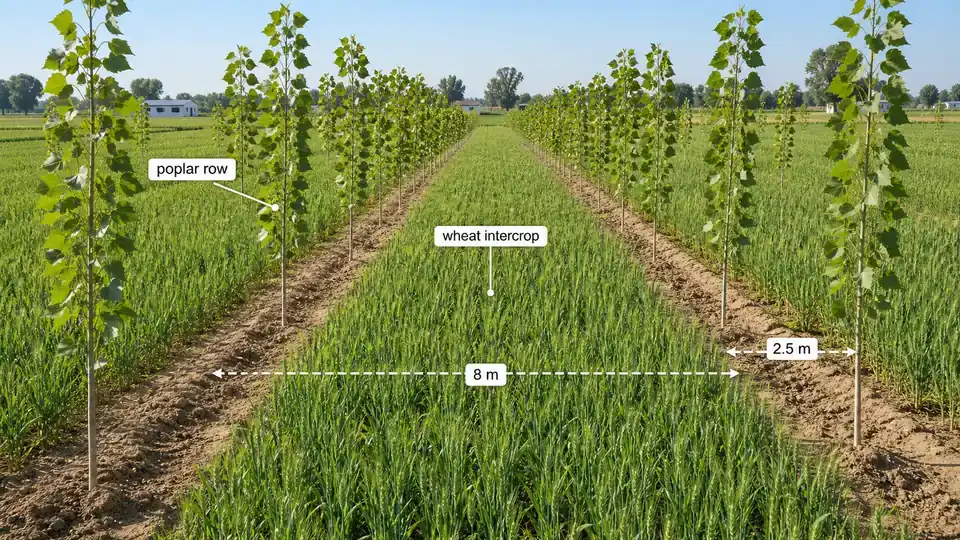
- Spacing of 8m×2.5m (500 plants/ha) is now preferred to facilitate intercropping
Species & Nursery Practices
Key poplar species used in India:
- Populus deltoides — most commercially planted; fast growth, suitable for northwest plains
- P. × euramericana hybrids — selected clones with superior wood quality
Nursery notes for MCQ:
Pro Content Locked
Upgrade to Pro to access this lesson and all other premium content.
₹99 charged monthly · Cancel anytime
- All Agriculture & Banking Courses
- AI Lesson Questions (100/day)
- AI Doubt Solver (50/day)
- Glows & Grows Feedback (30/day)
- AI Section Quiz (20/day)
- 22-Language Translation (100/day)
- Recall Questions (20/day)
- AI Quiz (15/day)
- AI Quiz Paper Analysis (100/day)
- AI Step-by-Step Explanations (100/day)
- Spaced Repetition Recall (FSRS)
- AI Tutor
- Immersive Text Questions
- Audio Lessons — Hindi & English
- Mock Tests & Previous Year Papers
- Summary & Mind Maps
- XP, Levels, Leaderboard & Badges
- Generate New Classrooms
- Voice AI Teacher (AgriDots Live)
- AI Revision Assistant
- Knowledge Gap Analysis
- Interactive Revision (LangGraph)
🔒 Secure via Razorpay · Cancel anytime · No hidden fees
Poplar (Populus spp.) is one of India's most commercially important fast-growing timber species, particularly dominant in the Indo-Gangetic plains of Punjab, Haryana, and western Uttar Pradesh. Its wood combines light weight with workability, making it the preferred raw material for matchsticks, plywood, sports goods, and paper pulp. NABARD finances poplar plantation as a bankable agroforestry investment.
- Poplar produces pealable wood at 20–25 m³/ha/year over a 6-year rotation
- Intercropping with wheat, mustard, or vegetables is possible in the first 3–4 years
- Spacing of 8m×2.5m (500 plants/ha) is now preferred to facilitate intercropping
Species & Nursery Practices
Key poplar species used in India:
- Populus deltoides — most commercially planted; fast growth, suitable for northwest plains
- P. × euramericana hybrids — selected clones with superior wood quality
Nursery notes for MCQ:
- Seeds germinate at 20–25°C during March–April
- One-year-old Entire Trans Plants (ETPs) without co-leaders are planted in mid-January to February end
- Pit size: 45cm × 45cm × 45cm
- Debudding done June–October by rubbing up to 2/3rd height from base
NOTE
Poplar is planted as bare-root ETPs (Entire Trans Plants) — without any ball of earth — during January–February. This timing detail is frequently tested. Planting in summer or monsoon is not recommended due to desiccation risk.
Spacing & Stocking
| Planting System | Spacing | Plants/ha |
|---|---|---|
| Block plantation (old practice) | 5m × 4m | 500 |
| Block plantation (current preferred) | 8m × 2.5m | 500 |
| Field boundary / single line | 3m plant-to-plant | Variable |
The 8m × 2.5m spacing is favoured because it allows intercropping for 4+ years, significantly improving the economics of the plantation by generating annual income while the poplar matures.
Rotation & Harvesting
- Rotation: 5–6 years; optimum harvest in the 6th year
- Trees attain girth of 75–90 cm at breast height (GBH) by harvest
- Harvested as standing trees or felled and cut into logs
- No coppice regrowth — new planting required after harvest (unlike bamboo/eucalyptus)
NOTE
Exam trap: Poplar does NOT coppice — unlike eucalyptus and subabul, which can be harvested 2–3 times from the same stump. Poplar requires replanting after each rotation. This is a direct MCQ comparison point.
Unit Cost & Financial Viability
Total investment over 6-year rotation (1 ha):
| Item | Cost (₹) |
|---|---|
| Planting material (ETPs) | ~25,000 |
| Land preparation, pit digging | ~15,000 |
| Fertilisers (Urea, SSP, MOP, FYM) | ~18,000 |
| Irrigation (6 years) | ~30,000 |
| Plant protection, weeding | ~12,000 |
| Labour (planting to harvest) | ~28,000 |
| Miscellaneous / contingency | ~24,900 |
| Total unit cost (6 years) | ₹1,52,900/ha |
Means of Finance:
| Source | Amount |
|---|---|
| Bank loan | ~90% of unit cost |
| Promoter margin | ~10% |
Yield & Returns
Under intensive management, poplar yields:
| Product | Yield/ha | Sale Value |
|---|---|---|
| Pealable logs (plywood/match grade) | 20–25 m³/ha/yr equivalent | ₹3,000–4,000/m³ |
| Lops & tops (pulpwood) | ~20% of total biomass | ₹800–1,200/MT |
Financial indicators:
| Indicator | Value |
|---|---|
| Total revenue (6 years, per ha) | ₹2.5–3.5 lakh+ |
| IRR | >15% (viable) |
| BCR | > 1.0 |
| Repayment | Bullet at harvest (year 6) |
NOTE
Poplar wood from the bole (trunk) qualifies as veneer-quality logs for plywood and match industries; lops and tops (branches) yield pulpwood. This grading distinction matters for price calculation in financial models.
End-Use Industries
Poplar wood is demanded by:
- Match industry — light, easily split into splints; dominated by Sivakasi cluster
- Plywood & block board — lighter alternative to timber
- Sports goods — cricket bat handles, hockey sticks (Jalandhar cluster)
- Paper & pulp — short-fibre pulp for writing paper
- Packaging cases — light weight and ease of nailing
Fertiliser Requirements
Poplar is a fast-growing, heavy-feeding species. NABARD model prescribes:
- Urea — nitrogen source for rapid vegetative growth
- Super phosphate (SSP) — phosphorus for root development
- Muriate of Potash (MOP) — potassium for stem strength
- Farm Yard Manure (FYM) — soil organic matter improvement
Fertiliser application is critical in the nursery phase when soil is rapidly depleted by fast-growing cuttings.
Lending Terms
- Loan type: Term loan under farm forestry
- Repayment schedule: Bullet repayment at harvest (year 6) — no annual instalment
- Security: Hypothecation of standing crop + land mortgage
- Priority sector: Agriculture (farm forestry on agricultural land)
- NABARD refinance: Available to banks and RRBs at concessional rates for farm forestry
NOTE
The bullet repayment structure (entire principal + interest repaid at harvest) is characteristic of forestry loans, unlike standard EMI-based term loans. Banks are permitted to structure forestry loans this way under RBI/NABARD guidelines. This is a key MCQ point distinguishing forestry finance from crop finance.
Sources & References
Primary source for this lesson is NABARD's official Model Bankable Projects portal.[1] Lesson-specific report copy used for this topic.[2]
References
2 sources • [1] [2]
References
Used for: Official NABARD portal for model bankable project documents and updates.
Used for: Reference copy used in this lesson for project parameters and worked figures.
The figures in this lesson reflect the cost norms and technical parameters as published in the NABARD document. Actual costs may vary by state, season, and year of implementation. Always refer to the latest NABARD circular for current norms.
Summary Cheat Sheet
| Concept / Topic | Key Details / Explanation |
|---|---|
| Species | Populus deltoides (most commercial); P. × euramericana hybrids; family Salicaceae |
| Region | Indo-Gangetic plains — Punjab, Haryana, western UP |
| Planting material | ETP (Entire Trans Plants) — bare-root cuttings without ball of earth |
| Planting time | January–February (mid-Jan to end-Feb); NOT summer/monsoon |
| Spacing (NABARD model) | 8 m × 2.5 m = 500 plants/ha (facilitates intercropping for 4+ years) |
| Pit size | 45 cm × 45 cm × 45 cm |
| Debudding | June–October; rub buds up to 2/3rd height from base |
| Rotation period | 6 years (optimum harvest in 6th year) |
| Coppice | NO coppice — replanting required after each rotation (key MCQ contrast point) |
| GBH at harvest | 75–90 cm girth at breast height |
| Total Unit Cost (6-year rotation) | ₹1,52,900/ha |
| Bank Loan | ~90% of unit cost |
| Margin Money | ~10% of unit cost |
| Interest rate | 12% per annum |
| Repayment | Bullet repayment at harvest (year 6) — no annual instalment |
| IRR | >15% (viable for bank finance) |
| BCR | >1.0 |
| Yield | Pealable logs: 20–25 m³/ha/yr equivalent; lops & tops: ~20% biomass as pulpwood |
| Pulpwood price | ₹800–1,200/MT (lops & tops); veneer logs ₹3,000–4,000/m³ |
| Intercropping | Wheat, mustard, vegetables in first 3–4 years |
| End uses | Matchsticks (Sivakasi), plywood/block board, sports goods (Jalandhar — cricket bat handles, hockey sticks), paper pulp, packaging cases |
| Fertilisers | Urea + SSP + MOP + FYM |
| Security | Hypothecation of standing crop + land mortgage |
| Priority sector | Agriculture (farm forestry on agricultural land) |
| Key MCQ trap | Poplar does NOT coppice — contrast: Eucalyptus coppices 2×, Bamboo regenerates 50+ years |
Lesson Doubts
Ask questions, get expert answers