🌲 Eucalyptus-Based Agroforestry — NABARD Model Bankable Project
NABARD's model bankable project for eucalyptus agroforestry covering six plantation models, unit costs from ₹35,000–₹53,000/ha, coppice management, and IRR analysis. Covers key facts for exams farm forestry questions.
Eucalyptus (Eucalyptus spp.) was introduced in India in 1843 in the Nilgiri Hills by the British as a high-yielding fuel and timber species. Popularly called Gum tree, Nilgiri, or Safeda, it is now one of the most widely planted species across India for pulpwood, poles, fuel, and construction. Its key advantage: it coppices strongly — after harvest, new shoots emerge from the stump, allowing 2–3 harvests from a single planting.
- Belongs to family Myrtaceae; fastest-growing trees, some attaining 480 feet (E. amygdalin)
- Annual rainfall of 800 mm preferred; moderately salt-tolerant and drought-hardy
- Grows best on light red sandy/alluvial soils; E. urophylla and E. urograndis suit heavy black cotton soils
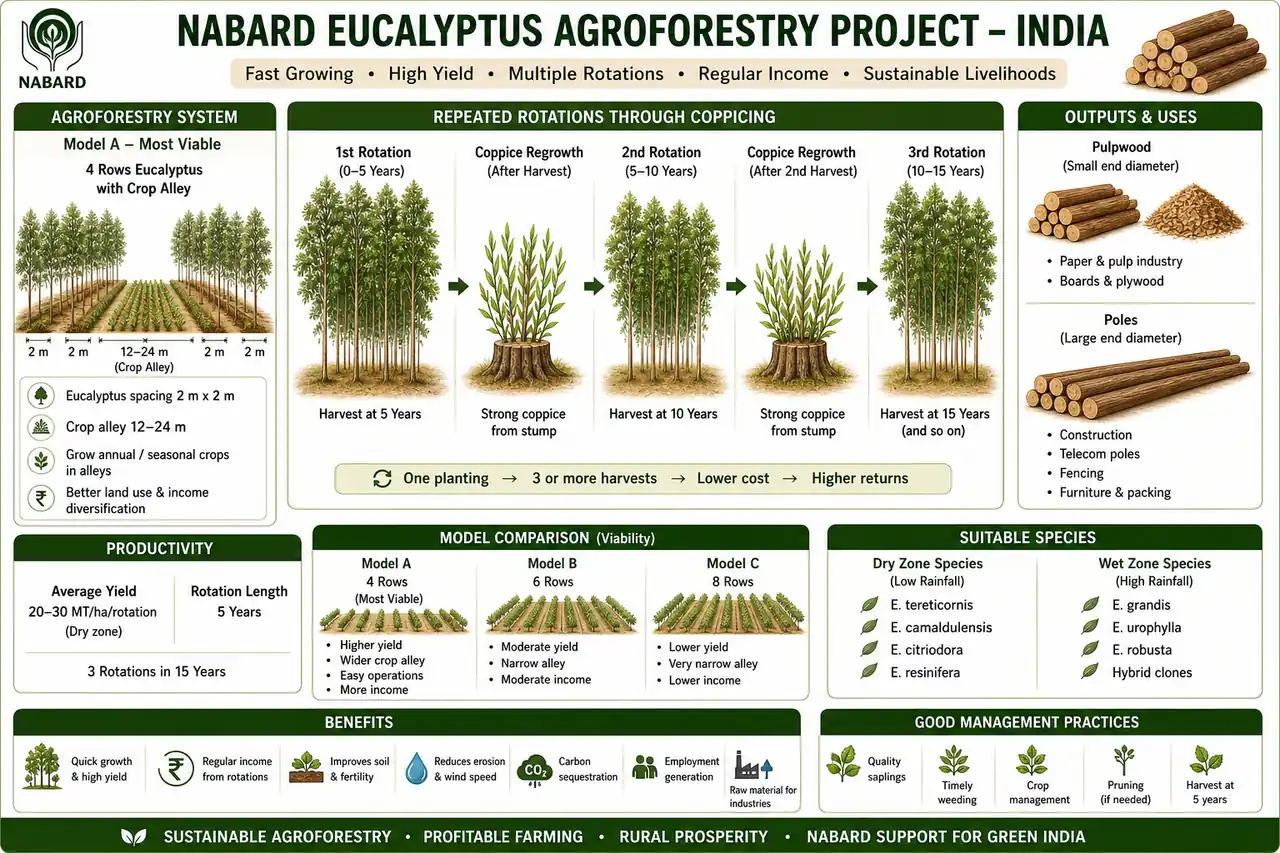
Species Selection by Rainfall Zone
| Rainfall Zone | Recommended Species |
|---|---|
| Dry zone (< 1000 mm) | E. camaldulensis, E. tereticornis, E. urograndis (specific clones) |
| Wet zone (> 1000 mm, ideally 1500–4000 mm) | E. pelleta, E. urophylla, E. urograndis (specific clones) |
NOTE
Pro Content Locked
Upgrade to Pro to access this lesson and all other premium content.
₹99 charged monthly · Cancel anytime
- All Agriculture & Banking Courses
- AI Lesson Questions (100/day)
- AI Doubt Solver (50/day)
- Glows & Grows Feedback (30/day)
- AI Section Quiz (20/day)
- 22-Language Translation (100/day)
- Recall Questions (20/day)
- AI Quiz (15/day)
- AI Quiz Paper Analysis (100/day)
- AI Step-by-Step Explanations (100/day)
- Spaced Repetition Recall (FSRS)
- AI Tutor
- Immersive Text Questions
- Audio Lessons — Hindi & English
- Mock Tests & Previous Year Papers
- Summary & Mind Maps
- XP, Levels, Leaderboard & Badges
- Generate New Classrooms
- Voice AI Teacher (AgriDots Live)
- AI Revision Assistant
- Knowledge Gap Analysis
- Interactive Revision (LangGraph)
🔒 Secure via Razorpay · Cancel anytime · No hidden fees
Eucalyptus (Eucalyptus spp.) was introduced in India in 1843 in the Nilgiri Hills by the British as a high-yielding fuel and timber species. Popularly called Gum tree, Nilgiri, or Safeda, it is now one of the most widely planted species across India for pulpwood, poles, fuel, and construction. Its key advantage: it coppices strongly — after harvest, new shoots emerge from the stump, allowing 2–3 harvests from a single planting.
- Belongs to family Myrtaceae; fastest-growing trees, some attaining 480 feet (E. amygdalin)
- Annual rainfall of 800 mm preferred; moderately salt-tolerant and drought-hardy
- Grows best on light red sandy/alluvial soils; E. urophylla and E. urograndis suit heavy black cotton soils
Species Selection by Rainfall Zone
| Rainfall Zone | Recommended Species |
|---|---|
| Dry zone (< 1000 mm) | E. camaldulensis, E. tereticornis, E. urograndis (specific clones) |
| Wet zone (> 1000 mm, ideally 1500–4000 mm) | E. pelleta, E. urophylla, E. urograndis (specific clones) |
NOTE
The hybrid Eucalyptus urograndis (E. urophylla × E. grandis) is the most commercially important clonal hybrid — highest vigour, yield, and site adaptability. It is NABARD's preferred recommendation for commercial plantations. MCQs often test this hybrid name.
Six Plantation Models
NABARD's eucalyptus MBP provides six spacing models to suit different land types:
| Model | Spacing | Plants/ha | Unit Cost (₹) | Bank Loan (₹) | Yield 1st Rotation (MT/ha) | IRR (%) |
|---|---|---|---|---|---|---|
| A — Agroforestry | 4×1×1.5 m | 3,600 | 47,000 | 43,000 | 60 | 29.01 |
| B — Wide row | 8.5×1.5×1 m | — | 35,000 | 32,000 | 30 | 17.79 |
| C — Block | 3×1.4 m | — | 41,000 | 36,000 | 50 | 28.46 |
| D — Block | 2×2 m | — | 41,000 | 36,000 | 50 | 28.46 |
| E — Dense farm forestry | 1.5×1.5 m | 4,300 | 53,000 | 47,700 | 60 | 25.38 |
| F — Bund plantation | 1×1 m | — | 6,000 | — | 8 | 18.84 |
Techno-economic parameters (all models):
- Year of harvesting: 5 years (1st rotation)
- Economic life: 15 years (1 main crop + 2 coppice crops)
- Margin (promoter contribution): 10%
- Interest on term loan: 12%
- Yield increases by 10% in 1st coppice and decreases by 10% in 2nd coppice
NOTE
Model A (4×1×1.5 m) gives the highest IRR (29.01%) at a moderate cost of ₹47,000/ha. Model E (1.5×1.5 m dense block) gives the highest unit cost (₹53,000/ha) but slightly lower IRR (25.38%). Exam questions often ask which model is most financially viable — answer is Model A.
Coppice Management — The Compounding Advantage
Eucalyptus's strongest financial advantage over poplar and teak is its coppicing ability:
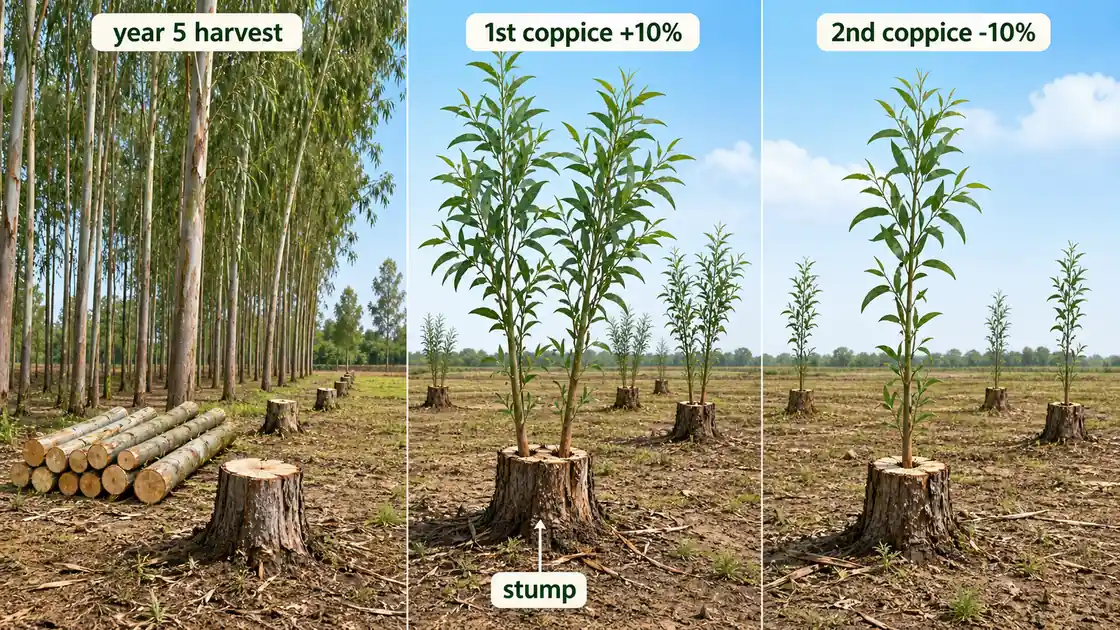
- First rotation (year 0–5): Plant, grow, harvest — full establishment cost incurred
- First coppice (year 5–10): 2 shoots retained per stump, yields 10% higher than rotation 1
- Second coppice (year 10–15): 1 shoot retained per stump, yields 10% less than rotation 1
This means the heavy upfront cost of land preparation, pit digging, and planting material is spread over 15 years of production rather than a single 5-year cycle. This dramatically improves the IRR compared to non-coppicing species.
Sale Price Benchmarks
| Product | Farm Gate Rate |
|---|---|
| Wood < 5 cm diameter (fuel/small pulp) | ₹1,500/MT |
| Mature poles 15–20 cm diameter (ballies) | ₹3,200/MT |
| Debarked wood (general pulpwood) | ₹1,500–4,500/MT |
| Transportation cost | ₹250–300/MT |
The NABARD model uses ₹2,200/MT for pulpwood and ₹1,000/MT for fuelwood as conservative assumptions.
Nursery & Propagation
Eucalyptus can be propagated by:
- Seeds — traditional method; genetically diverse
- Clonal cuttings — vegetative propagation; preferred for commercial plantations
Clonal material advantages:
- Uniform size across the plantation
- High genetic gains from tested parent trees
- Site-specific adaptation (chosen for dry or wet zones)
- Higher yield predictability — critical for bankability of the project
NOTE
Eucalyptus is moderately susceptible to chlorosis (yellowing due to reduced iron absorption) in alkaline soils — this is a silvicultural characteristic tested in MCQs. The solution is soil acidification or use of iron chelate fertilisers.
Environmental Controversy & Exam Context
Eucalyptus has been controversial in India due to:
- High water consumption (allelopathic effects debated)
- Reduced biodiversity in mono-culture plantations
- However, NABARD's agroforestry models (Model A, B) integrate eucalyptus with crops, mitigating monoculture concerns
Despite controversy, eucalyptus remains the most commonly financed farm forestry species by banks due to assured industrial demand from paper mills (ITC, TNPL, BILT) and pole/fencing industries.
Lending Terms
- Loan type: Term loan under farm forestry / agroforestry
- Repayment: Bullet at year 5 harvest; subsequent coppice crops provide annual income from year 6
- Margin: 10% of unit cost
- Priority sector: Agriculture (farm forestry on agricultural land)
- NABARD refinance: Available to all banks including cooperative banks and RRBs
Sources & References
Primary source for this lesson is NABARD's official Model Bankable Projects portal.[1] Lesson-specific report copy used for this topic.[2]
References
2 sources • [1] [2]
References
Used for: Official NABARD portal for model bankable project documents and updates.
Used for: Reference copy used in this lesson for project parameters and worked figures.
The figures in this lesson reflect the cost norms and technical parameters as published in the NABARD document. Actual costs may vary by state, season, and year of implementation. Always refer to the latest NABARD circular for current norms.
Summary Cheat Sheet
| Concept / Topic | Key Details / Explanation |
|---|---|
| Common name | Gum tree / Nilgiri / Safeda |
| Family | Myrtaceae |
| Introduced in India | 1843, Nilgiri Hills (by British) |
| Best hybrid (commercial) | Eucalyptus urograndis (E. urophylla × E. grandis) — highest vigour, yield, site adaptability |
| Rainfall preference | ≥800 mm; drought-hardy; moderately salt-tolerant |
| Soil | Light red sandy/alluvial; E. urograndis also suits heavy black cotton soils |
| Alkaline soil issue | Susceptible to chlorosis (iron deficiency); fix: soil acidification or iron chelate fertiliser |
| Propagation | Seeds (traditional) or clonal cuttings (preferred for commercial — uniform, high yield) |
| 1st rotation harvest | 5 years |
| Economic life | 15 years = 1 main crop + 2 coppice crops |
| Coppice yield pattern | 1st coppice: +10% yield vs rotation 1; 2nd coppice: −10% vs rotation 1 |
| Margin (all models) | 10% of unit cost |
| Interest rate | 12% per annum |
| Model A (best IRR) | Spacing 4×1×1.5 m, 3,600 plants/ha, cost ₹47,000/ha, IRR 29.01%, yield 60 MT/ha |
| Model B | Spacing 8.5×1.5×1 m, cost ₹35,000/ha (lowest cost), IRR 17.79%, yield 30 MT/ha |
| Model C / D | Spacing 3×1.4 m / 2×2 m, cost ₹41,000/ha, IRR 28.46%, yield 50 MT/ha |
| Model E (highest cost) | Spacing 1.5×1.5 m, 4,300 plants/ha, cost ₹53,000/ha, IRR 25.38%, yield 60 MT/ha |
| Model F (bund) | 1×1 m bund plantation, cost ₹6,000 (lowest), IRR 18.84%, yield 8 MT/ha |
| Most financially viable model | Model A — highest IRR (29.01%) at moderate cost |
| Pulpwood price (NABARD assumption) | ₹2,200/MT (pulpwood); ₹1,000/MT (fuelwood) |
| Poles (ballies) price | ₹3,200/MT (15–20 cm dia) |
| Fuel/small pulp price | ₹1,500/MT (< 5 cm dia) |
| Repayment | Bullet at year-5 harvest; coppice crops provide income from year 6+ |
| End uses | Pulpwood (ITC, TNPL, BILT paper mills), poles/fencing, fuel, construction |
| Key MCQ contrast | Eucalyptus coppices 2 times (15-yr life); Poplar — no coppice; Bamboo — 50+ yr regeneration |
| Environmental note | High water use; agroforestry models (A, B) mitigate monoculture concerns |
Lesson Doubts
Ask questions, get expert answers