🌿 Subabul Plantation — NABARD Model Bankable Project
NABARD's model for Subabul (Leucaena leucocephala) plantation covering unit cost of ₹69,000/ha, 6,200 plants/ha spacing, 29.2% IRR, and pulpwood market linkages. Essential for exams questions on nitrogen-fixing tree species and farm forestry finance.
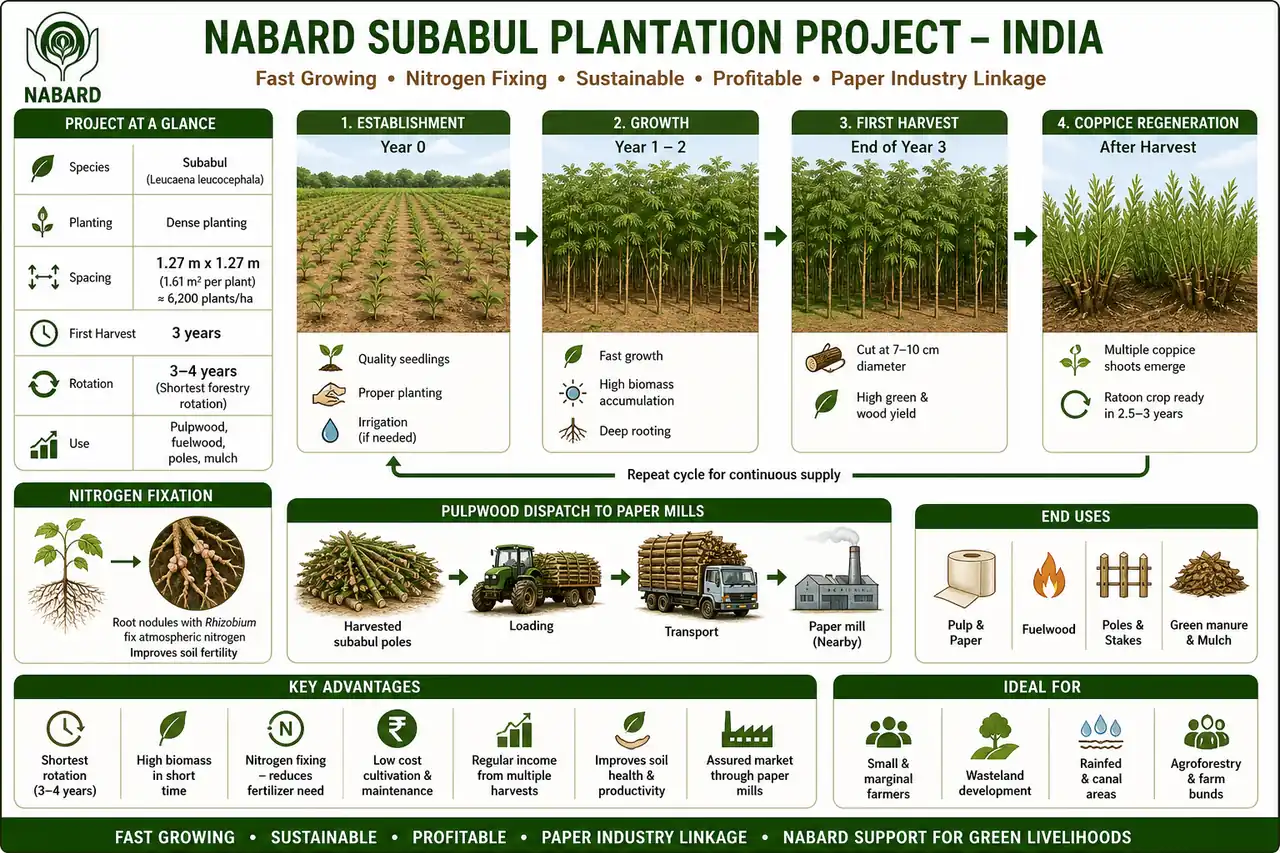
Subabul (Leucaena leucocephala), also known as Lead tree or White Popinac, is a nitrogen-fixing leguminous tree that uniquely combines pulpwood production with soil improvement. It is one of the few forestry species that actually enriches soil fertility while being commercially harvested — making it a favourite for degraded land reclamation combined with paper industry supply chains.
- Scientific name: Leucaena leucocephala — a direct MCQ target
- Family: Mimosaceae (or Fabaceae sub-family Mimosoideae)
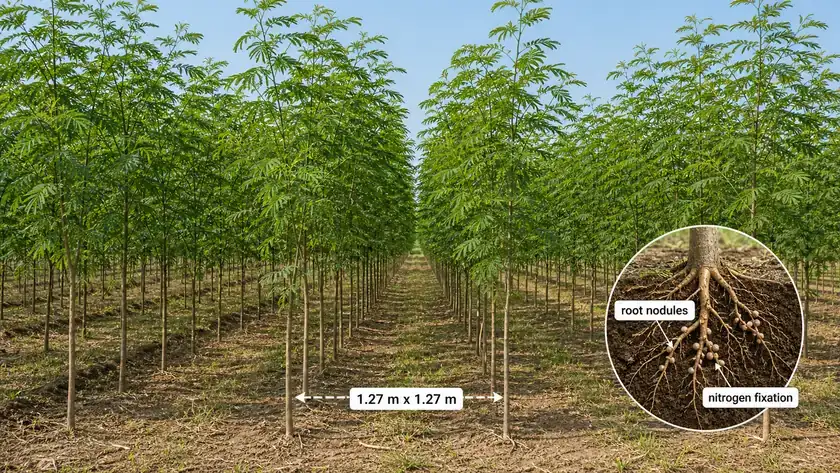
- Nitrogen-fixing root nodules improve soil health and reduce fertiliser need over time
- Major industrial demand from paper and pulp mills across India
Why Subabul for Farm Forestry?
Subabul occupies a unique niche in the NABARD forestry portfolio:
- Speed: Harvestable in just 3 years (first rotation) — faster than eucalyptus (5 years) and poplar (6 years)
- Coppice: Can be harvested 3 times from the same stump (3 coppice rotations)
- Soil: Being a legume, its root nodules fix atmospheric nitrogen at 100–300 kg N/ha/year — a major benefit for subsequent crops
- Fodder model: Young leaves and pods are high-protein fodder for livestock (alternative use case)
NOTE
Pro Content Locked
Upgrade to Pro to access this lesson and all other premium content.
₹99 charged monthly · Cancel anytime
- All Agriculture & Banking Courses
- AI Lesson Questions (100/day)
- AI Doubt Solver (50/day)
- Glows & Grows Feedback (30/day)
- AI Section Quiz (20/day)
- 22-Language Translation (100/day)
- Recall Questions (20/day)
- AI Quiz (15/day)
- AI Quiz Paper Analysis (100/day)
- AI Step-by-Step Explanations (100/day)
- Spaced Repetition Recall (FSRS)
- AI Tutor
- Immersive Text Questions
- Audio Lessons — Hindi & English
- Mock Tests & Previous Year Papers
- Summary & Mind Maps
- XP, Levels, Leaderboard & Badges
- Generate New Classrooms
- Voice AI Teacher (AgriDots Live)
- AI Revision Assistant
- Knowledge Gap Analysis
- Interactive Revision (LangGraph)
🔒 Secure via Razorpay · Cancel anytime · No hidden fees
Subabul (Leucaena leucocephala), also known as Lead tree or White Popinac, is a nitrogen-fixing leguminous tree that uniquely combines pulpwood production with soil improvement. It is one of the few forestry species that actually enriches soil fertility while being commercially harvested — making it a favourite for degraded land reclamation combined with paper industry supply chains.
- Scientific name: Leucaena leucocephala — a direct MCQ target
- Family: Mimosaceae (or Fabaceae sub-family Mimosoideae)
- Nitrogen-fixing root nodules improve soil health and reduce fertiliser need over time
- Major industrial demand from paper and pulp mills across India
Why Subabul for Farm Forestry?
Subabul occupies a unique niche in the NABARD forestry portfolio:
- Speed: Harvestable in just 3 years (first rotation) — faster than eucalyptus (5 years) and poplar (6 years)
- Coppice: Can be harvested 3 times from the same stump (3 coppice rotations)
- Soil: Being a legume, its root nodules fix atmospheric nitrogen at 100–300 kg N/ha/year — a major benefit for subsequent crops
- Fodder model: Young leaves and pods are high-protein fodder for livestock (alternative use case)
NOTE
Subabul's 3-year harvest rotation is the shortest among all NABARD model forestry species. This is a frequently tested comparison: Bamboo = 3–5 years, Subabul = 3 years (pulpwood), Eucalyptus = 5 years, Poplar = 6 years. Subabul also has the highest plant density at 6,200 plants/ha.
Technical Parameters
| Parameter | Value |
|---|---|
| Species | Leucaena leucocephala |
| Spacing | 1.27m × 1.27m |
| Plants per ha | 6,200 |
| Year of first harvest | Year 3 (end of 3rd year) |
| Economic life | 15 years (3 rotations × ~5 years each) |
| Mortality replacement | 10% |
| Interest on term loan | 12% |
| Wage rate per man-day | ₹200 |
Unit Cost Breakdown (Model A — 1.5m × 1.5m spacing)
| Item | Cost (₹/ha) |
|---|---|
| Site preparation (LS) | 10,000 |
| Initial ploughing (tractor) | 1,500 |
| Seed sowing (3 MD × ₹200) | 600 |
| Fertiliser (years 1–3, ₹1,700 × 2 doses) | 10,200 |
| Insecticide/fungicide | ~2,500 |
| Weeding/soil working (2/year × 3 years) | ~18,000 |
| Plant protection chemicals | ~5,000 |
| Miscellaneous/contingency | ~21,200 |
| Total unit cost (capitalised) | ₹69,000/ha |
| Bank loan (90%) | ₹62,000/ha |
| Promoter margin (10%) | ₹7,000/ha |
NOTE
Subabul's promoter margin is 10% — same as bamboo and eucalyptus — not 25% as in food processing. The unit cost of ₹69,000/ha makes it the most expensive per-hectare forestry model in NABARD's portfolio at this spacing, due to high plant density (6,200 plants vs 625 for bamboo).
Yield & Rotation Economics
| Rotation | Yield (MT/ha) | Sale Price (₹/MT) | Revenue (₹/ha) |
|---|---|---|---|
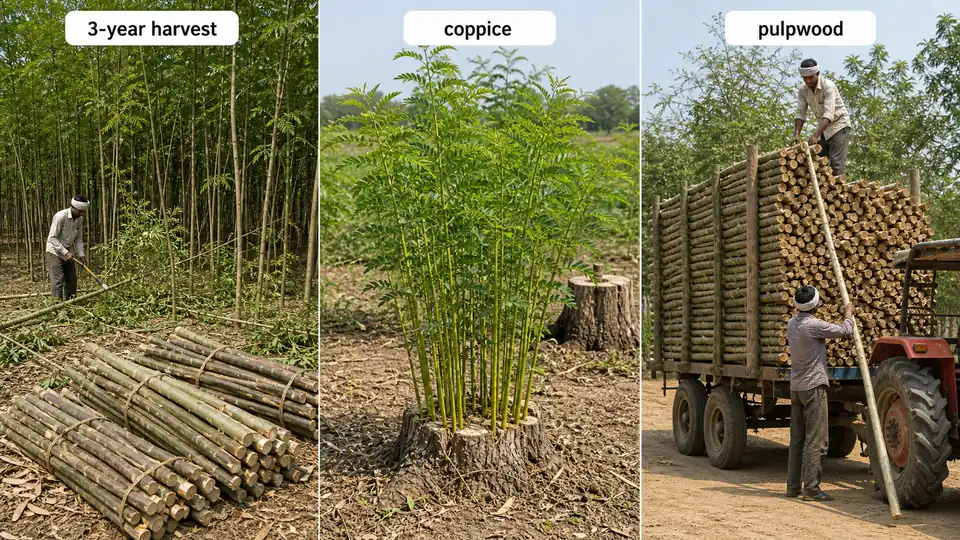
| 1st rotation (3 years) | 35–70 MT | ₹2,400 | ₹84,000–1,68,000 |
| 2nd coppice | 70 MT avg | ₹2,400 | ₹1,68,000 |
| 3rd coppice | 70 MT avg | ₹2,400 | ₹1,68,000 |
| Stump removal after 3 rotations | — | ₹350–400/MT (fuelwood) | Variable |
The NABARD model uses 70 MT/ha as average yield (1st rotation) at ₹2,400/MT for pulpwood.
Financial Viability (Model A):
| Indicator | Value |
|---|---|
| IRR | 29.20% |
| Expected yield (1st rotation) | 35 MT/ha |
| Bank loan | ₹62,000/ha |
Irrigation Requirements
- Irrigation needed in years 1–3 only for pole/timber plantation
- For fodder-based plantation: more frequent irrigation throughout
- After year 3, subabul is largely drought-tolerant
Weeding: Two weeding/soil working operations per year for the first 3 years.
Pests & Diseases
Subabul is generally disease-resistant but susceptible to:
- Jumping plant lice (psyllids) — causes serious defoliation and mortality in some regions; most significant pest
- Gummosis — caused by Fusarium or Phytophthora; likely in waterlogged conditions
- Leaf spot fungus — defoliation under wet conditions
NOTE
Psyllids (jumping plant lice) are the most serious pest of subabul globally. This is a direct MCQ fact. The psyllid problem was severe enough in parts of Southeast Asia that it prompted breeding of psyllid-resistant varieties of Leucaena.
Market & Industrial Linkages
Subabul wood serves as raw material (pulpwood) for paper mills. Major consumers:
- ITC Limited (Bhadrachalam paper mill, Andhra Pradesh/Telangana)
- TNPL (Tamil Nadu Newsprint and Papers Limited)
- JK Paper, West Coast Paper — all source raw material from farm forestry
The proximity to a paper mill is the critical location factor for subabul viability — typically within 100–150 km transport radius to keep transport costs below ₹300/MT.
Lending Terms
- Loan type: Term loan under farm forestry
- Repayment: First instalment due after year 3 harvest
- Margin: 10% of unit cost (₹7,000/ha)
- Security: Hypothecation of standing crop + land mortgage
- Priority sector: Agriculture and allied activities
- Subsidy: State forestry departments sometimes provide subsidised planting material for Leucaena
Sources & References
Primary source for this lesson is NABARD's official Model Bankable Projects portal.[1] Lesson-specific report copy used for this topic.[2]
References
2 sources • [1] [2]
References
Used for: Official NABARD portal for model bankable project documents and updates.
Used for: Reference copy used in this lesson for project parameters and worked figures.
The figures in this lesson reflect the cost norms and technical parameters as published in the NABARD document. Actual costs may vary by state, season, and year of implementation. Always refer to the latest NABARD circular for current norms.
Summary Cheat Sheet
| Concept / Topic | Key Details / Explanation |
|---|---|
| Scientific name | Leucaena leucocephala — direct MCQ target |
| Common names | Subabul, Lead tree, White Popinac |
| Family | Mimosaceae (Fabaceae sub-family Mimosoideae) |
| Key property | Nitrogen-fixing legume — root nodules fix 100–300 kg N/ha/year |
| Spacing | 1.27 m × 1.27 m = 6,200 plants/ha (highest density of all NABARD forestry models) |
| 1st harvest rotation | 3 years — shortest of all NABARD forestry species |
| Coppice | 3 rotations from same stump (3 × ~5 years) |
| Economic life | 15 years (3 rotations) |
| Mortality replacement | 10% |
| Total Unit Cost (capitalised) | ₹69,000/ha |
| Bank Loan | 90% = ₹62,000/ha |
| Margin Money | 10% = ₹7,000/ha |
| Interest rate | 12% per annum |
| Repayment | First instalment after year-3 harvest |
| Yield (1st rotation) | 35–70 MT/ha (model uses 70 MT/ha average) |
| Pulpwood price | ₹2,400/MT |
| Stump/fuelwood price | ₹350–400/MT (after final rotation) |
| IRR | 29.20% |
| Key pest | Psyllids (jumping plant lice) — most serious pest globally; causes defoliation and mortality |
| Key end use | Pulpwood for paper mills (ITC Bhadrachalam, TNPL, JK Paper, West Coast Paper) |
| Location factor | Must be within 100–150 km of paper mill to keep transport cost below ₹300/MT |
| Irrigation | Needed in years 1–3 only; drought-tolerant thereafter |
| Rotation comparison | Subabul 3 yr < Bamboo 3–5 yr < Eucalyptus 5 yr < Poplar 6 yr |
| Priority sector | Agriculture and allied activities; NABARD refinance available |
Lesson Doubts
Ask questions, get expert answers