🥜 Cashewnut Cultivation — NABARD Model Bankable Scheme (1.0 ha)
Cashew is India's third-largest foreign exchange earner in agriculture after tea and coffee. This lesson covers the NABARD model project for 1-hectare cashew cultivation, including variety selection, spacing, cost of cultivation, income, and loan parameters critical for exams.
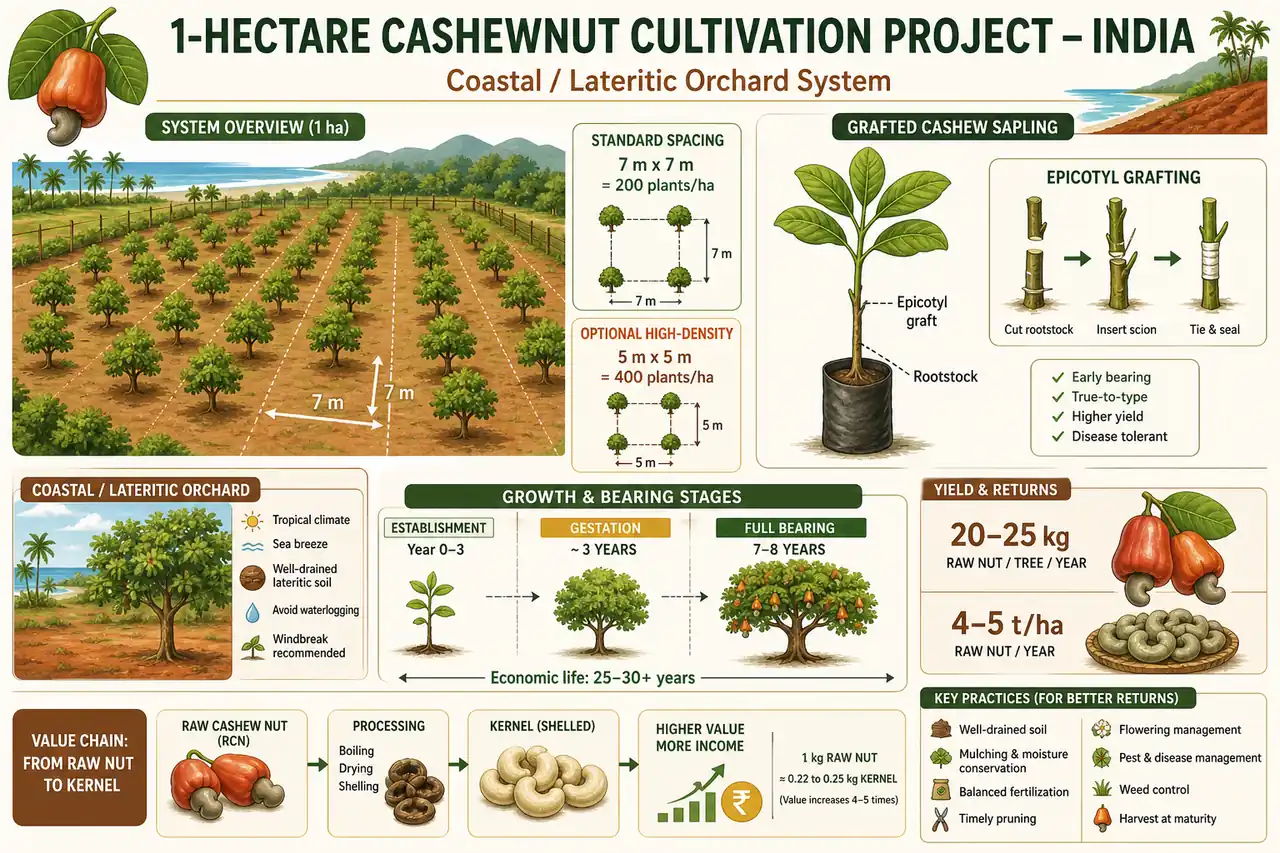
Cashew, native to Brazil, was introduced to India in the 16th century for afforestation. Today it is India's third largest foreign exchange earner in agriculture — after tea and coffee — and an important livelihood crop for coastal small farmers.
- India's cashew area: 9.53 lakh hectares (2010–11)
- India's production: 6.74 lakh tonnes of raw cashew nuts annually
- Global rank: 3rd largest producer and exporter (after Vietnam and Nigeria)
- India is the 2nd largest consumer and biggest processor with highest global acreage
NOTE
Exam trap: India is the 3rd largest producer of cashew (not 1st or 2nd). Vietnam and Nigeria lead. But India is the biggest processor globally — most cashew processing happens here.
Agro-Climatic Requirements
States: Andhra Pradesh, Goa, Karnataka, Kerala, Maharashtra, Orissa, Tamil Nadu, West Bengal (primary); also Assam, Chhattisgarh, Meghalaya, Nagaland, Tripura
Pro Content Locked
Upgrade to Pro to access this lesson and all other premium content.
₹99 charged monthly · Cancel anytime
- All Agriculture & Banking Courses
- AI Lesson Questions (100/day)
- AI Doubt Solver (50/day)
- Glows & Grows Feedback (30/day)
- AI Section Quiz (20/day)
- 22-Language Translation (100/day)
- Recall Questions (20/day)
- AI Quiz (15/day)
- AI Quiz Paper Analysis (100/day)
- AI Step-by-Step Explanations (100/day)
- Spaced Repetition Recall (FSRS)
- AI Tutor
- Immersive Text Questions
- Audio Lessons — Hindi & English
- Mock Tests & Previous Year Papers
- Summary & Mind Maps
- XP, Levels, Leaderboard & Badges
- Generate New Classrooms
- Voice AI Teacher (AgriDots Live)
- AI Revision Assistant
- Knowledge Gap Analysis
- Interactive Revision (LangGraph)
🔒 Secure via Razorpay · Cancel anytime · No hidden fees
Cashew, native to Brazil, was introduced to India in the 16th century for afforestation. Today it is India's third largest foreign exchange earner in agriculture — after tea and coffee — and an important livelihood crop for coastal small farmers.
- India's cashew area: 9.53 lakh hectares (2010–11)
- India's production: 6.74 lakh tonnes of raw cashew nuts annually
- Global rank: 3rd largest producer and exporter (after Vietnam and Nigeria)
- India is the 2nd largest consumer and biggest processor with highest global acreage
NOTE
Exam trap: India is the 3rd largest producer of cashew (not 1st or 2nd). Vietnam and Nigeria lead. But India is the biggest processor globally — most cashew processing happens here.
Agro-Climatic Requirements
States: Andhra Pradesh, Goa, Karnataka, Kerala, Maharashtra, Orissa, Tamil Nadu, West Bengal (primary); also Assam, Chhattisgarh, Meghalaya, Nagaland, Tripura
| Requirement | Optimum |
|---|---|
| Temperature | 20–30°C; above 36°C during flowering harms fruit set |
| Rainfall | 1000–2000 mm/year; needs dry season of ≥4 months |
| Altitude | Up to 700 m MSL |
| Soil | Deep, well-drained sandy loam, lateritic soils; pH < 8.0 |
Key soil fact: Cashew can grow on poor soils but thrives on deep sandy loams. Heavy clay, waterlogged, and highly alkaline (pH > 8.0) soils must be avoided.
Varieties and Planting
Propagation: Vegetative propagation only — epicotyl grafting and softwood grafting (seedlings show wide variation; grafts ensure uniformity).
| State | Recommended Varieties |
|---|---|
| Andhra Pradesh | BPP 4, BPP 6, BPP 8 |
| Karnataka | Chintamani 1 & 2, Ullal 1/3/4, Vengurla 4 & 7 |
| Kerala | Dhana, Madakkathara 1 & 2, Kanaka, Amrutha |
| Maharashtra | Vengurla 1, 4, 6, 7 |
| Tamil Nadu | VRI 1, VRI 5 |
Spacing and Density:
- Standard spacing: 7 m × 7 m (200 plants/ha) or 8 m × 8 m (156 plants/ha)
- Improved HDP (High Density Planting): 5 m × 5 m (400 plants/ha) with inter-cropping in early years
Pit size: 60 cm × 60 cm × 60 cm; filled with topsoil + compost before planting
Cost of Cultivation (1.0 ha)
Year-wise Investment:
| Year | Activity | Cost (₹) |
|---|---|---|
| Year 1 | Land prep, pits, planting material (200 grafts @ ₹25), manures, labour | ₹15,000–18,000 |
| Year 2–3 | Weeding, fertilizers, plant protection | ₹8,000–10,000/year |
| Year 4 onwards | Harvesting, processing, recurring inputs | ₹12,000–15,000/year |
| Total Investment (7 years) | ₹60,000–75,000 |
Project Cost Summary:
| Item | ₹ |
|---|---|
| Capital cost (land dev + planting) | 20,000 |
| Working capital (recurring 7 yrs) | 50,000 |
| Total Project Cost | ₹70,000 (approx) |
| Bank loan (85%) | ₹59,500 |
| Margin money (15%) | ₹10,500 |
Income and Financial Viability
Yield profile:
- Gestation period: 3 years (first bearing)
- Full bearing: from 7–8 years
- Yield per plant (full bearing, improved variety): 20–25 kg nuts/tree
- Yield per hectare (200 plants): 4,000–5,000 kg raw nuts
Income calculation:
| Item | Value |
|---|---|
| Yield at full bearing | 4,000 kg/ha |
| Farm gate price | ₹60–80/kg (raw cashew) |
| Gross Income | ₹2.40–3.20 lakh/ha/year |
| Annual operating cost | ₹0.50–0.60 lakh |
| Net Income | ₹1.80–2.60 lakh/ha/year |
NOTE
Cashew apple (the false fruit) is also commercially valuable — used for juice, feni (Goa), and jam. But the kernel (nut) accounts for 90% of commercial value. The cashew nut is technically the seed, not a true nut.
Repayment: Loan repaid over 7–9 years with moratorium of 3 years (matching gestation period).
Exam Summary
| Parameter | Value |
|---|---|
| India's global rank (production) | 3rd (Vietnam, Nigeria ahead) |
| India's global rank (processing) | 1st (biggest processor) |
| India's cashew area | 9.53 lakh ha |
| Spacing (standard) | 7m × 7m (200 plants/ha) |
| Yield (full bearing) | 20–25 kg/plant; 4–5 t/ha |
| Gestation period | 3 years |
| Full bearing age | 7–8 years |
| Loan component | 85% |
| Moratorium | 3 years |
| Key propagation method | Epicotyl / softwood grafting |
| Best soil | Sandy loam, laterite, pH < 8.0 |
Sources & References
Primary source for this lesson is NABARD's official Model Bankable Projects portal.[1] Lesson-specific report copy used for this topic.[2]
References
2 sources • [1] [2]
References
Used for: Official NABARD portal for model bankable project documents and updates.
Used for: Reference copy used in this lesson for project parameters and worked figures.
The figures in this lesson reflect the cost norms and technical parameters as published in the NABARD document. Actual costs may vary by state, season, and year of implementation. Always refer to the latest NABARD circular for current norms.
Summary Cheat Sheet
| Concept / Topic | Key Details / Explanation |
|---|---|
| Scientific name | Anacardium occidentale; native to Brazil; introduced to India in 16th century |
| Foreign exchange rank | India's 3rd largest agri forex earner (after tea and coffee) |
| India's global rank | 3rd largest producer (Vietnam 1st, Nigeria 2nd); 1st largest processor globally |
| India's area | 9.53 lakh ha (2010–11) |
| India's production | 6.74 lakh tonnes raw cashew nuts/year |
| Primary states | AP, Goa, Karnataka, Kerala, Maharashtra, Odisha, Tamil Nadu, West Bengal |
| Temperature | 20–30°C; above 36°C during flowering harms fruit set |
| Rainfall | 1,000–2,000 mm/year with dry season ≥4 months |
| Soil | Deep, well-drained sandy loam / lateritic; pH < 8.0 |
| Propagation | Epicotyl grafting and softwood grafting (NOT seeds — wide variation) |
| Standard spacing | 7 m × 7 m = 200 plants/ha |
| HDP spacing | 5 m × 5 m = 400 plants/ha |
| Pit size | 60 cm × 60 cm × 60 cm |
| Gestation period | 3 years (first bearing) |
| Full bearing age | 7–8 years |
| Yield (full bearing) | 20–25 kg/plant; 4,000–5,000 kg raw nuts/ha |
| Farm gate price | ₹60–80/kg (raw cashew) |
| Gross income | ₹2.40–3.20 lakh/ha/year |
| Net income | ₹1.80–2.60 lakh/ha/year |
| Total project cost (7 yr) | ₹70,000/ha (approx) |
| Bank loan | 85% = ₹59,500 |
| Margin money | 15% = ₹10,500 |
| Moratorium | 3 years (matching gestation) |
| Repayment | 7–9 years |
| Cashew apple | False fruit; used for juice, feni (Goa), jam — but kernel = 90% commercial value |
| Kernel outturn | ~30% of raw cashew weight |
| Key exam trap | India is 3rd producer (NOT 1st); but 1st processor globally |
Lesson Doubts
Ask questions, get expert answers