🌱 High Tech Nursery — NABARD Model Bankable Project
Covers the NABARD model scheme for establishing a modern commercial nursery producing quality grafted planting material for perennial horticulture crops. Exam-critical numbers on unit cost, loan structure, IRR, and repayment are tested frequently in exams and exams.
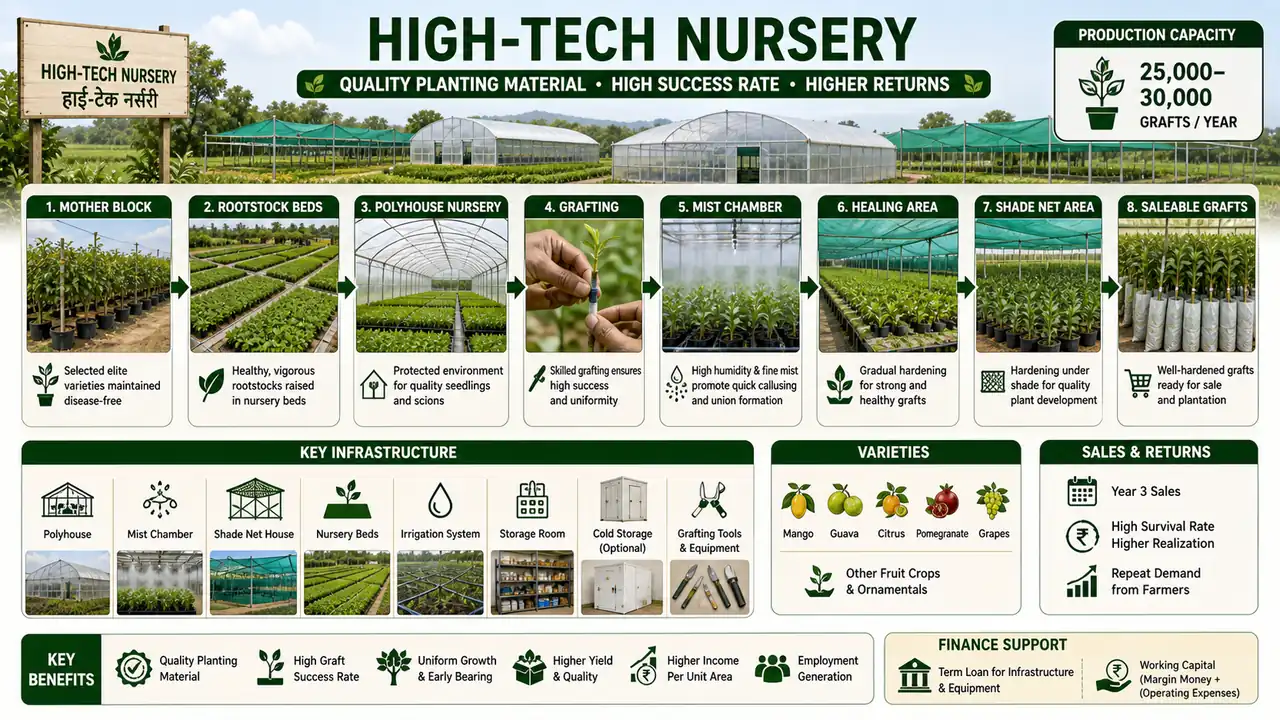
What is a High-Tech Nursery?
A commercial nursery unit produces certified, grafted planting material of perennial horticulture crops — mango, guava, pomegranate, sapota, aonla, citrus, cashew, coconut, etc. The NABARD model scheme addresses the gap between government nursery supply and actual farmer demand.
Why it matters for exams: India's horticulture expansion depends entirely on availability of quality, disease-free planting material. Understanding this model helps you answer questions on agri-financing patterns.
Project Size and Area Requirements
| Component | Specification |
|---|---|
| Total area | ~2 acres (7,550 sq m) |
| Mother plant garden | 6,000 sq m (1,500 plants @ 2m × 2m) |
| Rootstock nursery beds | 700 sq m (50 beds of 10m × 1.25m) |
| Poly house (10,000 grafts) | 200 sq m |
| Mist chamber | 20 sq m |
| Shade net area (10,000 plants) | 500 sq m |
| Store/utility area | 130 sq m |
NOTE
Pro Content Locked
Upgrade to Pro to access this lesson and all other premium content.
₹99 charged monthly · Cancel anytime
- All Agriculture & Banking Courses
- AI Lesson Questions (100/day)
- AI Doubt Solver (50/day)
- Glows & Grows Feedback (30/day)
- AI Section Quiz (20/day)
- 22-Language Translation (100/day)
- Recall Questions (20/day)
- AI Quiz (15/day)
- AI Quiz Paper Analysis (100/day)
- AI Step-by-Step Explanations (100/day)
- Spaced Repetition Recall (FSRS)
- AI Tutor
- Immersive Text Questions
- Audio Lessons — Hindi & English
- Mock Tests & Previous Year Papers
- Summary & Mind Maps
- XP, Levels, Leaderboard & Badges
- Generate New Classrooms
- Voice AI Teacher (AgriDots Live)
- AI Revision Assistant
- Knowledge Gap Analysis
- Interactive Revision (LangGraph)
🔒 Secure via Razorpay · Cancel anytime · No hidden fees
What is a High-Tech Nursery?
A commercial nursery unit produces certified, grafted planting material of perennial horticulture crops — mango, guava, pomegranate, sapota, aonla, citrus, cashew, coconut, etc. The NABARD model scheme addresses the gap between government nursery supply and actual farmer demand.
Why it matters for exams: India's horticulture expansion depends entirely on availability of quality, disease-free planting material. Understanding this model helps you answer questions on agri-financing patterns.
Project Size and Area Requirements
| Component | Specification |
|---|---|
| Total area | ~2 acres (7,550 sq m) |
| Mother plant garden | 6,000 sq m (1,500 plants @ 2m × 2m) |
| Rootstock nursery beds | 700 sq m (50 beds of 10m × 1.25m) |
| Poly house (10,000 grafts) | 200 sq m |
| Mist chamber | 20 sq m |
| Shade net area (10,000 plants) | 500 sq m |
| Store/utility area | 130 sq m |
NOTE
The nursery produces 25,000–30,000 grafts per year once fully stabilised (from Year 5). Saleable grafts start only from Year 3 — this long gestation is the key reason costs for Years 1–3 are capitalised.
Capital Cost Structure
| Year | Cost (₹) |
|---|---|
| Year 1 (capital items + ops) | 12,59,300 |
| Year 2 (operational) | 2,08,400 |
| Year 3 (operational) | 3,07,800 |
| Total capitalised unit cost | ₹17,75,500 |
Major Year 1 items:
- Shade net area (500 sq m) — ₹3,55,000
- Store room (50 sq m) — ₹2,50,000
- Poly house (200 sq m) — ₹1,86,000
- Mother plants (1,500 @ ₹75) — ₹1,12,500
- Water storage tank (10,000 L) — ₹75,000
- Drip irrigation — ₹40,000
- Fencing (450 running metres) — ₹33,750
Financing Pattern
| Source | Amount (₹) | % |
|---|---|---|
| Margin money (borrower) | 4,44,500 | 25% |
| Bank loan | ₹13,31,000 | 75% |
| Total | ₹17,75,500 | 100% |
- Rate of interest: 13%
- Subsidy (if available) counted towards margin money
Production & Income Ramp-Up
| Year | Scions/Plant | Grafts Made | Saleable Grafts | Sale Price/Graft | Income from Grafts |
|---|---|---|---|---|---|
| 2 | 8 | 12,000 | — | — | — |
| 3 | 15 | 22,500 | 9,600 | ₹35 | ₹3,36,000 |
| 4 | 25 | 37,500 | 18,000 | ₹35 | ₹6,30,000 |
| 5+ | 25 | 37,500 | 30,000 | ₹40 | ₹12,00,000 |
Survival/success rate assumed at 80%. Additional income from vegetable/flower nursery in poly house/shade net during intervening periods = ₹1,50,000/year.
NOTE
Exam trap: Saleable grafts in Year 3 are only 9,600 (not 22,500) because grafting was done in Year 2, with an 80% success rate. The 30,000 target stabilises from Year 5, not Year 3.
Key Financial Indicators
| Indicator | Value |
|---|---|
| Net Present Worth (NPW) | ₹13,96,817 |
| Benefit Cost Ratio (BCR) | 1.38 : 1 |
| Internal Rate of Return (IRR) | 30% |
The IRR of 30% indicates a financially viable and bankable investment.
Repayment Schedule
- Total bank loan: ₹13,31,000 (phased over 3 years)
- Repayment period: 9 years including 5 years grace period
- Deferred interest during Years 1–2 is recovered from Years 3–5
- Interest deferred for 2 years and repaid from Year 3 surplus
Propagation Methods by Crop
| Crop | Method |
|---|---|
| Mango | Stone grafting, softwood grafting, veneer grafting |
| Guava | Layering |
| Pomegranate | Air layering, stem cutting |
| Cashew nut | Softwood grafting, epicotyl grafting |
| Citrus | Budding |
| Sapota | Softwood grafting, approach grafting |
| Aonla | Layering |
| Ber | Budding/grafting |
Linked Schemes & Linkages
- NHM (National Horticulture Mission) — subsidy for quality planting material
- AC/ABC scheme — preference to Agriculture Graduates
- State Horticulture Departments / KVKs — technical support, skill building
- NABARD refinance — available to financing banks under normal refinance programme
NOTE
Nursery regulation varies by state. Entrepreneurs must comply with state-specific nursery regulations, and banks may stipulate this as a loan condition.
Sources & References
Primary source for this lesson is NABARD's official Model Bankable Projects portal.[1] Lesson-specific report copy used for this topic.[2]
References
2 sources • [1] [2]
References
Used for: Official NABARD portal for model bankable project documents and updates.
Used for: Reference copy used in this lesson for project parameters and worked figures.
The figures in this lesson reflect the cost norms and technical parameters as published in the NABARD document. Actual costs may vary by state, season, and year of implementation. Always refer to the latest NABARD circular for current norms.
Summary Cheat Sheet
| Concept / Topic | Key Details / Explanation |
|---|---|
| Purpose | Produces certified, grafted planting material for perennial horticulture crops (mango, guava, pomegranate, cashew, citrus, etc.) |
| Total area | ~2 acres (7,550 sq m) |
| Mother plant garden | 6,000 sq m (1,500 plants @ 2m × 2m) |
| Rootstock nursery beds | 700 sq m (50 beds of 10m × 1.25m) |
| Poly house | 200 sq m (10,000 grafts) |
| Shade net area | 500 sq m (10,000 plants) |
| Graft success rate | 80% assumed |
| First saleable year | Year 3 (grafted in Year 2 → 80% success = 9,600 saleable) |
| Full production from | Year 5 — 30,000 grafts/year |
| Sale price (Year 3–4) | ₹35/graft |
| Sale price (Year 5+) | ₹40/graft |
| Additional income | ₹1,50,000/year from vegetable/flower nursery in poly house/shade net |
| Year 1 cost | ₹12,59,300 |
| Year 2 cost | ₹2,08,400 |
| Year 3 cost | ₹3,07,800 |
| Total capitalised unit cost | ₹17,75,500 |
| Margin money | 25% = ₹4,44,500 |
| Bank loan | 75% = ₹13,31,000 |
| Interest rate | 13% |
| Repayment period | 9 years with 5-year grace period |
| IRR | 30% |
| BCR | 1.38:1 |
| NPW | ₹13,96,817 |
| Propagation — Mango | Stone grafting, softwood grafting, veneer grafting |
| Propagation — Cashew | Softwood grafting, epicotyl grafting |
| Propagation — Citrus | Budding |
| Propagation — Guava / Aonla | Layering |
| Propagation — Pomegranate | Air layering, stem cutting |
| Key linked scheme | NHM (National Horticulture Mission) — subsidy for quality planting material |
Lesson Doubts
Ask questions, get expert answers