🧅 Onion Storage Structure — NABARD Model Bankable Project
Covers the NABARD model bankable project for a 25 MT onion storage godown — construction cost, subsidy pattern, financial ratios, and storage science. Onion price volatility, storage losses, and NABARD's nodal role are key exam areas in exams and exams.
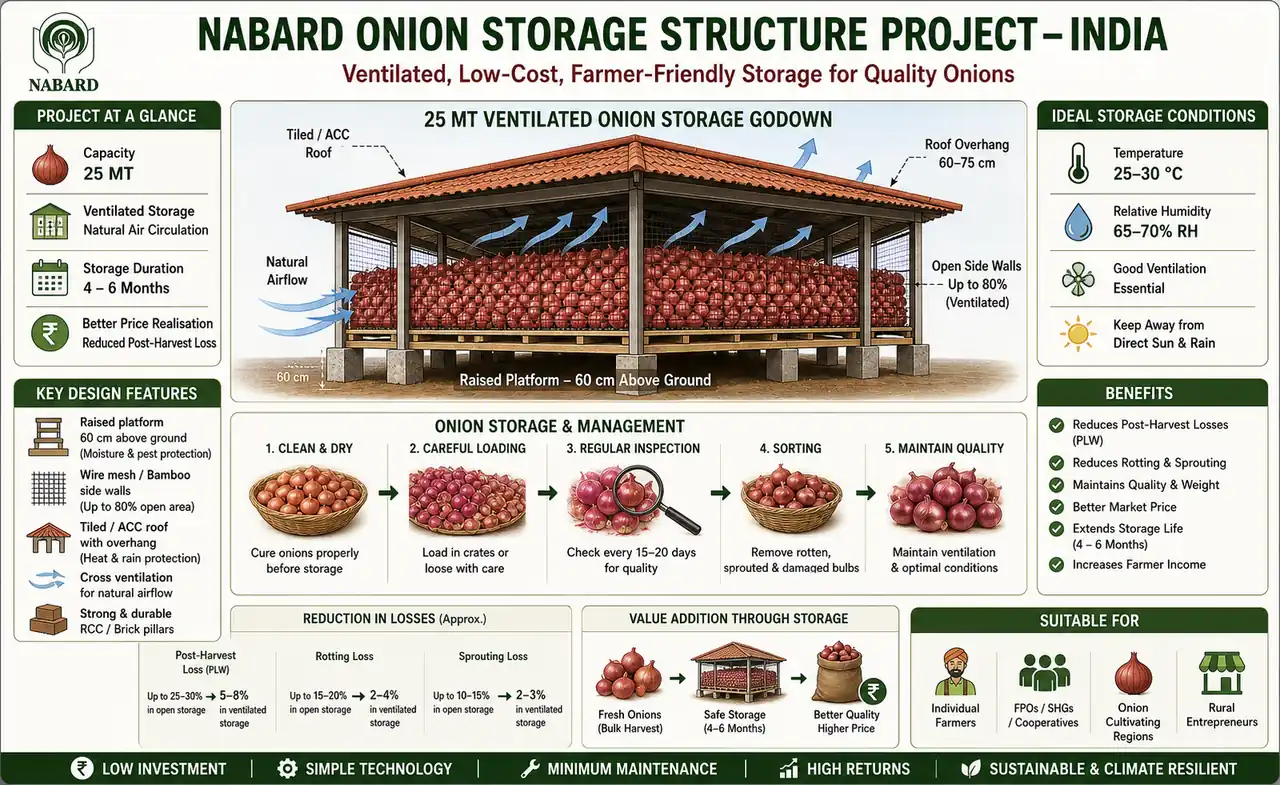
India's Onion Storage Problem
India is the 2nd largest onion producer globally (after China), accounting for:
- 16% of global area under onion
- 10% of global production
- Current production: ~4.7 million tonnes (2013–14)
Despite high production, lack of proper storage causes severe price volatility. Distress sales at harvest and shortages later are a direct consequence.
NOTE
Exam context: The onion price crisis (price crashing at harvest, spiking later) is directly linked to inadequate storage. This model was created to address exactly that structural gap.
Storage Losses in Onion
Losses during storage can be 50–90% depending on genotype and conditions:
| Loss Type | Percentage |
|---|---|
| Physiological loss in weight (PLW — moisture/shrinkage) | 30–40% |
| Rotting (peak in June–July) | 20–30% |
| Sprouting (end of storage) | 20–40% |
Why losses happen: Rotting peaks in June–July due to high temperature + high humidity. Sprouting increases with poor dormancy, thick-necked varieties, and dark red/white onion cultivars (more susceptible than light red).
Pro Content Locked
Upgrade to Pro to access this lesson and all other premium content.
₹99 charged monthly · Cancel anytime
- All Agriculture & Banking Courses
- AI Lesson Questions (100/day)
- AI Doubt Solver (50/day)
- Glows & Grows Feedback (30/day)
- AI Section Quiz (20/day)
- 22-Language Translation (100/day)
- Recall Questions (20/day)
- AI Quiz (15/day)
- AI Quiz Paper Analysis (100/day)
- AI Step-by-Step Explanations (100/day)
- Spaced Repetition Recall (FSRS)
- AI Tutor
- Immersive Text Questions
- Audio Lessons — Hindi & English
- Mock Tests & Previous Year Papers
- Summary & Mind Maps
- XP, Levels, Leaderboard & Badges
- Generate New Classrooms
- Voice AI Teacher (AgriDots Live)
- AI Revision Assistant
- Knowledge Gap Analysis
- Interactive Revision (LangGraph)
🔒 Secure via Razorpay · Cancel anytime · No hidden fees
India's Onion Storage Problem
India is the 2nd largest onion producer globally (after China), accounting for:
- 16% of global area under onion
- 10% of global production
- Current production: ~4.7 million tonnes (2013–14)
Despite high production, lack of proper storage causes severe price volatility. Distress sales at harvest and shortages later are a direct consequence.
NOTE
Exam context: The onion price crisis (price crashing at harvest, spiking later) is directly linked to inadequate storage. This model was created to address exactly that structural gap.
Storage Losses in Onion
Losses during storage can be 50–90% depending on genotype and conditions:
| Loss Type | Percentage |
|---|---|
| Physiological loss in weight (PLW — moisture/shrinkage) | 30–40% |
| Rotting (peak in June–July) | 20–30% |
| Sprouting (end of storage) | 20–40% |
Why losses happen: Rotting peaks in June–July due to high temperature + high humidity. Sprouting increases with poor dormancy, thick-necked varieties, and dark red/white onion cultivars (more susceptible than light red).
Optimal Storage Conditions
| Parameter | Required Value |
|---|---|
| Temperature | 25°C to 30°C |
| Relative humidity | 65% to 70% |
| Ventilation type | Natural (most economical in India) |
| Storage orientation | North–South (length facing East–West) |
| Platform clearance from ground | 60 cm |
| Platform storage height | 90–150 cm |
Cold storage is not used in India for onion due to poor economics and lack of cold chain infrastructure.
Structure Design — 25 MT Godown
| Parameter | Specification |
|---|---|
| Total land requirement | 6.5 m × 7.0 m |
| Storage space | 4.5 m × 6.0 m |
| Roof type | Mangalore tiles or ACC sheets (NOT corrugated GI — causes heat build-up) |
| Side walls | Chain link (GI wire) or half-split bamboo on MS angle frame |
| Side opening | Up to 80% (for ventilation) |
| Minimum overhang | 1.5 m (windward), 0.5 m (other sides) |
| Construction cost | ₹1,00,000 (@ ₹4,000/MT for 25 MT) |
NOTE
Exam trap: The construction cost range is ₹1,500–4,000/MT. The NABARD model assumes ₹4,000/MT (higher end) for working out economics conservatively. Some questions cite ₹3,000–4,000 range as the average.
Key Storage Practices (Dos and Don'ts)
| DO | DON'T |
|---|---|
| Provide bottom + side natural ventilation | Obstruct natural ventilation |
| Orient structure to face windward direction | Build along wind direction |
| Close leeward side below platform | Use corrugated GI sheets for roof |
| Provide adequate overhang (1.5m windward) | Build wider than 610 cm for natural ventilation |
| Sort onions every 30 days to remove rotten stock | Keep tall structures within 1.5× height of godown |
Techno-Financial Parameters
| Parameter | Value |
|---|---|
| Capacity | 25 MT |
| Capacity utilization | 100% |
| Weight loss (0–3 months) | 12.5% |
| Weight loss (3–6 months) | 12.5% |
| Onions sold at harvest price | 50% of stock |
| Onions sold after 3 months | 50% of stock |
| Structure life | 15 years |
Sale Prices:
| Stage | Price (₹/kg) |
|---|---|
| At harvest | 15.00 |
| Up to 3 months | 22.00 |
| 3–6 months | 24.00 |
Financial Viability — 25 MT Onion Storage
| Indicator | Value |
|---|---|
| Unit cost | ₹1,00,000 |
| Margin money | 25% = ₹25,000 |
| Bank loan | 75% = ₹75,000 |
| Rate of interest | 14% |
| Annual benefit (incremental) | ₹1,25,000/year |
| Annual recurring cost | ₹75,000/year |
| Net benefit | ₹36,000/year |
| NPW @ 15% DF | ₹33,000 |
| BCR | 1.308 : 1 |
| IRR | 36.53% |
| Average DSCR | 1.72 : 1 |
NOTE
Exam trap: The model Annexure II shows a different IRR (56.16%) — this is the raw calculation without properly accounting for the interest cost. The text of the scheme states IRR = 36.53%. Use 36.53% for exam answers.
Repayment Schedule
| Year | Loan O/S (Start) | Net Surplus | Interest @ 14% | Principal | Total Outgo | DSCR |
|---|---|---|---|---|---|---|
| 1 | 75,000 | 36,000 | 10,500 | 15,000 | 25,500 | 1.41 |
| 2 | 60,000 | 36,000 | 8,400 | 15,000 | 23,400 | 1.54 |
| 3 | 45,000 | 36,000 | 6,300 | 15,000 | 21,300 | 1.69 |
| 4 | 30,000 | 36,000 | 4,200 | 15,000 | 19,200 | 1.88 |
| 5 | 15,000 | 36,000 | 2,100 | 15,000 | 17,100 | 2.11 |
- Repayment: 5 years, no grace period
- Average DSCR of 1.72:1 indicates comfortable repayment capacity
Subsidy and NABARD's Role
- Capital Investment Subsidy (GoI): 25% of investment cost, subject to maximum of ₹500/tonne
- NABARD is the nodal agency for routing this subsidy through the credit delivery system
- Target capacity created: 4.5 lakh tonnes during 1999–2001
- NABARD provides refinance to eligible banks for onion storage under normal refinance programme
Promoter Eligibility
Eligible promoters: individuals, groups, cooperative societies, proprietary/partnership firms, joint sector companies (public or private sector).
Storage potential: If 40% of total production is earmarked for scientific storage, potential new storage = 12.6 lakh tonnes.
Sources & References
Primary source for this lesson is NABARD's official Model Bankable Projects portal.[1] Lesson-specific report copy used for this topic.[2]
References
2 sources • [1] [2]
References
Used for: Official NABARD portal for model bankable project documents and updates.
Used for: Reference copy used in this lesson for project parameters and worked figures.
The figures in this lesson reflect the cost norms and technical parameters as published in the NABARD document. Actual costs may vary by state, season, and year of implementation. Always refer to the latest NABARD circular for current norms.
Summary Cheat Sheet
| Concept / Topic | Key Details / Explanation |
|---|---|
| India's onion rank | 2nd largest producer globally (after China); 16% of global area, 10% of global production |
| Capacity of NABARD model | 25 MT godown |
| Storage losses — PLW | Physiological loss in weight (moisture/shrinkage): 30–40% |
| Storage losses — rotting | 20–30% (peaks June–July due to high temp + humidity) |
| Storage losses — sprouting | 20–40% (end of storage period) |
| Optimal temperature | 25–30°C |
| Optimal relative humidity | 65–70% |
| Ventilation type | Natural (no HVAC; cold storage not economic in India for onion) |
| Structure orientation | North–South (length facing East–West) |
| Platform clearance | 60 cm from ground |
| Platform storage height | 90–150 cm |
| Side opening | Up to 80% for ventilation |
| Roof type | Mangalore tiles or ACC sheets (NOT corrugated GI — causes heat build-up) |
| Minimum overhang | 1.5 m windward, 0.5 m other sides |
| Unit cost | ₹1,00,000 (@ ₹4,000/MT for 25 MT) |
| Cost range | ₹1,500–4,000/MT; NABARD model uses ₹4,000/MT (conservative) |
| Margin money | 25% = ₹25,000 |
| Bank loan | 75% = ₹75,000 |
| Interest rate | 14% |
| Structure life | 15 years |
| Repayment | 5 years, no grace period; ₹15,000 principal/year |
| IRR | 36.53% (NOT 56.16% — that is the unadjusted Annexure II figure) |
| BCR | 1.308:1 |
| Average DSCR | 1.72:1 |
| NPW @ 15% | ₹33,000 |
| Net benefit/year | ₹36,000 |
| Sale prices | At harvest: ₹15/kg; up to 3 months: ₹22/kg; 3–6 months: ₹24/kg |
| Weight loss assumption | 12.5% in 0–3 months + 12.5% in 3–6 months |
| Govt subsidy | 25% of investment cost, max ₹500/tonne (GoI Capital Investment Subsidy) |
| NABARD role | Nodal agency for routing subsidy through credit delivery system |
| Sorting practice | Remove rotten onions every 30 days |
Lesson Doubts
Ask questions, get expert answers