🚜 Custom Hiring Centre (CHC) at FPO — NABARD Model Business Activity
NABARD's model for FPO-operated Custom Hiring Centres providing tractors, harvesters, and implements to small farmers at affordable rental. Covers objectives, equipment list, cost structure, and lending terms for exams farm mechanisation questions.
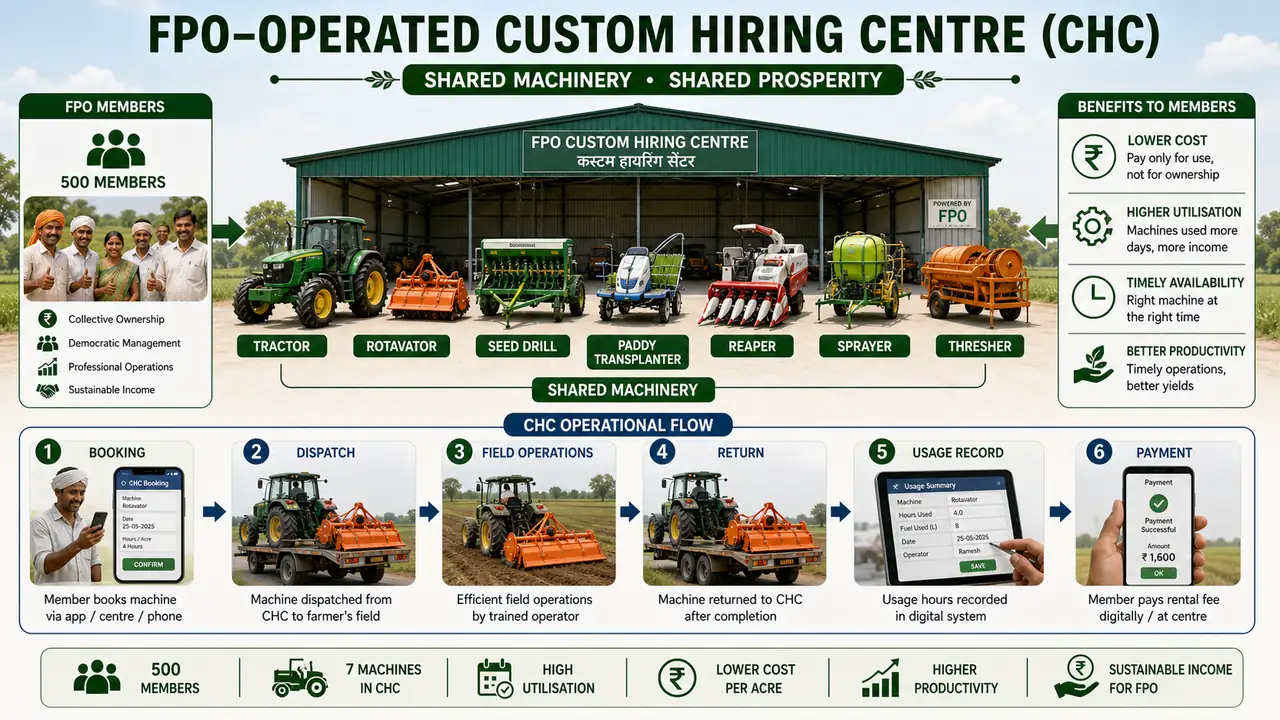
85% of India's agricultural landholdings belong to small and marginal farmers — yet farm power availability for these holdings is the lowest in the country. Modern agricultural machinery (tractors, combine harvesters, laser levellers, paddy transplanters) costs ₹5–50 lakh per unit — impossible for individual small farmers to own. This creates a mechanisation gap that directly reduces productivity and increases drudgery.
Custom Hiring Centres (CHCs) solve this by making expensive machinery available to small farmers at affordable rental rates — transforming ownership economics into sharing economics. FPOs are ideally placed to operate CHCs because they already have farmer membership and trust networks.
Why CHC Through FPO?
| Problem | FPO-CHC Solution |
|---|---|
| High machinery ownership cost | Pool resources across 500 members |
| Seasonal machinery use (only 20–30 days/machine/year for individual farmer) | Shared use maximises utilisation to 150–200 days/year |
| Private hiring at exploitative rates during peak season | FPO hires at cost-based rates (no profit-gouging) |
| No access to crop-specific machines | FPO can invest in specialised equipment (sugarcane harvester, paddy transplanter) |
NOTE
Pro Content Locked
Upgrade to Pro to access this lesson and all other premium content.
₹99 charged monthly · Cancel anytime
- All Agriculture & Banking Courses
- AI Lesson Questions (100/day)
- AI Doubt Solver (50/day)
- Glows & Grows Feedback (30/day)
- AI Section Quiz (20/day)
- 22-Language Translation (100/day)
- Recall Questions (20/day)
- AI Quiz (15/day)
- AI Quiz Paper Analysis (100/day)
- AI Step-by-Step Explanations (100/day)
- Spaced Repetition Recall (FSRS)
- AI Tutor
- Immersive Text Questions
- Audio Lessons — Hindi & English
- Mock Tests & Previous Year Papers
- Summary & Mind Maps
- XP, Levels, Leaderboard & Badges
- Generate New Classrooms
- Voice AI Teacher (AgriDots Live)
- AI Revision Assistant
- Knowledge Gap Analysis
- Interactive Revision (LangGraph)
🔒 Secure via Razorpay · Cancel anytime · No hidden fees
85% of India's agricultural landholdings belong to small and marginal farmers — yet farm power availability for these holdings is the lowest in the country. Modern agricultural machinery (tractors, combine harvesters, laser levellers, paddy transplanters) costs ₹5–50 lakh per unit — impossible for individual small farmers to own. This creates a mechanisation gap that directly reduces productivity and increases drudgery.
Custom Hiring Centres (CHCs) solve this by making expensive machinery available to small farmers at affordable rental rates — transforming ownership economics into sharing economics. FPOs are ideally placed to operate CHCs because they already have farmer membership and trust networks.
Why CHC Through FPO?
| Problem | FPO-CHC Solution |
|---|---|
| High machinery ownership cost | Pool resources across 500 members |
| Seasonal machinery use (only 20–30 days/machine/year for individual farmer) | Shared use maximises utilisation to 150–200 days/year |
| Private hiring at exploitative rates during peak season | FPO hires at cost-based rates (no profit-gouging) |
| No access to crop-specific machines | FPO can invest in specialised equipment (sugarcane harvester, paddy transplanter) |
NOTE
Farm mechanisation level in India is only 40–45 kW/ha compared to 7.5 kW/ha in USA and 6 kW/ha in China (different measure contexts). In terms of farm power: small/marginal holdings have 0.5 kW/ha versus the national average of 2 kW/ha. The CHC model specifically targets this gap. These figures are MCQ targets.
Objectives of CHC at FPO Level
- Provide farm machinery at affordable rent to small and marginal farmers
- Offset adverse economies of scale from high individual ownership costs
- Improve mechanisation in areas with low farm power availability
- Provide hiring services for various agri machinery for different operations
- Expand mechanised activity in small and marginal holdings during peak crop seasons
- Provide access to high-value, crop-specific machines (sugarcane harvester, vegetable planter)
Equipment List — Typical FPO-CHC
A full-service CHC typically includes:
| Category | Equipment |
|---|---|
| Power unit | Tractor (35–50 HP), Power tiller |
| Land preparation | MB plough, disc harrow, rotavator, laser leveller |
| Sowing & planting | Seed drill, paddy transplanter, sugarcane planter |
| Irrigation | Pump set, sprinkler/drip components |
| Harvesting | Combine harvester (self-propelled or tractor-drawn), reaper-binder |
| Post-harvest | Thresher, chaff cutter, mini dal mill, paddy cleaner |
| Crop-specific | Potato planter/harvester, onion harvester, maize sheller |
The actual equipment selection depends on the cropping pattern of the FPO's service area.
Location & Service Area
- CHC should be located at a point convenient to members — ideally equidistant from the villages served
- One CHC typically serves 500 members (same as other FPO models) plus non-member farmers if capacity allows
- Service radius: 5–10 km depending on terrain and road connectivity
- Non-member access: FPO may extend services to non-members to improve utilisation and viability
NOTE
Extending CHC services to non-member farmers is explicitly encouraged by NABARD to improve viability — higher utilisation rates mean better returns on capital investment. However, members should get priority access and lower rates than non-members. This governance principle is tested in FPO management questions.
Capital Cost & Means of Finance
The cost of a CHC varies significantly based on equipment mix. A typical NABARD-modelled CHC:
| Equipment | Approximate Cost (₹ lakh) |
|---|---|
| 45 HP Tractor | 5.00–7.00 |
| Rotavator + disc harrow + MB plough | 1.00–1.50 |
| Seed drill + fertiliser applicator | 0.80–1.20 |
| Paddy transplanter | 1.50–2.50 |
| Straw reaper/binder | 0.80–1.20 |
| Combine harvester (tractor-drawn) | 8.00–12.00 |
| Thresher + cleaner | 0.80–1.00 |
| Sprinkler/micro-irrigation components | 0.50–1.00 |
| Total equipment cost | ₹20–30 lakh (typical) |
Means of Finance:
| Source | Share |
|---|---|
| Promoter/FPO margin | 15–25% |
| Bank term loan | 75–85% |
| SMAM subsidy (see below) | 40–50% (reduces bank loan) |
SMAM Subsidy — Key Scheme for CHC
Sub-Mission on Agricultural Mechanisation (SMAM) under the Ministry of Agriculture & Farmers' Welfare provides:
- 40% subsidy for general category farmers/FPOs
- 50% subsidy for SC/ST/women/small & marginal farmers
This dramatically changes the financial viability:
- A ₹25 lakh CHC with 40% SMAM subsidy → effective cost to FPO = ₹15 lakh
- Bank loan (on post-subsidy cost): ~₹12 lakh (80%)
- FPO margin: ~₹3 lakh
NOTE
SMAM (Sub-Mission on Agricultural Mechanisation) is the primary subsidy scheme for CHC establishment. It replaced the earlier ISAM (Integrated Scheme for Agricultural Mechanisation). MCQs frequently test: SMAM subsidy rates (40%/50%), implementing agency (DAC&FW), and that NABARD provides refinance to banks financing CHCs after SMAM subsidy.
Revenue & Viability
CHC generates revenue through rental charges for machinery. Sample rates:
| Service | Typical Rental Rate |
|---|---|
| Tractor ploughing | ₹700–1,200/hour or ₹800–1,500/acre |
| Combine harvesting | ₹1,500–2,500/acre |
| Paddy transplanting | ₹1,000–1,500/acre |
| Rotavation | ₹600–900/acre |
| Threshing | ₹200–400/quintal |
With 150–200 machine-days/year at average ₹2,000–3,000/day, a well-managed CHC can generate ₹3–6 lakh/year gross revenue from equipment alone.
Financial Viability Indicators
| Indicator | Typical Range |
|---|---|
| IRR | 15–25% (post-SMAM subsidy) |
| Payback period | 4–6 years |
| DSCR | > 1.5 |
| BCR | > 1.0 |
Viability improves with:
- Higher machinery utilisation (>150 days/year)
- Diverse equipment mix (different machines for different seasons)
- Non-member access to increase utilisation
Lending Terms
- Loan type: Term loan for equipment purchase
- Repayment: 5–7 years with 6-month moratorium (until harvest season generates first revenues)
- Security: Hypothecation of machinery + personal guarantee from FPO board members
- Priority sector: Agriculture and allied activities (farm mechanisation)
- NABARD refinance: Available to banks and RRBs under farm mechanisation scheme
NOTE
CHC equipment is subject to rapid depreciation — tractors depreciate at 15% p.a. (WDV), combine harvesters at 20% p.a. under IT Act. Banks must factor this into asset valuation for security purposes. This is tested in credit appraisal and banking finance questions.
Sources & References
Primary source for this lesson is NABARD's official Model Bankable Projects portal.[1] Lesson-specific report copy used for this topic.[2]
References
2 sources • [1] [2]
References
Used for: Official NABARD portal for model bankable project documents and updates.
Used for: Reference copy used in this lesson for project parameters and worked figures.
The figures in this lesson reflect the cost norms and technical parameters as published in the NABARD document. Actual costs may vary by state, season, and year of implementation. Always refer to the latest NABARD circular for current norms.
Summary Cheat Sheet
| Concept / Topic | Key Details / Explanation |
|---|---|
| CHC full form | Custom Hiring Centre — makes farm machinery available at affordable rental to small farmers |
| Problem addressed | 85% landholdings are small/marginal; individual machine ownership costs ₹5–50 lakh each |
| Farm power — small holders | <0.5 kW/ha vs national average 2 kW/ha (mechanisation gap) |
| CHC utilisation advantage | Shared use → 150–200 machine-days/year vs 20–30 days for individual farmer |
| Members served | 500 members (same as other FPO models); non-members also allowed to improve viability |
| Non-member access | Explicitly encouraged by NABARD; members get priority + lower rates |
| Service radius | 5–10 km depending on terrain and road connectivity |
| Typical total equipment cost | ₹20–30 lakh |
| Margin (promoter/FPO) | 15–25% of project cost |
| Bank term loan | 75–85% |
| SMAM subsidy (general) | 40% of equipment cost |
| SMAM subsidy (SC/ST/women/S&M) | 50% of equipment cost |
| SMAM full form | Sub-Mission on Agricultural Mechanisation (replaced ISAM) |
| SMAM ministry | DAC&FW (Department of Agriculture, Cooperation & Farmers' Welfare) |
| Post-SMAM effective cost | ₹25L CHC with 40% subsidy → FPO pays ₹15L → bank loan ~₹12L |
| IRR (post-SMAM) | 15–25% |
| Payback period | 4–6 years |
| DSCR | >1.5 |
| Repayment | 5–7 years with 6-month moratorium |
| Security | Hypothecation of machinery + personal guarantee from FPO board |
| Depreciation — tractor | 15% p.a. (WDV) under IT Act |
| Depreciation — combine | 20% p.a. (WDV) under IT Act |
| Gross revenue (well-managed) | ₹3–6 lakh/year (150–200 machine-days @ ₹2,000–3,000/day) |
| Key MCQ fact | SMAM replaced ISAM; 40%/50% subsidy; NABARD refinance available post-subsidy |
Lesson Doubts
Ask questions, get expert answers