🪱 Vermicompost Units at FPO Level — NABARD Business Model
NABARD's FPO business model for commercial vermicomposting covering nutrient composition, production technology, market linkages, and financial analysis. Key for exams questions on organic farming inputs and FPO agribusiness.
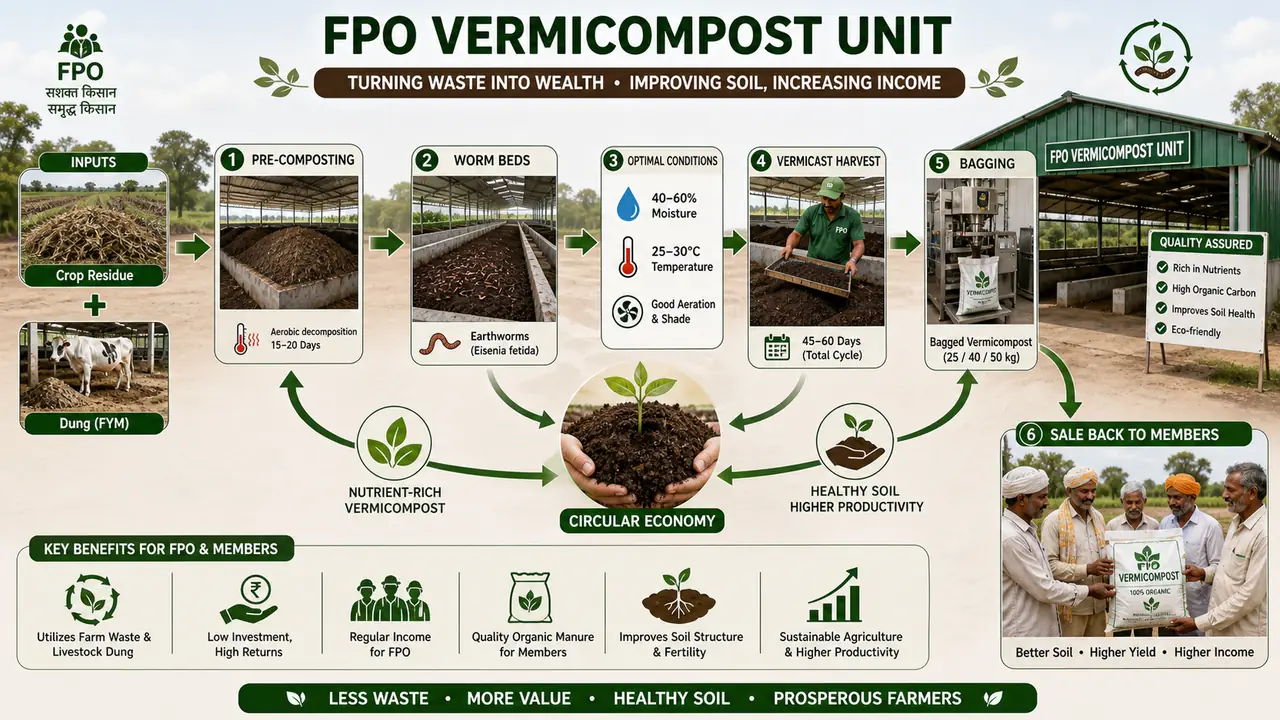
Vermicomposting is called "gold from garbage" — it converts agricultural waste, crop residue, and organic matter into a nutrient-rich soil amendment using earthworms. The process is simple, low-cost, and scalable. As chemical fertiliser prices rise and soil health degrades from decades of over-application, demand for vermicompost is growing across India's organic and conventional farming sectors alike.
FPO-level vermicompost units create a circular economy within the farm: members' crop residues become inputs for compost production, which is then sold back to members at subsidised prices or marketed externally for profit.
- Production of compost through earthworms (Eisenia fetida, Lumbricus rubellus) is the core process
- Organic carbon: 9.15–17.18%, significantly higher than FYM (~3%)
- Earthworms eat biomass and excrete it in a digested, mineralised form — vermicast
Why Vermicompost? The Soil Science Behind It
Chemical fertilisers provide NPK but damage soil structure over time — they reduce microbial populations, compact soil, and decrease water retention. Vermicompost addresses all three:
Pro Content Locked
Upgrade to Pro to access this lesson and all other premium content.
₹99 charged monthly · Cancel anytime
- All Agriculture & Banking Courses
- AI Lesson Questions (100/day)
- AI Doubt Solver (50/day)
- Glows & Grows Feedback (30/day)
- AI Section Quiz (20/day)
- 22-Language Translation (100/day)
- Recall Questions (20/day)
- AI Quiz (15/day)
- AI Quiz Paper Analysis (100/day)
- AI Step-by-Step Explanations (100/day)
- Spaced Repetition Recall (FSRS)
- AI Tutor
- Immersive Text Questions
- Audio Lessons — Hindi & English
- Mock Tests & Previous Year Papers
- Summary & Mind Maps
- XP, Levels, Leaderboard & Badges
- Generate New Classrooms
- Voice AI Teacher (AgriDots Live)
- AI Revision Assistant
- Knowledge Gap Analysis
- Interactive Revision (LangGraph)
🔒 Secure via Razorpay · Cancel anytime · No hidden fees
Vermicomposting is called "gold from garbage" — it converts agricultural waste, crop residue, and organic matter into a nutrient-rich soil amendment using earthworms. The process is simple, low-cost, and scalable. As chemical fertiliser prices rise and soil health degrades from decades of over-application, demand for vermicompost is growing across India's organic and conventional farming sectors alike.
FPO-level vermicompost units create a circular economy within the farm: members' crop residues become inputs for compost production, which is then sold back to members at subsidised prices or marketed externally for profit.
- Production of compost through earthworms (Eisenia fetida, Lumbricus rubellus) is the core process
- Organic carbon: 9.15–17.18%, significantly higher than FYM (~3%)
- Earthworms eat biomass and excrete it in a digested, mineralised form — vermicast
Why Vermicompost? The Soil Science Behind It
Chemical fertilisers provide NPK but damage soil structure over time — they reduce microbial populations, compact soil, and decrease water retention. Vermicompost addresses all three:
| Benefit | Mechanism |
|---|---|
| Nutrient supply | Slow-release NPK in plant-available form |
| Soil structure | Improves aggregation, aeration, and water-holding capacity |
| Microbial activity | Contains beneficial bacteria, fungi, and enzymes |
| pH buffering | Helps neutralise both acid and alkaline soils |
| Disease suppression | Certain vermicompost types suppress soil-borne pathogens |
Nutrient Composition of Vermicompost
| Nutrient | Content |
|---|---|
| Organic carbon | 9.15–17.18% |
| Total nitrogen | 1.5–2.10% |
| Total phosphorus | 1.0–1.50% |
| Total potassium | 0.60% |
| Calcium & Magnesium | 22.00–70,110 (units vary) |
| Available sulphur | 128–549 ppm |
| Copper | 1,110 ppm |
| Iron | 1,800 ppm |
| Zinc | 517 ppm |
NOTE
Vermicompost has significantly higher nitrogen (1.5–2.1%) compared to regular FYM/compost (~0.5–1.0%). The high zinc content (517 ppm) is important — zinc deficiency is the most widespread micronutrient deficiency in Indian soils, and vermicompost application helps correct it. These nutrient values are directly tested in exams.
Production Technology
Raw materials (inputs):
- Agricultural residues (paddy straw, sugarcane bagasse, vegetable waste)
- Animal dung (cattle, sheep, goat — NOT poultry as it can be too hot)
- Kitchen organic waste
- Green manure/biomass from field borders
Process steps:
- Prepare beds/windrows with pre-composted organic material (30 days pre-composting to reduce heat)
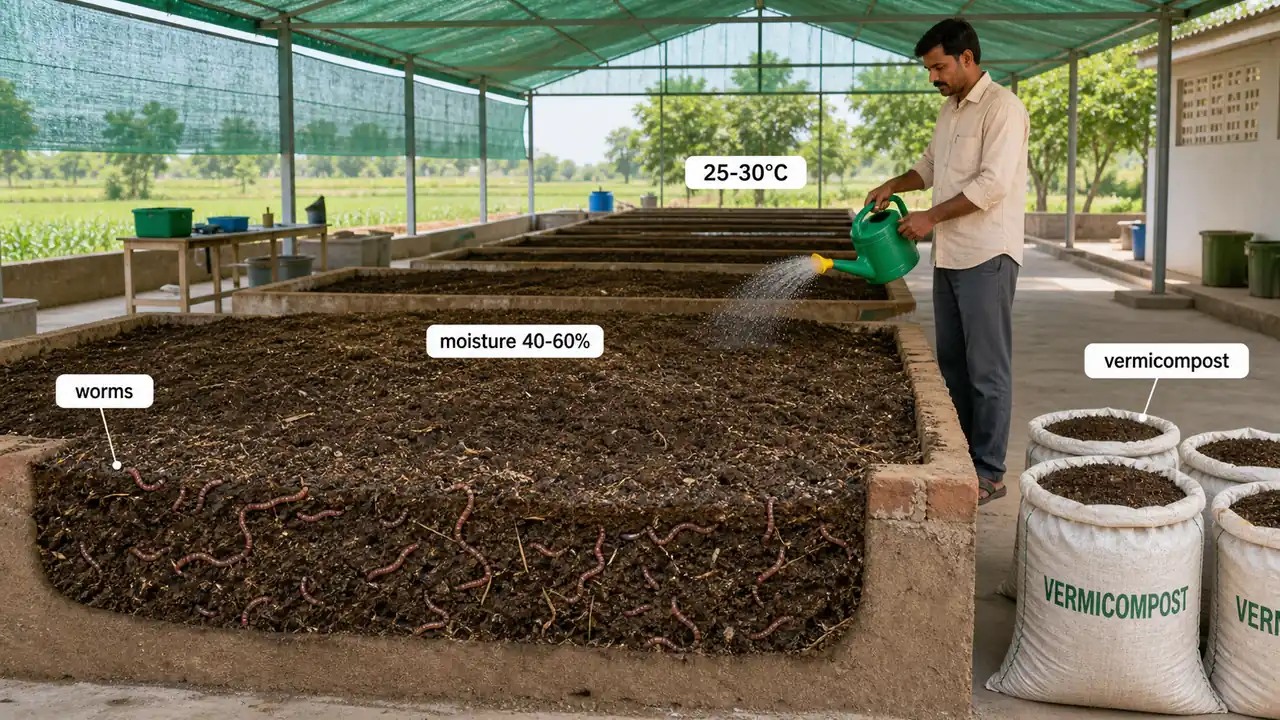
- Introduce earthworms (1–2 kg worms per 100 kg raw material)
- Maintain moisture at 40–60% (critical for worm activity)
- Maintain temperature at 25–30°C (worms die above 35°C and below 10°C)
- Harvest vermicompost in 45–60 days
- Separate worms from compost (using light — worms move to bottom)
- Pack and store in cool, dry conditions
NOTE
The critical temperature range for earthworm activity is 25–30°C. Above 35°C or below 10°C, earthworms either die or become inactive. This is a standard MCQ fact in animal science and organic farming questions.
Production Scale at FPO Level
FPO-level vermicompost production is typically structured as multi-bed units to create commercially viable output:
| Unit Size | Beds | Annual Production | Approx Revenue |
|---|---|---|---|
| Small (pilot) | 10 beds | ~10 MT | ₹50,000–1,00,000 |
| Medium (FPO standard) | 50 beds | ~50 MT | ₹2,50,000–5,00,000 |
| Large (commercial) | 100+ beds | ~100+ MT | ₹5,00,000+ |
Market price of vermicompost: ₹5–10 per kg (bagged, branded), or ₹3–5/kg bulk to dealers.
Business Model for FPO
The FPO vermicompost business works in two modes:
Mode 1 — Input substitution for members:
- Members supply crop residue/dung → FPO produces vermicompost → sold back to members at 20–30% below market price
- Saves members money on fertiliser costs while creating a business asset
Mode 2 — Commercial production for external sale:
- FPO sells branded vermicompost to:
- Organic farmers (premium price, direct sale)
- Horticulture/nursery industry
- State agriculture departments for subsidised distribution
- Export (organic certification required)
Capital Cost Components
| Component | Description |
|---|---|
| Shed/covered area | To protect beds from rain and excess sun |
| Vermicompost beds | Brick or HDPE-lined pits/raised beds |
| Water supply system | Sprinkler/drip for moisture maintenance |
| Earthworm stock | Initial purchase of worm culture |
| Packing equipment | For bagged product (weighing + sealing) |
| Storage shed | For finished product |
This is a low capital intensity business — the main investment is in shed construction and initial worm culture. Raw materials (organic waste) are either free or low-cost.
Financial Viability
| Parameter | Value |
|---|---|
| Capital investment | Low (shed-based) |
| Working capital | Minimal (organic waste is free/cheap) |
| Payback period | 1–2 years |
| IRR | High (>30%) due to low capex and good margins |
| Margin for bank loan | 15% (FPO norms) |
The business is self-sustaining once earthworm culture is established, as worms multiply rapidly (doubling every 60–90 days under optimal conditions).
Government Scheme Support
- Paramparagat Krishi Vikas Yojana (PKVY): Promotes cluster-based organic farming; vermicompost units are eligible for subsidy
- National Mission for Sustainable Agriculture (NMSA): Supports soil health management including organic input production
- NABARD Watershed Projects: Often include vermicompost units as livelihood components
NOTE
PKVY (Paramparagat Krishi Vikas Yojana) is the government's flagship scheme for cluster-based organic farming. It provides financial assistance of ₹50,000/ha over 3 years for organic input production and certification. Vermicompost units are the primary input production activity under PKVY. This scheme is frequently tested in exams context.
Certification for Premium Pricing
To access premium organic markets, FPO vermicompost must be:
- Certified organic under PGS-India (Participatory Guarantee System) — a peer-certification system suitable for small producers
- Or certified by an APEDA-accredited certification agency for export
- Registered under FCO (Fertiliser Control Order) for commercial sale as a fertiliser
FCO registration requires vermicompost to meet minimum nutrient standards (e.g., minimum 1.5% N equivalent).
Sources & References
Primary source for this lesson is NABARD's official Model Bankable Projects portal.[1] Lesson-specific report copy used for this topic.[2]
References
2 sources • [1] [2]
References
Used for: Official NABARD portal for model bankable project documents and updates.
Used for: Reference copy used in this lesson for project parameters and worked figures.
The figures in this lesson reflect the cost norms and technical parameters as published in the NABARD document. Actual costs may vary by state, season, and year of implementation. Always refer to the latest NABARD circular for current norms.
Summary Cheat Sheet
| Concept / Topic | Key Details / Explanation |
|---|---|
| Common name | "Gold from garbage" — converts organic waste into nutrient-rich soil amendment using earthworms |
| Key earthworm species | Eisenia fetida, Lumbricus rubellus |
| Organic carbon | 9.15–17.18% (vs FYM ~3%) |
| Total nitrogen | 1.5–2.10% (vs FYM/compost ~0.5–1.0%) |
| Total phosphorus | 1.0–1.50% |
| Total potassium | 0.60% |
| Zinc content | 517 ppm — corrects India's most widespread micronutrient deficiency |
| Moisture for worms | 40–60% — critical for worm activity |
| Temperature for worms | 25–30°C; die above 35°C or below 10°C |
| Harvest time | 45–60 days after inoculation |
| Worm multiplication | Doubles every 60–90 days under optimal conditions |
| Market price | ₹5–10/kg (bagged/branded); ₹3–5/kg bulk |
| FPO standard scale | ~50 beds → ~50 MT/year → ₹2.5–5 lakh revenue |
| Margin for bank loan | 15% (FPO norms) |
| IRR | >30% (low capex + good margins) |
| Payback period | 1–2 years |
| FCO registration | Required for commercial fertiliser sale; minimum 1.5% N equivalent |
| PGS-India | Participatory Guarantee System — peer certification for organic markets (small producers) |
| Key government scheme | PKVY (Paramparagat Krishi Vikas Yojana) — ₹50,000/ha over 3 years for organic cluster farming; vermicompost is primary input activity |
| Other schemes | NMSA (soil health management), NABARD Watershed Projects |
| Business modes | Mode 1: internal supply to members at 20–30% below market; Mode 2: commercial sale to organic farmers/horticulture/state depts/export |
| Raw materials | Crop residues, cattle/sheep/goat dung (NOT poultry — too hot), kitchen waste, green manure |
Lesson Doubts
Ask questions, get expert answers