🥛 Milk Collection Unit by FPO — NABARD Business Model
NABARD's FPO business model for milk collection with AMCU (Automatic Milk Collection Unit) and BMC (Bulk Milk Cooler), covering capital cost, working capital, financial analysis, and dairy-to-bank payment linkage. Key for exams dairy FPO questions.
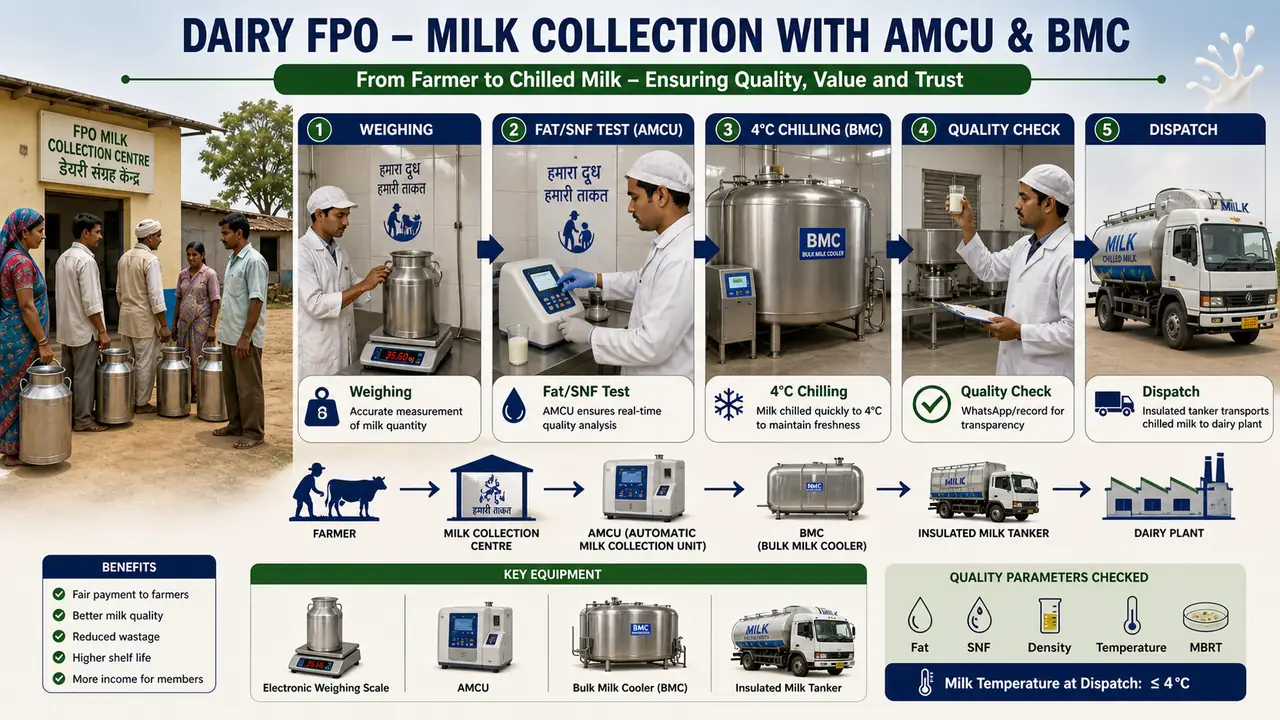
India is the world's largest milk producer, accounting for 20% of global milk production. Milk production grew from 55.6 million tonnes in 1991-92 to 176.3 million tonnes in 2017-18 — a consistent annual growth rate of 4.5%. Per capita availability reached 350 grams/day. Yet most of this milk is produced by smallholder farmers who lack cold chain infrastructure — leading to massive spoilage and price exploitation by middlemen.
FPO-led milk collection centres, equipped with AMCU and BMC, bridge this gap by bringing cooperative-model dairy infrastructure within reach of small farmers through institutional credit.
The Problem: Why Raw Milk Spoils
Raw milk at ambient temperature (25–35°C in Indian conditions) becomes bacterially unsafe within 2–4 hours. Without cooling:
Pro Content Locked
Upgrade to Pro to access this lesson and all other premium content.
₹99 charged monthly · Cancel anytime
- All Agriculture & Banking Courses
- AI Lesson Questions (100/day)
- AI Doubt Solver (50/day)
- Glows & Grows Feedback (30/day)
- AI Section Quiz (20/day)
- 22-Language Translation (100/day)
- Recall Questions (20/day)
- AI Quiz (15/day)
- AI Quiz Paper Analysis (100/day)
- AI Step-by-Step Explanations (100/day)
- Spaced Repetition Recall (FSRS)
- AI Tutor
- Immersive Text Questions
- Audio Lessons — Hindi & English
- Mock Tests & Previous Year Papers
- Summary & Mind Maps
- XP, Levels, Leaderboard & Badges
- Generate New Classrooms
- Voice AI Teacher (AgriDots Live)
- AI Revision Assistant
- Knowledge Gap Analysis
- Interactive Revision (LangGraph)
🔒 Secure via Razorpay · Cancel anytime · No hidden fees
India is the world's largest milk producer, accounting for 20% of global milk production. Milk production grew from 55.6 million tonnes in 1991-92 to 176.3 million tonnes in 2017-18 — a consistent annual growth rate of 4.5%. Per capita availability reached 350 grams/day. Yet most of this milk is produced by smallholder farmers who lack cold chain infrastructure — leading to massive spoilage and price exploitation by middlemen.
FPO-led milk collection centres, equipped with AMCU and BMC, bridge this gap by bringing cooperative-model dairy infrastructure within reach of small farmers through institutional credit.
The Problem: Why Raw Milk Spoils
Raw milk at ambient temperature (25–35°C in Indian conditions) becomes bacterially unsafe within 2–4 hours. Without cooling:
- Bacteria multiply exponentially → milk curdles
- Fat separates → quality degrades
- Farmers are forced to sell immediately at low prices to local middlemen (kacchha dodhiyas)
Chilling milk at 4°C within 2 hours of milking extends safe storage to 24–48 hours — enough time for organised collection, testing, and dispatch to processors.
Key Equipment: AMCU & BMC
AMCU — Automatic Milk Collection Unit
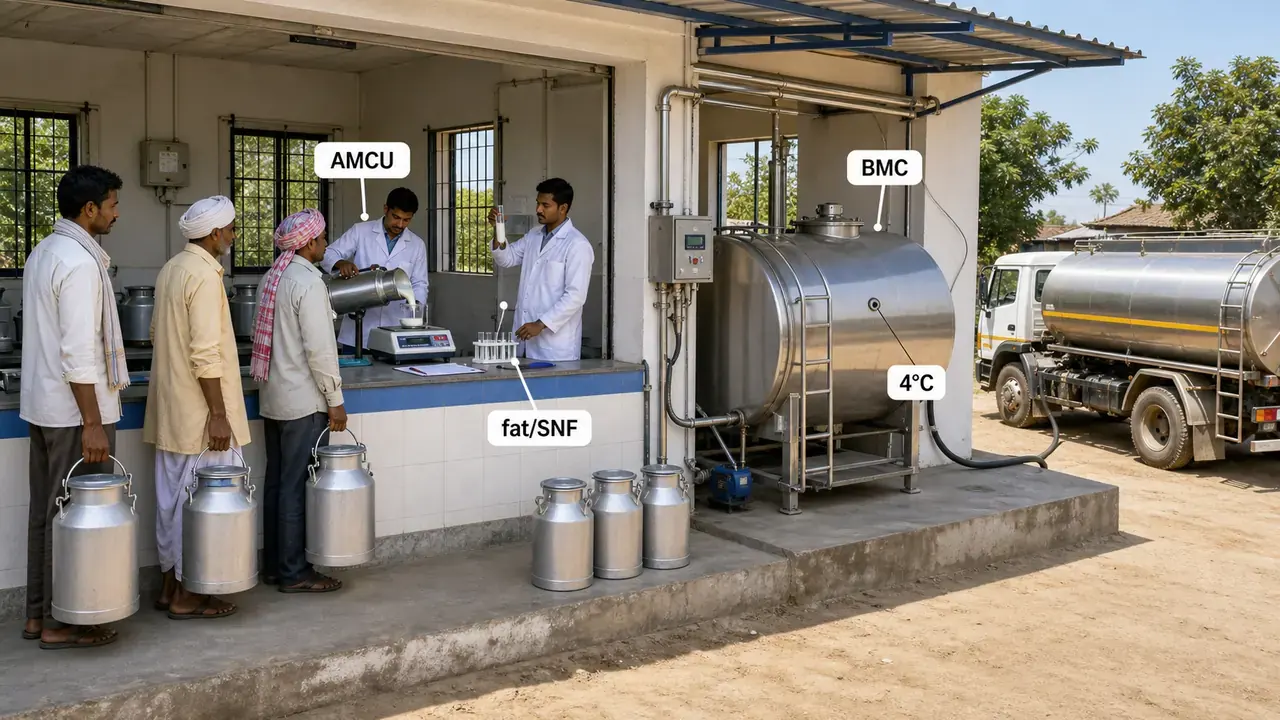
AMCU is an integrated unit combining:
- Automatic Milk Weighing System — records weight for each farmer
- Electronic Milk Testing (EMT) — measures fat%, SNF%, water adulteration %
- Computer with printer — generates farmer-wise payment slips
- Battery backup — for power cut situations
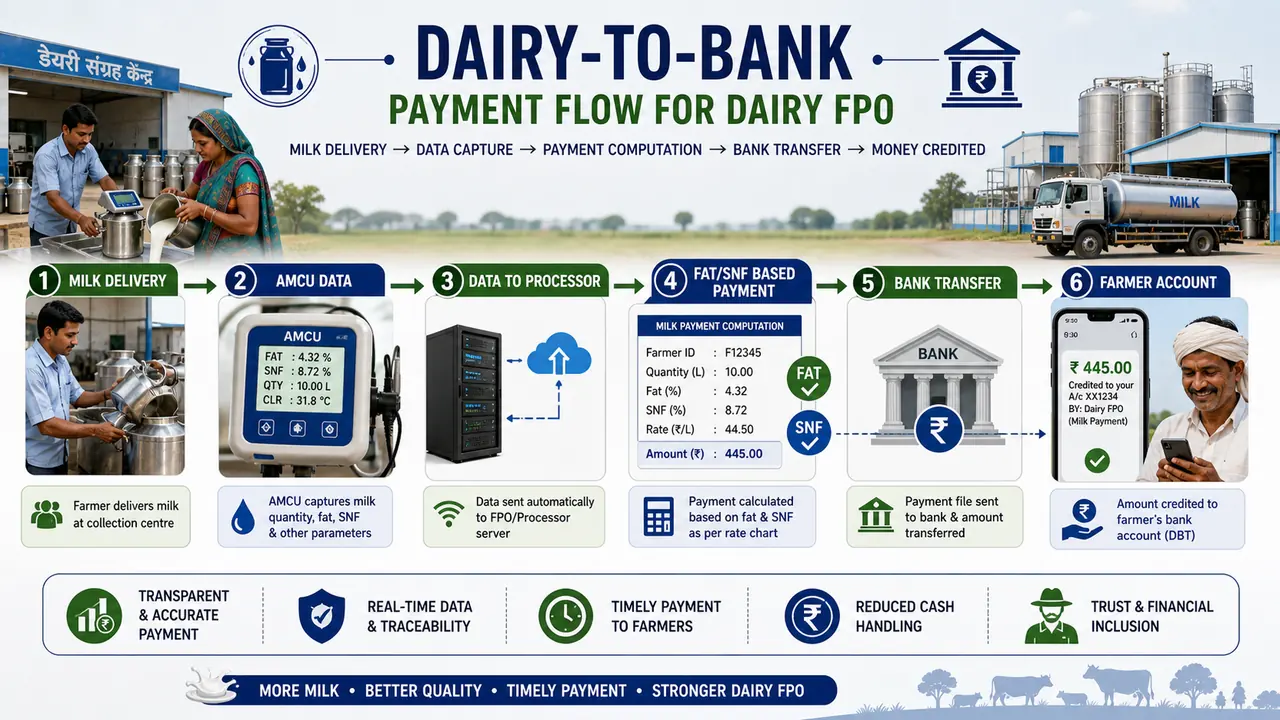
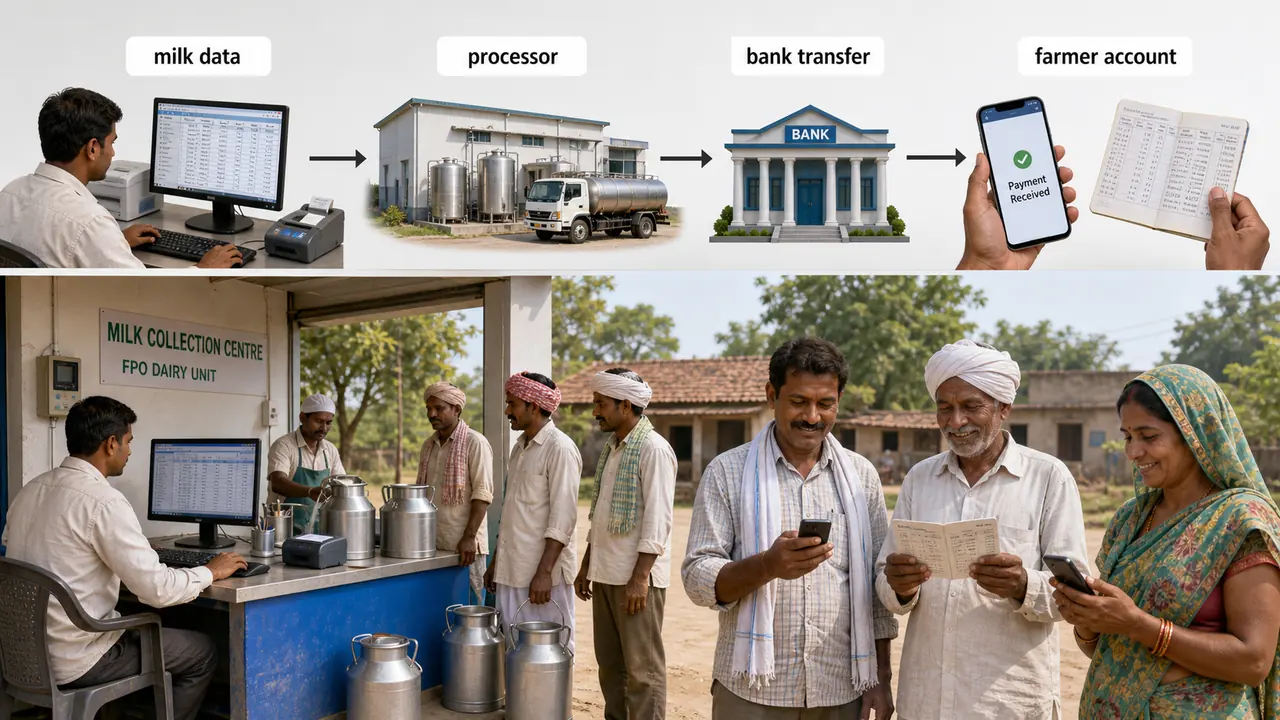
Advanced AMCUs support web-based data management where farmer-wise data from AMCU is sent to a central server and payment is transferred directly to farmer's bank account — the dairy-to-bank concept.
NOTE
The dairy-to-bank concept in AMCU means farmer payments are directly debited from the milk processing company's account to the farmer's bank account — eliminating payment delays and reducing cash handling. This is a financial inclusion tool aligned with NABARD's mandate. MCQs test this as a feature of modern AMCU systems.
BMC — Bulk Milk Cooler (Bulk Milk Cooling Unit)
BMC maintains collected milk at 4°C to arrest bacterial growth and retain freshness. Key specifications:
| Capacity | Common sizes |
|---|---|
| Small | 500–1,000 litres |
| Medium | 2,000–5,000 litres |
| Large | 5,000–10,000 litres |
BMC operates on DX (Direct Expansion) refrigeration principle. Milk is received, tested (AMCU), chilled (BMC), and dispatched to the dairy processing plant via insulated tankers.
Objectives of the FPO Milk Collection Model
- To procure quality milk from member farmers at remunerative prices
- To eliminate middlemen and increase farmer's share in consumer price
- To arrest bacterial growth through prompt chilling at 4°C
- To ensure clean milk production practices at farm level
- To create quality milk supply for processing units and export
- To implement dairy-to-bank payment for farmers
Project Details & Capital Cost
Beneficiary profile:
- FPO with ~500 shareholders
- Members are small dairy farmers (2–5 animals each)
- Total milk collection: depends on member herd size (typically 500–2,000 litres/day per centre)
Capital cost components:
| Component | Description |
|---|---|
| AMCU (Automatic Milk Collection Unit) | Electronic weighing, fat testing, PC, printer |
| BMC (Bulk Milk Cooling Unit) | Refrigerated tank, DX cooling system |
| Civil works | Collection shed, operator room, water supply |
| Electrical installation | Power connection, DG set backup |
| Miscellaneous | Weighing cans, sampling equipment |
Lending terms:
| Parameter | Value |
|---|---|
| Margin money | As per bank norms (typically 15–25%) |
| Interest rate | As determined by financing bank |
| Repayment period | Based on cash flow analysis (typically 5–7 years) |
| Working capital | Short-term revolving credit for milk procurement |
Working Capital Structure
Working capital for the milk collection FPO covers:
- Milk procurement payment to farmers (daily cash/bank transfer)
- Operational expenses (electricity, chemicals, staff salaries)
- The cycle is short: milk collected today → dispatched to processor → payment received within 3–7 days
This makes milk collection a low working capital, high turnover business — attractive for banks.
Financial Analysis Framework
| Indicator | Tool Used | Threshold |
|---|---|---|
| BCR | Discounted cash flow | > 1.0 |
| NPW | @ discount rate | Positive |
| DSCR | Annual surplus/loan service | > 1.5 |
| Repayment schedule | Cash flow based | Comfortable |
The BCR and NPW analysis covers the full economic life of the BMC and AMCU equipment (typically 10–15 years).
Backward & Forward Linkages
Backward linkages (farmer side):
- Extension on clean milk production practices (hygienic milking)
- Access to veterinary services through FPO
- AI (Artificial Insemination) services for herd improvement
- Input supply — cattle feed, mineral mixtures
Forward linkages (processor/buyer side):
- Tie-up with dairy cooperative (Amul, Mother Dairy, state cooperative)
- Supply to private dairy processors (Nestlé, Heritage, Parag)
- Direct supply to institutional buyers (hotels, hospitals)
NOTE
The forward linkage (supply agreement with a dairy processor) must be established before loan sanction as per NABARD guidelines. Without a confirmed buyer, the milk collection model is not bankable. This is a pre-condition tested in exam questions on FPO project appraisal.
Potential Areas
NABARD specifies that milk collection centres with AMCU and BMC can be taken up across all parts of the country — not restricted to traditional dairy belts. The scheme is specifically designed for:
- Milk surplus areas with no organised collection infrastructure
- Tribal and backward regions with dairy potential but lacking market access
- Areas with NDDB or state cooperative dairy expansion plans
Special Lending Conditions
- FPO must demonstrate that member farmers collectively produce sufficient milk to justify BMC capacity
- AMCU data must be linked to a dairy processing unit's payment system
- Milk quality testing records (fat%, SNF%) must be maintained and available for bank inspection
- Insurance on BMC equipment and milk stock is mandatory
Sources & References
Primary source for this lesson is NABARD's official Model Bankable Projects portal.[1] Lesson-specific report copy used for this topic.[2]
References
2 sources • [1] [2]
References
Used for: Official NABARD portal for model bankable project documents and updates.
Used for: Reference copy used in this lesson for project parameters and worked figures.
The figures in this lesson reflect the cost norms and technical parameters as published in the NABARD document. Actual costs may vary by state, season, and year of implementation. Always refer to the latest NABARD circular for current norms.
Summary Cheat Sheet
| Concept / Topic | Key Details / Explanation |
|---|---|
| India's milk production | World's largest — 20% of global production; 176.3 million tonnes (2017-18); 4.5% annual growth |
| Per capita availability | 350 grams/day |
| Spoilage risk | Raw milk unsafe in 2–4 hours at 25–35°C; must chill to 4°C within 2 hours |
| Chilling benefit | At 4°C → safe storage for 24–48 hours |
| AMCU full form | Automatic Milk Collection Unit |
| AMCU components | Automatic weighing + Electronic Milk Testing (fat%, SNF%, adulteration%) + computer/printer + battery backup |
| Dairy-to-bank concept | AMCU links to central server → payment directly from dairy processor's account to farmer's bank account (no cash) |
| BMC full form | Bulk Milk Cooler (Bulk Milk Cooling Unit) |
| BMC principle | DX (Direct Expansion) refrigeration |
| BMC sizes | 500–1,000 L (small), 2,000–5,000 L (medium), 5,000–10,000 L (large) |
| FPO membership | ~500 shareholders (small dairy farmers, 2–5 animals each) |
| Margin money | As per bank norms (typically 15–25%) |
| Repayment period | Based on cash flow analysis (typically 5–7 years) |
| Working capital cycle | Milk collected → dispatched → payment in 3–7 days (low WC, high turnover) |
| Financial indicators | BCR (>1.0), NPW (positive), DSCR (>1.5) over 10–15 year equipment life |
| Key pre-condition | Forward linkage (supply agreement with dairy processor) must be signed before loan sanction |
| Forward linkage buyers | Amul, Mother Dairy, state cooperatives; Nestlé, Heritage, Parag (private); institutional buyers |
| Backward linkages | Clean milk extension, AI services, veterinary access, cattle feed/mineral mixture supply |
| Key MCQ fact | Dairy-to-bank = financial inclusion tool; AMCU eliminates payment delays and cash handling |
Lesson Doubts
Ask questions, get expert answers