🥥 Coconut Cultivation — NABARD Model Bankable Scheme (1.0 ha)
Coconut is a small farmer's crop — 98% of holdings are under 2 hectares. This NABARD model covers 1-hectare coconut cultivation including varieties, spacing, costs, income from nuts and by-products, and financing parameters essential for exams.
Coconut is grown in over 93 countries and is the backbone of India's coastal farming economy. It is truly a small farmer's crop — 98% of approximately 5 million coconut holdings are under 2 hectares.
- India's coconut area: 18.95 lakh hectares (2010–11)
- India's production: 16,943 million nuts/year
- Average productivity: 8,937 nuts/ha
- Major producers globally: Indonesia, Philippines, India (top 3)
NOTE
Exam trap: The top three coconut producers globally are Indonesia, Philippines, India — in that order. India is 3rd. Remember: "IPI" = Indonesia, Philippines, India.
Primary States and Crops
Traditional states: Kerala, Tamil Nadu, Karnataka, Andhra Pradesh, Odisha, Goa, West Bengal, Pondicherry, Maharashtra, Lakshadweep, Andaman & Nicobar
Emerging (non-traditional) states: Assam, Gujarat, Madhya Pradesh, Bihar, Tripura, Manipur, Nagaland, Arunachal Pradesh
Products from coconut:
- Copra and coconut oil (soaps, hair oil, cosmetics, industrial)
- Coir fibre (husk) → coir industry
- Tender nut water (health beverage)
- Virgin Coconut Oil (VCO) — extracted from fresh kernel, rich in vitamins, antioxidants
Agro-Climatic Requirements
| Parameter | Optimum |
|---|---|
| Mean annual temperature | 27°C with diurnal variation of 6–7°C |
| Relative humidity | >60% |
| Rainfall | 1,000–3,000 mm/year; ideal ~2,000 mm well-distributed |
| Altitude | Up to 600 m MSL |
| Soil pH | 5.2–8.0 |
Soil types: Laterite, alluvial, red sandy loam, coastal sandy, reclaimed soils. Minimum soil depth: 1.2 m. Waterlogged and clayey soils must be avoided.
Pro Content Locked
Upgrade to Pro to access this lesson and all other premium content.
₹99 charged monthly · Cancel anytime
- All Agriculture & Banking Courses
- AI Lesson Questions (100/day)
- AI Doubt Solver (50/day)
- Glows & Grows Feedback (30/day)
- AI Section Quiz (20/day)
- 22-Language Translation (100/day)
- Recall Questions (20/day)
- AI Quiz (15/day)
- AI Quiz Paper Analysis (100/day)
- AI Step-by-Step Explanations (100/day)
- Spaced Repetition Recall (FSRS)
- AI Tutor
- Immersive Text Questions
- Audio Lessons — Hindi & English
- Mock Tests & Previous Year Papers
- Summary & Mind Maps
- XP, Levels, Leaderboard & Badges
- Generate New Classrooms
- Voice AI Teacher (AgriDots Live)
- AI Revision Assistant
- Knowledge Gap Analysis
- Interactive Revision (LangGraph)
🔒 Secure via Razorpay · Cancel anytime · No hidden fees
Coconut is grown in over 93 countries and is the backbone of India's coastal farming economy. It is truly a small farmer's crop — 98% of approximately 5 million coconut holdings are under 2 hectares.
- India's coconut area: 18.95 lakh hectares (2010–11)
- India's production: 16,943 million nuts/year
- Average productivity: 8,937 nuts/ha
- Major producers globally: Indonesia, Philippines, India (top 3)
NOTE
Exam trap: The top three coconut producers globally are Indonesia, Philippines, India — in that order. India is 3rd. Remember: "IPI" = Indonesia, Philippines, India.
Primary States and Crops
Traditional states: Kerala, Tamil Nadu, Karnataka, Andhra Pradesh, Odisha, Goa, West Bengal, Pondicherry, Maharashtra, Lakshadweep, Andaman & Nicobar
Emerging (non-traditional) states: Assam, Gujarat, Madhya Pradesh, Bihar, Tripura, Manipur, Nagaland, Arunachal Pradesh
Products from coconut:
- Copra and coconut oil (soaps, hair oil, cosmetics, industrial)
- Coir fibre (husk) → coir industry
- Tender nut water (health beverage)
- Virgin Coconut Oil (VCO) — extracted from fresh kernel, rich in vitamins, antioxidants
Agro-Climatic Requirements
| Parameter | Optimum |
|---|---|
| Mean annual temperature | 27°C with diurnal variation of 6–7°C |
| Relative humidity | >60% |
| Rainfall | 1,000–3,000 mm/year; ideal ~2,000 mm well-distributed |
| Altitude | Up to 600 m MSL |
| Soil pH | 5.2–8.0 |
Soil types: Laterite, alluvial, red sandy loam, coastal sandy, reclaimed soils. Minimum soil depth: 1.2 m. Waterlogged and clayey soils must be avoided.
Varieties
| Category | Examples | Notable Trait |
|---|---|---|
| Tall | West Coast Tall, East Coast Tall, Benaulim, Tiptur Tall | Main commercial type |
| Dwarf | Chowghat Orange Dwarf, Malayan Yellow Dwarf | Tender nut; parent for hybrids |
| Hybrid | Chandra Sankara, Kerachandra, Chandrakalpa | High yield, early bearing |
Key hybrid data:
| Hybrid | Yield (nuts/palm/year) | Copra/nut (g) | Oil (%) |
|---|---|---|---|
| Chandrakalpa | 97 | 195 | 70 |
| Kerachandra | 110 | 198 | 66 |
| Kalpatharu | 116 | 176 | 68 |
NOTE
Hybrid coconuts yield 80–150 nuts/palm vs 40–60 for traditional tall varieties. For exams, remember: Kalpatharu (116 nuts/palm) is one of the highest-yielding hybrids.
Planting System and Spacing
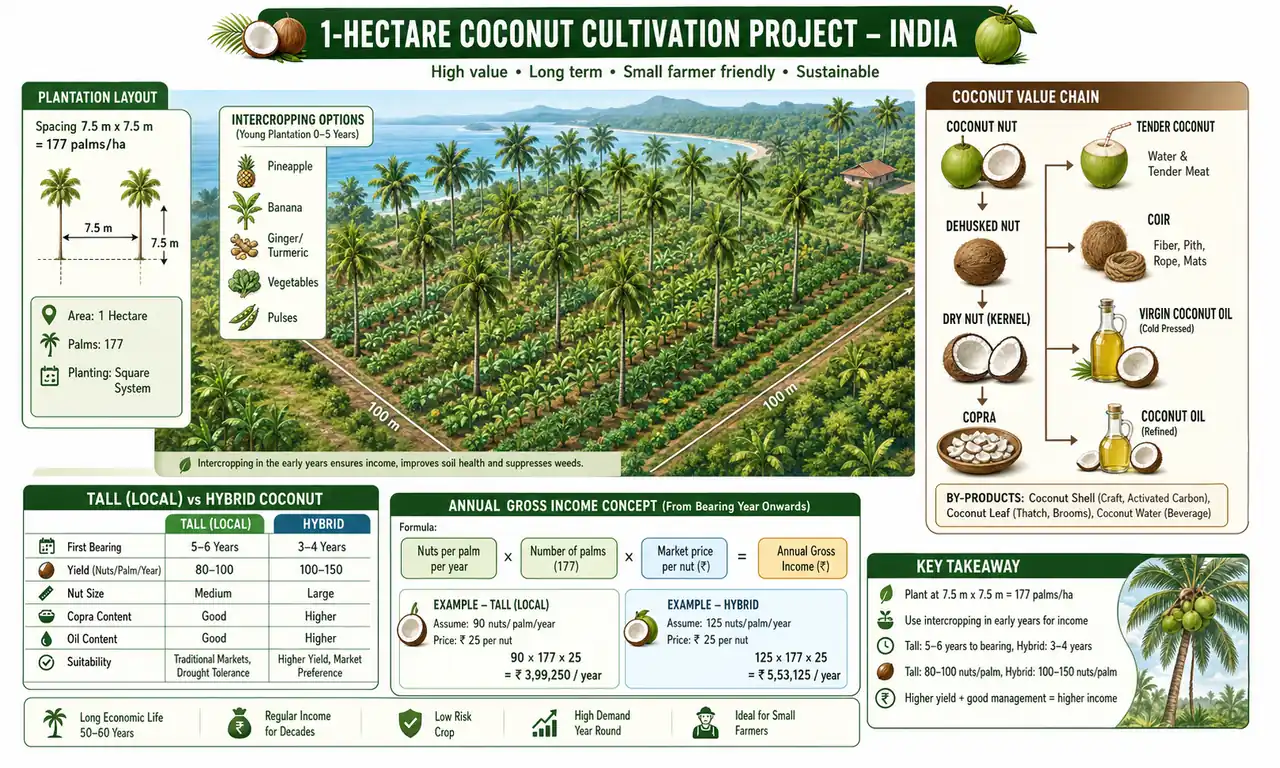
Standard spacing: 7.5 m × 7.5 m (square system) = 177 palms/hectare
Range practiced: 7.5 m to 10 m depending on region and intercropping.
Pit size:
- Laterite soils: 1.2 m × 1.2 m × 1.2 m
- Loamy soils: 1.0 m × 1.0 m × 1.0 m
Planting material: 12–18 month old seedlings with minimum 6 leaves and 10 cm girth at collar. Plant at onset of pre-monsoon (May).
Cost of Cultivation (1.0 ha)
| Year | Activity | Cost (₹) |
|---|---|---|
| Year 1 | Land prep, pits, seedlings (177 @ ₹40–50), manures, labour | ₹20,000–25,000 |
| Year 2–5 | Fertilizers, irrigation, weeding, intercropping | ₹10,000–15,000/year |
| Year 6 onwards | Full management, harvesting, intercultural | ₹20,000–25,000/year |
| Total project cost (7 years) | ₹1.00–1.20 lakh |
| Financing | Value |
|---|---|
| Bank loan (85%) | ₹0.85–1.02 lakh |
| Margin money (15%) | ₹0.15–0.18 lakh |
| Moratorium | 5–6 years (gestation period) |
| Repayment | 9–12 years |
Income and Viability
| Parameter | Value |
|---|---|
| First bearing | 5–6 years (tall); 3–4 years (hybrid/dwarf) |
| Full bearing | 8–10 years |
| Yield (tall) | 80–100 nuts/palm/year |
| Yield (hybrid) | 100–150 nuts/palm/year |
| Nuts/ha (177 palms, tall) | 14,160–17,700 nuts |
| Price/100 nuts | ₹1,500–2,500 |
| Annual gross income | ₹2.12–4.42 lakh/ha |
| By-products (husk, shell, etc.) | ₹20,000–30,000 additional |
| Net income | ₹1.50–3.50 lakh/ha |
Intercropping opportunity: Coconut's wide spacing and open canopy make it ideal for intercropping with banana, pineapple, cocoa, black pepper, vanilla (in early years) — significantly boosting income during the long gestation period.
Exam Summary
| Parameter | Value |
|---|---|
| Global rank | 3rd producer (Indonesia, Philippines, India) |
| India's area | 18.95 lakh ha |
| India's production | 16,943 million nuts/year |
| Avg productivity | 8,937 nuts/ha |
| % holdings < 2 ha | 98% |
| Standard spacing | 7.5 m × 7.5 m = 177 palms/ha |
| Gestation period | 5–6 years (tall), 3–4 years (hybrid) |
| Moratorium | 5–6 years |
| Optimal RH | >60% |
| Optimal rainfall | 2,000 mm/year |
| VCO full form | Virgin Coconut Oil |
Sources & References
Primary source for this lesson is NABARD's official Model Bankable Projects portal.[1] Lesson-specific report copy used for this topic.[2]
References
2 sources • [1] [2]
References
Used for: Official NABARD portal for model bankable project documents and updates.
Used for: Reference copy used in this lesson for project parameters and worked figures.
The figures in this lesson reflect the cost norms and technical parameters as published in the NABARD document. Actual costs may vary by state, season, and year of implementation. Always refer to the latest NABARD circular for current norms.
Summary Cheat Sheet
| Concept / Topic | Key Details / Explanation |
|---|---|
| Global rank | 3rd producer — Indonesia (1st), Philippines (2nd), India (3rd); mnemonic: "IPI" |
| India's area | 18.95 lakh ha (2010–11) |
| India's production | 16,943 million nuts/year |
| Average productivity | 8,937 nuts/ha |
| Small farmer dominance | 98% of ~5 million holdings are under 2 ha |
| Mean annual temperature | 27°C with 6–7°C diurnal variation |
| Relative humidity | >60% |
| Rainfall | 1,000–3,000 mm/year (ideal ~2,000 mm well-distributed) |
| Altitude limit | Up to 600 m MSL |
| Soil pH | 5.2–8.0 |
| Min soil depth | 1.2 m |
| Standard spacing | 7.5 m × 7.5 m = 177 palms/ha |
| Pit size (laterite) | 1.2 m × 1.2 m × 1.2 m |
| Pit size (loamy) | 1.0 m × 1.0 m × 1.0 m |
| Planting material | 12–18 month old seedlings; ≥6 leaves; ≥10 cm girth at collar; plant at pre-monsoon (May) |
| Gestation (tall) | 5–6 years first bearing; full bearing 8–10 years |
| Gestation (hybrid/dwarf) | 3–4 years first bearing |
| Yield (tall) | 80–100 nuts/palm/year |
| Yield (hybrid — Kalpatharu) | 116 nuts/palm/year (highest yielding) |
| Annual gross income | ₹2.12–4.42 lakh/ha |
| Total project cost (7 yr) | ₹1.00–1.20 lakh/ha |
| Bank loan | 85% |
| Margin money | 15% |
| Moratorium | 5–6 years |
| Repayment | 9–12 years |
| VCO | Virgin Coconut Oil — extracted from fresh kernel; rich in vitamins + antioxidants |
| Intercropping | Banana, pineapple, cocoa, black pepper, vanilla (during gestation) |
| Key exam trap | India = 3rd (NOT 1st); 98% holdings < 2 ha; Kalpatharu = highest yield hybrid |
Lesson Doubts
Ask questions, get expert answers